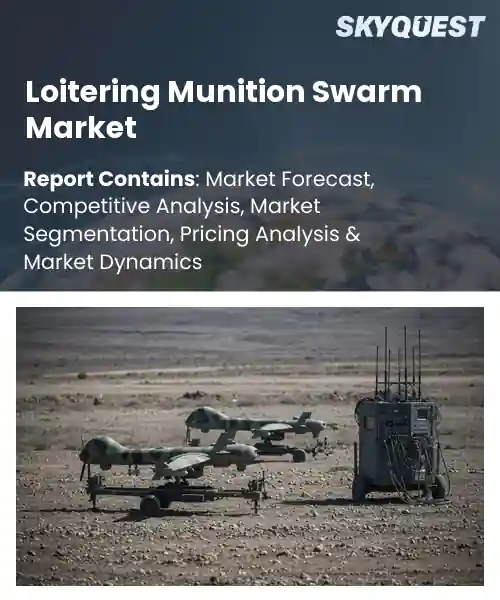
Loitering Munition Swarm Market
Report ID: SQMIG20A2553
Report ID: SQMIG20A2553
[email protected]
USA +1 351-333-4748
Report ID:
SQMIG20A2553 |
Region:
Global |
Published Date: February, 2026
Pages:
157
|Tables:
176
|Figures:
79


Global Loitering Munition Swarm Market size was valued at USD 2.40 Billion in 2024 and is poised to grow from USD 2.74 Billion in 2025 to USD 7.99 Billion by 2033, growing at a CAGR of 14.3% during the forecast period (2026-2033).
Loitering munition swarms represent a convergence of autonomous systems, miniaturized propulsion, and affordable precision strike capabilities that can surveil an area persistently and engage targets when conditions are optimal. This industry is important due to its altered manner of implementing the traditional concept of force projection around the world. Its development accelerated as sensors, networking, and AI became more reliable, and as manufacturers iterated from single loitering munitions like Israel's Harop to experiments in cooperative swarm behaviors by nations. Rising geopolitical tensions and budget reallocations toward unmanned platforms have become the primary driver shaping procurement priorities and industry investment.
A key trend driving the global loitering munition swarm sector growth is rapid maturation of autonomy and communications, enabling coordinated swarms to deliver persistent distributed effect at lower cost. As algorithms, mesh networking and miniaturized sensors improved, armed forces found practical use cases ranging from contested area surveillance to precision suppression of high value targets and procurement shifted toward swarm capable platforms. World demonstrations in recent conflicts produced lessons that precipitated funding for command and control, manufacturing scale up and maintenance ecosystems. Consequently vendors seize opportunities in swarm management software, modular payloads and logistics services while operators prioritize integration and legal frameworks to manage risk.
How is AI-Enabled Autonomy Driving the Loitering Munition Swarm Market?
AI enabled autonomy is changing the loitering munition swarm market by turning individual platforms into cooperative systems that sense adapt and decide together. Key aspects include onboard machine perception for target identification adaptive tasking for dynamic environments and distributed coordination that reduces operator workload. The current state shows growing interest from militaries and integrators as autonomy improves mission flexibility and lowers logistics costs. This is driving investment and consolidation across the supply chain and prompting developers to combine advanced software with scalable production to meet field demand. Examples include new purpose built loitering munitions and acquisitions that bring swarm know how into traditional drone makers.
Market snapshot - (2026-2033)
Global Market Size
USD 2.4 Billion
Largest Segment
Expendable
Fastest Growth
Recoverable
Growth Rate
14.3% CAGR
To get more insights on this market click here to Request a Free Sample Report
Global loitering munition swarm market is segmented by operational type, range, warhead type, navigation sensor, launch mode, end user and region. Based on operational type, the market is segmented into expendable and recoverable. Based on range, the market is segmented into short range, medium range and long range. Based on warhead type, the market is segmented into high-explosive, fragmentation, anti-armor, anti-radiation and thermobaric. Based on navigation sensor, the market is segmented into electro-optical, GPS/GNSS, IR/thermal, inertial navigation, and RF-based. Based on launch mode, the market is segmented into air-launched, vertical take-off, canister-launched, catapult-Launched, and hand-launched. Based on end user, the market is segmented into army, navy, and air force. Based on region, the market is segmented into North America, Europe, Asia Pacific, Latin America, and Middle East & Africa.
Based on the global loitering munition swarm market forecast, long range segment dominates because it enables loitering munitions to operate across extended depths of the battlespace, supporting persistent surveillance, deep strike sequences, and layered area denial that transform swarm employment. Extended reach incentivizes investment in communications, sensor fusion, and endurance improvements, which in turn create new tactics for staggered ingress and multiaxis engagement, making longer-reaching platforms central to procurement priorities and doctrinal planning.
However, short range is emerging as the most rapidly expanding area because its compact, low-cost platforms meet growing demand for agile, high-tempo engagements in dense operational environments. Improved miniaturization and rapid sortie capabilities accelerate adoption among maneuver units, spurring production scale-up and modular payload innovation that open up new tactical use cases and procurement pathways.
GPS/GNSS segment dominates because reliable global positioning underwrites coordinated swarm navigation, synchronized loiter patterns, and precise target handoffs that maximize mission efficiency and reduce operator burden. Satellite navigation provides reliable guidance to facilitate collaborative autonomy and network-level integration of command systems and mission planning tools. This supports interoperability and drives investment in platforms that offer repeatably, GPS-enabled partnerships.
However, inertial navigation is experiencing the strongest growth momentum as operators seek resilient positioning in contested or denied signal environments, prompting investment in higher-performance inertial units and fusion architectures. The improved onboard autonomy and sensor fusion enhancements have exponentially increased the operational area for deployment where external signals are uncertain resulting in demand for upgrading navigation systems suite & creating new mission profiles to expedite enabling capability.
To get detailed segments analysis, Request a Free Sample Report
As per the global loitering munition swarm market analysis, North America dominates the industry through a concentration of advanced defense research, integrated procurement processes, and an ecosystem that fosters rapid prototyping and fielding of complex systems. There is a significant benefit to all parties involved through collaborative partnerships established between large prime contractors with extensive experience, innovative startups with niche capabilities and academic research institutions focused on solving problems. Ultimately, the collaboration accelerates the maturation of capabilities and helps mitigate integration risks. Logistics and sustainment infrastructure that is mature, and doctrinal emphasis placed upon joint operations and network‐level lethality allow for the conversion of operational concepts to acquisition priorities.
Loitering munition swarm market in the United States is driven by deep defense research infrastructure, diverse industrial base, and close ties between military end users and system integrators. Emphasis on operational experimentation and joint doctrine development supports iterative capability refinement. A wide network of test ranges and simulation facilities enables thorough validation of swarm concepts, while procurement pathways and industry scale facilitate transition into fielded roles across layered operational environments.
Loitering munition swarm market in Canada benefits from close cooperation with allied programs, a focus on versatile mission payloads, and a growing cluster of SMEs engaging in unmanned systems. The integration of coalition forces is supported by an emphasis on interoperable design and modular architectures. Investments will be focused on supporting test and evaluation capability as well as providing the training units needed to create a practical path for prototype development into useful operational capabilities which complement the allied use of swarming.
Rapid expansion in the Asia Pacific stems from heightened focus on asymmetric deterrence, modernized force postures, and an expanding industrial base attuned to unmanned systems. Regional governments are making distributed lethality (DL) and layered air defense suppression their top priorities, which is driving investment into swarm (drone) concepts as lower cost and more tactically flexible alternatives. As local high-tech companies supply increasing amounts of autonomy, sensors, and secure communications, they are also substantially reducing their development cycles, thereby enabling custom tailored products that correspond to specific geographic and operational concerns.
Loitering munition swarm market in Japan reflects a strategic emphasis on coastal defense, maritime awareness, and sensor network integration. Domestic firms and research institutions focus on autonomy, miniaturized payloads, and robust communications to suit archipelagic operations. International partnership-based cooperative programs create opportunities for sharing of technologies and interoperability amongst all participant organizations; careful consideration during procurement processes promotes testing before use as well as providing gradual implementation; thus supporting the deterrence capabilities of your alliances through improved maritime area awareness.
Loitering munition swarm market in South Korea is characterized by strong indigenous development, close ties between defense conglomerates and agile technology firms, and emphasis on layered deterrence. Key topics of investigation include autonomy; the capability to fight through (resilience) in electronic battle; and compatibility with national command networks. Continuous joint exercise and active procurement strategies are used to drive an iterative process to improve capability, while export strategy facilitates manufacturing capability and supports the operational deployment (readiness) ecosystem through contested environment.
Europe is strengthening its position through collaborative procurement programs, harmonized standards efforts, and focused investment in autonomy and countermeasure technologies. National research centers and industrial champions are leveraging cross border partnerships to de risk integration and to create interoperable solutions suited to joint expeditionary and territorial defense concepts. Emphasis on survivable communications, electronic warfare tolerance, and scalable production methods supports both domestic needs and export competitiveness. Training and joint experimentation initiatives enable shared doctrine development and accelerate operational validation. By aligning industrial policy with military requirement cycles and encouraging public private cooperation, European companies are progressively closing capability gaps and enhancing their contribution to allied swarm operations.
Loitering munition swarm market in Germany combines a strong engineering base, emphasis on electronic warfare resilience, and coordinated research across laboratories and industry. Prime contractors and innovative companies are focusing on modular architectures, secure communications, and dual use technologies to enable the ability to support territorial defense and coalition operations. The systematic approach to testing and interoperability standards will ensure that solutions align with the NATO framework so that meaningful contributions can be made to allied concepts of swarming and joint development of capabilities.
Loitering munition swarm market in United Kingdom is shaped by a defense innovation agenda that promotes rapid prototyping, industry academia collaboration and export focus. Networked operations, resilient communications, and countermeasures integrated will support both expeditionary forces and homeland defense. Investments made into realistic experimentation ranges, joint exercises and suppliers along with supportive procurement paths provide doctrinal test capabilities and provide the means for advanced swarm concepts to be integrated into warfighting capabilities.
Loitering munition swarm market in France leverages a strong defense industrial network and national research institutes with emphasis on sovereignty in key technologies. Modular payloads, secure communications, are among the French companies' priorities in providing solutions to their customers in North America and Europe. Partnership programs focused on cooperative defence initiatives will enhance the ability of various defence partners to achieve interoperability when strengthening their capabilities through an experimental procurement approach.
To know more about the market opportunities by region and country, click here to
Buy The Complete Report
Advancements In Autonomous Coordination
Growing Integration with Command and Control
Regulatory and Ethical Concerns
Complex System Integration and Reliability
Request Free Customization of this report to help us to meet your business objectives.
Competition in the global loitering munition swarm market share is intensifying as battlefield demand and GNSS-denied requirements drive firms to pursue rapid scale, autonomy, and resilient supply chains. Firms are using M&A to acquire launch and ALE capabilities, strategic industrial partnerships to secure production and certification, and software-led productization to differentiate with AI-enabled targeting and swarm C2.
SkyQuest’s ABIRAW (Advanced Business Intelligence, Research & Analysis Wing) is our Business Information Services team that Collects, Collates, Correlates, and Analyses the Data collected by means of Primary Exploratory Research backed by robust Secondary Desk research.
As per SkyQuest analysis, the global loitering munition swarm industry is advancing rapidly driven primarily by maturation of AI-enabled autonomy and communications that enable coordinated, cost-effective distributed effects, and a secondary driver is increasing integration with command-and-control networks that boosts interoperability and mission value. The procurement and implementation of autonomous lethal decision-making systems are currently restricted by concerns regarding regulations and ethics. North America has been an area of dominance due to the availability of extensive defense research and development funds, the presence of industry/startup ecosystems, and the existence of test infrastructure. The long-range segment is experiencing growth because longer ranges enable operators to establish persistent surveillance over targets, deliver deep strikes and employ layered denial tactics against enemies.
| Report Metric | Details |
|---|---|
| Market size value in 2024 | USD 2.4 Billion |
| Market size value in 2033 | USD 7.99 Billion |
| Growth Rate | 14.3% |
| Base year | 2024 |
| Forecast period | (2026-2033) |
| Forecast Unit (Value) | USD Billion |
| Segments covered |
|
| Regions covered | North America (US, Canada), Europe (Germany, France, United Kingdom, Italy, Spain, Rest of Europe), Asia Pacific (China, India, Japan, Rest of Asia-Pacific), Latin America (Brazil, Rest of Latin America), Middle East & Africa (South Africa, GCC Countries, Rest of MEA) |
| Companies covered |
|
| Customization scope | Free report customization with purchase. Customization includes:-
|
To get a free trial access to our platform which is a one stop solution for all your data requirements for quicker decision making. This platform allows you to compare markets, competitors who are prominent in the market, and mega trends that are influencing the dynamics in the market. Also, get access to detailed SkyQuest exclusive matrix.
Table Of Content
Executive Summary
Market overview
Parent Market Analysis
Market overview
Market size
KEY MARKET INSIGHTS
COVID IMPACT
MARKET DYNAMICS & OUTLOOK
Market Size by Region
KEY COMPANY PROFILES
Methodology
For the Loitering Munition Swarm Market, our research methodology involved a mixture of primary and secondary data sources. Key steps involved in the research process are listed below:
1. Information Procurement: This stage involved the procurement of Market data or related information via primary and secondary sources. The various secondary sources used included various company websites, annual reports, trade databases, and paid databases such as Hoover's, Bloomberg Business, Factiva, and Avention. Our team did 45 primary interactions Globally which included several stakeholders such as manufacturers, customers, key opinion leaders, etc. Overall, information procurement was one of the most extensive stages in our research process.
2. Information Analysis: This step involved triangulation of data through bottom-up and top-down approaches to estimate and validate the total size and future estimate of the Loitering Munition Swarm Market.
3. Report Formulation: The final step entailed the placement of data points in appropriate Market spaces in an attempt to deduce viable conclusions.
4. Validation & Publishing: Validation is the most important step in the process. Validation & re-validation via an intricately designed process helped us finalize data points to be used for final calculations. The final Market estimates and forecasts were then aligned and sent to our panel of industry experts for validation of data. Once the validation was done the report was sent to our Quality Assurance team to ensure adherence to style guides, consistency & design.
Analyst Support
Customization Options
With the given market data, our dedicated team of analysts can offer you the following customization options are available for the Loitering Munition Swarm Market:
Product Analysis: Product matrix, which offers a detailed comparison of the product portfolio of companies.
Regional Analysis: Further analysis of the Loitering Munition Swarm Market for additional countries.
Competitive Analysis: Detailed analysis and profiling of additional Market players & comparative analysis of competitive products.
Go to Market Strategy: Find the high-growth channels to invest your marketing efforts and increase your customer base.
Innovation Mapping: Identify racial solutions and innovation, connected to deep ecosystems of innovators, start-ups, academics, and strategic partners.
Category Intelligence: Customized intelligence that is relevant to their supply Markets will enable them to make smarter sourcing decisions and improve their category management.
Public Company Transcript Analysis: To improve the investment performance by generating new alpha and making better-informed decisions.
Social Media Listening: To analyze the conversations and trends happening not just around your brand, but around your industry as a whole, and use those insights to make better Marketing decisions.
REQUEST FOR SAMPLE
 REQUEST FREE CUSTOMIZATION
Global Loitering Munition Swarm Market size was valued at USD 2.4 Billion in 2024 and is poised to grow from USD 2.74 Billion in 2025 to USD 7.99 Billion by 2033, growing at a CAGR of 14.3% during the forecast period (2026-2033).
Competition in the loitering munition swarm market is intensifying as battlefield demand and GNSS-denied requirements drive firms to pursue rapid scale, autonomy, and resilient supply chains. Firms are using M&A to acquire launch and ALE capabilities, strategic industrial partnerships to secure production and certification, and software-led productization to differentiate with AI-enabled targeting and swarm C2. 'AeroVironment, Inc.', 'Elbit Systems LTD', 'Rheinmetall AG', 'Uvision', 'Israel Aerospace Industries', 'Thales Group', 'Paramount Group', 'Embention', 'WB Group', 'ZALA Aero Group', 'Northrop Grumman', 'Edge Group PJSC', 'Anduril Industries', 'AEVEX Aerospace', 'STM', 'MBDA', 'Teledyne FLIR LLC', 'Kratos Defense & Security Solutions', 'General Atomics', 'Insitu Inc.'
Distributed Autonomy Integration: Operational doctrines are shifting toward distributed autonomy, enabling individual loitering munitions to collaborate, self-organize, and reassign tasks dynamically within a swarm. This trend emphasizes interoperable command frameworks, decentralized decision-making protocols, and adaptive mission planning that reduce latency and increase resilience in contested environments. Manufacturers and operators prioritize modular software architectures and secure peer to peer communications to facilitate collective behavior, rapid re tasking, and mission level coordination, creating demand for platforms that can operate semi independently while maintaining coherent strategic objectives across diverse operational scenarios.
Region 1: Why does North America Dominate the Global Loitering Munition Swarm Market? |@12


Want to customize this report? This report can be personalized according to your needs. Our analysts and industry experts will work directly with you to understand your requirements and provide you with customized data in a short amount of time. We offer $1000 worth of FREE customization at the time of purchase.
Feedback From Our Clients


 USA (+1) 351-333-4748

