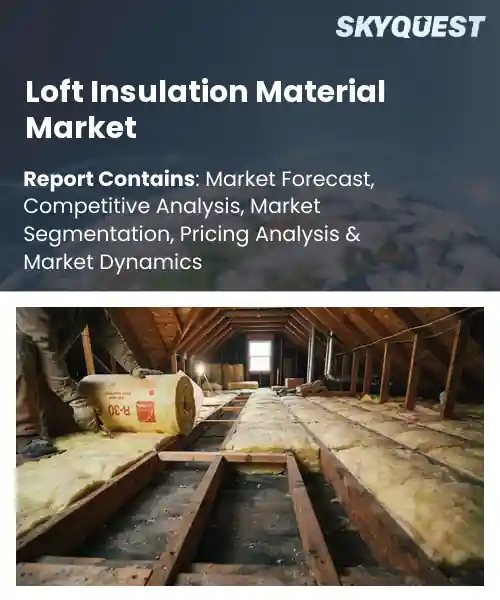
Loft Insulation Material Market
Report ID: SQMIG20B2359
Report ID: SQMIG20B2359
[email protected]
USA +1 351-333-4748
Report ID:
SQMIG20B2359 |
Region:
Global |
Published Date: September, 2026
Pages:
157
|Tables:
151
|Figures:
78


Global Loft Insulation Material Market size was valued at USD 35.6 Billion in 2024 and is poised to grow from USD 37.45 Billion in 2025 to USD 56.19 Billion by 2033, growing at a CAGR of 5.2% during the forecast period (2026-2033).
An emerging catalyst for the loft insulation market is the surge in construction standards that reward envelope solutions, prompting builders to specify materials such as phenolic foam and vacuum‑insulated panels. This shift creates demand for products with higher thermal conductivity and thinner profiles, enabling architects to meet net‑zero targets without sacrificing interior volume. In practice, developers in Scandinavia have integrated aerogel blankets into roof assemblies, cutting heating loads by 40 percent and qualifying for government subsidies. The resulting narrative encourages further adoption, while suppliers leverage these projects to justify premium pricing and invest in scalable manufacturing, thereby expanding market reach.
How is AI-driven automation impacting the loft insulation material market?
AI-driven automation is reshaping the loft insulation material market by linking data‑rich design tools with high‑speed manufacturing. Machine‑learning models predict optimal fiber density and binder ratios, allowing producers to tailor thermal performance while cutting material waste. Robotics handle cutting, stacking and palletizing, delivering consistent panel dimensions and reducing labor variability. Real‑time sensor networks feed quality‑control algorithms that flag defects before they leave the line, improving product reliability and lowering warranty costs. At the same time, AI‑enabled demand forecasting aligns production schedules with seasonal building cycles, keeping inventories lean and accelerating delivery to contractors and DIY customers.Owens Corning announced in July 2023 an AI‑driven automated production line for its fiberglass loft insulation, boosting output consistency and cutting cycle times. The technology enables faster scaling of high‑performance panels, reinforcing market growth by meeting rising demand for energy‑efficient retrofits while reducing material waste and supporting tighter building codes.
Market snapshot - (2026-2033)
Global Market Size
USD 35.6 Billion
Largest Segment
Mineral Wool
Fastest Growth
Polyisocyanurate
Growth Rate
5.2% CAGR
To get more insights on this market click here to Request a Free Sample Report
Global loft insulation material market is segmented by material type, form, application, installation, end user and region. Based on material type, the market is segmented into Mineral Wool, Fiberglass, Cellulose, Polyurethane Foam, Polyisocyanurate, Expanded Polystyrene, Sheep Wool and Others. Based on form, the market is segmented into Batts and Rolls, Loose-Fill, Boards, Spray Foam and Others. Based on application, the market is segmented into Residential Buildings, Commercial Buildings and Industrial Buildings. Based on installation, the market is segmented into New Construction and Retrofit and Renovation. Based on end user, the market is segmented into Homeowners, Construction Contractors, Building Developers and Others. Based on region, the market is segmented into North America, Europe, Asia Pacific, Latin America and Middle East & Africa.
Mineral wool segment dominates because it offers a balanced combination of thermal performance, fire resistance, and acoustic dampening that aligns with building codes and homeowner expectations. Its long standing manufacturing base provides reliable supply chains, and installers appreciate its ease of handling in batts and rolls. These attributes reinforce confidence among contractors and developers, sustaining its preferred status across new builds and retrofits. Additionally, its recyclability supports sustainability goals, further cementing its market leadership.
However, cellulose segment is witnessing the strongest growth momentum because its renewable origin and superior air sealing properties resonate with eco conscious builders and tightening energy efficiency regulations. Innovative blown in applications simplify installation in existing lofts, unlocking new retrofit opportunities and driving rapid market expansion. This momentum is further amplified by government incentives promoting low carbon building materials, encouraging broader adoption across residential projects.
Batts and rolls form segment leads because it provides a ready to install solution that matches standard loft dimensions, reducing labor time and waste. Installers favor its predictable performance and ease of cutting to fit irregular spaces, while manufacturers benefit from scalable production lines. This practicality aligns with cost sensitive construction budgets, making it the default choice for both new builds and retrofit projects across the market. Additionally, its compatibility with various insulation accessories enhances overall thermal envelope performance, reinforcing its market preference.
Meanwhile, spray foam segment is emerging as the key high growth area because its ability to create an airtight seal directly addresses energy efficiency targets in modern loft designs. Advanced application equipment reduces installation time, and the material’s superior R value attracts premium segment developers seeking long term performance. This innovation is unlocking new opportunities in high performance building projects, propelling rapid market expansion.
To get detailed segments analysis, Request a Free Sample Report
The region benefits from a mature construction sector that emphasizes energy efficiency and a regulatory environment that encourages high‑performance building envelopes. Strong industry expertise, extensive research collaborations, and a well‑established supply chain for advanced insulation solutions further reinforce market leadership. Consumer awareness of comfort and cost savings drives demand for innovative loft insulation products, while the presence of major manufacturers ensures consistent availability and rapid adoption of new technologies. Together, these factors create a robust ecosystem that sustains North America’s leading position in the global loft insulation material arena.
Loft Insulation Material Market in the United States is propelled by widespread retrofit initiatives and a culture that values sustainable building practices. Builders and homeowners alike prioritize thermal performance, leading to steady uptake of high‑efficiency insulation. Collaborative efforts between academia, industry, and government agencies foster continual product improvement, while a diversified manufacturing base supports competitive pricing and broad distribution channels across the country.
Loft Insulation Material Market in Canada reflects a strong commitment to climate‑responsive construction and energy savings. Regional building codes emphasize superior thermal barriers, encouraging the integration of advanced insulation in new and existing residential structures. Close partnerships between material producers and retrofit specialists enable tailored solutions for varied climatic zones, while growing consumer awareness of long‑term comfort and operational cost reductions fuels market expansion.
Europe’s market expansion is underpinned by rigorous environmental directives that mandate improved building efficiency and a cultural emphasis on sustainability. Collaborative research networks across the continent accelerate the development of eco‑friendly insulation technologies, while Green Building certifications boost consumer confidence. Market participants benefit from a dense network of suppliers and distributors, allowing swift diffusion of innovative products. The convergence of policy incentives, heightened consumer demand for comfort, and a tradition of high‑quality manufacturing positions Europe as a dynamic hub for loft insulation material growth.
Loft Insulation Material Market in Germany is characterized by a strong engineering foundation and a preference for high‑performance building solutions. Stringent energy standards drive adoption of cutting‑edge insulation, and the presence of leading manufacturers ensures a consistent supply of premium products. Cooperative initiatives between research institutes and industry accelerate material innovations, reinforcing Germany’s dominant role in the European loft insulation landscape.
Loft Insulation Material Market in the United Kingdom experiences accelerated growth through extensive retrofit programs and a public keen on reducing carbon footprints. Government incentives paired with rising awareness of energy costs propel homeowners to upgrade loft spaces with efficient insulation. A vibrant ecosystem of suppliers and specialist installers facilitates rapid market penetration, establishing the United Kingdom as a fast‑moving segment within Europe.
Loft Insulation Material Market in France is emerging alongside a national focus on energy transition and building modernization. Emerging manufacturers are introducing innovative, environmentally friendly insulation options that resonate with eco‑conscious consumers. Collaborative projects between local authorities and industry stakeholders encourage adoption in residential renovations, positioning France as an increasingly influential player in the regional market.
Asia Pacific is leveraging rapid urbanization and a growing middle class that seeks higher living standards, prompting increased investment in energy‑efficient construction. Governments across the region are embedding sustainability targets into building codes, encouraging the use of advanced loft insulation. Local manufacturers are scaling up production capabilities and embracing research partnerships to enhance material performance. This combination of policy support, expanding construction activity, and technological advancement is elevating the region’s stature in the global loft insulation material market.
Loft Insulation Material Market in Japan benefits from a culture of meticulous building practices and a governmental focus on reducing energy consumption. Ongoing modernization of residential stock drives demand for high‑efficiency insulation, while collaboration between research institutions and manufacturers spurs continuous product refinement. The market’s emphasis on quality and reliability reinforces Japan’s position as a key contributor to regional growth.
Loft Insulation Material Market in South Korea is advancing through strong governmental encouragement of green building initiatives and a tech‑savvy construction sector. Manufacturers are integrating smart material technologies to meet evolving performance expectations. Growing awareness of long‑term energy savings among homeowners fuels market uptake, while robust supply chains ensure timely delivery of innovative insulation solutions across the country.
To know more about the market opportunities by region and country, click here to
Buy The Complete Report
Increasing Energy Efficiency Regulations
Regulatory bodies worldwide are implementing stricter energy efficiency standards, prompting builders to seek materials that deliver superior thermal performance. Loft insulation solutions, because they reduce heat loss and improve building envelope integrity, become a preferred choice. This regulatory momentum drives demand as developers aim to meet compliance while enhancing occupant comfort, creating a consistent market pull for advanced insulation products. Consequently, manufacturers experience heightened interest and broader adoption across residential and commercial projects, reinforcing growth trajectories and encouraging long‑term investment in research and development.
Growing Adoption Of Sustainable Construction
Rising consumer awareness about indoor air quality and energy costs is motivating homeowners to upgrade existing loft spaces with high‑performance insulation. The perceived health benefits and reduced utility expenditures enhance the attractiveness of modern insulation systems. Manufacturers respond by offering products with improved breathability and thermal characteristics, aligning with consumer expectations. This alignment accelerates market penetration as renovation projects increase, reinforcing demand for innovative loft insulation solutions that balance comfort, sustainability, and cost efficiency. Consequently, market players invest heavily in educational campaigns to further stimulate adoption.
High Initial Material Cost
High Initial Material Cost remains a significant barrier for many construction projects, especially in price‑sensitive markets. The expense associated with premium loft insulation products discourages budget‑constrained developers from selecting top‑tier options, leading them to consider lower‑cost alternatives with reduced performance. This cost sensitivity limits market expansion and slows the transition toward more efficient building envelopes, as stakeholders prioritize immediate financial constraints over long‑term energy savings benefits. Consequently, many projects defer insulation upgrades, opting for conventional materials that offer lower upfront costs but higher operational expenses over time.
Limited Skilled Installation Workforce
Limited Skilled Installation Workforce hampers the rapid deployment of advanced loft insulation solutions. The specialized techniques required for optimal material placement demand trained personnel, yet the supply of such workers lags behind growing market demand. This skills gap results in longer project timelines, increased labor costs, and occasional installation errors that diminish performance benefits. Consequently, developers may postpone or downgrade insulation specifications, slowing overall market adoption and reducing the anticipated efficiency gains from newer products. Furthermore, training programs struggle to keep pace, constraining the industry's capacity to meet rising demand.
Request Free Customization of this report to help us to meet your business objectives.
Competition in the global loft insulation material market is intensifying as incumbents such as Kingspan, Rockwool and Owens Corning pursue aggressive M&A, strategic partnerships and technology upgrades. Recent examples include Kingspan’s acquisition of a UK retrofit specialist, Rockwool’s joint venture with a renewable fiber supplier, and Owens Corning’s launch of a next‑generation spray‑foam system that improves thermal performance while lowering installation time.
Top Player’s Company Profile
Recent Developments
SkyQuest’s ABIRAW (Advanced Business Intelligence, Research & Analysis Wing) is our Business Information Services team that Collects, Collates, Correlates, and Analyses the Data collected by means of Primary Exploratory Research backed by robust Secondary Desk research. As per SkyQuest analysis the global loft insulation material market is projected to reach $56.19 billion by 2033, driven primarily by stricter energy‑efficiency regulations that push builders toward high‑performance solutions and further accelerated by the rising demand for sustainable construction as homeowners and developers seek lower energy bills and greener buildings. The mineral wool segment, especially in batts and rolls form, remains the market’s dominant choice because of its balanced thermal, fire and acoustic benefits. North America leads the market thanks to mature supply chains and strong regulatory support, while high upfront material costs continue to limit adoption in price‑sensitive projects overall.
| Report Metric | Details |
|---|---|
| Market size value in 2024 | USD 35.6 Billion |
| Market size value in 2033 | USD 56.19 Billion |
| Growth Rate | 5.2% |
| Base year | 2024 |
| Forecast period | (2026-2033) |
| Forecast Unit (Value) | USD Billion |
| Segments covered |
|
| Regions covered | North America (US, Canada), Europe (Germany, France, United Kingdom, Italy, Spain, Rest of Europe), Asia Pacific (China, India, Japan, Rest of Asia-Pacific), Latin America (Brazil, Rest of Latin America), Middle East & Africa (South Africa, GCC Countries, Rest of MEA) |
| Companies covered |
|
| Customization scope | Free report customization with purchase. Customization includes:-
|
To get a free trial access to our platform which is a one stop solution for all your data requirements for quicker decision making. This platform allows you to compare markets, competitors who are prominent in the market, and mega trends that are influencing the dynamics in the market. Also, get access to detailed SkyQuest exclusive matrix.
Table Of Content
Executive Summary
Market overview
Parent Market Analysis
Market overview
Market size
KEY MARKET INSIGHTS
COVID IMPACT
MARKET DYNAMICS & OUTLOOK
Market Size by Region
KEY COMPANY PROFILES
Methodology
For the Loft Insulation Material Market, our research methodology involved a mixture of primary and secondary data sources. Key steps involved in the research process are listed below:
1. Information Procurement: This stage involved the procurement of Market data or related information via primary and secondary sources. The various secondary sources used included various company websites, annual reports, trade databases, and paid databases such as Hoover's, Bloomberg Business, Factiva, and Avention. Our team did 45 primary interactions Globally which included several stakeholders such as manufacturers, customers, key opinion leaders, etc. Overall, information procurement was one of the most extensive stages in our research process.
2. Information Analysis: This step involved triangulation of data through bottom-up and top-down approaches to estimate and validate the total size and future estimate of the Loft Insulation Material Market.
3. Report Formulation: The final step entailed the placement of data points in appropriate Market spaces in an attempt to deduce viable conclusions.
4. Validation & Publishing: Validation is the most important step in the process. Validation & re-validation via an intricately designed process helped us finalize data points to be used for final calculations. The final Market estimates and forecasts were then aligned and sent to our panel of industry experts for validation of data. Once the validation was done the report was sent to our Quality Assurance team to ensure adherence to style guides, consistency & design.
Analyst Support
Customization Options
With the given market data, our dedicated team of analysts can offer you the following customization options are available for the Loft Insulation Material Market:
Product Analysis: Product matrix, which offers a detailed comparison of the product portfolio of companies.
Regional Analysis: Further analysis of the Loft Insulation Material Market for additional countries.
Competitive Analysis: Detailed analysis and profiling of additional Market players & comparative analysis of competitive products.
Go to Market Strategy: Find the high-growth channels to invest your marketing efforts and increase your customer base.
Innovation Mapping: Identify racial solutions and innovation, connected to deep ecosystems of innovators, start-ups, academics, and strategic partners.
Category Intelligence: Customized intelligence that is relevant to their supply Markets will enable them to make smarter sourcing decisions and improve their category management.
Public Company Transcript Analysis: To improve the investment performance by generating new alpha and making better-informed decisions.
Social Media Listening: To analyze the conversations and trends happening not just around your brand, but around your industry as a whole, and use those insights to make better Marketing decisions.
REQUEST FOR SAMPLE
 REQUEST FREE CUSTOMIZATION


Want to customize this report? This report can be personalized according to your needs. Our analysts and industry experts will work directly with you to understand your requirements and provide you with customized data in a short amount of time. We offer $1000 worth of FREE customization at the time of purchase.
Feedback From Our Clients


 USA (+1) 351-333-4748

