Pharmaceutical Contract Manufacturing Market
Report ID: SQMIG35H2359
Report ID: SQMIG35H2359
[email protected]
USA +1 351-333-4748
Report ID:
SQMIG35H2359 |
Region:
Global |
Published Date: August, 2025
Pages:
188
|Tables:
67
|Figures:
69


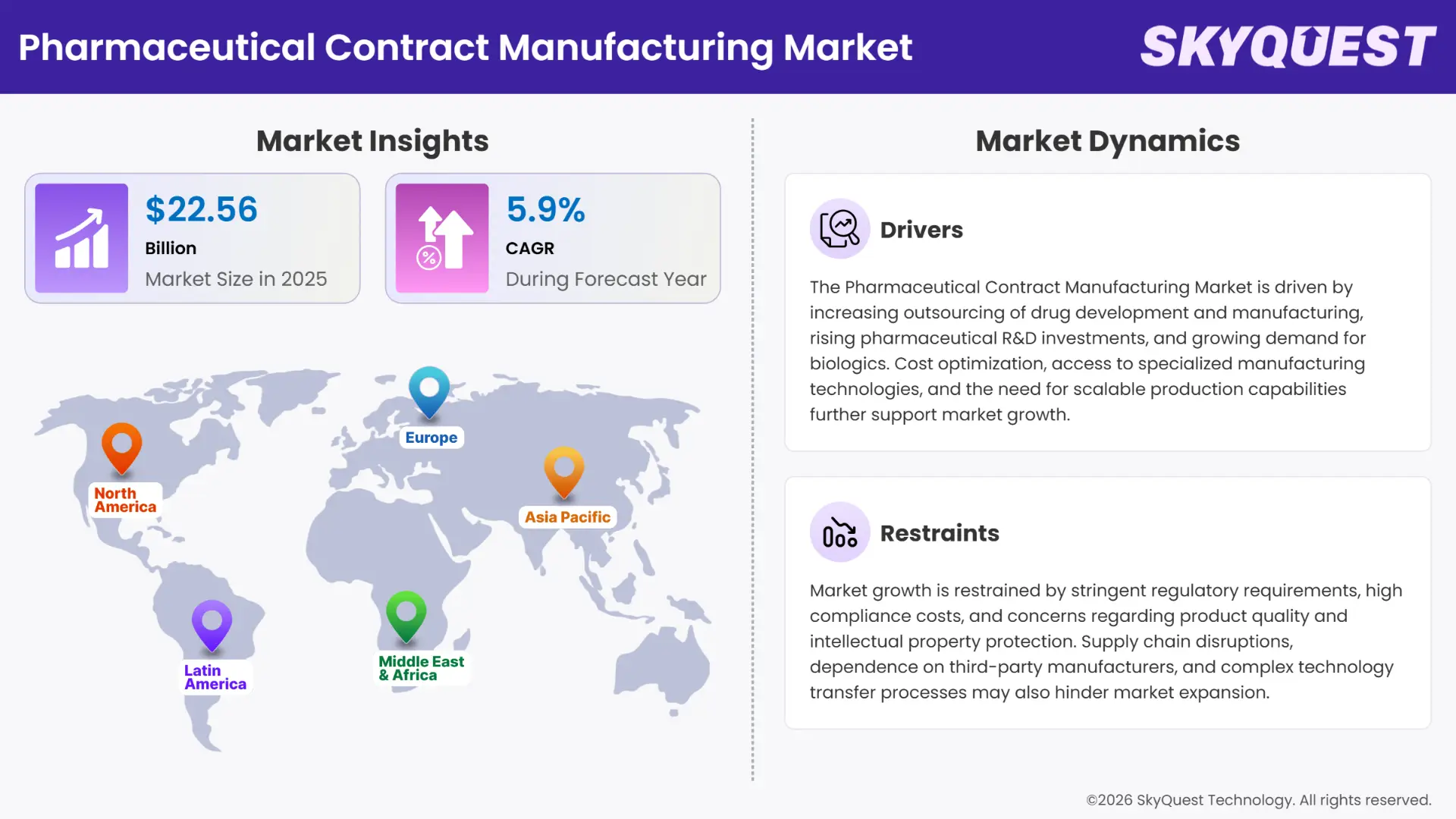
Global Pharmaceutical Contract Manufacturing Market size was valued at USD 21.31 Billion in 2024 and is poised to grow from USD 22.56 Billion in 2025 to USD 35.69 Billion by 2033, growing at a CAGR of 5.9% in the forecast period (2026–2033).
Key Takeaways: Market Trends & Insights
The pharmaceutical contract manufacturing market is gaining significant momentum as pharmaceutical and biotechnology companies increasingly seek to optimize operational efficiency and reduce production costs. Outsourcing manufacturing operations allows companies to allocate more resources to research, innovation, and faster product development cycles. This trend is particularly pronounced in the production of generics and biosimilars, where price competition and time-to-market are critical.
The market is also influenced by growing complexity in drug formulations, including high-potency active pharmaceutical ingredients (HPAPIs), biologics, and cell and gene therapies. Contract manufacturers with advanced technological capabilities and regulatory expertise are becoming vital partners for pharmaceutical firms looking to navigate the intricacies of global compliance and production scalability.
Additionally, the rising burden of chronic diseases and increasing healthcare access across emerging economies are driving demand for efficient drug production and supply chain management. This has led to a surge in long-term partnerships and strategic collaborations between pharmaceutical companies and contract manufacturing organizations (CMOs). Many CMOs are expanding their capabilities in aseptic processing, continuous manufacturing, and sterile fill-finish services to meet evolving client demands.
Moreover, regulatory harmonization and favorable government policies in several regions are creating an enabling environment for contract manufacturing growth. The trend toward integrated service offerings, covering everything from formulation development to packaging and distribution, is also reshaping the competitive landscape. CMOs that can offer end-to-end solutions with compliance, flexibility, and speed-to-market advantages are emerging as preferred partners.
How is AI Transforming Pharmaceutical Contract Manufacturing Operations?
Artificial Intelligence (AI) is significantly transforming the pharmaceutical contract manufacturing market by streamlining operations, enhancing quality control, and accelerating time-to-market. In 2024, AI integration across contract manufacturing organizations (CMOs) moved beyond pilot projects to full-scale adoption in areas such as predictive maintenance, real-time process monitoring, and digital batch release. Advanced machine learning algorithms are being deployed to optimize production yields, reduce downtime, and ensure consistent quality in complex biologics manufacturing.
To get more insights on this market click here to Request a Free Sample Report
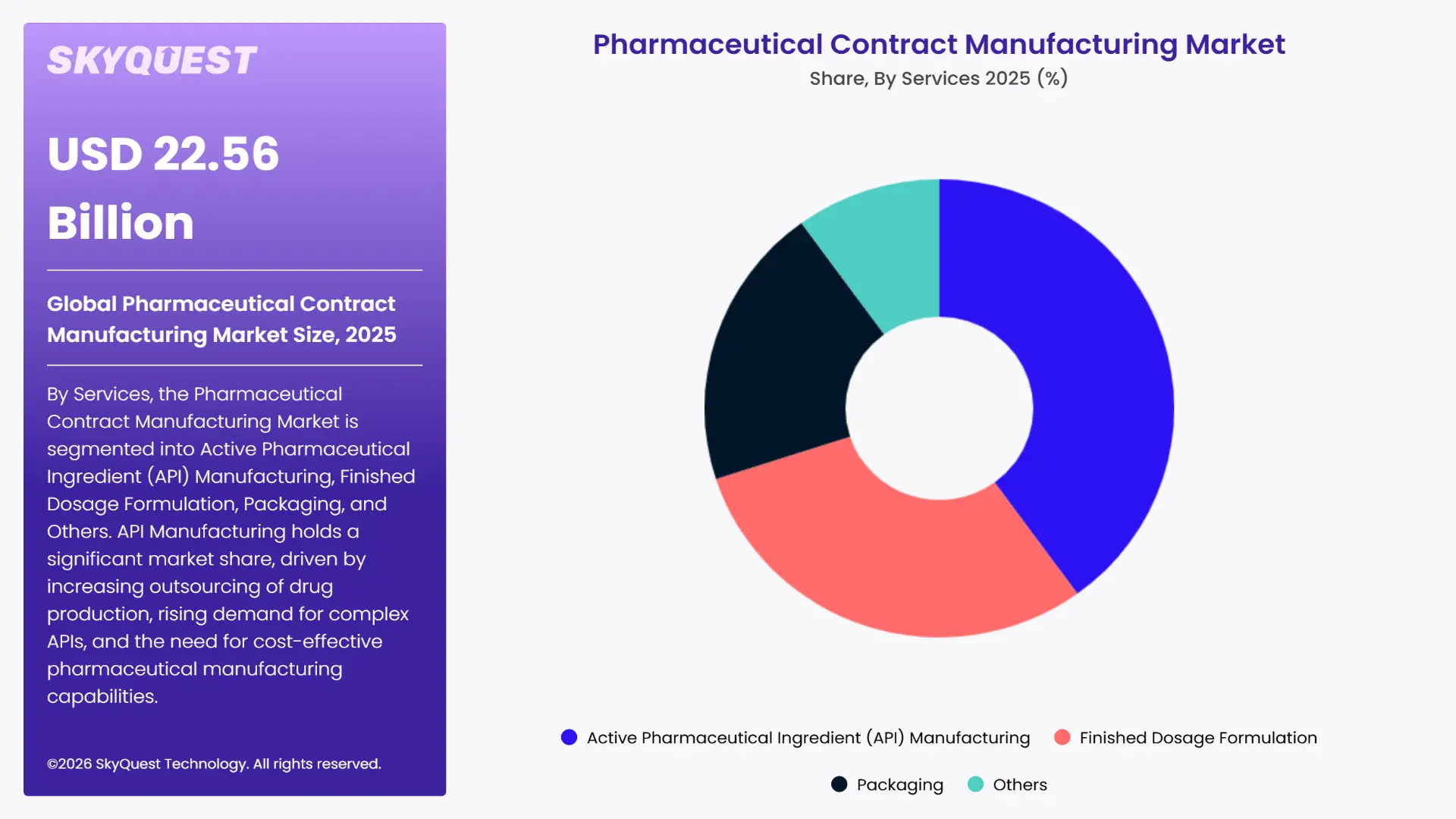
The global pharmaceutical contract manufacturing market is segmented by services, end user and region. Based on services, the market is segmented into pharmaceutical manufacturing services, drug development services, biologics manufacturing services, packaging & labelling services, fill-finish services, and other services. Based on end user, the market is segmented into big pharmaceutical companies, small & medium-sized pharmaceutical companies, generic pharmaceutical companies and other end users. Based on region, the market is segmented into North America, Asia-Pacific, Europe, Latin America, and Middle East & Africa.
Pharmaceutical manufacturing services are the dominant segment of the market. This segment includes large-scale production of solid, liquid, and injectable drug forms, including generics and branded pharmaceuticals. It holds the largest pharmaceutical contract manufacturing market share due to the sheer volume of outsourcing by pharma companies looking to reduce internal manufacturing costs and focus on core R&D. High demand for oral solid dosage forms and APIs further strengthens this segment. Its scalability, established infrastructure, and regulatory maturity make it a cornerstone of CDMO operations globally.
As per the global pharmaceutical contract manufacturing market forecast, biologics manufacturing services are the fastest-growing segment. This rapid growth is driven by rising global demand for biologics, biosimilars, monoclonal antibodies, and advanced therapies such as cell and gene therapies. The manufacturing of biologics is complex, capital-intensive, and highly regulated, prompting many pharma companies to outsource these tasks to CDMOs with specialized expertise. Expansion of chronic disease treatments, aging populations, and increased approvals of biologics are accelerating the need for advanced biologics manufacturing capabilities.
As per the global pharmaceutical contract manufacturing market outlook, big pharmaceutical companies are the dominant segment in the market. Large pharma companies continue to account for the highest share of outsourcing to CDMOs, driven by their global drug pipelines, complex portfolios, and need to streamline manufacturing across geographies. They often engage with CDMOs for large-scale commercial production, especially for biologics, sterile injectables, and high-potency APIs. Outsourcing enables these firms to reduce capital expenditure, improve operational flexibility, and accelerate time-to-market for both new and lifecycle-managed drugs.
As per the global pharmaceutical contract manufacturing market analysis, small & medium-sized pharmaceutical companies are the fastest-growing segment. This growth is fueled by the rise of biotech startups and specialty pharma firms that typically lack in-house manufacturing capabilities. These companies rely heavily on CDMOs for everything from early-stage development and clinical manufacturing to commercial-scale production. As innovation increasingly shifts toward smaller firms developing niche or advanced therapies (e.g., orphan drugs, mRNA platforms), their dependence on external manufacturing support is rising rapidly. CDMOs offer these firms the flexibility, speed, and regulatory expertise needed to bring new drugs to market efficiently.
To get detailed segments analysis, Request a Free Sample Report
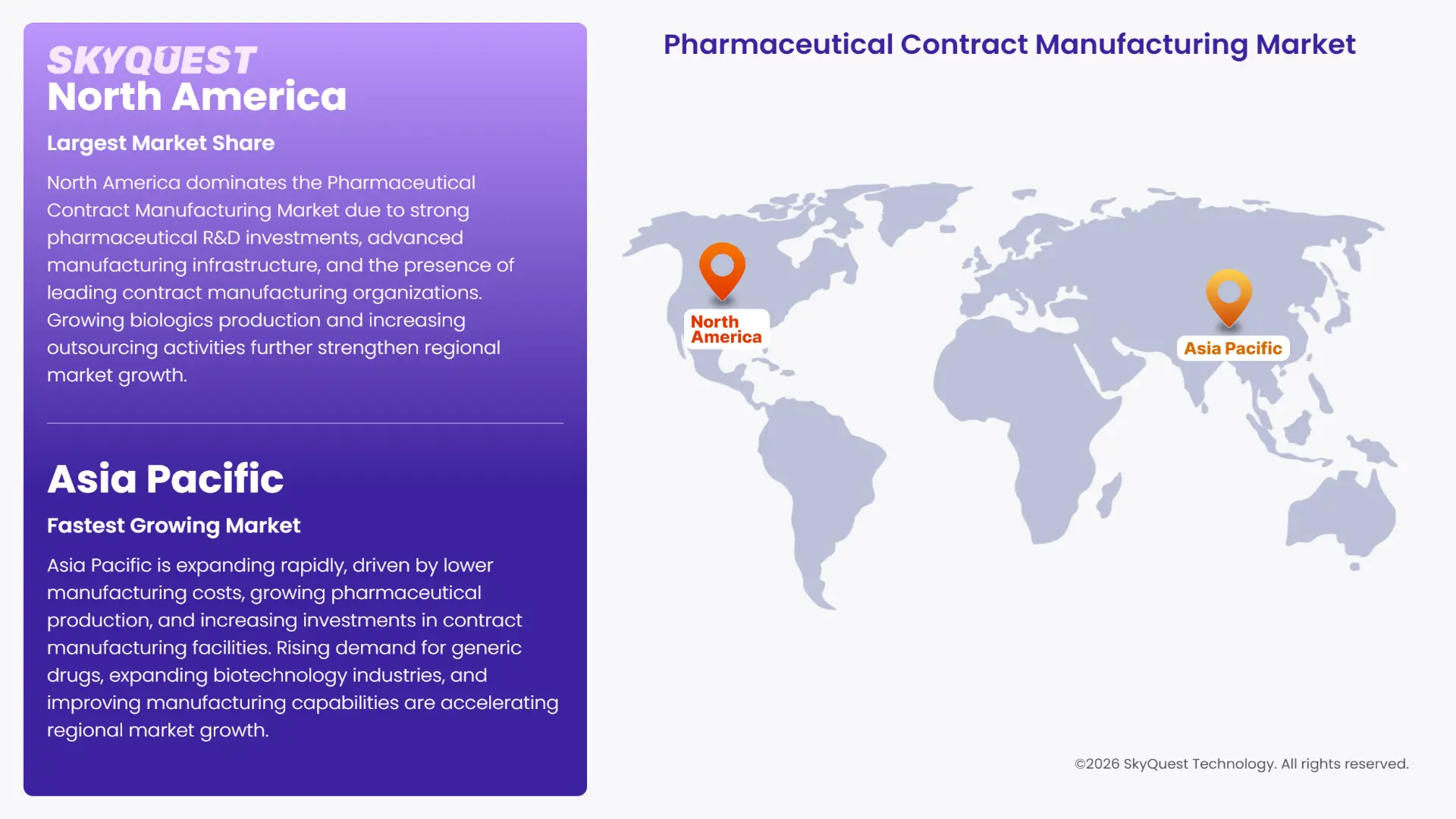
As per regional outlook, North America remains a dominant region in the pharmaceutical contract manufacturing market due to its advanced pharmaceutical ecosystem, large R&D investments, and strong regulatory infrastructure. The region benefits from the presence of major CDMOs and high demand for biologics and complex formulations. Increasing outsourcing from biotech startups and rising production of injectable therapies are major growth drivers. Technological advancements like AI-based manufacturing and real-time quality control have been widely adopted. Ongoing consolidation and integration of end-to-end services are notable trends across North America.
Pharmaceutical Contract Manufacturing Market in the U.S.
The U.S. leads the North American market with a high concentration of global pharma companies and CDMOs. Favorable FDA regulations, strong IP protection, and growing biological demand contribute to pharmaceutical contract manufacturing market growth. The U.S. also sees increasing investment in digital transformation of manufacturing and expansion of injectable fill-finish capabilities.
Pharmaceutical Contract Manufacturing Market in Canada
Canada's market is growing steadily, supported by government incentives for pharma manufacturing and R&D. The country is emerging as a nearshoring destination due to its proximity to the U.S. and strong compliance standards. Canadian CDMOs are focusing on sterile injectables and small-batch production for clinical trials.
As per regional forecast, Asia-Pacific is emerging as a major hub for pharmaceutical contract manufacturing due to its cost competitiveness, skilled labor, and expanding pharma infrastructure. The region attracts global companies outsourcing large-scale production to serve both local and international markets. Growth is also fueled by increasing domestic demand, especially in generics and biosimilars. Trends include automation adoption, regulatory upgrades, and expansion of GMP-compliant facilities.
Pharmaceutical Contract Manufacturing Market in Japan
As per industry analysis, Japan’s market is driven by a strong pharmaceutical base, aging population, and demand for high-quality production standards. Domestic CDMOs focus on high-end formulations and specialized services, including oncology drugs and injectables. Japan maintains a reputation for quality and precision, appealing to global clients seeking premium manufacturing standards.
Pharmaceutical Contract Manufacturing Market in South Korea
South Korea is gaining traction as a biologics manufacturing leader, backed by government support and global partnerships. Companies like Samsung Biologics are expanding their capacity and adopting cutting-edge technologies. The country is a preferred destination for biosimilar and monoclonal antibody production, with strong regulatory alignment with international standards.
Europe represents a mature and innovation-driven pharmaceutical manufacturing region, supported by a strong regulatory framework and advanced technical capabilities. Demand is rising for sterile injectables, high-potency APIs, and biologics manufacturing. The trend toward CDMOs offering integrated development-to-delivery solutions is shaping the European market. M&A activity remains high, and digital manufacturing adoption is growing steadily.
Pharmaceutical Contract Manufacturing Market in Germany
Germany leads the European market with its advanced manufacturing infrastructure and concentration of pharmaceutical and biotech firms. The country emphasizes quality, automation, and compliance, making it a strategic hub for both domestic and outsourced manufacturing. Focus areas include APIs, biosimilars, and oncology drugs.
Pharmaceutical Contract Manufacturing Market in the UK
The UK’s market is evolving post-Brexit, with increased investment in localized manufacturing and innovation hubs. The country is focusing on specialized manufacturing, cell and gene therapy, and digital transformation in pharma production. Government support and regulatory agility are aiding growth.
Pharmaceutical Contract Manufacturing Market in Italy
Italy is known for its strong export-oriented pharmaceutical manufacturing base. The country excels in contract manufacturing of solid dosage forms and sterile injectables. Italian CDMOs are expanding into biologics and gaining regulatory recognition from international bodies, enhancing their global competitiveness.
To know more about the market opportunities by region and country, click here to
Buy The Complete Report
Rising Need for Cost Efficiency
Growing Demand for Biologics and Complex Drugs
Regulatory Compliance Challenges
Concerns Over Intellectual Property (IP) Protection
Request Free Customization of this report to help us to meet your business objectives.
The pharmaceutical contract manufacturing industry is moderately consolidated, with a mix of global players and region-specific CMOs competing based on service capabilities, technological expertise, regulatory track record, and geographic presence. Leading companies are focusing on expanding their end-to-end service offerings by integrating development, manufacturing, packaging, and even logistics solutions to become full-service CDMOs. Strategic mergers, acquisitions, and capacity expansions continue to shape the competitive landscape.
As per market strategies, in 2024, a notable example was the acquisition of a European sterile injectables facility by a major U.S.-based CDMO, aimed at strengthening its biologics fill-finish capabilities and expanding its footprint in the EU market.
In recent years, a new wave of startups has entered the pharmaceutical contract manufacturing space, bringing innovation, flexibility, and technology-driven approaches to a traditionally capital-intensive industry. These emerging players are focused on niche areas such as biologics, high-potency APIs, and personalized medicine. Unlike traditional CMOs, these startups are often built around agile manufacturing models, advanced digital infrastructure, and modular facilities that allow for faster turnaround and greater customization. Leveraging artificial intelligence, automation, and data analytics, they offer smart manufacturing solutions tailored to the needs of biotech firms and early-stage pharmaceutical companies.
Adoption of Smart Manufacturing Technologies
Shift Toward Integrated CDMO Models
SkyQuest’s ABIRAW (Advanced Business Intelligence, Research & Analysis Wing) is our Business Information Services team that Collects, Collates, Correlates, and Analyses the Data collected by means of Primary Exploratory Research backed by robust Secondary Desk research.
As per SkyQuest analysis, increasing use of generic drugs and funding, developments in the field of CMOs technology, the high cost of in-house drug discovery, and regulatory filing by the CMOs drive the growth of the pharmaceutical contract manufacturing market. Pharma CMOs using Al in drug development and manufacturing will bring efficiency and quality. Strict rules may limit the growth of the market. Moreover, applies AI in predictive analytics for supply chain management, planning efficient production schedules, and inventory levels. AI also optimizes clinical trials through incidental candidate identification, predictions of clinical trial results, and patient compliance monitoring4 which will lower the costs and raise success rates of clinical trials. It paves the way for further innovations and developments, as bringing Al to pharmaceutical contract manufacturing transforms the whole industry in terms of efficiency, guarantees quality, and accelerates development processes.
| Report Metric | Details |
|---|---|
| Market size value in 2024 | USD 21.31 Billion |
| Market size value in 2033 | USD 35.69 Billion |
| Growth Rate | 5.9% |
| Base year | 2024 |
| Forecast period | 2026–2033 |
| Forecast Unit (Value) | USD Billion |
| Segments covered |
|
| Regions covered | North America (US, Canada), Europe (Germany, France, United Kingdom, Italy, Spain, Rest of Europe), Asia Pacific (China, India, Japan, Rest of Asia-Pacific), Latin America (Brazil, Rest of Latin America), Middle East & Africa (South Africa, GCC Countries, Rest of MEA) |
| Companies covered |
|
| Customization scope | Free report customization with purchase. Customization includes:-
|
To get a free trial access to our platform which is a one stop solution for all your data requirements for quicker decision making. This platform allows you to compare markets, competitors who are prominent in the market, and mega trends that are influencing the dynamics in the market. Also, get access to detailed SkyQuest exclusive matrix.
Table Of Content
Executive Summary
Market overview
Parent Market Analysis
Market overview
Market size
KEY MARKET INSIGHTS
COVID IMPACT
MARKET DYNAMICS & OUTLOOK
Market Size by Region
KEY COMPANY PROFILES
Methodology
For the Pharmaceutical Contract Manufacturing Market, our research methodology involved a mixture of primary and secondary data sources. Key steps involved in the research process are listed below:
1. Information Procurement: This stage involved the procurement of Market data or related information via primary and secondary sources. The various secondary sources used included various company websites, annual reports, trade databases, and paid databases such as Hoover's, Bloomberg Business, Factiva, and Avention. Our team did 45 primary interactions Globally which included several stakeholders such as manufacturers, customers, key opinion leaders, etc. Overall, information procurement was one of the most extensive stages in our research process.
2. Information Analysis: This step involved triangulation of data through bottom-up and top-down approaches to estimate and validate the total size and future estimate of the Pharmaceutical Contract Manufacturing Market.
3. Report Formulation: The final step entailed the placement of data points in appropriate Market spaces in an attempt to deduce viable conclusions.
4. Validation & Publishing: Validation is the most important step in the process. Validation & re-validation via an intricately designed process helped us finalize data points to be used for final calculations. The final Market estimates and forecasts were then aligned and sent to our panel of industry experts for validation of data. Once the validation was done the report was sent to our Quality Assurance team to ensure adherence to style guides, consistency & design.
Analyst Support
Customization Options
With the given market data, our dedicated team of analysts can offer you the following customization options are available for the Pharmaceutical Contract Manufacturing Market:
Product Analysis: Product matrix, which offers a detailed comparison of the product portfolio of companies.
Regional Analysis: Further analysis of the Pharmaceutical Contract Manufacturing Market for additional countries.
Competitive Analysis: Detailed analysis and profiling of additional Market players & comparative analysis of competitive products.
Go to Market Strategy: Find the high-growth channels to invest your marketing efforts and increase your customer base.
Innovation Mapping: Identify racial solutions and innovation, connected to deep ecosystems of innovators, start-ups, academics, and strategic partners.
Category Intelligence: Customized intelligence that is relevant to their supply Markets will enable them to make smarter sourcing decisions and improve their category management.
Public Company Transcript Analysis: To improve the investment performance by generating new alpha and making better-informed decisions.
Social Media Listening: To analyze the conversations and trends happening not just around your brand, but around your industry as a whole, and use those insights to make better Marketing decisions.
REQUEST FOR SAMPLE
 REQUEST FREE CUSTOMIZATION
Global Pharmaceutical Contract Manufacturing Market size was valued at USD 21.31 Billion in 2024 and is poised to grow from USD 22.56 Billion in 2025 to USD 35.69 Billion by 2033, growing at a CAGR of 5.9% in the forecast period (2026–2033).
The key vendors in the Pharmaceutical Contract Manufacturing Market include Lonza Group AG, Thermo Fisher Scientific Inc. (Patheon), Catalent, Inc., Samsung Biologics Co., Ltd., WuXi Biologics, Siegfried Holding AG, FUJIFILM Diosynth Biotechnologies, Boehringer Ingelheim, Recipharm AB, and Piramal Pharma Solutions. These companies provide active pharmaceutical ingredient manufacturing, drug formulation, biologics production, and commercial-scale manufacturing services.
The key driver of the Pharmaceutical Contract Manufacturing Market is the growing trend of outsourcing drug development and manufacturing to reduce operational costs and improve production efficiency. Rising demand for biologics, increasing pharmaceutical R&D investments, and the need for scalable manufacturing capabilities further support market growth.
The key market trend in the Pharmaceutical Contract Manufacturing Market is the growing adoption of advanced manufacturing technologies and specialized outsourcing for biologics, cell and gene therapies, and complex drug formulations. Companies are increasingly investing in automation, continuous manufacturing, and flexible production facilities to improve efficiency, quality, and scalability.
North America accounted for the largest share of the Pharmaceutical Contract Manufacturing Market, driven by strong pharmaceutical R&D investments, advanced manufacturing infrastructure, and the presence of leading contract manufacturing organizations. Growing biologics production, increasing outsourcing activities, and stringent quality standards further support regional market dominance.


Want to customize this report? This report can be personalized according to your needs. Our analysts and industry experts will work directly with you to understand your requirements and provide you with customized data in a short amount of time. We offer $1000 worth of FREE customization at the time of purchase.
Feedback From Our Clients


 USA (+1) 351-333-4748

