
lntelligent Transportation Management System Market
Report ID: SQMIG35H2450
Report ID: SQMIG35H2450
[email protected]
USA +1 351-333-4748
Report ID:
SQMIG35H2450 |
Region:
Global |
Published Date: February, 2026
Pages:
157
|Tables:
120
|Figures:
77


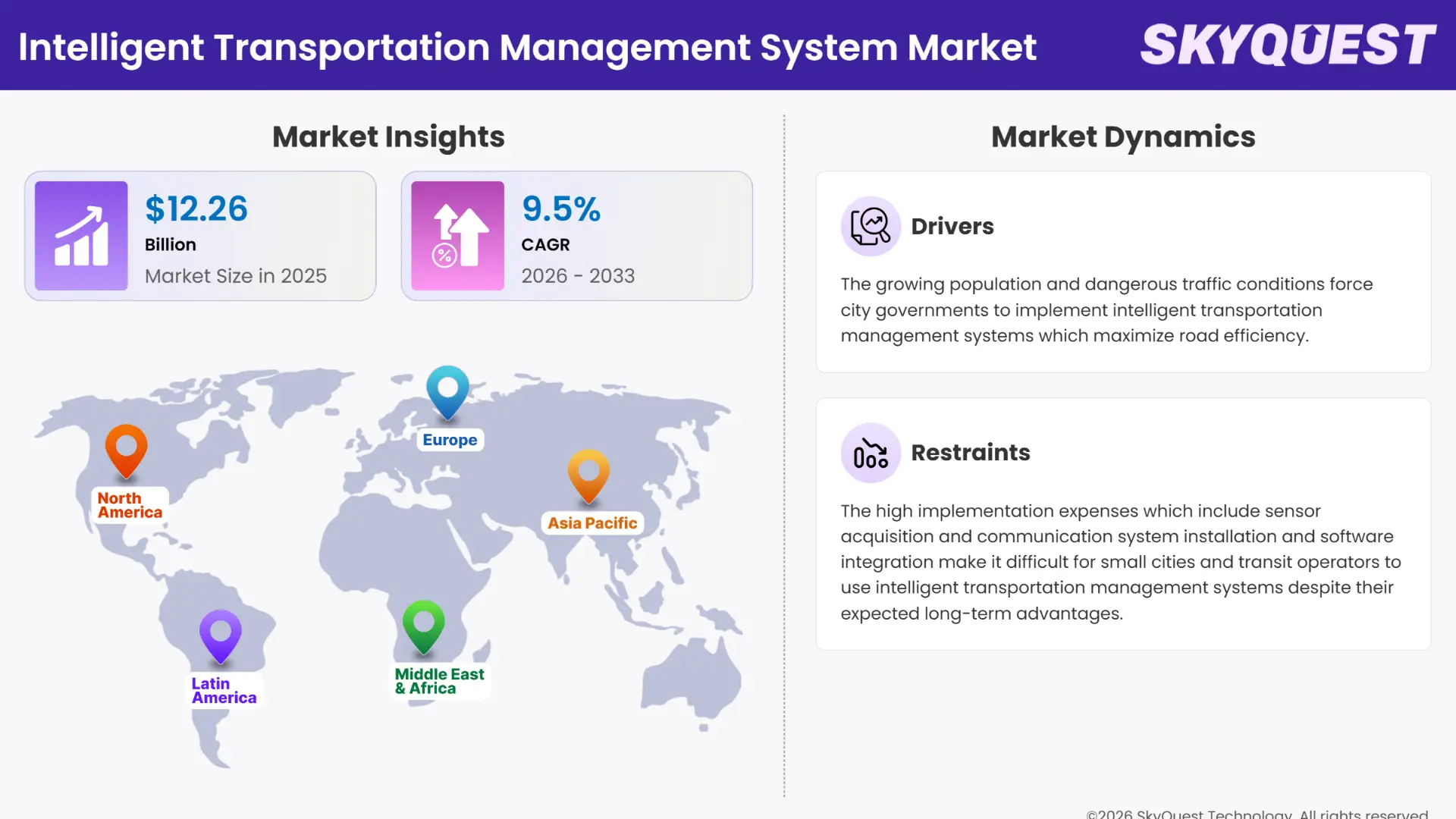
Global Intelligent Transportation Management System Market size was valued at USD 11.2 Billion in 2024 and is poised to grow from USD 12.26 Billion in 2025 to USD 25.35 Billion by 2033, growing at a CAGR of 9.5% during the forecast period (2026-2033).
Key Takeaways: Market Trends & Insights
The global intelligent transportation management system industry encompasses all hardware and software and service solutions which utilize mobility data to conduct traffic optimization and safety improvement and emission reduction measures. The situation matters because urban population growth combined with insufficient infrastructure resources creates ongoing traffic jams which harm both productivity and public health and lead authorities toward digital mobility solutions.
Moreover, the global intelligent transportation management system outlook has transformed from separate traffic signals and manual observation methods to complete systems which employ sensors and cloud-based analytics and machine learning technology as demonstrated by Los Angeles' ATSAC adaptive signals and Singapore's electronic road pricing system. The primary driver is the need to reduce congestion and realize efficiency gains.
Advanced connectivity, which combines with analytics to create useful insights, drives the main market growth because this technology enables improved network performance to support real-time communications between vehicles and infrastructure components and control centers which leads to increased demand for V2X platforms and edge computing solutions. The initiation of V2X trials hasled to both roadside deployments and OEM partnerships, while the port of Rotterdam utilizes its combined traffic and terminal systems to achieve reduced dwell times and increased throughput. The combination of declining cloud costs and the emergence of standardized APIs enables cities and operators to implement scalable systems, which produces business possibilities for the integration of mobility-as-a-service solutions and the management of autonomous vehicle fleets. Organizations tend to adopt new technologies because predictive maintenance solutions combined with reduced operational costs throughout an asset lifetime make those technologies more appealing.
How is AI Enhancing Operational Efficiency in the Intelligent Transportation Management System Market?
Intelligent transportation management systems achieve their operational improvements through AI-powered systems which combine real-time sensing with machine learning and digital twin technology. The core functions of the system include traffic control which adapts to existing traffic conditions and asset maintenance which uses predictive analytics and incident detection through automated processes and fleet optimization through intelligent routing systems. The current market shows increasing adoption of cloud-based analytics and edge AI systems because they enable organizations to achieve better performance and lower operational delays. The system allows operators to manage essential corridors which then helps them to direct traffic during busy periods while decreasing unexpected system interruptions and maintainingsystem expansion capabilities and enhanced response times to citywide requirements. The demonstration of case examples shows how organizations employ AI-based solutions to optimize signal timing and cloud technology to perform continuous system efficiency checks which drive daily operational choices.
To get more insights on this market click here to Request a Free Sample Report
The global intelligent transportation management system market is segmented based on component, deployment mode, application, end user, and region. By component, the market is categorized into hardware, software, and services. Based on deployment mode, it is segmented into on-premises and cloud-based solutions. In terms of application, the market includes traffic management, incident and emergency management, fleet management and asset monitoring, parking management, and others. Based on end user, it is divided into government and public authorities, transport and traffic authorities, public transport operators, logistics and freight companies, and others. Regionally, the market is segmented into North America, Europe, Asia Pacific, Latin America, and the Middle East & Africa.
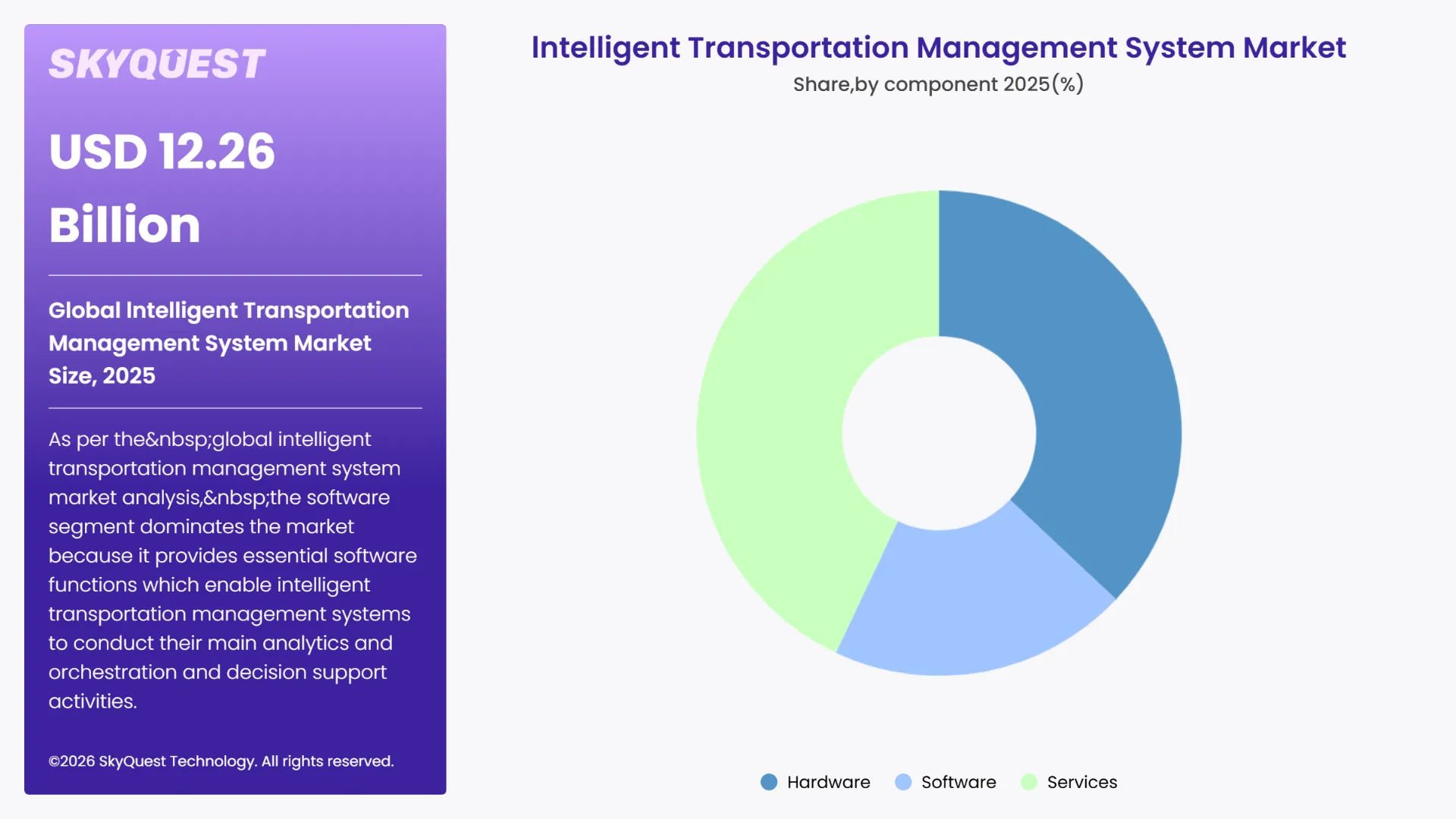
As per the global intelligent transportation management system market analysis, the software segment dominates the market because it provides essential software functions which enable intelligent transportation management systems to conduct their main analytics and orchestration and decision support activities. Integrated platforms process data from various sensors and vehicles through advanced algorithms which enable automatic control adjustments which result in better traffic management and efficient resource usage. The ongoing investment by vendors in software products which support interoperability with cloud technology and open API standards, enables organizations to achieve operational value through better integration capabilities and continuous delivery of new features.
However, the hardware category has become the fastest growing segment because the rising use of connected sensors and edge devices and rugged controllers creates demand for new installation sites. The increasing need for field devices which capture real-time traffic and vehicle information together with telecom integration and durable infrastructure requirements drives the market for hardware procurement while creating opportunities for bundled hardware and service packages.
According to the global intelligent transportation management system market forecast, the cloud-based segment dominates the market because cloud systems provide both scalable processing power and centralized data storage, which enables real-time analytics and corridor-wide data sharing and quick deployment of new features across intelligent transportation management systems. Central hosting enables multiple stakeholders to work together more efficiently while decreasing the need for local IT support, which allows organizations to perform continuous AI model updates through managed service options that support control strategy improvements and third-party service integration.
Whereas the on-premises segment has become the fastest growing area for agencies because they need to handle their data while maintaining low latency connections to their existing traffic control systems. Organizations choose private deployments, which leads them to fund the development of custom systems that include local processing capabilities, which causes vendors to develop platforms that meet mission-critical reliability standards while providing secure access and compliance functionalities.
To get detailed segments analysis, Request a Free Sample Report
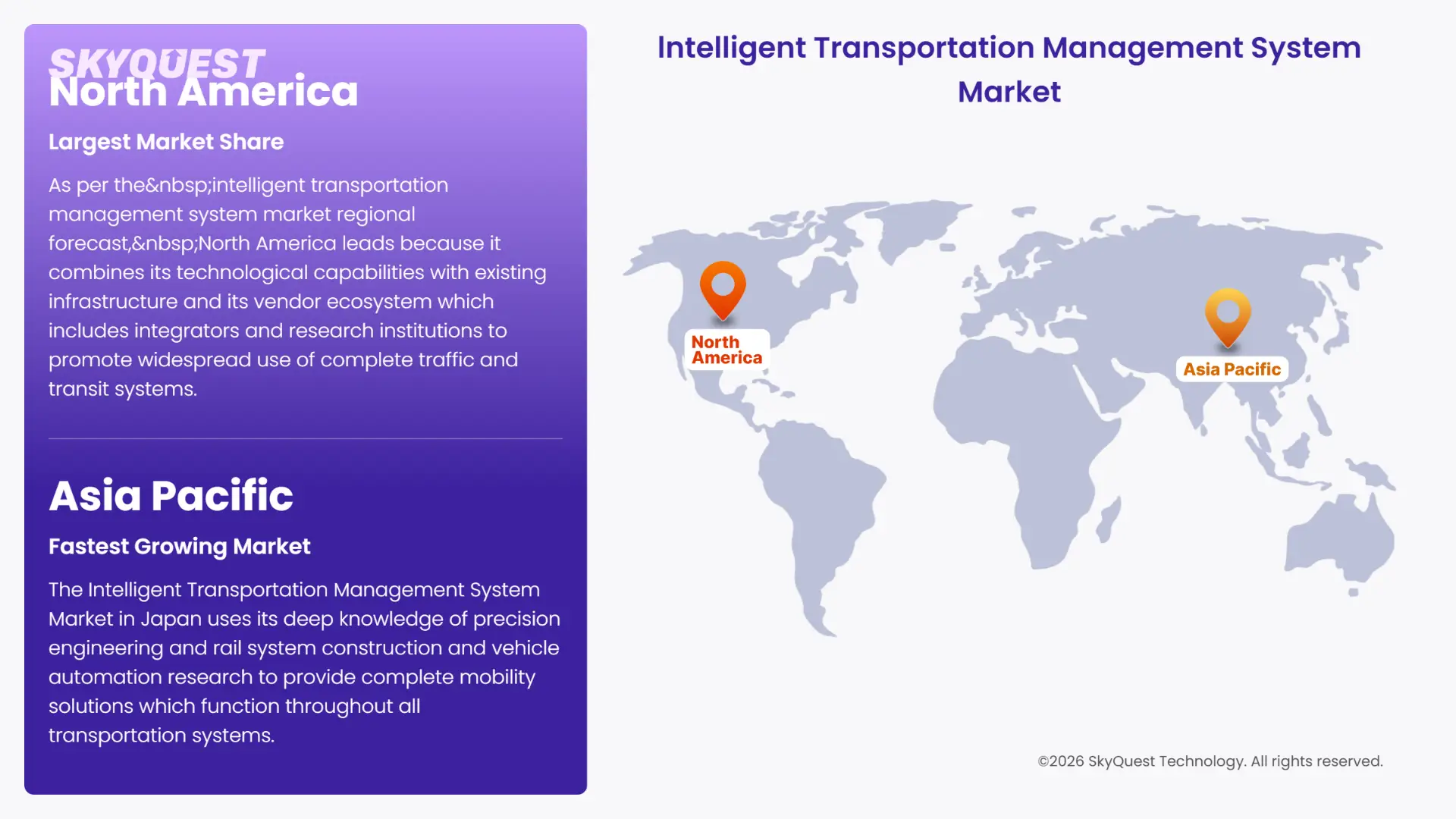
As per the intelligent transportation management system market regional forecast, North America leads because it combines its technological capabilities with existing infrastructure and its vendor ecosystem which includes integrators and research institutions to promote widespread use of complete traffic and transit systems.
Public agencies and private operators focus on safety and reduced congestion and improved freight efficiency, which creates a need for advanced analytics and connected vehicle platforms and multimodal integration solutions. Scalable deployments receive assistance from interoperability standards and organizations which possess strong cybersecurity capabilities and have established extensive pilot programs. Federal and regional authorities work together with technology providers to enable large-scale implementation while the mature procurement environment and skilled workforce allow quick deployment of sensors and communications and cloud analytics through urban and corridor networks.
The Intelligent Transportation Management System sector in the United States operates through two different deployment methods which include dense metropolitan areas and important freight corridors that exist between municipal and state authorities who concentrate on traffic control and safety measures and emissions reductions. The presence of system integrators and technology vendors enables the organization of traffic control and transit priority and freight visibility systems. The public procurement system and academic partnerships with private mobility companies enable cities to test and expand connected vehicle and smart infrastructure solutions which solve complicated urban mobility problems.
The Intelligent Transportation Management System Market in Canada operates according to urban modernization requirements which need more advanced solutions and the need for rural areas to maintain their remote connections. Municipal and provincial bodies work together to establish better transit systems and traffic control solutions and freight transportation processes which are required in various geographic regions. The planning process will be inclusive because indigenous communities work with project teams to achieve sustainable development goals. Local integrators develop intelligent systems for extreme weather conditions while they use national research capabilities and partnerships between different jurisdictions to enhance network performance and traveler information systems.
The Intelligent Transportation Management System Market in Asia Pacific experiences fast growth because of two key factors which include the increasing number of people moving into cities and the government projects which promote smart city development and the national capacity to create advanced mobility solutions through electronics production and automotive technology development. Real-time traffic management systems and public transit and freight transportation systems need both integrated ticketing systems and dynamic routing capabilities to handle their operational requirements. The national and municipal initiatives will create a digital infrastructure foundation which supports connected vehicle testing and sensor installation activities throughout the country. Local vendors work with international providers to customize their solutions for highly populated urban centers while their multimodal integration approach and user-centric system design will lead to quick adoption of services throughout both urban and intercity transportation routes.
The Intelligent Transportation Management System Market in Japan uses its deep knowledge of precision engineering and rail system construction and vehicle automation research to provide complete mobility solutions which function throughout all transportation systems. The bus and rail and road networks work together to maintain accurate schedules and safe operations through their use of advanced mapping systems and sensor integration and operational data analysis. Public private partnerships support testing of cooperative systems and mobility solutions which have been designed for demographic changes and urban population density. The operators will enhance system performance by making sure systems operate correctly, and passengers can switch between different transport modes without interruption.
The Intelligent Transportation Management System Market in South Korea experiences growth because its modern connectivity infrastructure and domestic electronics and automotive manufacturing companies enable quick implementation of connected mobility systems. Smart mobility projects at the city level use real-time data systems and integrated transit operations and dynamic traffic control systems to manage heavy urban traffic flows. The technology companies and mobility service providers and public agencies work together to develop new systems which enable vehicles to communicate with infrastructure, and they also build systems that help optimize logistics operations. The focus on user experience and interoperability, and scalable platforms will lead to adoption in all major cities and transportation routes.
The European Union fortifies its power base through a collective strategy which combines regulatory compliance with international system compatibility and environmentally friendly transportation targets that direct funding towards smart transport systems. The public sector provides funding for advanced traffic management systems and freight corridor control systems and secure data exchange systems because they require these to establish their multimodal transport systems and reduce greenhouse gas emissions and build essential infrastructure. The collaboration between national agencies and metropolitan authorities and private vendors enables them to establish standardized platforms and procurement methods which simplify joint operations across different jurisdictions. The solution design process applies privacy and cybersecurity and accessibility requirements with industrial clusters and research alliances enabling advancement of connected and automated mobility development.
The German intelligent transportation management system market connects with the country’s automotive and engineering sectors which support the development of systems that enable vehicle technologies to work together with road and freight operations systems. The focus on efficient logistics corridors and motorway traffic flow optimization and industrial interoperability enables advanced operational systems. The cooperation between local authorities and research institutions and suppliers leads to the creation of standards and secure architectural design solutions. The solutions use reliability and system robustness together with manufacturing and distribution of network connections to meet multiple transport and environmental policy requirements.
The United Kingdom intelligent transportation management system market centers on urban traffic management and congestion control solutions which help improve public transit operations while creating reliable transportation routes and reducing negative environmental impacts. The Dynamic pricing and signal coordination and multimodal information services systems which strategic municipal programs and transport authorities now prioritize will help solve public transit delays while creating better access for all users. The research centers and technology companies develop autonomous systems with transportation operators to demonstrate connected and automated mobility systems which focus on data governance and passenger experience and metropolitan network operational improvements.
The French intelligent transportation management system market focuses on multimodal transport connections and railway system links and mobility as a service system which help create integrated urban and regional transportation networks. The national and local governments support intelligent traffic control systems and integrated ticketing systems together with passenger information systems which help improve modal shifts and decrease environmental pollution. The collaboration between transportation companies and technology companies and local authorities works to create platforms which enable different operators to deliver personalized services while the existing vendor ecosystem provides flexible solutions for both urban centers and regional transportation routes.
To know more about the market opportunities by region and country, click here to
Buy The Complete Report
Urbanization and Traffic Congestion
The growing population and dangerous traffic conditions force city governments to implement intelligent transportation management systems which maximize road efficiency. The systems enable real-time traffic monitoring, which leads to improved infrastructure use and reduced service disruptions, and better public mobility service perception. The need to manage complex multimodal transport flows and reduce emissions encourages sustained investment by planners and operators who need to establish scalable interoperable solutions for upcoming urban mobility projects.
Advances in Artificial Intelligence
The advancements in artificial intelligence and machine learning and predictive analytics now enable better traffic prediction and incident identification and adaptive signal control functioning which improve intelligent transportation management systems effectiveness. The system enables operators to detect future traffic jams while they manage emergency response activities and optimize vehicle routes without needing extensive human control, which decreases operational complexities while enhancing service dependability. Public agencies and private operators are increasingly willing to implement complete systems which provide them with verifiable operational and safety advantages as AI solutions evolve into advanced sensor systems and cloud-based platforms.
High Implementation and Integration Costs
The high implementation expenses which include sensor acquisition and communication system installation and software integration make it difficult for small cities and transit operators to use intelligent transportation management systems despite their expected long-term advantages. The cost of upgrading existing systems to work with various vendor platforms creates financial unpredictability which extends project timelines and decreases the chances of quick system implementation. Public funding limits together with insufficient capital access create obstacles for organizations which forces them to postpone complete system implementations or choose smaller system changes.
Data Privacy and Security Concerns
Stakeholders hesitate to use intelligent transportation management systems because of their data collection and processing methods which involve handling both mobility information and personal identification data and existing security problems and undefined industry regulations. The implementation of information systems creates concerns because it exposes organizations to information breaches and unauthorized data distribution and accidental legal problems which require them to implement extra protection measures that disrupt system operations. Public agencies and private partners hesitate to move forward with projects which involve shared systems because they lack both universal standards and established governance frameworks which would protect them from political and legal liabilities.
Request Free Customization of this report to help us to meet your business objectives.
The competitive market sees its current state of competition because existing companies use their data partnerships and real-time data systems to achieve better competitive results. Companies use M&A processes to obtain data assets and SaaS software packages which their business model shows through its acquisition of TrafficCast and its subsequent sale to Almaviva. The platform partnerships of Siemens Mobility with HERE location and traffic data systems enable cities to achieve fast feature deployments throughout their entire urban areas.
Connected Multimodal Mobility Integration: Connected multimodal mobility systems create new transportation ecosystems that enable different transportation modes to work together better by connecting roadways with rail systems and microtransit solutions and shared mobility options, which helps both network performance and passenger satisfaction. Platforms that synchronize scheduling with ticketing and vehicle routing enable public agencies and private operators to work together while they decrease traffic congestion and improve first/last-mile connectivity. Stakeholders increasingly prioritize interoperable interfaces and open data models to enable citywide deployments while developing flexible service offerings that match shifting traveler patterns and changing policy objectives and private capital investment.
AI-driven Predictive Operations: AI-driven predictive operations allow transportation managers to predict maintenance requirements and optimize traffic signal schedules and adjust service capacity according to changing demand patterns, which results in improved asset availability and better travel experience for passengers. Machine learning models process multiple types of sensor data together with historical data to create insights which enable automated decision support systems to deliver faster processing times. The organization promotes trust development with model users through its focus on explainable models and human-in-the-loop design, which allows agencies and operators to transition their operations from reactive maintenance work to active system management and enhancement.
SkyQuest’s ABIRAW (Advanced Business Intelligence, Research & Analysis Wing) is our Business Information Services team that Collects, Collates, Correlates, and Analyses the Data collected by means ofPrimary Exploratory Research backed by robust Secondary Desk research.
As per SkyQuest analysis, the intelligent transportation management system market worldwide expands because of urban growth and traffic congestion problems that emerge in various cities, while AI technology advances and edge-cloud analytics capabilities serve as the second force driving market growth. The North American software market leads traffic control software adoption because its analytics and orchestration platforms permit users to execute adaptive traffic control and create multimodal street systems. High implementation and integration costs serve as the main barrier which prevents small municipalities from establishing their systems while making it difficult to upgrade existing legacy systems. Public agencies and vendors can modernize mobility operations through predictive maintenance use cases which create lasting business value between them and the ability to decline cloud costs while standardizing application programming interfaces.
| Report Metric | Details |
|---|---|
| Market size value in 2024 | USD 11.2 Billion |
| Market size value in 2033 | USD 25.35 Billion |
| Growth Rate | 9.5% |
| Base year | 2024 |
| Forecast period | 2026-2033 |
| Forecast Unit (Value) | USD Billion |
| Segments covered |
|
| Regions covered | North America (US, Canada), Europe (Germany, France, United Kingdom, Italy, Spain, Rest of Europe), Asia Pacific (China, India, Japan, Rest of Asia-Pacific), Latin America (Brazil, Rest of Latin America), Middle East & Africa (South Africa, GCC Countries, Rest of MEA) |
| Companies covered |
|
| Customization scope | Free report customization with purchase. Customization includes:-
|
To get a free trial access to our platform which is a one stop solution for all your data requirements for quicker decision making. This platform allows you to compare markets, competitors who are prominent in the market, and mega trends that are influencing the dynamics in the market. Also, get access to detailed SkyQuest exclusive matrix.
Table Of Content
Executive Summary
Market overview
Parent Market Analysis
Market overview
Market size
KEY MARKET INSIGHTS
COVID IMPACT
MARKET DYNAMICS & OUTLOOK
Market Size by Region
KEY COMPANY PROFILES
Methodology
For the lntelligent Transportation Management System Market, our research methodology involved a mixture of primary and secondary data sources. Key steps involved in the research process are listed below:
1. Information Procurement: This stage involved the procurement of Market data or related information via primary and secondary sources. The various secondary sources used included various company websites, annual reports, trade databases, and paid databases such as Hoover's, Bloomberg Business, Factiva, and Avention. Our team did 45 primary interactions Globally which included several stakeholders such as manufacturers, customers, key opinion leaders, etc. Overall, information procurement was one of the most extensive stages in our research process.
2. Information Analysis: This step involved triangulation of data through bottom-up and top-down approaches to estimate and validate the total size and future estimate of the lntelligent Transportation Management System Market.
3. Report Formulation: The final step entailed the placement of data points in appropriate Market spaces in an attempt to deduce viable conclusions.
4. Validation & Publishing: Validation is the most important step in the process. Validation & re-validation via an intricately designed process helped us finalize data points to be used for final calculations. The final Market estimates and forecasts were then aligned and sent to our panel of industry experts for validation of data. Once the validation was done the report was sent to our Quality Assurance team to ensure adherence to style guides, consistency & design.
Analyst Support
Customization Options
With the given market data, our dedicated team of analysts can offer you the following customization options are available for the lntelligent Transportation Management System Market:
Product Analysis: Product matrix, which offers a detailed comparison of the product portfolio of companies.
Regional Analysis: Further analysis of the lntelligent Transportation Management System Market for additional countries.
Competitive Analysis: Detailed analysis and profiling of additional Market players & comparative analysis of competitive products.
Go to Market Strategy: Find the high-growth channels to invest your marketing efforts and increase your customer base.
Innovation Mapping: Identify racial solutions and innovation, connected to deep ecosystems of innovators, start-ups, academics, and strategic partners.
Category Intelligence: Customized intelligence that is relevant to their supply Markets will enable them to make smarter sourcing decisions and improve their category management.
Public Company Transcript Analysis: To improve the investment performance by generating new alpha and making better-informed decisions.
Social Media Listening: To analyze the conversations and trends happening not just around your brand, but around your industry as a whole, and use those insights to make better Marketing decisions.
REQUEST FOR SAMPLE
 REQUEST FREE CUSTOMIZATION
Global Lntelligent Transportation Management System Market size was valued at USD 11.2 Billion in 2024 and is poised to grow from USD 12.26 Billion in 2025 to USD 25.35 Billion by 2033, growing at a CAGR of 9.5% during the forecast period (2026-2033).
Competitive landscape is characterized by consolidation and data partnerships as incumbents secure real time feeds and analytic capabilities to outcompete peers. Firms pursue M&A to acquire data and SaaS stacks, exemplified by Iteris's acquisition of TrafficCast and its later sale to Almaviva, while platform partnerships, such as Siemens Mobility integrating HERE location and traffic data, drive rapid feature integration and city scale deployments. 'IBM', 'Cisco Systems', 'Siemens Mobility', 'Kapsch TrafficCom', 'Garmin', 'Thales Group', 'Trafficware', 'Cubic Corporation', 'INRIX', 'Hitachi Rail', 'Transcore', 'Q-Free ASA', 'TomTom', 'Alexa Traffic Solutions', 'Acyclica', 'Advanced Traffic Solutions', 'Wavetronix', 'Iteris', 'NuTonomy', 'Geotab'
Rapid urbanization and increasing traffic congestion compel municipal authorities to adopt intelligent transportation management systems to optimize road capacity, reduce commuter delays, and enhance safety across dense urban networks. By enabling real-time monitoring and coordinated traffic control, these systems support more efficient use of existing infrastructure, minimize disruption, and improve public perception of mobility services. The need to manage complex multimodal transport flows and reduce emissions encourages sustained investment by planners and operators seeking scalable, interoperable solutions for long-term urban mobility challenges.
Connected Multimodal Mobility Integration: Integration of connected multimodal mobility is reshaping transportation ecosystems by enabling seamless coordination among road, rail, microtransit and shared mobility services, improving network efficiency and passenger experience. Platforms that harmonize scheduling, ticketing and vehicle routing foster collaboration across public agencies and private operators, reduce congestion, and support first/last-mile connectivity. Stakeholders increasingly prioritize interoperable interfaces and open data models to scale citywide deployments and create flexible service offerings that respond to shifting traveler patterns and policy objectives and private capital flows.
North America Dominate the Global lntelligent Transportation Management System Market?
An Intelligent Transportation Management System (ITMS) refers to advanced solutions that use technologies like AI, IoT, big data, and sensors to manage traffic, improve road safety, and optimize transportation efficiency. These systems enable real-time monitoring, traffic signal control, and better mobility planning.


Want to customize this report? This report can be personalized according to your needs. Our analysts and industry experts will work directly with you to understand your requirements and provide you with customized data in a short amount of time. We offer $1000 worth of FREE customization at the time of purchase.
Feedback From Our Clients


 USA (+1) 351-333-4748

