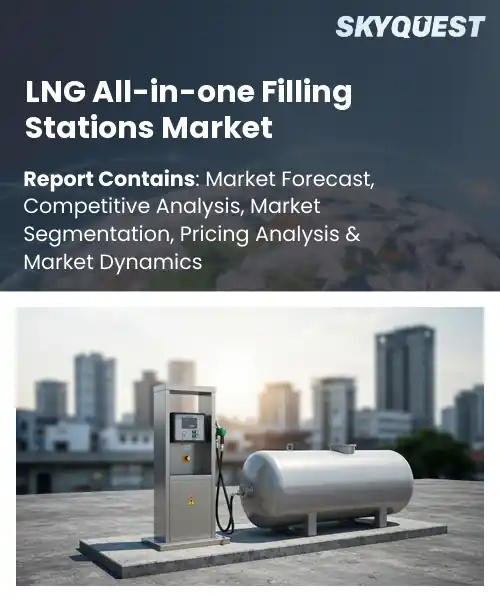
LNG All-in-one Filling Stations Market
Report ID: SQMIG55B2016
Report ID: SQMIG55B2016
[email protected]
USA +1 351-333-4748
Report ID:
SQMIG55B2016 |
Region:
Global |
Published Date: February, 2026
Pages:
157
|Tables:
118
|Figures:
77


Global LNG All-In-One Filling Stations Market size was valued at USD 1.20 Billion in 2024 and is poised to grow from USD 1.31 Billion in 2025 to USD 2.65 Billion by 2033, growing at a CAGR of 9.2% during the forecast period (2026-2033).
As stricter standards for emissions are implemented, the economic necessity of reducing operating costs for heavy-duty transportation and maritime operations becomes more pronounced. All-inclusive filling stations for LNG provide complete LNG functionalities (storage, vaporization, and dispensing) with CNG and/or bio-LNG options to enable fleets and vessels to make switching fuels possible, reducing the burden on fragmented infrastructure. The trend for the conversion of isolated pilot bunkering systems has moved to the creation of coordinated national highway and port networks, influenced by government regulation mandating sulfur cap reductions and CO2 emissions targets; examples include the significant expansion of bunkering operations. Consequently, increased investment into modular and scalable design concepts was generated.
The rapid growth of global LNG all-inclusive filling stations is primarily driven by modular design and corresponding regulations mandating incentives to reduce the risk associated with built stations and to promote potentially profitable returns on investment. Modular skid-mounted LNG filling stations are allowing operators to build LNG refueling stations along freight corridors, thereby establishing a high degree of confidence in the ability of fleets to use LNG as a viable fuel source.
How will IoT-enabled Monitoring Improve Operational Efficiency in the LNG All-in-one Filling Stations Market?
To modernize LNG stations using IoT technology for monitoring and dispensing natural gas, sensor technologies are put in place that allow operators to connect to real-time data (e.g., temperatures, pressure, flow rates of LNG and equipment health) via the Internet through telemetry systems. This helps improve technology to support predictive maintenance (through AI), allows for remote diagnostics, and automates alerts to help move operators from re-actively troubleshooting issues to pro-actively scheduling maintenance. With the current state of the LNG business, fleet operators/ports have been trending toward having automatic stations because they require fleet operators to maintain higher levels of uptime, safer fueling, and simpler compliance with regulations.
Market snapshot - 2026-2033
Global Market Size
USD 1.2 Billion
Largest Segment
LNG Filling Stations
Fastest Growth
LNG Filling Stations
Growth Rate
9.2% CAGR
To get more insights on this market click here to Request a Free Sample Report
The LNG all-in-one filling stations market is segmented into product type, application, end-user, distribution mode and region. Based on product type, the market is segmented into LNG filling stations and components. Based on application, the market is segmented into transportation, industrial, marine, and power generation. Based on end-user, the market is segmented into public transport, private fleet operators, shipping industry, power generation companies and heavy-duty vehicles. Based on distribution mode, the market is segmented into direct supply and retail distribution. Based on the region, the market is segmented into North America, Europe, Asia Pacific, Latin America, and Middle East & Africa.
As per LNG all-in-one filling stations market outlook, the LNG filling station segment is dominated due to being the one-stop source for an onsite fueling solution that provides an integrated solution for supply, storage, and dispensing; thus, meeting the operator’s needs. Customers prefer turnkey solutions to reduce the amount of coordination required to install and speed up the time to deployment, while investors put greater weight on proven and established end to end systems to provide predictable results over the long term. Investing projects with the same supplier provides a single source of purchasing and enables the company to focus on packaged station offerings.
As per LNG all-in-one filling stations market analysis, components are emerging as the fastest growing area because modular equipment and advanced control systems allow for retrofitting of existing stations and scaling of deployment without the need to build a full station. As manufacturers continue to improve valves, meters and cryogenic components, they are removing the barriers to installation thus providing fleets with the ability to expand their fueling capacity and creating aftermarket opportunities for service providers to enhance their product offerings and expedite market acceptance.
The heavy duty vehicles segment dominates in the market trends, due to the high volume of fuel used by these types of vehicles and being capital-intensive, allowing for an integrated fueling infrastructure to be built. Long-distance routes and routine fueling cycles provide predictable fuel throughput, so those who invest fully in fueling stations for this type of vehicle will have economic returns leading to huge returns on investment, as such there will be a concentration of demand at these fueling stations creating unique design requirements on fueling stations to support these unique vehicles as well as long-term purchasing agreements that affect technology selection and deployment approaches across the market.
As per LNG all-in-one filling stations market forecast, private fleet operators represent the fastest-growing segment of the end-user market for heavy-duty vehicles as their need to fuel at controlled locations and the need for predictability around routing create opportunities to install depot-based fueling stations. Such fleet operators prefer modular and lower footprint solutions that fit within their normal scheduled fleet maintenance cycles, which will ultimately lead to repeatable deployment models along with contracting opportunities that will increase available demand while at the same time attracting more specialized service providers to the industry.
To get detailed segments analysis, Request a Free Sample Report
Asia Pacific is the leading region of the world in terms of LNG (Liquefied Natural Gas) all-in-one filling stations. This region's success comes from a combination of many different demand drivers, industrial capabilities, and strategic maritime placements. There are multiple major economies in Asia Pacific that have dense clusters of manufacturing combined with extensive freight networks which support a lot of heavy-duty alternatives. This gives rise to the constant need for facilities that support the LNG fuel supply chain. The emphasis at the national level as well as at the corporate level is on diversification of fuels and investment in bunkering facilities as well as integrating the supply, storage, and dispensing of LNG.
Japan LNG All-in-one Filling Stations Market
As per LNG All-in-one filling stations market regional forecast, Japan market has established itself with strong technology leadership and a high level of coordination between manufacturers, ports, and energy companies. The market is supported by strict safety regulations and efforts to integrate the supply, storage, and dispensing of LNG with maritime bunkering and industry fuel requirements. The development of LNG filling stations in Japan is also supported by public-private partnerships and targeted infrastructure investments to enable pilot projects and commercial rollouts.
South Korea LNG All-in-one Filling Stations Market
LNG All-in-one filling stations market revenue in South Korea utilizes the advantages of the country's position as a leader in shipbuilding and a concentrated industrial base to facilitate the deployment of integrated fuel stations. There is a commitment on behalf of the government to invest in port facilities and there has been significant involvement by large conglomerates with interests in shipping, logistics, and energy in South Korea to advance the LNG fuel supply chain. This commitment to export-oriented infrastructure and the success of fleet conversion efforts provides a growing demand for reliable bunkering and refueling solutions for road transport.
Europe's expansion has been accelerated by extensive regulatory obligations that have been put in place to reduce the carbon intensity of transportation and maritime industries, as well as through an overarching strategy for developing infrastructure in a way that takes into consideration border-to-border connectivity. The existing institutional framework, as well as various environmental commitments at both the federal and regional levels, encourage fleet operators and shipping lines to switch to liquefied natural gas (LNG) as a transitional fuel and facilitate investment in a single station model that streamlines the supply and re-fueling process for users of the fuel.
Germany LNG All-in-one Filling Stations Market
The LNG all-in-one filling stations industry in Germany leverages strong logistics and energy company activity to facilitate and promote the implementation of LNG infrastructure in key freight corridors. The Germany market emphasis on progressive regulatory frameworks combined with a large industrial customer base that is seeking out alternatives to conventional fuels for large-scale freight transportation. The cooperative nature of partnerships between infrastructure developers and transportation companies assists in the development and implementation of integrated refueling solutions that support national decarbonization goals creating a steady demand for these stations, while at the same time allowing for continual improvements to the technical operation of the stations.
United Kingdom LNG All-in-one Filling Stations Market
Emerging LNG all-in-one filling stations in the UK have attracted investment, primarily through targeted investments into port bunkering and long-haul freight refueling. The growth within this market is a result of fleets recognizing the reduction of emissions from the maritime sector and having a willingness to trial LNG as a solution. Coordination of efforts between port authorities, energy providers, and logistics providers enables the deployment of all-in-one concepts servicing both the road and maritime sectors. Regulatory certainty and strategic demonstration projects provide operational experience and building confidence in the market.
France LNG All-in-one Filling Stations Market
As per LNG All-in-one filling stations market regional outlook, LNG All-in-one filling stations are seeing rapid growth in France due to government-supported initiatives promoting the use of alternative fuels as well as varied deployment programs across regions. The market includes transport operators and energy companies actively engaged with an emphasis on ensuring complete coverage along corridors and interoperability. A strong focus on environmental objectives and region-specific industrial need is driving the rollout of stations, while assisting in coordination among stakeholders for consistency in technical standards and considerations related to overall mobility and logistics strategies.
As per LNG all-in-one filling stations industry analysis, through the combination of the region’s access to energy resources such as natural gas, private sector investment, and logistical alignment, North America is enhancing its capabilities to support and improve supply chain security while leveraging existing freight corridors, intermodal terminals and downstream logistics programming to demonstrate applications for refueling with liquefied natural gas (LNG).
United States LNG All-in-one Filling Stations Market
Several factors have propelled the LNG all-in-one filling stations market growth in the United States; the expansive freight networks and growing demand from trucking and shipping companies for lower emissions fuels are driving businesses. Businesses that have invested in LNG facilities to create hub-and-spoke refueling systems and other types of new technology packaged with integrated station systems.
Canada LNG All-in-one Filling Stations Market
The LNG all-in-one filling stations market in Canada is developing in direct response to the need for infrastructure supporting regional energy hubs, maritime routes supporting the transport of goods into Canada and the northern states of the U.S. and other areas that generally require reliable infrastructures to support alternative fuel solutions for their respective logistics needs. Development of LNG filling stations is supported by a combination of provincial governmental initiatives and partnerships with First Nations communities and reflects a strong collaboration between all stakeholders involved to ensure each station is built according to the specific operating requirements of the region/area in which they will be located.
To know more about the market opportunities by region and country, click here to
Buy The Complete Report
Rising Demand for Cleaner Fuels
Government Incentives and Policies
High Capital Expenditure Requirements
Technical Standardization Challenges
Request Free Customization of this report to help us to meet your business objectives.
The global competition for LNG all-in-one filling stations is intensifying as both established companies and new entrants vie for LNG all-in-one filling stations market share through strategic acquisitions, offtake partnerships, and modular technologies. Recent examples include the emergence of small-scale liquefaction firms with venture capital backing, project financing, and offtake agreements from bio-LNG producers, and modular micro-LNG producers accelerating rapid filling station rollouts to meet regional heavy-duty trucking and marine transportation demand.
Infrastructure Network Expansion
Renewable Integration
SkyQuest’s ABIRAW (Advanced Business Intelligence, Research & Analysis Wing) is our Business Information Services team that Collects, Collates, Correlates, and Analyses the Data collected by means of Primary Exploratory Research backed by robust Secondary Desk research.
As per SkyQuest analysis, the global LNG all-in-one filling stations market is propelled by a key driver, stricter emissions regulations combined with the economic need to reduce fuel costs, while a second driver is the rise of modular station design supported by policy incentives that lower execution risk. A major restraint is the high capital expenditure required for integrated stations which can slow rollout. Asia Pacific is the dominating region due to strong industrial demand and port bunkering activity, and the LNG Filling Stations segment is the dominating segment as operators prefer turnkey end-to-end fueling solutions that accelerate deployment and ensure reliability.
| Report Metric | Details |
|---|---|
| Market size value in 2024 | USD 1.20 Billion |
| Market size value in 2033 | USD 2.65 Billion |
| Growth Rate | 9.2% |
| Base year | 2024 |
| Forecast period | 2026-2033 |
| Forecast Unit (Value) | USD Billion |
| Segments covered |
|
| Regions covered | North America (US, Canada), Europe (Germany, France, United Kingdom, Italy, Spain, Rest of Europe), Asia Pacific (China, India, Japan, Rest of Asia-Pacific), Latin America (Brazil, Rest of Latin America), Middle East & Africa (South Africa, GCC Countries, Rest of MEA) |
| Companies covered |
|
| Customization scope | Free report customization with purchase. Customization includes:-
|
To get a free trial access to our platform which is a one stop solution for all your data requirements for quicker decision making. This platform allows you to compare markets, competitors who are prominent in the market, and mega trends that are influencing the dynamics in the market. Also, get access to detailed SkyQuest exclusive matrix.
Table Of Content
Executive Summary
Market overview
Parent Market Analysis
Market overview
Market size
KEY MARKET INSIGHTS
COVID IMPACT
MARKET DYNAMICS & OUTLOOK
Market Size by Region
KEY COMPANY PROFILES
Methodology
For the LNG All-in-one Filling Stations Market, our research methodology involved a mixture of primary and secondary data sources. Key steps involved in the research process are listed below:
1. Information Procurement: This stage involved the procurement of Market data or related information via primary and secondary sources. The various secondary sources used included various company websites, annual reports, trade databases, and paid databases such as Hoover's, Bloomberg Business, Factiva, and Avention. Our team did 45 primary interactions Globally which included several stakeholders such as manufacturers, customers, key opinion leaders, etc. Overall, information procurement was one of the most extensive stages in our research process.
2. Information Analysis: This step involved triangulation of data through bottom-up and top-down approaches to estimate and validate the total size and future estimate of the LNG All-in-one Filling Stations Market.
3. Report Formulation: The final step entailed the placement of data points in appropriate Market spaces in an attempt to deduce viable conclusions.
4. Validation & Publishing: Validation is the most important step in the process. Validation & re-validation via an intricately designed process helped us finalize data points to be used for final calculations. The final Market estimates and forecasts were then aligned and sent to our panel of industry experts for validation of data. Once the validation was done the report was sent to our Quality Assurance team to ensure adherence to style guides, consistency & design.
Analyst Support
Customization Options
With the given market data, our dedicated team of analysts can offer you the following customization options are available for the LNG All-in-one Filling Stations Market:
Product Analysis: Product matrix, which offers a detailed comparison of the product portfolio of companies.
Regional Analysis: Further analysis of the LNG All-in-one Filling Stations Market for additional countries.
Competitive Analysis: Detailed analysis and profiling of additional Market players & comparative analysis of competitive products.
Go to Market Strategy: Find the high-growth channels to invest your marketing efforts and increase your customer base.
Innovation Mapping: Identify racial solutions and innovation, connected to deep ecosystems of innovators, start-ups, academics, and strategic partners.
Category Intelligence: Customized intelligence that is relevant to their supply Markets will enable them to make smarter sourcing decisions and improve their category management.
Public Company Transcript Analysis: To improve the investment performance by generating new alpha and making better-informed decisions.
Social Media Listening: To analyze the conversations and trends happening not just around your brand, but around your industry as a whole, and use those insights to make better Marketing decisions.
REQUEST FOR SAMPLE
 REQUEST FREE CUSTOMIZATION
Global Lng All-In-One Filling Stations Market size was valued at USD 1.2 Billion in 2024 and is poised to grow from USD 1.31 Billion in 2025 to USD 2.65 Billion by 2033, growing at a CAGR of 9.2% during the forecast period (2026-2033).
CIMC ENRIC, Chart Industries, Linde, Clean Energy Fuels, Cryeng Group, Cryonorm BV, Nikkiso Co., Kobe Steel, Sumitomo Precision Products Co., Incryo Systems, Cryogas Equipment Private Limited, Teyco Comercial SL, Kwangsan Co., Scandinavian Engineering Group, Honeywell, DNV GL, Air Products and Chemicals, Inc., Mitsubishi Heavy Industries, GE Oil & Gas, Siemens Energy
The key driver of the LNG All-in-one Filling Stations Market is the growing adoption of liquefied natural gas (LNG) as a clean and cost-effective alternative fuel for heavy-duty vehicles and commercial fleets. Increasing environmental regulations, rising demand for low-emission transport solutions, and government incentives for LNG infrastructure are significantly fueling market growth globally.
A key market trend in the LNG All‑in‑One Filling Stations Market is the rapid expansion of integrated LNG fueling infrastructure paired with multi‑energy services (e.g., LNG + CNG + electric). Operators are increasingly deploying modular, scalable filling station designs that support a broader range of heavy‑duty vehicles and fleets, enabling faster network rollout and improved customer access to clean fuel options.
Europe accounted for the largest share in the LNG All-in-One Filling Stations Market, driven by strict emission regulations, strong adoption of LNG for heavy-duty transport, and well-established LNG infrastructure in countries such as Germany, France, and the Netherlands. Government incentives and growing investments in clean energy transportation also support market growth in the region.


Want to customize this report? This report can be personalized according to your needs. Our analysts and industry experts will work directly with you to understand your requirements and provide you with customized data in a short amount of time. We offer $1000 worth of FREE customization at the time of purchase.
Feedback From Our Clients


 USA (+1) 351-333-4748

