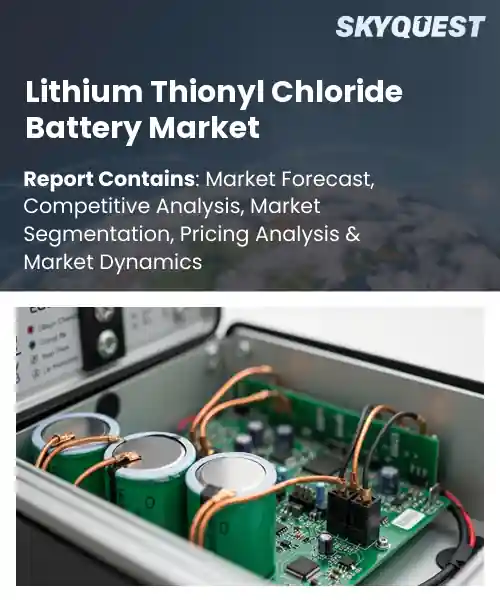
Lithium Thionyl Chloride Battery Market
Report ID: SQMIG20D2575
Report ID: SQMIG20D2575
[email protected]
USA +1 351-333-4748
Report ID:
SQMIG20D2575 |
Region:
Global |
Published Date: March, 2026
Pages:
157
|Tables:
116
|Figures:
77


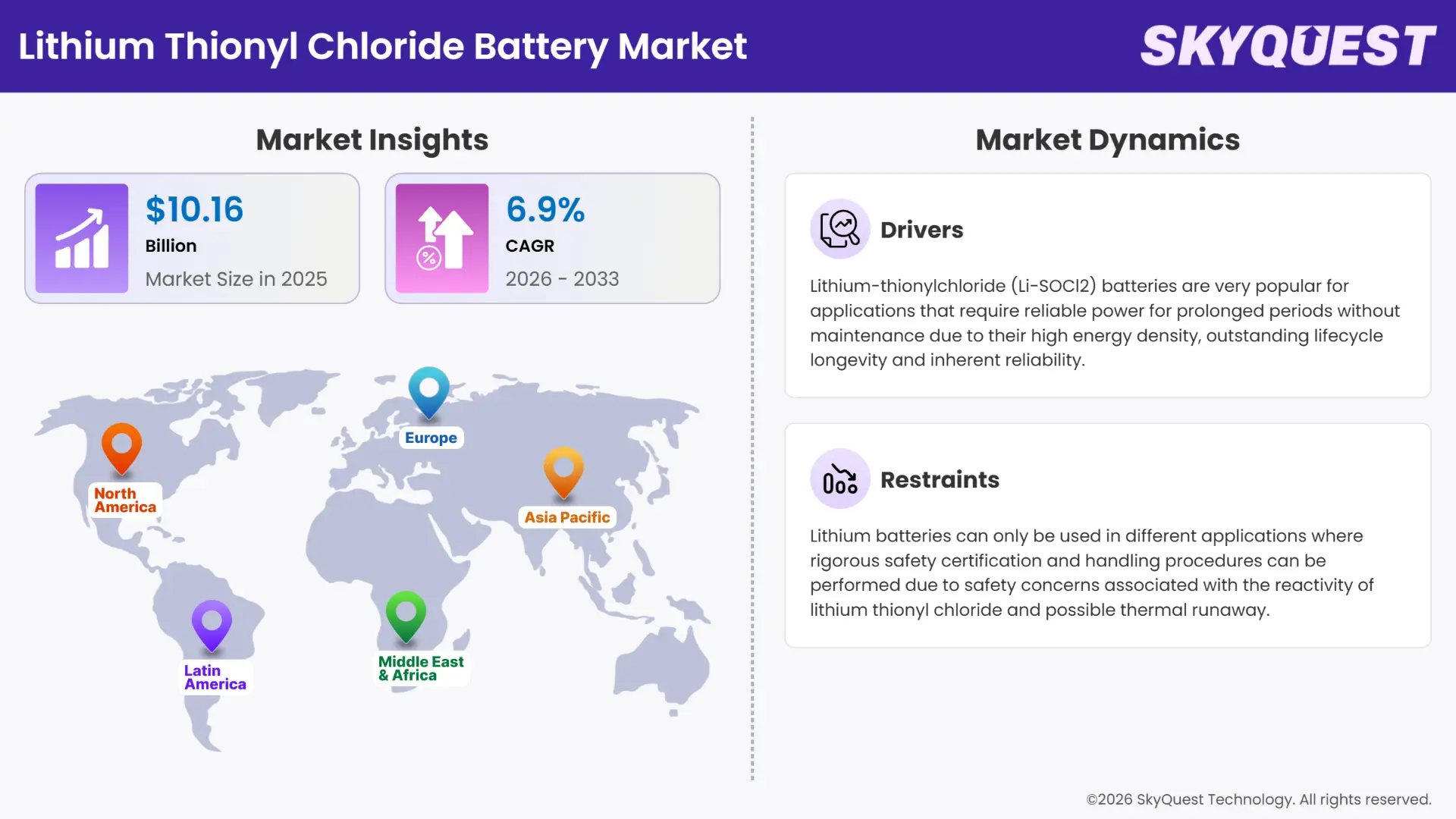
Global Lithium Thionyl Chloride Battery Market size was valued at USD 9.50 Billion in 2024 and is poised to grow from USD 10.16 Billion in 2025 to USD 17.32 Billion by 2033, growing at a CAGR of 6.9% during the forecast period (2026-2033).
Key Takeaways: Market Trends & Insights
The global lithium thionyl chloride battery industry is experiencing significant growth due to the chemistry's unique combination of high-energy density and long shelf life, providing devices that operate without supervision with reliable and long-lasting power supply. This market is comprised of primary (non-rechargeable) cylindrical and coin cell batteries that are used in smart metering, remote sensing, medical implants, and military applications and are therefore essential to both infrastructure and safety. Over the past 20 years, there has been a shift in demand from military applications to wider commercial use due to the rapidly expanding IoT and increasing demand for reduced maintenance costs, while advances in manufacturing and safety standards have improved performance and acceptability.
Regulatory requirements and growth of low-power wide-area networks have pushed utilities to implement battery-operated endpoints creating increased demand for lithium thionyl chloride batteries because of their long shelf life and low self-discharge, leading to lower total cost of ownership. Expanding production capacity to support the needs of smart metering and remote monitoring provides economies of scale that will lower pricing and facilitate adoption into adjacent verticals including oil and gas pipeline monitoring, wildlife tracking, and asset telemetry. Thus, creating opportunities for custom form factors and higher pulse-current power levels.
How is AI Enhancing Performance Forecasting in the Lithium Thionyl Chloride Battery Market?
In the lithium thionyl chloride battery market, performance forecasting focuses on predicting internal resistance rise, capacity loss, and end of practical life. Artificial intelligence (AI) enhances this by merging physical models (i.e., engineering-based and research-based), accelerated lab tests, and real-time field telemetry via digital twins that provide a realistic view of the degradation of lithium thionyl chloride batteries in a practical environment. Also, using machine learning simplifies the development of predictive models and makes it easier to create condition-based maintenance plans, and select good design options and develop more reliable supply chain plans. This is essential for long-lived IoT meters, remote sensors, and industrial systems where procurement and engineering decisions are based on systems uptime and predictability.
In February 2026, Tadiran Batteries published a new version of their technical brochure for lithium thionyl chloride cells and standardized performance data at the level of the cell. The documentation will contribute to the training of AI models and calibration of digital twins for accurate forecasting of the life cycle of lithium thionyl chloride cells and will allow for greater precision in forecasting field replacements and streamlining inventory, design and development.
To get more insights on this market click here to Request a Free Sample Report
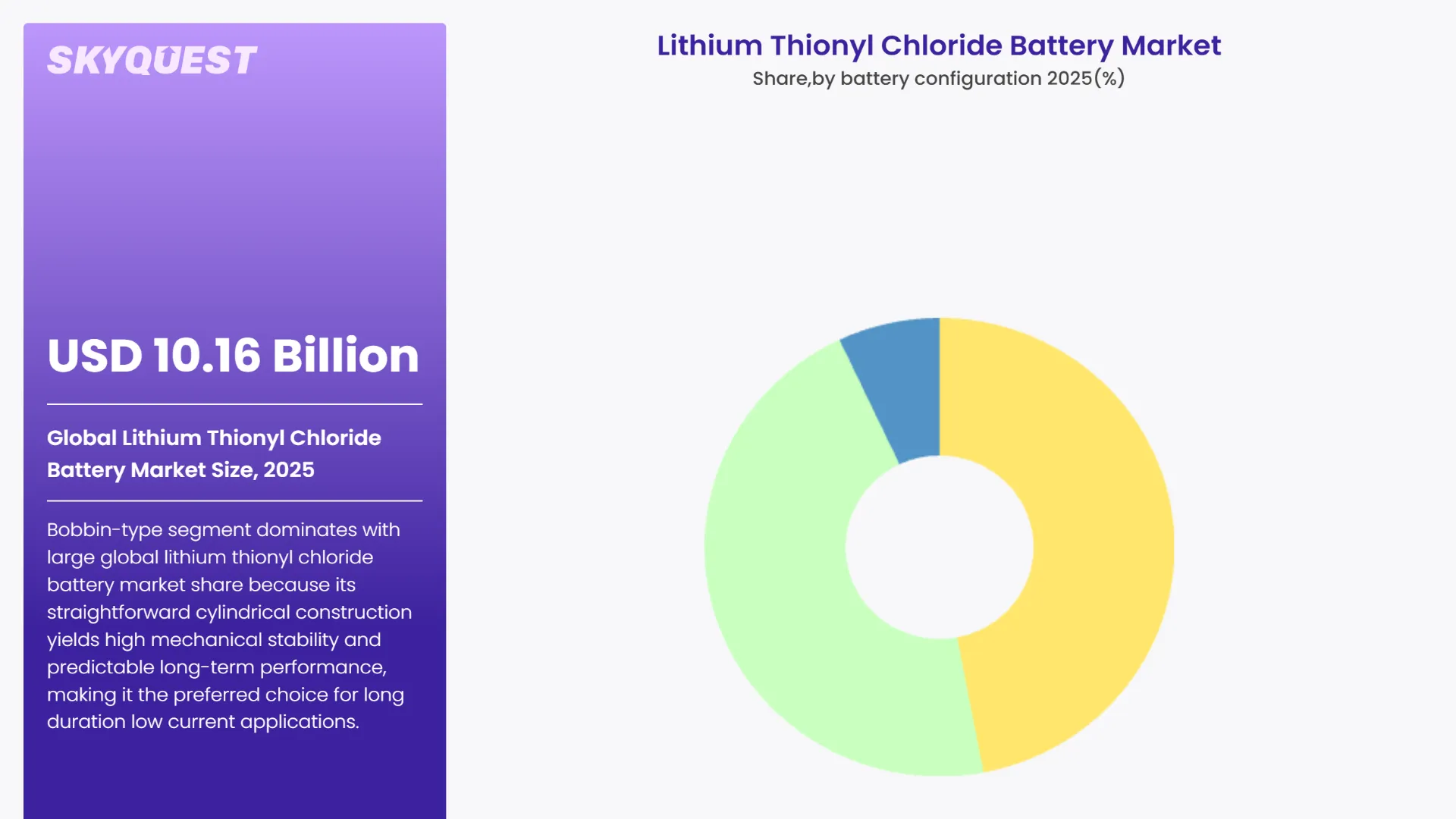
Global lithium thionyl chloride battery market is segmented into battery configuration, application vertical, temperature range focus, distribution channel and region. Based on battery configuration, the market is segmented into bobbin-type, spiral-type and battery packs & custom modules. Based on application vertical, the market is segmented into utility metering, industrial IoT & remote sensors, medical devices and military & aerospace. Based on temperature range focus, the market is segmented into standard industrial and high temperature optimized. Based on distribution channel, the market is segmented into OEM direct supply and specialized industrial distributors. Based on region, the market is segmented into North America, Europe, Asia Pacific, Latin America and Middle East & Africa.
Bobbin-type segment dominates with large global lithium thionyl chloride battery market share because its straightforward cylindrical construction yields high mechanical stability and predictable long-term performance, making it the preferred choice for long duration low current applications. Further, the reliability and efficiency with which bobbin cells can be qualified result in a significant reduction in the number of field failures and the amount of maintenance required. Thus making them the cell type that the majority of utilities and industrial customers use.
As per global lithium thionyl chloride battery market forecast, spiral type is witnessing the strongest growth momentum as higher energy density and better pulse capability enable compact advanced sensors and telemetry. Also, advances in the winding and sealing techniques used to manufacture spiral cells have resulted in improved performance and reliability under a wide range of operating conditions, which has further encouraged many original equipment manufacturers (OEMs) to be enthusiastic about using spiral cells in new product designs and has stimulated the development of new service and supply businesses.
As per global lithium thionyl chloride battery market analysis, OEM direct supply has established itself as the leading supplier to manufacturers of mission critical equipment because of direct partnerships with manufacturers for the design and qualification of lithium thionyl chloride cells. When OEMs work closely with their suppliers, they can customize their cell selection and develop modules integrated into each product. This leads to more predictable lifetimes and improved compatibility between components. Increased predictability in component lifetimes allows for the reliability of mission critical equipment.
As per global lithium thionyl chloride battery market outlook, specialized industrial distributors are emerging as the fastest growing channel by offering rapid fulfillment, flexible order sizes and technical inventory management for remote sensors and retrofit projects. However, due to the rapid growth and emergence of specialized industrial distributors as the fastest growing channel providing rapid fulfillment, flexible ordering and technical inventory management services for remote sensing devices and retrofit installation jobs, smaller OEM’s and installers will continue to grow and build their customer base through the partnerships. The value-added services that industrial distributors provide (such as kitting out the aftermarket) create a pathway for OEMs to reach new customers, increasing the utilization of product in various applications.
To get detailed segments analysis, Request a Free Sample Report
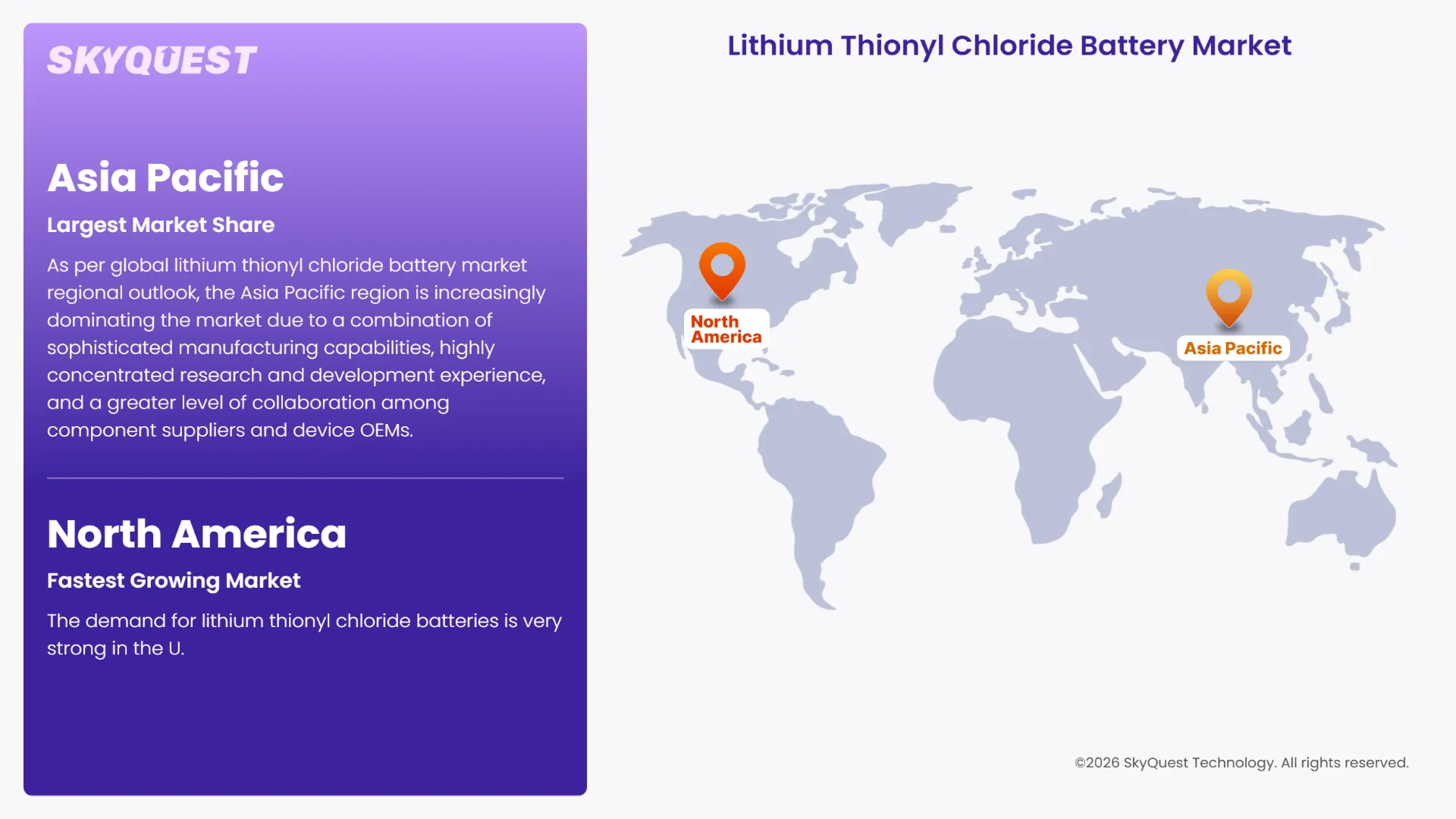
As per global lithium thionyl chloride battery market regional outlook, the Asia Pacific region is increasingly dominating the market due to a combination of sophisticated manufacturing capabilities, highly concentrated research and development experience, and a greater level of collaboration among component suppliers and device OEMs. Strong demand from industrial, telecom, and infrastructure markets, as well as well-established supply chains support the continued use of long-life, high-energy density battery technologies.
As per lithium thionyl chloride battery market regional analysis, Japan is benefiting from a well-established ecosystem in the electronics industry, with high-quality expectations and strong connections between academia and industry. Manufacturers are producing high-reliability and custom-built solutions for applications including industrial monitoring, medical devices, and military use. Suppliers in Japan place emphasis on following rigorous testing procedures and accurately tracing materials used, which builds confidence for OEMs. The collaboration between manufacturers on process optimisation and incremental innovation results in the production of high-end products that are then positioned in global export supply chains.
The lithium thionyl chloride battery market in South Korea is being driven by high demand from industry and advanced manufacturing techniques, as well as a focus on miniaturization and high reliability. South Korean manufacturers are working to develop batteries that can be integrated with telemetry and sensor-based platforms for remote energy monitoring and management. Close partnerships and collaborations between manufacturers in electronics, research institutions, and serial component suppliers allow for the efficient alignment of applications.
The global lithium thionyl chloride battery market growth of North America is driven by the rapid adoption of dependable, long-lasting energy sources across significant sectors i.e. critical infrastructure, industrial monitoring and remote sensing. Many companies requiring a stable, maintenance-free power source in harsh climates are increasingly interested in specialty chemistries that provide maximum energy density and shelf life.
The demand for lithium thionyl chloride batteries is very strong in the U.S. as they provide long-lasting, reliable power to critical infrastructure, oil and gas applications, and remote monitoring. Ongoing cooperation between manufacturers and system integrators to verify form factors and performance under extreme environmental conditions will continue to support future suppliers to market based on domestic qualification standards and the ongoing procurement of public-sector projects. The emphasis on supply chain security and working closely with service providers will enhance the rate of adoption.
The lithium thionyl chloride battery market in Canada is growing because of demand from utilities, natural resource exploration, and remote communication all of which require a long-term, reliable power source and very little maintenance. Local procurement/certification practices will continue to support manufacturers and systems integrators in their efforts to cooperate to customize their products based on site ruggedization requirements.
Through focusing on developing/standardizing batteries, like creating specific certification processes and collaborating with industries that want batteries tailored to meet their specific requirements, Europe is establishing itself. Europe has its strengths as it builds on its experience making very reliable products for endeavours such as transport, industrial automation, and providing solutions for defence all of which require products to perform robustly under heavy regulations. By working together (across countries) between battery manufacturers, research institutions & system integrators, there is a quicker way for products to be approved so they can fit into different procurement models successfully. Manufacturers creating transparency within their supply chains, allowing for traceability of components and safety for end-users, builds more confidence in the buyer's trust. More specifically, for applications (like batteries) banking major investments in specific tests and building product variability to meet markets where there are requirements for both customization, compliance and an established life performance, rather than just focusing on costs will enhance product competitiveness on a global scale.
The Germany lithium thionyl chloride battery market will continue with strong industrial engineering capabilities, require high-quality manufacturing standards and work closely with industry equipment suppliers. The Germany manufacturers (lithium thionyl chloride batteries) of the industry are specifically working on non-flammable, rugged, reliable and functioning commercial cells for the use in industrial automation, railway instrumentation and infrastructure monitoring. The quality of products manufactured in Germany is not solely based on projects/studies but rather through research-based and conservatively determined by rigorous testing, traceability of materials supply and application-based customization. The partnerships of manufacturers working with local integrators and the testing of those partnerships at lab facilities support the qualification of battery manufacturers as dependable power providers to firms.
As per lithium thionyl chloride battery industry analysis, United Kingdom is focused on telecommunications, defense, and remote monitoring, due to the requirement for a long service life and strict safety standards. Local producers are focused on customized cell formats and have demonstrated that their products can operate under extreme condition. Local companies work with research centers and system integrators to establish prototyping and qualification processes. A strong emphasis on traceability and aftercare provides purchasers and industry purchasers confidence in the sourcing of reliable, low maintenance power options.
The lithium thionyl chloride battery market trends in France is focused on manufacturing quality and working with research institutions to develop industrial sensing and transportation applications. Manufacturers in France tend to place a greater emphasis on robustness of the cells, traceability of materials, and compliance with local/regional safety regulations than those in the United Kingdom to meet demanding customer specifications. Working with system developers to create custom solutions for environmental monitoring and instrumentation markets has been a focus for many manufacturers within France. Adequate testing infrastructure and attention to product stewardship have also contributed to acceptance by commercial entities such as utilities and equipment manufacturers looking for reliable sources of power.
To know more about the market opportunities by region and country, click here to
Buy The Complete Report
High Energy Density Advantage
Expansion In Metering and IoT
Safety and Handling Concerns
Regulatory and Transport Constraints
Request Free Customization of this report to help us to meet your business objectives.
The lithium thionyl chloride battery industry is highly competitive due to increased demand for ultra-long-life, high-energy-density batteries for smart metering and industrial IoT, resulting in several active competitive strategies including minority stakes in competing manufacturers, targeted M&A activity and upgrades to product safety. Manufacturers are employing technology partnerships and innovation in cell components to gain utility and defense contracts; meanwhile, start-ups are developing technology that targets separators and power management systems for niche applications.
SkyQuest’s ABIRAW (Advanced Business Intelligence, Research & Analysis Wing) is our Business Information Services team that Collects, Collates, Correlates, and Analyses the Data collected by means of Primary Exploratory Research backed by robust Secondary Desk research.
As per SkyQuest analysis, the global lithium thionyl chloride battery industry is propelled by a key driver the chemistry’s high energy density and exceptional shelf life which enables long unattended deployments, while a restraint remains safety and regulatory constraints around handling and transport that limit some applications. The dominating region is Asia Pacific due to advanced manufacturing scale and strong demand from industrial and telecom sectors, and the dominating segment is bobbin-type cells favored for reliable, low current utility metering. A second driver is the rapid expansion of metering and Industrial IoT deployments that create steady demand for long life primary cells, encouraging product innovation and scaled production.
| Report Metric | Details |
|---|---|
| Market size value in 2024 | USD 9.50 Billion |
| Market size value in 2033 | USD 17.32 Billion |
| Growth Rate | 6.9% |
| Base year | 2024 |
| Forecast period | 2026-2033 |
| Forecast Unit (Value) | USD Billion |
| Segments covered |
|
| Regions covered | North America (US, Canada), Europe (Germany, France, United Kingdom, Italy, Spain, Rest of Europe), Asia Pacific (China, India, Japan, Rest of Asia-Pacific), Latin America (Brazil, Rest of Latin America), Middle East & Africa (South Africa, GCC Countries, Rest of MEA) |
| Companies covered |
|
| Customization scope | Free report customization with purchase. Customization includes:-
|
To get a free trial access to our platform which is a one stop solution for all your data requirements for quicker decision making. This platform allows you to compare markets, competitors who are prominent in the market, and mega trends that are influencing the dynamics in the market. Also, get access to detailed SkyQuest exclusive matrix.
Table Of Content
Executive Summary
Market overview
Parent Market Analysis
Market overview
Market size
KEY MARKET INSIGHTS
COVID IMPACT
MARKET DYNAMICS & OUTLOOK
Market Size by Region
KEY COMPANY PROFILES
Methodology
For the Lithium Thionyl Chloride Battery Market, our research methodology involved a mixture of primary and secondary data sources. Key steps involved in the research process are listed below:
1. Information Procurement: This stage involved the procurement of Market data or related information via primary and secondary sources. The various secondary sources used included various company websites, annual reports, trade databases, and paid databases such as Hoover's, Bloomberg Business, Factiva, and Avention. Our team did 45 primary interactions Globally which included several stakeholders such as manufacturers, customers, key opinion leaders, etc. Overall, information procurement was one of the most extensive stages in our research process.
2. Information Analysis: This step involved triangulation of data through bottom-up and top-down approaches to estimate and validate the total size and future estimate of the Lithium Thionyl Chloride Battery Market.
3. Report Formulation: The final step entailed the placement of data points in appropriate Market spaces in an attempt to deduce viable conclusions.
4. Validation & Publishing: Validation is the most important step in the process. Validation & re-validation via an intricately designed process helped us finalize data points to be used for final calculations. The final Market estimates and forecasts were then aligned and sent to our panel of industry experts for validation of data. Once the validation was done the report was sent to our Quality Assurance team to ensure adherence to style guides, consistency & design.
Analyst Support
Customization Options
With the given market data, our dedicated team of analysts can offer you the following customization options are available for the Lithium Thionyl Chloride Battery Market:
Product Analysis: Product matrix, which offers a detailed comparison of the product portfolio of companies.
Regional Analysis: Further analysis of the Lithium Thionyl Chloride Battery Market for additional countries.
Competitive Analysis: Detailed analysis and profiling of additional Market players & comparative analysis of competitive products.
Go to Market Strategy: Find the high-growth channels to invest your marketing efforts and increase your customer base.
Innovation Mapping: Identify racial solutions and innovation, connected to deep ecosystems of innovators, start-ups, academics, and strategic partners.
Category Intelligence: Customized intelligence that is relevant to their supply Markets will enable them to make smarter sourcing decisions and improve their category management.
Public Company Transcript Analysis: To improve the investment performance by generating new alpha and making better-informed decisions.
Social Media Listening: To analyze the conversations and trends happening not just around your brand, but around your industry as a whole, and use those insights to make better Marketing decisions.
REQUEST FOR SAMPLE
 REQUEST FREE CUSTOMIZATION
Global Lithium Thionyl Chloride Battery Market size was valued at USD 9.5 Billion in 2024 and is poised to grow from USD 10.16 Billion in 2025 to USD 17.32 Billion by 2033, growing at a CAGR of 6.9% during the forecast period (2026-2033).
Competition in the lithium thionyl chloride battery market is driven by demand from smart metering and industrial IoT for ultra long life and high energy density cells, prompting active competitive moves such as strategic minority investments, targeted M&A and product safety upgrades. Manufacturers demonstrate technology partnerships and component innovation to win utility and defense contracts, while startups push separator and power management advances to capture niche applications. 'Varta AG', 'Saft Groupe S.A.', 'EnerSys, Inc.', 'BYD Company Limited', 'KLIB Battery Co., Ltd.', 'A123 Systems LLC', 'Toshiba Corporation', 'Panasonic Corporation', 'Sion Power Corporation', 'Ultralife Corporation', 'FDK Corporation', 'Innovative Battery Solutions', 'EaglePicher Technologies, LLC', 'Lincad Ltd.', 'Magna International Inc.', 'Primus Power', 'Excell Battery Co.', 'CMBlu Energy AG', 'Imprint Energy', 'Blue Solutions S.A.'
High energy density and long shelf life make lithium thionyl chloride batteries particularly well suited for applications requiring reliable, long-term power without maintenance; this advantage encourages adoption in sectors such as utility metering, remote sensing, and security devices where battery replacement is costly or impractical. Manufacturers benefit from clear value propositions when promoting products that reduce total lifecycle support and downtime. As customers prioritize dependable, compact power solutions, demand for cells that offer concentrated energy storage and extended operational lifetimes grows, supporting broader market expansion.
Iot And Asset Tracking Growth: Demand from connected devices and remote sensors is accelerating adoption of long-life primary batteries that offer stable voltage and wide temperature tolerance. Manufacturers are adapting cell formats and packaging to meet lifecycle expectations for asset tracking, smart metering, and environmental monitoring while prioritizing low self-discharge and reliable performance in constrained form factors. Partnerships between battery makers and IoT solution providers are fostering integrated power solutions, enabling field deployments and reducing maintenance cycles for distributed operators focused on uptime and efficiency.
Asia Pacific Dominate the Global Lithium Thionyl Chloride Battery Market.
The Bobbin-type battery segment dominates the market due to its high energy density, low self-discharge rate, long operational life, and suitability for low-drain applications such as utility meters and environmental sensors.
AI is improving battery performance forecasting by using machine learning, digital twins, and predictive analytics to estimate capacity loss, internal resistance changes, and battery lifespan, helping optimize maintenance and inventory planning.
These batteries are widely used in smart metering, remote sensing, medical implants, military equipment, asset tracking systems, industrial automation, environmental monitoring, and oil & gas pipeline monitoring.


Want to customize this report? This report can be personalized according to your needs. Our analysts and industry experts will work directly with you to understand your requirements and provide you with customized data in a short amount of time. We offer $1000 worth of FREE customization at the time of purchase.
Feedback From Our Clients


 USA (+1) 351-333-4748

