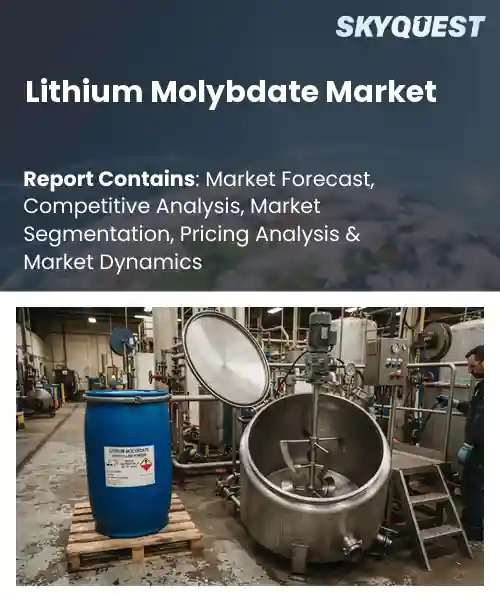
Lithium Molybdate Market
Report ID: SQMIG15E4524
Report ID: SQMIG15E4524
[email protected]
USA +1 351-333-4748
Report ID:
SQMIG15E4524 |
Region:
Global |
Published Date: November, 2026
Pages:
157
|Tables:
120
|Figures:
77


Global Lithium Molybdate Market size was valued at USD 165.0 Million in 2024 and is poised to grow from USD 174.57 Million in 2025 to USD 274.07 Million by 2033, growing at a CAGR of 5.8% during the forecast period (2026-2033).
Lithium molybdate (Li₂MoO₄) has emerged as a niche yet strategically significant material within the advanced ceramics and energy storage sectors, primarily because of its high ionic conductivity, thermal stability, and compatibility with solid‑state battery architectures. The market traces its origins to research labs in the early 2000s where the compound was identified as a promising solid electrolyte for next‑generation lithium‑ion batteries, offering lower interfacial resistance than conventional sulfide or oxide electrolytes. Over the past decade, commercial interest intensified as automakers and grid‑scale storage developers pursued safer, higher‑energy‑density solutions, prompting pilot production lines in Europe and East Asia. This evolution demonstrates how scientific discovery, coupled with mounting demand for safe high‑performance batteries, transformed lithium molybdate from a laboratory curiosity into an emerging commercial commodity.The next phase of market expansion hinges on the convergence of two key drivers: the scaling of solid‑state battery manufacturing and the rise of high‑temperature electrochemical applications such as aerospace power systems. As battery pack designers strive to replace liquid electrolytes, lithium molybdate’s ability to operate reliably at temperatures above 200 °C opens opportunities for aircraft, satellites, and deep‑well drilling equipment where conventional electrolytes fail. Companies that secure stable supply chains for high‑purity molybdenum oxides and invest in low‑cost synthesis methods are poised to capture a growing share of the market, as illustrated by a recent partnership between a Japanese battery maker and a Chinese chemical producer to co‑develop a roll‑to‑roll coating process. Consequently, the material’s unique performance attributes feed directly into expanding demand, creating a virtuous cycle where increased adoption spurs economies of scale, further reducing costs and encouraging broader implementation across multiple high‑value sectors.
How is AI-driven automation impacting the lithium molybdate market supply chain?
AI driven automation is reshaping the lithium molybdate supply chain by linking data insights with physical processes. Key aspects include predictive analytics that forecast demand, robotics that handle fragile powders, and real time quality monitoring that catches defects early. The market is moving from manual batch mixing to integrated digital factories, where AI schedules production runs and balances inventory across suppliers. Instances such as machine vision checking particle size and autonomous guided vehicles moving finished material illustrate how efficiency gains are becoming tangible. These advances lower lead times, improve consistency and make the supply chain more resilient to raw material fluctuations.In June 2024 a leading materials firm launched an AI driven pilot for lithium molybdate production, cutting cycle time and boosting yield, supporting market growth. The system integrates sensor data with machine learning to adjust synthesis parameters on the fly, reducing waste and ensuring consistent purity across batches, which strengthens supplier reliability and accelerates downstream battery manufacturing.
Market snapshot - (2026-2033)
Global Market Size
USD 165.0 Million
Largest Segment
Industrial Grade
Fastest Growth
Battery-Related Research Grade
Growth Rate
5.8% CAGR
To get more insights on this market click here to Request a Free Sample Report
Global lithium molybdate market is segmented by product grade, form, application, end-use industry and region. Based on product grade, the market is segmented into Industrial Grade, High-Purity Grade and Battery-Related Research Grade. Based on form, the market is segmented into Powder, Crystalline Form and Solution. Based on application, the market is segmented into Corrosion Inhibitors, Industrial Water Treatment, Battery & Electrochemical Research, Specialty Chemical Manufacturing and Other Applications. Based on end-use industry, the market is segmented into Chemicals, Energy & Batteries, Industrial Water Treatment and Other Industries. Based on region, the market is segmented into North America, Europe, Asia Pacific, Latin America and Middle East & Africa.
High-Purity Grade segment leads because its stringent impurity controls meet the exacting standards of emerging lithium‑ion and solid‑state cell chemistries. The ability to deliver consistent stoichiometry enhances electrochemical stability, reducing performance variability and enabling researchers to push voltage thresholds without detrimental side reactions. This reliability fuels its preference among R&D labs seeking reproducible results, reinforcing its central role in the market and accelerates technology transfer to pilot scale within industry ecosystems.
Meanwhile, Industrial Grade segment is witnessing the strongest growth momentum because manufacturers are scaling up cost‑effective lithium molybdate for bulk corrosion inhibitor formulations. Its lower purity requirements align with high‑volume industrial water treatment and chemical processing, where price sensitivity drives adoption. This expanding usage broadens market reach and fuels future demand.
Powder form segment dominates because its fine particle morphology enables homogeneous dispersion in aqueous matrices, which is critical for consistent performance in large‑scale water treatment plants. The solid state simplifies storage, transport, and handling while preserving chemical stability, reducing the risk of premature hydrolysis. These practical benefits align with operational efficiencies demanded by industry, making powder the preferred choice for bulk additives and reinforcing its market leadership across diverse process environments.
On the other hand, Solution form emerges as the most rapidly expanding area because it offers ready formulations that reduce preparation time for specialty chemical manufacturers. The liquid state enables precise dosing and integration with automated blending lines, appealing to high‑mixing throughput facilities. This convenience drives increased adoption, unlocking new application niches and propelling market expansion.
To get detailed segments analysis, Request a Free Sample Report
Asia Pacific leverages a combination of deep industrial expertise, strong demand from high‑tech manufacturing, and proactive policy frameworks that prioritize advanced materials. The region’s established electronics and automotive sectors create a consistent need for high‑performance lithium compounds, encouraging local producers to invest heavily in research and capacity expansion. Collaborative networks between manufacturers, academic institutions, and government agencies accelerate innovation cycles, ensuring that product specifications align closely with emerging application requirements. Moreover, the presence of major multinational corporations in Japan and South Korea amplifies supply chain integration, reinforcing the region’s ability to meet global demand efficiently while maintaining stringent quality standards.
Lithium Molybdate Market in Japan benefits from a legacy of precision engineering and a robust automotive component ecosystem that seeks reliable high‑temperature battery additives. Strong collaboration between chemical firms and research universities drives continuous improvement of material performance, while government incentives for green technology adoption further embed lithium molybdate in emerging energy storage solutions.
Lithium Molybdate Market in South Korea is propelled by a dynamic electronics manufacturing base and a focused national agenda on battery innovation. Close ties between conglomerates and specialty chemical producers facilitate rapid scaling of production capabilities, and strategic investments in next‑generation battery research ensure that lithium molybdate remains a key material in high‑efficiency energy storage applications.
Europe’s expansion is anchored by a firm commitment to sustainability, rigorous environmental regulations, and a thriving advanced manufacturing sector. The region’s emphasis on reducing carbon footprints has spurred interest in high‑performance battery materials that support longer life cycles and improved safety. Collaborative research initiatives across borders enhance knowledge sharing, while strong industrial clusters in Germany, the United Kingdom, and France provide a fertile ground for technology integration and market adoption. Policy frameworks that encourage circular economy practices also create incentives for incorporating lithium molybdate into recycling processes, further reinforcing its strategic relevance across a broad range of applications.
Lithium Molybdate Market in Germany is shaped by a powerful automotive engineering tradition and a proactive approach to renewable energy integration. Close collaboration between chemical manufacturers and vehicle makers drives the development of optimized lithium molybdate formulations, while stringent quality standards ensure reliable performance in demanding operational environments.
Lithium Molybdate Market in the United Kingdom benefits from a vigorous research ecosystem and a rapidly growing electric mobility sector. Partnerships between universities, startups, and established chemical firms accelerate the commercialization of innovative lithium molybdate solutions, positioning the market for swift adoption across diverse energy storage projects.
Lithium Molybdate Market in France is emerging alongside a strong emphasis on green technology and a supportive framework for industrial innovation. Collaborative efforts between national research institutes and specialty chemical producers foster the development of tailored lithium molybdate applications, enhancing its appeal in both automotive and grid‑scale storage contexts.
North America advances its market position through a blend of substantial investment in battery research, a broad base of high‑tech manufacturing, and an ecosystem that encourages rapid commercialization of new materials. The United States leads with expansive R&D programs and a vibrant venture capital environment that fuels the growth of specialty chemical firms focused on lithium compounds. Canada contributes with a strong emphasis on sustainable resource management and emerging expertise in clean energy technologies. The synergy between academic research, corporate innovation, and policy support creates a fertile landscape for lithium molybdate integration across a spectrum of applications, reinforcing the region’s strategic relevance in the global supply chain.
Lithium Molybdate Market in the United States is propelled by extensive collaboration between federal research laboratories and private sector innovators, fostering advanced material development for high‑energy storage. Strong emphasis on technology transfer and market readiness accelerates the adoption of lithium molybdate in cutting‑edge battery designs.
Lithium Molybdate Market in Canada is driven by a commitment to environmentally responsible manufacturing and growing expertise in clean energy solutions. Partnerships between natural resource stakeholders and specialty chemical producers support the refinement of lithium molybdate processes that align with national sustainability objectives.
To know more about the market opportunities by region and country, click here to
Buy The Complete Report
Increasing Demand for High‑Performance Batteries
Regulatory Support for Sustainable Materials
High Production Cost Challenges
Limited Long‑Term Stability Data
Request Free Customization of this report to help us to meet your business objectives.
The global lithium molybdate market is shaped by intense competition among key chemical producers who are accelerating M&A activity, forming strategic supply‑chain partnerships, and investing in advanced synthesis technologies to improve purity and reduce production costs. Recent joint ventures between major battery material firms and specialty chemical companies illustrate how collaborative innovation is becoming a primary market driver, while acquisitions of niche molybdate producers aim to secure raw‑material access and expand geographic reach.
Top Player’s Company Profile
Recent Developments
SkyQuest’s ABIRAW (Advanced Business Intelligence, Research & Analysis Wing) is our Business Information Services team that Collects, Collates, Correlates, and Analyses the Data collected by means of Primary Exploratory Research backed by robust Secondary Desk research. As per SkyQuest analysis, the global lithium molybdate market is being propelled primarily by the surging demand for high‑performance batteries in electric vehicles and grid‑scale storage, while regulatory incentives that favor sustainable, low‑toxicity materials provide a second boost. The most significant restraint remains the high production cost associated with energy‑intensive synthesis, which can deter price‑sensitive users. Asia Pacific dominates the market thanks to its strong industrial base and aggressive material‑innovation policies, and the industrial‑grade powder segment holds the largest share because its cost‑effective formulation meets bulk requirements in corrosion inhibition and water‑treatment applications. Together these forces shape market momentum through 2033.
| Report Metric | Details |
|---|---|
| Market size value in 2024 | USD 165.0 Million |
| Market size value in 2033 | USD 274.07 Million |
| Growth Rate | 5.8% |
| Base year | 2024 |
| Forecast period | (2026-2033) |
| Forecast Unit (Value) | USD Million |
| Segments covered |
|
| Regions covered | North America (US, Canada), Europe (Germany, France, United Kingdom, Italy, Spain, Rest of Europe), Asia Pacific (China, India, Japan, Rest of Asia-Pacific), Latin America (Brazil, Rest of Latin America), Middle East & Africa (South Africa, GCC Countries, Rest of MEA) |
| Companies covered |
|
| Customization scope | Free report customization with purchase. Customization includes:-
|
To get a free trial access to our platform which is a one stop solution for all your data requirements for quicker decision making. This platform allows you to compare markets, competitors who are prominent in the market, and mega trends that are influencing the dynamics in the market. Also, get access to detailed SkyQuest exclusive matrix.
Table Of Content
Executive Summary
Market overview
Parent Market Analysis
Market overview
Market size
KEY MARKET INSIGHTS
COVID IMPACT
MARKET DYNAMICS & OUTLOOK
Market Size by Region
KEY COMPANY PROFILES
Methodology
For the Lithium Molybdate Market, our research methodology involved a mixture of primary and secondary data sources. Key steps involved in the research process are listed below:
1. Information Procurement: This stage involved the procurement of Market data or related information via primary and secondary sources. The various secondary sources used included various company websites, annual reports, trade databases, and paid databases such as Hoover's, Bloomberg Business, Factiva, and Avention. Our team did 45 primary interactions Globally which included several stakeholders such as manufacturers, customers, key opinion leaders, etc. Overall, information procurement was one of the most extensive stages in our research process.
2. Information Analysis: This step involved triangulation of data through bottom-up and top-down approaches to estimate and validate the total size and future estimate of the Lithium Molybdate Market.
3. Report Formulation: The final step entailed the placement of data points in appropriate Market spaces in an attempt to deduce viable conclusions.
4. Validation & Publishing: Validation is the most important step in the process. Validation & re-validation via an intricately designed process helped us finalize data points to be used for final calculations. The final Market estimates and forecasts were then aligned and sent to our panel of industry experts for validation of data. Once the validation was done the report was sent to our Quality Assurance team to ensure adherence to style guides, consistency & design.
Analyst Support
Customization Options
With the given market data, our dedicated team of analysts can offer you the following customization options are available for the Lithium Molybdate Market:
Product Analysis: Product matrix, which offers a detailed comparison of the product portfolio of companies.
Regional Analysis: Further analysis of the Lithium Molybdate Market for additional countries.
Competitive Analysis: Detailed analysis and profiling of additional Market players & comparative analysis of competitive products.
Go to Market Strategy: Find the high-growth channels to invest your marketing efforts and increase your customer base.
Innovation Mapping: Identify racial solutions and innovation, connected to deep ecosystems of innovators, start-ups, academics, and strategic partners.
Category Intelligence: Customized intelligence that is relevant to their supply Markets will enable them to make smarter sourcing decisions and improve their category management.
Public Company Transcript Analysis: To improve the investment performance by generating new alpha and making better-informed decisions.
Social Media Listening: To analyze the conversations and trends happening not just around your brand, but around your industry as a whole, and use those insights to make better Marketing decisions.
REQUEST FOR SAMPLE
 REQUEST FREE CUSTOMIZATION


Want to customize this report? This report can be personalized according to your needs. Our analysts and industry experts will work directly with you to understand your requirements and provide you with customized data in a short amount of time. We offer $1000 worth of FREE customization at the time of purchase.
Feedback From Our Clients


 USA (+1) 351-333-4748

