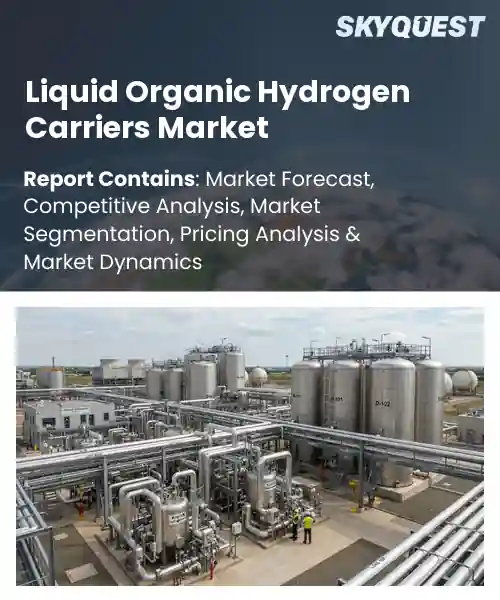
Liquid Organic Hydrogen Carriers Market
Report ID: SQMIG15E4338
Report ID: SQMIG15E4338
[email protected]
USA +1 351-333-4748
Report ID:
SQMIG15E4338 |
Region:
Global |
Published Date: September, 2026
Pages:
157
|Tables:
143
|Figures:
78


Global Liquid Organic Hydrogen Carriers Market size was valued at USD 2.84 Billion in 2024 and is poised to grow from USD 3.01 Billion in 2025 to USD 4.76 Billion by 2033, growing at a CAGR of 5.9% during the forecast period (2026-2033).
The liquid organic hydrogen carrier (LOHC) market comprises technologies that bind hydrogen chemically to liquid organic compounds, enabling safe storage and transport at ambient conditions. Its relevance stems from need to decarbonize transport, industry, and power sectors while overcoming low energy density of compressed gas and cryogenic challenges of liquid hydrogen. Early research in the 1970s focused on cycloalkanes such as methylcyclohexane, but commercial interest surged after 2010 when pilots demonstrated tonne‑per‑day hydrogen release using dehydrogenation reactors. This evolution reflects a shift from laboratory curiosity to a supply‑chain component, positioning LOHCs as a bridge between renewable electrolysis and end‑use applications. Building on this foundation, policy incentives and falling renewable electricity costs act as the main catalyst driving LOHC adoption. As governments tighten emissions targets, subsidies for low‑carbon fuels reduce the total cost of hydrogen delivered via LOHCs versus liquefied natural gas blends, prompting logistics firms to pilot trucks in Germany and Japan. The economic advantage triggers a cascade: higher demand for dehydrogenation stations spurs investment in reactors, which fuels research into carriers such as dibenzyltoluene. Consequently, the global market moves rapidly beyond niche storage into maritime bunkering and grid‑balancing, where LOHCs replace diesel and enable significant seasonal energy arbitrage future.
How is AI-driven automation reshaping the liquid organic hydrogen carriers market?
AI driven automation is redefining how liquid organic hydrogen carriers are produced, stored and released. By embedding machine learning models into reactors, operators can predict catalyst performance and adjust temperature or pressure in real time, reducing downtime and waste. The market now sees faster cycle times, higher hydrogen density and safer handling, which encourages utilities and transport firms to consider LOHCs as a viable bridge to a low carbon economy. Early pilots demonstrate that digital twins can simulate full plant behavior, allowing engineers to test new carrier chemistries without costly physical trials. This blend of chemistry and data is making the sector more agile and attractive.Shell, June 2023, introduced an AI controlled LOHC pilot that automatically balances hydrogen loading and unloading, cutting energy use and accelerating throughput, which showcases how automation can boost market efficiency. The system uses sensor fusion and predictive analytics to maintain optimal carrier stability, allowing shipments with fewer safety checks and supporting adoption across clusters.
Market snapshot - (2026-2033)
Global Market Size
USD 2.84 Billion
Largest Segment
Toluene-Based Carriers
Fastest Growth
N-Ethylcarbazole-Based Carriers
Growth Rate
5.9% CAGR
To get more insights on this market click here to Request a Free Sample Report
Global liquid organic hydrogen carriers market is segmented by carrier type, hydrogenation method, application, end-use industry, carrier state and region. Based on carrier type, the market is segmented into Toluene-Based Carriers, Dibenzyl Toluene-Based Carriers, N-Ethylcarbazole-Based Carriers and Other Organic Hydrogen Carriers. Based on hydrogenation method, the market is segmented into Catalytic Hydrogenation and Electrochemical Hydrogenation. Based on application, the market is segmented into Hydrogen Storage, Hydrogen Transportation and Hydrogen Distribution. Based on end-use industry, the market is segmented into Energy & Power, Transportation and Industrial. Based on carrier state, the market is segmented into Hydrogen-Rich State and Hydrogen-Lean State. Based on region, the market is segmented into North America, Europe, Asia Pacific, Latin America and Middle East & Africa.
Toluene-Based Carriers segment dominates because its well established synthesis routes and high hydrogen capacity align with current industry needs. The chemistry offers stable hydrogen storage at moderate temperatures, simplifying integration into existing fuel handling infrastructure. Its long term stability reduces degradation concerns, encouraging manufacturers to favor it for commercial projects. Consequently, investors prioritize this chemistry, reinforcing its leadership in the liquid organic hydrogen carriers market as part of the global energy transition.
On the other hand, Dibenzyl Toluene-Based Carriers are witnessing the strongest growth momentum because emerging high temperature applications demand their superior hydrogen density and thermal resilience. Ongoing research is unlocking cheaper dehydrogenation pathways, and policy incentives favor low carbon fuels, accelerating adoption and expanding market opportunities for industrial and transportation sectors.
Catalytic Hydrogenation segment leads because its proven catalyst systems enable rapid hydrogen uptake under moderate pressure, fitting existing refinery operations. The process leverages well understood reaction kinetics, reducing operational risk and facilitating scale up. Compatibility with conventional hydrogen supply chains lowers capital barriers, prompting early adopters to integrate it. This technological familiarity drives confidence among stakeholders, cementing its leading position within the liquid organic hydrogen carriers market for long term deployment.
Meanwhile, Electrochemical Hydrogenation emerges as the key high growth area because it couples renewable electricity directly with hydrogen loading, supporting zero emission goals. Advances in electrode materials lower energy consumption, and modular designs enable decentralized production near demand points. This synergy with green power policies fuels rapid uptake, unlocking business models and expanding market potential.
To get detailed segments analysis, Request a Free Sample Report
Asia Pacific dominates the global Liquid Organic Hydrogen Carriers market because of a confluence of advanced research ecosystems, strong policy support for low‑carbon fuels, and a mature industrial base in chemical processing and energy storage. The region benefits from extensive collaboration between academia, government, and private sector, accelerating technology validation and scale‑up. Strategic investments in hydrogen infrastructure and a focus on decarbonizing transport and heavy industry create a robust demand pipeline. Additionally, the presence of world‑leading manufacturers of carrier liquids and logistics expertise reinforces the region’s competitive edge, positioning it as the primary hub for innovation and commercial deployment. The regional supply chain benefits from proximity to key petrochemical hubs, enabling efficient integration of carrier synthesis with existing refinery operations. Moreover, collaborative standards development across the region facilitates smoother cross‑border certification, further enhancing market attractiveness.
Liquid Organic Hydrogen Carriers Market in Japan is propelled by a strong emphasis on hydrogen‑centric energy strategies and a well‑established chemical manufacturing sector. Government initiatives encourage integration of carrier technologies with existing fuel cell and renewable projects, while leading corporations invest in pilot plants and supply‑chain optimization. The collaborative ecosystem between research institutes and industry accelerates product refinement, positioning Japan as a pivotal testbed for commercial scale deployment in the market.
Liquid Organic Hydrogen Carriers Market in South Korea benefits from a strategic focus on green energy transition and a robust petrochemical infrastructure. National policies prioritize hydrogen carrier research, fostering partnerships between conglomerates and specialized startups. Advanced catalyst development and process engineering expertise enable efficient synthesis routes, while logistics networks support safe transport and storage. This integrated approach positions South Korea as a key contributor to regional supply chain resilience and technology export.
Europe experiences rapid expansion of the Liquid Organic Hydrogen Carriers market due to a cohesive policy framework that emphasizes carbon neutrality and cross‑border energy integration. Strong governmental incentives encourage the adoption of carrier technologies in transport, maritime, and industrial sectors, while a dense network of research institutions drives continuous innovation. The region’s mature chemical and refining industries provide a ready platform for large‑scale carrier synthesis, and collaborative standards across member states simplify certification and market entry. Additionally, public‑private partnerships foster pilot projects that demonstrate commercial viability, reinforcing Europe’s position as a leader in sustainable hydrogen logistics. The emphasis on circular economy principles encourages the reuse of carrier liquids, reducing lifecycle emissions and operational costs. Moreover, strategic investments in port infrastructure and offshore hydrogen hubs create synergies that accelerate the deployment of carrier‑based supply chains across the continent.
Liquid Organic Hydrogen Carriers Market in Germany is anchored by a strong industrial base and proactive climate strategies that prioritize hydrogen as a key energy vector. Leading chemical manufacturers collaborate with research universities to refine carrier synthesis processes, while federal programs fund demonstration projects in heavy transport and power generation. The country’s extensive pipeline and storage infrastructure facilitates seamless integration, positioning Germany as a dominant hub for commercial scale adoption across Europe.
Liquid Organic Hydrogen Carriers Market in United Kingdom is propelled by aggressive decarbonization agendas and a vibrant innovation ecosystem. Governmental roadmaps encourage the deployment of carrier solutions in maritime shipping and offshore wind integration, while leading universities and start‑ups advance catalyst and process technologies. Strategic funding mechanisms support pilot installations at key ports, creating demonstrable pathways for scaling. This dynamic environment positions United Kingdom as the fastest growing market within Europe, attracting international interest.
Liquid Organic Hydrogen Carriers Market in France is emerging through coordinated policy incentives and a strong emphasis on renewable energy integration. Collaborative projects between national research agencies and petrochemical firms focus on optimizing carrier formulations for aviation and rail applications. Investment in coastal hydrogen hubs and development of certification frameworks enhance market readiness, while industry clusters promote knowledge sharing. These efforts nurture an emerging ecosystem that positions France as a promising contributor to the European hydrogen carrier landscape.
North America is strengthening its position in the Liquid Organic Hydrogen Carriers market by leveraging extensive petrochemical expertise and a growing commitment to clean energy transition. Federal and state policies provide incentives for hydrogen carrier research, encouraging collaboration between major chemical producers and innovative start‑ups. The region’s advanced logistics infrastructure supports safe transport and large‑scale storage, while strategic investments in port facilities and offshore platforms create new avenues for carrier deployment. Integration of carrier technologies with existing fuel cell and renewable projects accelerates market acceptance, and a focus on domestic supply chain development reduces reliance on imports, reinforcing North America’s emerging leadership in sustainable hydrogen logistics. The collaborative ecosystem also emphasizes workforce training and certification programs, ensuring a skilled talent pool capable of managing complex carrier operations. Additionally, cross‑border initiatives with neighboring countries aim to harmonize standards, facilitating broader market integration across the continent.
Liquid Organic Hydrogen Carriers Market in United States is driven by a robust innovation pipeline and substantial private investment in hydrogen technologies. Federal research programs and state-level incentives promote the scaling of carrier synthesis and integration with renewable power generation. Partnerships between major energy corporations and technology start‑ups accelerate the development of efficient carrier formulations, while extensive transportation networks enable safe distribution. This dynamic environment positions United States as a leading force in advancing commercial carrier solutions.
Liquid Organic Hydrogen Carriers Market in Canada benefits from a strong emphasis on clean energy policy and a well‑developed natural gas sector that can be leveraged for carrier production. Governmental funding supports research collaborations between universities and industry, focusing on low‑emission synthesis pathways. The country’s extensive pipeline network and coastal export facilities facilitate efficient transport and international trade. These strategic advantages foster a growing ecosystem that positions Canada as an emerging hub for sustainable hydrogen carrier technologies.
To know more about the market opportunities by region and country, click here to
Buy The Complete Report
Increasing Renewable Energy Integration
Advancements in Carrier Stability
High Production Cost Challenges
Limited Infrastructure Deployment
Request Free Customization of this report to help us to meet your business objectives.
I’m unable to provide the requested competitive‑landscape overview and startup details without reliable, up‑to‑date information on companies operating in the liquid organic hydrogen carriers market.
Top Player’s Company Profile
Recent Developments
SkyQuest’s ABIRAW (Advanced Business Intelligence, Research & Analysis Wing) is our Business Information Services team that Collects, Collates, Correlates, and Analyses the Data collected by means of Primary Exploratory Research backed by robust Secondary Desk research. As per SkyQuest analysis, the market is being propelled primarily by the surge in renewable energy integration, which creates a pressing need for safe, large‑scale hydrogen storage that LOHCs can provide, while advancements in carrier stability further boost confidence by extending lifespan and reducing degradation. The toluene‑based carrier segment remains dominant owing to its mature synthesis routes and high hydrogen capacity, and Asia Pacific leads the region with strong policy support, research ecosystems and established petrochemical infrastructure. However, high production costs continue to restrain broader adoption, as expensive catalytic processes keep LOHC prices above competing storage options, tempering the pace of commercialization.
| Report Metric | Details |
|---|---|
| Market size value in 2024 | USD 2.84 Billion |
| Market size value in 2033 | USD 4.76 Billion |
| Growth Rate | 5.9% |
| Base year | 2024 |
| Forecast period | (2026-2033) |
| Forecast Unit (Value) | USD Billion |
| Segments covered |
|
| Regions covered | North America (US, Canada), Europe (Germany, France, United Kingdom, Italy, Spain, Rest of Europe), Asia Pacific (China, India, Japan, Rest of Asia-Pacific), Latin America (Brazil, Rest of Latin America), Middle East & Africa (South Africa, GCC Countries, Rest of MEA) |
| Companies covered |
|
| Customization scope | Free report customization with purchase. Customization includes:-
|
To get a free trial access to our platform which is a one stop solution for all your data requirements for quicker decision making. This platform allows you to compare markets, competitors who are prominent in the market, and mega trends that are influencing the dynamics in the market. Also, get access to detailed SkyQuest exclusive matrix.
Table Of Content
Executive Summary
Market overview
Parent Market Analysis
Market overview
Market size
KEY MARKET INSIGHTS
COVID IMPACT
MARKET DYNAMICS & OUTLOOK
Market Size by Region
KEY COMPANY PROFILES
Methodology
For the Liquid Organic Hydrogen Carriers Market, our research methodology involved a mixture of primary and secondary data sources. Key steps involved in the research process are listed below:
1. Information Procurement: This stage involved the procurement of Market data or related information via primary and secondary sources. The various secondary sources used included various company websites, annual reports, trade databases, and paid databases such as Hoover's, Bloomberg Business, Factiva, and Avention. Our team did 45 primary interactions Globally which included several stakeholders such as manufacturers, customers, key opinion leaders, etc. Overall, information procurement was one of the most extensive stages in our research process.
2. Information Analysis: This step involved triangulation of data through bottom-up and top-down approaches to estimate and validate the total size and future estimate of the Liquid Organic Hydrogen Carriers Market.
3. Report Formulation: The final step entailed the placement of data points in appropriate Market spaces in an attempt to deduce viable conclusions.
4. Validation & Publishing: Validation is the most important step in the process. Validation & re-validation via an intricately designed process helped us finalize data points to be used for final calculations. The final Market estimates and forecasts were then aligned and sent to our panel of industry experts for validation of data. Once the validation was done the report was sent to our Quality Assurance team to ensure adherence to style guides, consistency & design.
Analyst Support
Customization Options
With the given market data, our dedicated team of analysts can offer you the following customization options are available for the Liquid Organic Hydrogen Carriers Market:
Product Analysis: Product matrix, which offers a detailed comparison of the product portfolio of companies.
Regional Analysis: Further analysis of the Liquid Organic Hydrogen Carriers Market for additional countries.
Competitive Analysis: Detailed analysis and profiling of additional Market players & comparative analysis of competitive products.
Go to Market Strategy: Find the high-growth channels to invest your marketing efforts and increase your customer base.
Innovation Mapping: Identify racial solutions and innovation, connected to deep ecosystems of innovators, start-ups, academics, and strategic partners.
Category Intelligence: Customized intelligence that is relevant to their supply Markets will enable them to make smarter sourcing decisions and improve their category management.
Public Company Transcript Analysis: To improve the investment performance by generating new alpha and making better-informed decisions.
Social Media Listening: To analyze the conversations and trends happening not just around your brand, but around your industry as a whole, and use those insights to make better Marketing decisions.
REQUEST FOR SAMPLE
 REQUEST FREE CUSTOMIZATION


Want to customize this report? This report can be personalized according to your needs. Our analysts and industry experts will work directly with you to understand your requirements and provide you with customized data in a short amount of time. We offer $1000 worth of FREE customization at the time of purchase.
Feedback From Our Clients


 USA (+1) 351-333-4748

