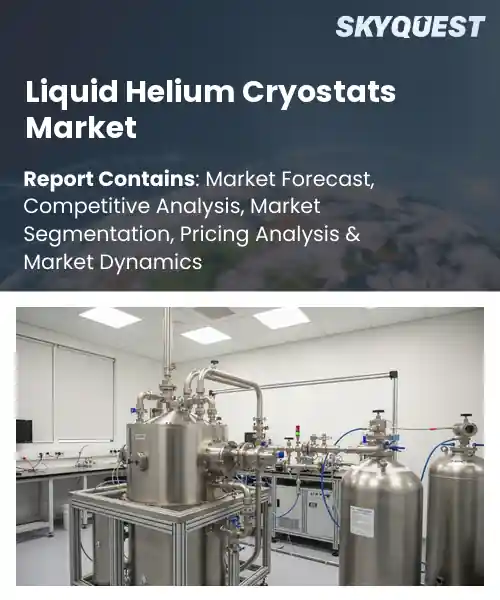
Liquid Helium Cryostats Market
Report ID: SQMIG45J2785
Report ID: SQMIG45J2785
[email protected]
USA +1 351-333-4748
Report ID:
SQMIG45J2785 |
Region:
Global |
Published Date: August, 2026
Pages:
157
|Tables:
124
|Figures:
77


Global Liquid Helium Cryostats Market size was valued at USD 1.28 Billion in 2024 and is poised to grow from USD 1.39 Billion in 2025 to USD 2.69 Billion by 2033, growing at a CAGR of 8.6% during the forecast period (2026-2033).
The global liquid‑helium cryostat market supplies the ultra‑low‑temperature vessels that enable superconducting magnets, quantum‑computing chips, and particle‑physics detectors to operate. Its importance stems from the unique ability of liquid helium to reach temperatures near absolute zero, a prerequisite for maintaining quantum coherence and magnetic field stability. Historically, the market emerged in the 1960s alongside the first superconducting MRI scanners, expanded during the 1990s with high‑energy physics laboratories, and accelerated in the 2010s as quantum‑information research demanded cooling platforms. Consequently, demand has shifted from niche scientific installations toward commercial semiconductor fabs and aerospace testing facilities, driving volume growth and product diversification.
The adoption of quantum‑computing hardware represents the key trend driving the global liquid helium cryostats sector expansion, because each qubit array requires a cryogenic environment that only liquid‑helium cryostats can provide. Companies such as IBM and Google have announced quantum processors that rely on modular cryostats, prompting manufacturers to invest in lower‑boil‑off designs. This pressure creates opportunities for suppliers to offer temperature‑control software, refill cycles, and hybrid systems that combine cryocoolers with helium recondenser loops, thereby reducing operating costs for data‑center operators. As a result, capital expenditures rise while cost of ownership declines, encouraging commercialization of quantum services across finance, drug discovery, and climate modeling sectors.
How is AI-Driven Automation Improving Performance in the Liquid Helium Cryostats Market?
AI-driven automation is reshaping liquid helium cryostats by integrating smart sensors, predictive algorithms, and robotic control loops. These technologies continuously monitor temperature gradients, pressure stability, and coolant flow, allowing systems to self‑adjust in real time and reduce human intervention. The market now sees tighter thermal regulation, longer hold times, and lower helium consumption, which are critical for high‑precision research and quantum computing applications. Manufacturers are embedding machine‑learning models that anticipate drift and trigger corrective actions before performance degrades, making cryostats more reliable and easier to operate. This shift not only shortens setup cycles but also expands the appeal of cryogenic solutions to laboratories that previously lacked specialized expertise.
In June 2025, Snowcap Compute raised $23 million to develop superconducting AI chips designed for significantly higher performance per watt. Because these AI processors require cryogenic cooling, the development is expected to increase demand for advanced cryostats and ultra-low-temperature systems, supporting innovation and adoption across the liquid helium cryostats market.
Market snapshot - (2026-2033)
Global Market Size
USD 1.28 Billion
Largest Segment
Bath Cryostats
Fastest Growth
Closed-Cycle Cryostats
Growth Rate
8.6% CAGR
To get more insights on this market click here to Request a Free Sample Report
Global liquid helium cryostats market is segmented by cryostat type, temperature range, application, end user and region. Based on cryostat type, the market is segmented into bath cryostats, continuous-flow cryostats, closed-cycle cryostats, variable-temperature cryostats and others. Based on temperature range, the market is segmented into below 4 K, 4–10 K and above 10 K. Based on application, the market is segmented into mri systems, quantum computing, particle physics, research & laboratory, semiconductor & electronics and others. Based on end user, the market is segmented into healthcare institutions, research institutes & universities, semiconductor & electronics companies, aerospace & defense and others. Based on region, the market is segmented into North America, Europe, Asia Pacific, Latin America and Middle East & Africa.
Based on the global liquid helium cryostats market growth, closed cycle cryostats segment dominates because they eliminate the need for continuous liquid helium supply, offering operational simplicity and lower long term costs. Their ability to achieve ultra low temperatures with high stability makes them attractive for a broad range of scientific and industrial uses. This reliability, combined with reduced maintenance requirements, drives widespread adoption and positions them as the preferred choice across the liquid helium cryostats market.
Meanwhile, variable temperature cryostats segment is the most rapidly expanding as researchers seek flexible temperature control for multidisciplinary experiments. The ability to adjust across a broad range without hardware changes speeds prototyping and lowers inventory needs. This adaptability drives higher procurement in emerging research fields, accelerating market growth and opening new opportunities for manufacturers.
Quantum computing segment dominates because the pursuit of scalable qubit architectures requires ultra stable, sub kelvin environments that only liquid helium cryostats can provide. The stringent coherence time requirements push developers toward cryogenic platforms with minimal thermal noise, making these systems indispensable for advancing quantum processors. Consequently, investment in specialized cryostats accelerates, reinforcing their central role in the overall liquid helium cryostats market.
On the other hand, particle physics segment is the most rapidly expanding as large collider experiments demand high performance cryogenic systems for detector cooling. The drive to achieve higher luminosity and precision fuels orders for advanced liquid helium cryostats with robust thermal management. This surge broadens market scope and spurs innovation across the supply chain.
To get detailed segments analysis, Request a Free Sample Report
As per the global liquid helium cryostats market share, North America leads the industry through a combination of deep research infrastructure, strong industrial demand, and a mature supply chain. The region benefits from world‑class laboratories, advanced manufacturing capabilities, and a culture of innovation that drives continuous refinement of cryogenic technologies. Robust funding mechanisms support large‑scale scientific projects that rely on liquid helium cryostats, reinforcing expertise and encouraging talent development. Collaborative partnerships between academia, government agencies, and private firms create a feedback loop that accelerates product improvement and market responsiveness. These strengths collectively position North America as the benchmark for performance, reliability, and technological leadership in the field.
Liquid helium cryostats market in the United States is propelled by extensive federal research programs and a high concentration of premier scientific institutions. Continuous investment in particle physics, quantum computing, and medical imaging fuels demand for sophisticated cryogenic solutions. A well‑established manufacturing base coupled with a skilled workforce ensures swift adaptation to evolving technical requirements. Strong intellectual property frameworks encourage innovation, while strategic collaborations across sectors accelerate the translation of research into commercial applications.
Liquid helium cryostats market in Canada is anchored by a vibrant research ecosystem and a commitment to advanced materials science. Government‑backed initiatives support cutting‑edge superconductivity studies and low‑temperature physics, creating steady demand for high‑performance cryostats. Canadian manufacturers emphasize precision engineering and quality assurance, reinforcing the market’s reputation for reliability. Partnerships between universities and industry foster knowledge transfer, enabling rapid incorporation of emerging technologies into product offerings.
Based on global liquid helium cryostats regional forecast, Europe’s expansion is driven by a strong emphasis on collaborative research, stringent environmental standards, and a focus on precision instrumentation. The region’s extensive network of multinational research facilities and cross‑border scientific programs cultivates shared expertise and standardization, which accelerates adoption of advanced cryogenic equipment. Policy frameworks that promote sustainable practices encourage the development of efficient helium recovery and recycling processes, enhancing cost‑effectiveness and environmental stewardship. Moreover, a tradition of engineering excellence supports continuous refinement of cryostat designs, meeting the exacting needs of sectors such as particle physics, aerospace, and medical diagnostics. These interlinked factors collectively boost Europe’s market momentum.
Liquid helium cryostats market in Germany is characterized by a formidable industrial base and leading research institutions that drive high demand. The nation’s emphasis on precision engineering and rigorous quality standards ensures that cryogenic solutions meet the exacting requirements of scientific and technological applications. Strong collaboration between academia and industry fosters rapid prototyping and the integration of cutting‑edge materials. This environment sustains Germany’s position as a dominant influencer in the European market.
Liquid helium cryostats market in the United Kingdom is experiencing accelerated growth due to expansive government research funding and a thriving biotech sector. High‑profile scientific initiatives, particularly in quantum research and advanced imaging, stimulate demand for sophisticated cryostat systems. The UK’s emphasis on innovation ecosystems encourages startups and established firms to co‑develop next‑generation products. This dynamic landscape underpins the United Kingdom’s reputation as the fastest‑growing market within Europe.
Liquid helium cryostats market in France is emerging through strategic investment in national research labs and a focus on interdisciplinary collaboration. Emerging projects in low‑temperature physics and medical technology drive interest in reliable cryogenic equipment. French manufacturers leverage expertise in precision machining to deliver tailored solutions, while academic partnerships facilitate knowledge exchange. This emerging momentum positions France as a noteworthy contributor to Europe’s overall market expansion.
As per global liquid helium cryostats regional outlook, Asia Pacific is strengthening its role by leveraging rapid technological adoption, expanding research capacity, and investing in domestic helium infrastructure. The region’s commitment to establishing world‑class scientific facilities, particularly in fields like superconductivity and space exploration, generates robust demand for advanced cryostats. Local manufacturers are enhancing capabilities through strategic partnerships and technology transfer, resulting in higher quality and more cost‑competitive offerings. Government policies that prioritize research excellence and encourage private sector participation foster a supportive ecosystem. These combined efforts enable Asia Pacific to transition from a growing consumer to a significant producer and innovator within the global market.
Liquid helium cryostats market in Japan benefits from a long history of precision engineering and a concentration of leading research universities. Focused investment in quantum science and advanced material research drives consistent demand for high‑performance cryogenic systems. Japanese manufacturers emphasize meticulous craftsmanship and reliability, reinforcing market confidence. Collaborative initiatives between industry and academic institutions accelerate the development of next‑generation cryostats tailored to emerging scientific challenges.
Liquid helium cryostats market in South Korea is propelled by strategic government support for high‑tech research and a vibrant semiconductor industry. The nation’s emphasis on low‑temperature physics and magnetic resonance technologies creates a steady requirement for sophisticated cryogenic equipment. Local firms are increasingly adopting advanced manufacturing techniques to improve product performance and efficiency. Integration of research institutions with commercial enterprises fosters rapid innovation, strengthening South Korea’s position within the regional.
To know more about the market opportunities by region and country, click here to
Buy The Complete Report
Increasing Demand For Quantum Computing
The rapid expansion of quantum computing research drives laboratories to seek ultra‑low temperature environments, and liquid helium cryostats provide the essential cooling performance required for qubit stability. As experimental setups become more sophisticated, the need for reliable, high‑precision cryogenic systems grows, prompting manufacturers to develop advanced models that meet stringent temperature control specifications. This heightened interest fuels investment in cryostat technology and accelerates market adoption across academic and industrial sectors. Consequently, funding agencies allocate greater resources toward cryogenic infrastructure, reinforcing a cycle of demand and innovation.
Advancements In Superconducting Materials
Recent breakthroughs in superconducting materials enhance the performance envelope of liquid helium cryostats, allowing higher magnetic field strengths and longer operational lifetimes. These material improvements reduce thermal losses and improve efficiency, making cryogenic systems more attractive for applications such as MRI, particle accelerators, and space research. As manufacturers integrate these advanced alloys into cryostat designs, they can offer differentiated solutions that meet evolving client requirements, thereby stimulating market growth through expanded applicability and increased customer confidence. Furthermore, the reliability gains encourage longer deployment cycles, reducing total cost of ownership for end users.
High Cost Of Helium Supply
The escalating price of helium, driven by limited global reserves and increasing industrial consumption, imposes a significant financial burden on organizations seeking to procure liquid helium cryostats. As the cost of the coolant rises, end users must allocate larger portions of their budgets to maintain cryogenic operations, which can deter investment in new equipment or upgrades. This economic pressure encourages some facilities to explore alternative cooling technologies, thereby constraining demand for traditional helium‑based cryostats and slowing market expansion. Consequently, procurement decisions become more cautious, impacting overall market momentum.
Regulatory Constraints on Cryogenic Safety
Stringent safety regulations governing the handling, storage, and transport of liquid helium impose rigorous compliance requirements on manufacturers and end users. Operators must invest in specialized equipment, training programs, and certification processes to meet these standards, which increases operational complexity and overhead costs. The heightened regulatory scrutiny can lengthen project timelines and discourage adoption of new cryostat installations, particularly in regions with less mature regulatory frameworks. As a result, market entrants may face barriers that limit rapid expansion and constrain overall growth prospects.
Request Free Customization of this report to help us to meet your business objectives.
The global liquid helium cryostats market outlook is competitive, with major players including Oxford Instruments, Janis Research, Lake Shore Cryotronics, Cryomech, Bluefors, Quantum Design, and Advanced Research Systems. Companies compete through low-vibration designs, customizable cryogenic platforms, and helium-management technologies. Bluefors/Cryomech emphasizes integrated cryostats, cryocoolers, and helium recovery solutions, while Oxford Instruments focuses on advanced cryogenic systems for scientific research and quantum applications.
Top Player’s Company Profile
Recent Developments
SkyQuest’s ABIRAW (Advanced Business Intelligence, Research & Analysis Wing) is our Business Information Services team that Collects, Collates, Correlates, and Analyses the Data collected by means of Primary Exploratory Research backed by robust Secondary Desk research.
As per SkyQuest analysis, the global liquid helium cryostats industry is being propelled primarily by the rapid expansion of quantum‑computing research, which demands ultra‑low temperature environments for stable qubits. A second important driver is the breakthrough in superconducting materials that boost magnetic field strength and efficiency, widening applications from MRI to particle accelerators. The market is led by North America, where deep research infrastructure and a mature supply chain support growth, and the closed‑cycle cryostat segment dominates because it removes the need for continuous helium deliveries. However, rising helium prices act as a significant restraint, pressuring budgets and slowing new‑equipment investments.
| Report Metric | Details |
|---|---|
| Market size value in 2024 | USD 1.28 Billion |
| Market size value in 2033 | USD 2.69 Billion |
| Growth Rate | 8.6% |
| Base year | 2024 |
| Forecast period | (2026-2033) |
| Forecast Unit (Value) | USD Billion |
| Segments covered |
|
| Regions covered | North America (US, Canada), Europe (Germany, France, United Kingdom, Italy, Spain, Rest of Europe), Asia Pacific (China, India, Japan, Rest of Asia-Pacific), Latin America (Brazil, Rest of Latin America), Middle East & Africa (South Africa, GCC Countries, Rest of MEA) |
| Companies covered |
|
| Customization scope | Free report customization with purchase. Customization includes:-
|
To get a free trial access to our platform which is a one stop solution for all your data requirements for quicker decision making. This platform allows you to compare markets, competitors who are prominent in the market, and mega trends that are influencing the dynamics in the market. Also, get access to detailed SkyQuest exclusive matrix.
Table Of Content
Executive Summary
Market overview
Parent Market Analysis
Market overview
Market size
KEY MARKET INSIGHTS
COVID IMPACT
MARKET DYNAMICS & OUTLOOK
Market Size by Region
KEY COMPANY PROFILES
Methodology
For the Liquid Helium Cryostats Market, our research methodology involved a mixture of primary and secondary data sources. Key steps involved in the research process are listed below:
1. Information Procurement: This stage involved the procurement of Market data or related information via primary and secondary sources. The various secondary sources used included various company websites, annual reports, trade databases, and paid databases such as Hoover's, Bloomberg Business, Factiva, and Avention. Our team did 45 primary interactions Globally which included several stakeholders such as manufacturers, customers, key opinion leaders, etc. Overall, information procurement was one of the most extensive stages in our research process.
2. Information Analysis: This step involved triangulation of data through bottom-up and top-down approaches to estimate and validate the total size and future estimate of the Liquid Helium Cryostats Market.
3. Report Formulation: The final step entailed the placement of data points in appropriate Market spaces in an attempt to deduce viable conclusions.
4. Validation & Publishing: Validation is the most important step in the process. Validation & re-validation via an intricately designed process helped us finalize data points to be used for final calculations. The final Market estimates and forecasts were then aligned and sent to our panel of industry experts for validation of data. Once the validation was done the report was sent to our Quality Assurance team to ensure adherence to style guides, consistency & design.
Analyst Support
Customization Options
With the given market data, our dedicated team of analysts can offer you the following customization options are available for the Liquid Helium Cryostats Market:
Product Analysis: Product matrix, which offers a detailed comparison of the product portfolio of companies.
Regional Analysis: Further analysis of the Liquid Helium Cryostats Market for additional countries.
Competitive Analysis: Detailed analysis and profiling of additional Market players & comparative analysis of competitive products.
Go to Market Strategy: Find the high-growth channels to invest your marketing efforts and increase your customer base.
Innovation Mapping: Identify racial solutions and innovation, connected to deep ecosystems of innovators, start-ups, academics, and strategic partners.
Category Intelligence: Customized intelligence that is relevant to their supply Markets will enable them to make smarter sourcing decisions and improve their category management.
Public Company Transcript Analysis: To improve the investment performance by generating new alpha and making better-informed decisions.
Social Media Listening: To analyze the conversations and trends happening not just around your brand, but around your industry as a whole, and use those insights to make better Marketing decisions.
REQUEST FOR SAMPLE
 REQUEST FREE CUSTOMIZATION
Global Liquid Helium Cryostats Market size was valued at USD 1.28 Billion in 2024 and is poised to grow from USD 1.39 Billion in 2025 to USD 2.69 Billion by 2033, growing at a CAGR of 8.6% during the forecast period (2026-2033).
I’m unable to provide the requested Competitive Landscape section because I don’t have sufficient verified information about real companies, their strategies, or recent developments in the global liquid helium cryostats market. 'Oxford Instruments plc', 'Bluefors Oy', 'Lake Shore Cryotronics, Inc.', 'Janis Research Company, LLC', 'Cryomech, Inc.', 'Advanced Research Systems, Inc.', 'Quantum Design, Inc.', 'SHI Cryogenics Group', 'Oxford Superconducting Technology', 'Leiden Cryogenics B.V.', 'Cryogenic Limited', 'JanisULT', 'Chart Industries, Inc.', 'Linde plc', 'Air Liquide S.A.', 'Cryofab, Inc.', 'PHPK Technologies, Inc.', 'Infrared Laboratories, Inc.', 'Montana Instruments Corporation', 'Cryomagnetics, Inc.'
Quantum Research Expansion Driving Demand: Rapid advancements in quantum computing and fundamental physics are increasing the need for ultra‑low temperature environments, positioning liquid helium cryostats as essential infrastructure. Research institutions and private firms are scaling up experimental facilities, requiring reliable, high‑performance cryogenic systems to maintain superconducting qubits and particle detectors. This surge in scientific activity fuels demand for customized cryostats with enhanced stability, driving manufacturers to innovate in design, integration, and service support, thereby expanding market opportunities across North America, Europe, and Asia and beyond.
Why does North America Dominate the Global Liquid Helium Cryostats Market? |@12


Want to customize this report? This report can be personalized according to your needs. Our analysts and industry experts will work directly with you to understand your requirements and provide you with customized data in a short amount of time. We offer $1000 worth of FREE customization at the time of purchase.
Feedback From Our Clients


 USA (+1) 351-333-4748

