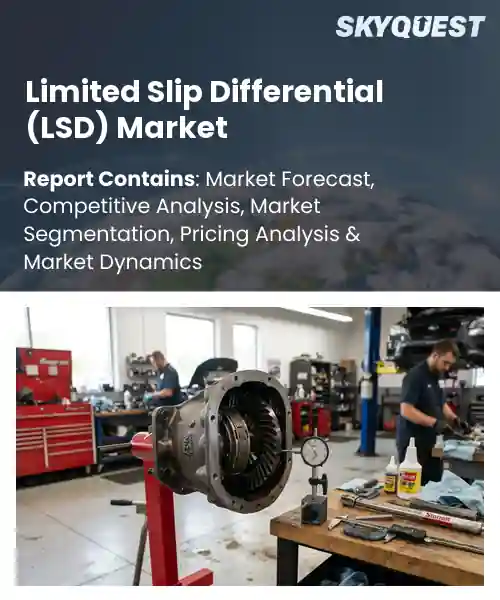
Limited Slip Differential (LSD) Market
Report ID: SQMIG25A2983
Report ID: SQMIG25A2983
[email protected]
USA +1 351-333-4748
Report ID:
SQMIG25A2983 |
Region:
Global |
Published Date: August, 2026
Pages:
157
|Tables:
117
|Figures:
77


Global Limited Slip Differential (Lsd) Market size was valued at USD 3.76 Billion in 2024 and is poised to grow from USD 4.03 Billion in 2025 to USD 6.98 Billion by 2033, growing at a CAGR of 7.1% during the forecast period (2026-2033).
The global limited‑slip differential (LSD) market comprises manufacturers and suppliers of mechanical and electronic units that distribute torque between driven wheels to improve traction and handling. Its significance stems from the growing demand for vehicles, off‑road equipment and electric drivetrains that require torque management. Historically, LSDs were niche components for motorsport, but widespread adoption began in the early 2000s as automotive OEMs integrated them into SUVs and performance sedans to meet safety regulations and consumer expectations. For example, Subaru’s symmetrical AWD system and Ford’s electronic LSD in the F‑150 have illustrated how the technology migrated from specialty to mass market, fueling revenue expansion.
The primary growth catalyst for the global LSD market today is the rapid electrification of powertrains, which creates a technical need for torque vectoring to maximize efficiency and stability. Electric motors deliver instantaneous torque, but without a differential that can modulate wheel slip, vehicles suffer reduced range and uneven wear. Consequently, manufacturers such as Tesla and BYD are integrating electronically controlled LSDs into their e‑SUVs and high‑performance models, unlocking better regenerative‑braking balance and cornering confidence. This trend spurs investment in smart‑actuator designs, expands aftermarket retrofitting opportunities, and stimulates cross‑industry collaboration, thereby widening the market’s addressable base and driving revenue acceleration through 2028 forecasts.
How is AI-driven predictive maintenance influencing the limited slip differential market?
AI-driven predictive maintenance is reshaping the limited slip differential market by turning reactive repairs into proactive service cycles. Sensors embedded in the differential continuously stream data on temperature, vibration and torque distribution, while machine‑learning models detect patterns that precede wear or failure. This insight enables manufacturers to schedule interventions just before a component reaches a critical condition, reducing downtime and extending product life. Fleet operators benefit from lower maintenance costs and higher vehicle availability, while OEMs can differentiate their offerings with smarter, data‑rich differentials. The approach also supports design refinement as aggregated failure data feeds back into engineering, fostering more reliable and efficient products.
Market snapshot - (2026-2033)
Global Market Size
USD 3.76 Billion
Largest Segment
Mechanical Limited Slip Differential
Fastest Growth
Torque Vectoring Differential
Growth Rate
7.1% CAGR
To get more insights on this market click here to Request a Free Sample Report
Global limited slip differential (lsd) market is segmented by product type, vehicle type, drive type, sales channel and region. Based on product type, the market is segmented into Mechanical Limited Slip Differential, Electronic Limited Slip Differential and Torque Vectoring Differential. Based on vehicle type, the market is segmented into Passenger Vehicles, Light Commercial Vehicles, Heavy Commercial Vehicles and Off-Highway Vehicles. Based on drive type, the market is segmented into Front-Wheel Drive, Rear-Wheel Drive and All-Wheel Drive. Based on sales channel, the market is segmented into OEM and Aftermarket. Based on region, the market is segmented into North America, Europe, Asia Pacific, Latin America and Middle East & Africa.
Mechanical Limited Slip Differential segment dominates because it offers proven reliability and straightforward integration into existing drivetrains, which manufacturers prioritize for cost effective performance upgrades. Its purely mechanical engagement delivers predictable torque transfer under varied load conditions, meeting consumer expectations for durability and low maintenance. This heritage of robust design aligns with OEM preference for scalable solutions, reinforcing its central position in the overall lsd market across multiple vehicle platforms.
However, Electronic Limited Slip Differential segment is witnessing the strongest growth momentum because digital control enables adaptive torque distribution, catering to emerging vehicle electrification trends and advanced driver assistance systems. Its firmware flexibility allows rapid updates, attracting OEMs seeking future proof solutions and generating new aftermarket opportunities that accelerate market expansion.
All-Wheel Drive segment leads because it inherently requires balanced torque distribution between front and rear axles, prompting manufacturers to embed sophisticated limited slip solutions that boost traction and stability. The architecture benefits from differentials that can dynamically modulate power, meeting consumer expectations for confident handling in diverse conditions. This integration spans multiple vehicle categories, supporting performance goals while enhancing fuel efficiency and complying with safety standards.
Meanwhile, Torque Vectoring Differential segment is emerging as the key high growth area because its ability to independently control wheel torque enables precise cornering dynamics demanded by sporty and autonomous vehicle platforms. Improvements and integration with vehicle control units drive interest, allowing manufacturers to differentiate offerings, meet performance benchmarks and open value chains, expanding market opportunities.
To get detailed segments analysis, Request a Free Sample Report
Asia Pacific dominates the global Limited Slip Differential market through a confluence of advanced manufacturing capabilities, strong automotive engineering culture, and rapid adoption of performance‑oriented vehicles. The region benefits from a dense network of original equipment manufacturers that integrate LSD technology early in vehicle development, fostering innovation and economies of scale. Robust supply chains and a skilled workforce support high‑volume production while maintaining stringent quality standards. Additionally, growing consumer interest in sport‑tuned and off‑road vehicles fuels demand, and supportive trade policies facilitate export opportunities, reinforcing the region’s leadership position. The ecosystem also encourages collaboration between research institutions and component suppliers, accelerating the introduction of next‑generation LSD designs that cater to both mainstream and niche segments. As regional automakers pursue electrified powertrains, they are adapting LSD solutions to meet torque‑vectoring requirements, further cementing the market’s depth and resilience.
Limited Slip Differential (LSD) Market in Japan is anchored by a legacy of precision engineering and a concentration of tier‑one suppliers that serve both domestic and international OEMs. The close collaboration between manufacturers and research universities fosters continuous refinement of clutch‑based and helical‑gear designs, catering to high‑performance sedans and compact sports cars. Strong emphasis on reliability and aftermarket support sustains demand across a broad vehicle spectrum through regional distribution networks.
Limited Slip Differential (LSD) Market in South Korea benefits from a robust automotive sector that prioritizes integration of advanced driveline technologies in both passenger and commercial vehicles. Domestic manufacturers leverage close ties with electronics firms to embed smart control modules, enhancing LSD responsiveness and efficiency. Government incentives for research and development encourage rapid prototyping, while a growing enthusiast culture drives demand for performance‑oriented variants across diverse vehicle classes globally today.
The rapid expansion of the European Limited Slip Differential market is propelled by stringent performance standards, a strong heritage of motorsport engineering, and accelerating commitments to vehicle electrification. European automakers integrate LSD systems to satisfy handling expectations for premium sedans, sports cars, and emerging electric models that require precise torque distribution. Collaborative research initiatives across borders enable the development of lightweight, high‑efficiency clutch packs and electronically controlled variants. Regulatory frameworks that encourage fuel efficiency and emissions reduction indirectly boost demand for LSD solutions that improve traction and reduce wheel slip. Additionally, a well‑established aftermarket network and a passionate enthusiast community sustain continuous demand for upgrades and specialized applications, reinforcing Europe’s position as a hub of technological advancement in driveline components.
Limited Slip Differential (LSD) Market in Germany is driven by a concentration of vehicle manufacturers that demand torque‑biasing solutions for high‑performance platforms. The country’s engineering institutes collaborate closely with OEMs to refine clutch‑based and electronically actuated systems, emphasizing durability and precision. A supply chain of specialized steel producers and machining firms ensures rapid prototyping and production for niche models. Strong consumer appreciation for driving dynamics sustains an aftermarket for upgrades.
Limited Slip Differential (LSD) Market in United Kingdom is shaped by a performance‑car culture and a motorsport sector that demands advanced torque distribution technologies. Collaborative clusters of automotive firms and university research centers accelerate development of lightweight, electronically controlled LSD units for both internal combustion and electric drivetrains. A supportive regulatory environment encourages certification of innovative components, while an enthusiastic community fuels a stream of aftermarket refinements and bespoke applications.
Limited Slip Differential (LSD) Market in France is emerging through automotive heritage and a focus on lightweight mobility. French manufacturers integrate LSD technology into midsize and compact models to improve traction while meeting efficiency goals. Partnerships with research institutes encourage novel friction materials and compact electronic controls. Growing consumer interest in sporty driving, together with a policy framework for low‑emission vehicles, drives significant demand across the OEM and aftermarket channels.
North America is strengthening its position in the Limited Slip Differential market through a combination of innovative engineering, a diverse vehicle portfolio, and strategic investments in advanced driveline technologies. Major manufacturers in the United States integrate LSD solutions across performance‑oriented trucks, SUVs, and performance sedans to enhance traction and handling. Collaborative ecosystems linking OEMs, tier‑one suppliers, and technology startups accelerate the development of electronically controlled units that complement hybrid and electric powertrains. A well‑established aftermarket network provides rapid access to high‑performance upgrades, while consumer enthusiasm for off‑road and rally‑style driving fuels steady demand. Additionally, supportive policy incentives for fuel‑efficient technologies encourage the adoption of LSDs that improve torque distribution, reinforcing the region’s competitive advantage in both original equipment and aftermarket segments.
Limited Slip Differential (LSD) Market in United States is driven by a large base of manufacturers that prioritize torque‑biasing solutions for trucks, sports cars, and electric models. R&D centers collaborate with tier‑one suppliers to create electronically actuated units that improve handling and efficiency. A vibrant aftermarket culture supports rapid adoption of upgrades, while regulatory emphasis on fuel economy encourages integration of LSD technology to maximize traction and reduce wheel slip.
Limited Slip Differential (LSD) Market in Canada benefits from automotive engineering firms that focus on performance in climates. Collaboration between manufacturers and research institutes yields LSD designs optimized for heavy‑duty trucks and terrain vehicles, emphasizing reliability under extreme conditions. Government programs supporting clean‑technology innovation encourage integration of LSD units with hybrid powertrains. An aftermarket network caters to enthusiasts seeking traction for recreational and commercial use, reinforcing growth across the sector.
To know more about the market opportunities by region and country, click here to
Buy The Complete Report
Rising Demand For High‑Performance Vehicles
Growing Adoption Of Advanced Drivetrain Technologies
High Production Cost Of Precision Components
Stringent Regulatory Standards On Emissions
Request Free Customization of this report to help us to meet your business objectives.
The LSD market is shaped by intense competition as data‑driven firms accelerate performance gains. AI‑focused startup Sqd leverages machine‑learning analytics to optimize torque distribution, while Rezolve AI’s capital backing fuels rapid scaling. Differential Ventures injects seed capital, enabling niche players to pursue strategic partnerships and early‑stage M&A, intensifying pressure on incumbents.
Top Player’s Company Profile
SkyQuest’s ABIRAW (Advanced Business Intelligence, Research & Analysis Wing) is our Business Information Services team that Collects, Collates, Correlates, and Analyses the Data collected by means of Primary Exploratory Research backed by robust Secondary Desk research.
As per SkyQuest analysis, the global Limited Slip Differential (LSD) market is propelled primarily by the rising demand for high‑performance vehicles that require superior traction, while a second important catalyst is the growing adoption of advanced drivetrain technologies such as electronic torque‑vectoring which enhance handling and safety. Mechanical limited‑slip differentials remain the dominant segment because of their proven reliability and cost‑effective integration across vehicle lines. Asia Pacific leads the market, driven by strong manufacturing bases and enthusiastic consumer demand for performance‑oriented models. However, the market faces a restraint from the high production cost of precision components, which can limit broader adoption in price‑sensitive segments.
| Report Metric | Details |
|---|---|
| Market size value in 2024 | USD 3.76 Billion |
| Market size value in 2033 | USD 6.98 Billion |
| Growth Rate | 7.1% |
| Base year | 2024 |
| Forecast period | (2026-2033) |
| Forecast Unit (Value) | USD Billion |
| Segments covered |
|
| Regions covered | North America (US, Canada), Europe (Germany, France, United Kingdom, Italy, Spain, Rest of Europe), Asia Pacific (China, India, Japan, Rest of Asia-Pacific), Latin America (Brazil, Rest of Latin America), Middle East & Africa (South Africa, GCC Countries, Rest of MEA) |
| Companies covered |
|
| Customization scope | Free report customization with purchase. Customization includes:-
|
To get a free trial access to our platform which is a one stop solution for all your data requirements for quicker decision making. This platform allows you to compare markets, competitors who are prominent in the market, and mega trends that are influencing the dynamics in the market. Also, get access to detailed SkyQuest exclusive matrix.
Table Of Content
Executive Summary
Market overview
Parent Market Analysis
Market overview
Market size
KEY MARKET INSIGHTS
COVID IMPACT
MARKET DYNAMICS & OUTLOOK
Market Size by Region
KEY COMPANY PROFILES
Methodology
For the Limited Slip Differential (LSD) Market, our research methodology involved a mixture of primary and secondary data sources. Key steps involved in the research process are listed below:
1. Information Procurement: This stage involved the procurement of Market data or related information via primary and secondary sources. The various secondary sources used included various company websites, annual reports, trade databases, and paid databases such as Hoover's, Bloomberg Business, Factiva, and Avention. Our team did 45 primary interactions Globally which included several stakeholders such as manufacturers, customers, key opinion leaders, etc. Overall, information procurement was one of the most extensive stages in our research process.
2. Information Analysis: This step involved triangulation of data through bottom-up and top-down approaches to estimate and validate the total size and future estimate of the Limited Slip Differential (LSD) Market.
3. Report Formulation: The final step entailed the placement of data points in appropriate Market spaces in an attempt to deduce viable conclusions.
4. Validation & Publishing: Validation is the most important step in the process. Validation & re-validation via an intricately designed process helped us finalize data points to be used for final calculations. The final Market estimates and forecasts were then aligned and sent to our panel of industry experts for validation of data. Once the validation was done the report was sent to our Quality Assurance team to ensure adherence to style guides, consistency & design.
Analyst Support
Customization Options
With the given market data, our dedicated team of analysts can offer you the following customization options are available for the Limited Slip Differential (LSD) Market:
Product Analysis: Product matrix, which offers a detailed comparison of the product portfolio of companies.
Regional Analysis: Further analysis of the Limited Slip Differential (LSD) Market for additional countries.
Competitive Analysis: Detailed analysis and profiling of additional Market players & comparative analysis of competitive products.
Go to Market Strategy: Find the high-growth channels to invest your marketing efforts and increase your customer base.
Innovation Mapping: Identify racial solutions and innovation, connected to deep ecosystems of innovators, start-ups, academics, and strategic partners.
Category Intelligence: Customized intelligence that is relevant to their supply Markets will enable them to make smarter sourcing decisions and improve their category management.
Public Company Transcript Analysis: To improve the investment performance by generating new alpha and making better-informed decisions.
Social Media Listening: To analyze the conversations and trends happening not just around your brand, but around your industry as a whole, and use those insights to make better Marketing decisions.
REQUEST FOR SAMPLE
 REQUEST FREE CUSTOMIZATION
Global Limited Slip Differential (Lsd) Market size was valued at USD 3.76 Billion in 2024 and is poised to grow from USD 4.03 Billion in 2025 to USD 6.98 Billion by 2033, growing at a CAGR of 7.1% during the forecast period (2026-2033).
The LSD market is shaped by intense competition as data‑driven firms accelerate performance gains. AI‑focused startup Sqd leverages machine‑learning analytics to optimize torque distribution, while Rezolve AI’s capital backing fuels rapid scaling. Differential Ventures injects seed capital, enabling niche players to pursue strategic partnerships and early‑stage M&A, intensifying pressure on incumbents. 'American Axle & Manufacturing Holdings, Inc.', 'Eaton Corporation plc', 'GKN Automotive Limited', 'ZF Friedrichshafen AG', 'JTEKT Corporation', 'Dana Incorporated', 'BorgWarner Inc.', 'Schaeffler AG', 'Auburn Gear, LLC', 'CUSCO Japan Co., Ltd.', 'OS Giken Co., Ltd.', 'Kaaz Corporation', 'Drexler Automotive GmbH', 'Quaife Engineering Limited', 'Yamaha Motor Co., Ltd.', 'Kawasaki Motors, Ltd.', 'Honda Motor Co., Ltd.', 'Toyota Motor Corporation', 'Nissan Motor Co., Ltd.', 'Hyundai WIA Corporation'
Automakers are prioritizing sporty handling and rapid acceleration, prompting engineers to integrate limited slip differentials that improve traction during aggressive cornering. This technical solution enhances power distribution to wheels, delivering smoother power delivery and reducing wheel slip. As consumers seek vehicles that combine comfort with performance, manufacturers respond by offering LSDs as standard or optional features across a broader model range. Consequently, demand for these components expands, encouraging suppliers to innovate and scale production to meet the evolving expectations of performance‑oriented drivers.
Vehicle Platform Consolidation: Automakers are unifying chassis architectures across multiple models to streamline development and reduce complexity, allowing limited slip differential technologies to be integrated earlier in the design cycle. This convergence enables economies of scale for suppliers, accelerates the rollout of advanced torque‑vectoring solutions, and supports quicker adaptation to emerging powertrain configurations such as hybrid and performance‑focused gasoline engines, fostering broader adoption of LSDs in both mainstream and premium segments and drives measurable gains in cornering confidence, driver satisfaction, and brand perception.
Why does Asia Pacific Dominate the Global Limited Slip Differential (LSD) Market? |@12


Want to customize this report? This report can be personalized according to your needs. Our analysts and industry experts will work directly with you to understand your requirements and provide you with customized data in a short amount of time. We offer $1000 worth of FREE customization at the time of purchase.
Feedback From Our Clients


 USA (+1) 351-333-4748

