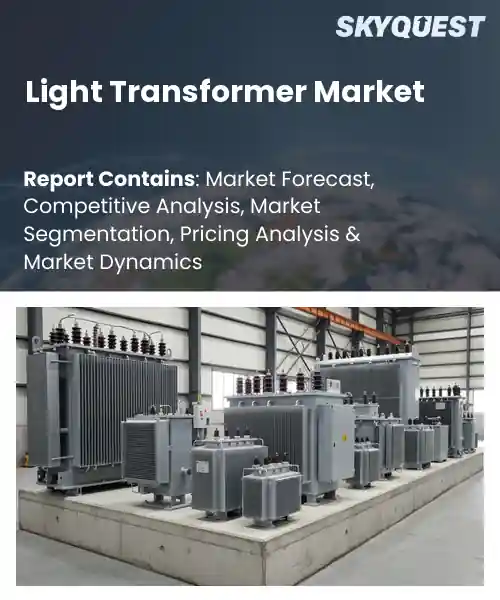
Light Transformer Market
Report ID: SQMIG20E2185
Report ID: SQMIG20E2185
[email protected]
USA +1 351-333-4748
Report ID:
SQMIG20E2185 |
Region:
Global |
Published Date: March, 2026
Pages:
157
|Tables:
90
|Figures:
76


Global Light Transformer Market size was valued at USD 1.9 Billion in 2024 and is poised to grow from USD 2.01 Billion in 2025 to USD 3.21 Billion by 2033, growing at a CAGR of 6.0% during the forecast period (2026-2033).
The key trend driving the global light transformer sector is the shift toward energy-efficient lighting systems, which has accelerated demand for compact reliable transformers that can support LED arrays. Light transformers are devices that step down voltage and condition power for lighting fixtures. These are critical because inefficient or incompatible power supplies can shorten lamp lifespan and undermine overall energy efficiency. Historically the sector moved from bulky magnetic transformers used for halogen bulbs to electronic and specialized LED drivers as lighting technologies evolved. For example, commercial retrofits in office buildings and large-scale streetlight conversions have triggered procurement cycles and stimulated innovation at transformer manufacturers.
As municipal and commercial LED conversions alter voltage and control requirements, manufacturers that invest in electronic and digitally connected transformers gain market share while legacy suppliers lose relevance. Tightening energy regulations and favorable incentives reduce total cost of ownership for LED systems, which in turn encourages large-scale retrofits and recurring procurement. This expands demand for lightweight, resilient transformers designed for dimming and networked control. There are many examples where cities are modernizing street lighting or when retailers increase their storefront illumination – these show how the change in specification creates opportunities for the vendor's bundle of modular product offerings with service contracts and the ability for vendors to provide full maintenance, analytics, and maintenance services that can increase lifetime value and overall profitability.
How is AI Improving Efficiency in the Light Transformer Market?
The improvement in efficiency of the light transformer industry due to AI’s impact on improved designs, production processes, and management of resources is significant. Significant innovations include the ability to design lighter cores, more efficient thermal performance of windings, and developing digitally-created models of products that simulate stress on the product when used in the intended manner. Many manufacturers and electric utilities are now implementing sensor-driven condition monitoring of equipment and automated visual inspection for detecting potential “hot spots” in their equipment early in the manufacturing process to decrease the likelihood of unplanned outages and ensure reliability of lighting systems in urban and commercial applications.
In November 2025, all-in-one, intelligent monitor for transformers using AI to track visual and infrared data has been created by Systems With Intelligence. This new technology adds value to the marketplace through predictively maintaining transformers and extending their lifespan; therefore, the equipment can be deployed with greater confidence and require less ongoing servicing.
Market snapshot - (2026-2033)
Global Market Size
USD 1.9 Billion
Largest Segment
Electronic
Fastest Growth
Electronic
Growth Rate
6.0% CAGR
To get more insights on this market click here to Request a Free Sample Report
Global light transformer market is segmented by type, power rating, application, and region. Based on type, the market is segmented into electronic, isolation and magnetic. Based on power rating, the market is segmented into small, medium and large. Based on application, the market is segmented into utility, residential and commercial and industrial. Based on region, the market is segmented into North America, Europe, Asia Pacific, Latin America and Middle East & Africa.
Based on the global light transformer market growth, electronic segment dominates because its compactness and compatibility with modern power electronics make it the default choice for reduced loss and high efficiency in light transformer designs, enabling tight integration with LED drivers and smart controls. Manufacturers prioritize electronic designs to meet efficiency and thermal constraints, and their material and manufacturing advances drive performance gains, reducing overall system costs and improving reliability across applications. This alignment with evolving lighting ecosystems accelerates adoption among OEMs.
However, magnetic segment is witnessing the strongest growth momentum as material innovations and compact core designs unlock improved thermal handling and saturation margins for demanding lighting fixtures. Because of its strength in difficult environments, combined with an ability to be customized for specific products, this type of product provides companies investing in new products plenty of new business opportunities.
Large segment dominates because its capacity to handle high load densities and deliver stable voltage under variable demand makes it indispensable for major lighting infrastructures, specialized industrial plants, and large public facilities. Designers and specifiers favor large transformers for their robustness, predictable maintenance profiles, and ability to integrate protective functionality, which reduces system downtime and aligns with long term asset management strategies in complex lighting deployments and supports scalable retrofit programs.
Meanwhile, small segment is the most rapidly expanding area as compact fixtures and modular lighting encourage integration of miniature transformers into distributed designs. Advances in materials have enabled more cost-effective manufacturing and compatibility with intelligent drivers allowing greater use in retrofitting residential and commercial properties though this has made way for broader product form factors and set up quick entrances for other vendors.
To get detailed segments analysis, Request a Free Sample Report
As per the global light transformer market share, Asia Pacific leads the global light transformer market due to a confluence of strong manufacturing ecosystems, deep electrical infrastructure investment, and a concentration of advanced component suppliers. The regional policy focus on the development of a resilient grid and energy efficiency complements the goals of the corporations that are developing compact and energy-efficient transformers. Domestic demand for consumer electronics and industrial automation will provide a long-term market for these products, while companies that export will have the benefit of an established supply chain and competitive manufacturing capabilities. Because of the close proximity of component manufacturers and the availability of a highly qualified engineering workforce, the time to market is significantly reduced, and customization for different types of applications can be accommodated, giving the region an advantage over other areas.
Light transformer market in Japan features advanced manufacturing hubs and a technology driven supply chain that prioritizes compactness, efficiency, and quality. Demand from both the electronics and industrial automation industries drives demand for new specialized orders as well as many additional value-added services. The supportive environment provided by engineers with extensive experience and long-term relationships with OEM customers allows for ongoing, sustained innovation and maintains global competitiveness for local OEMs.
Light transformer market in South Korea is characterized by strong integration between electronics OEMs and transformer specialists, fostering compact high performance solutions tailored to consumer and industrial applications. Innovation & proximity to suppliers compresses development times and enhance customization. Strategic emphasis on producing goods for export, plus ensuring quality of those goods, drives advanced materials and thermal management. Collaborative research and development with joint institutions further enriches product differentiation and operational excellence.
Based on global light transformer market regional forecast, North America growth in the light transformer market is propelled by a combination of modernization priorities, strong demand from high technology sectors, and emphasis on grid resilience and energy efficiency. Investing in distributed energy resources, electrification of transport, and smart infrastructure promotes demand for compact and low-loss transformers that work with digital monitoring systems and can integrate with electrical systems. Collaboration between utility companies and suppliers will fast track pilot programs and adoption of compact transformer technology. Regulatory compliance, reliability standards, and service offerings throughout the lifecycle of a product will lead to suppliers designing transformers that are durable and easy to maintain. In addition to supporting growth for startups and established manufacturers in refining their products, the innovation ecosystem in the region will enable suppliers to create products which can meet the needs of different types of industries and businesses as well as municipal customers.
Light transformer market in United States is driven by utility modernization efforts and demand from technology intensive industries for compact, monitored transformer solutions. Digital technology can help the supply chain run smoothly by integrating sensors, remote diagnostics and computer-based analysis of assets, allowing manufacturers to be innovative in material and manufacturing processes while keeping assets reliable and safe. Manufacturers focus on high reliability and safety standards, which will help improve the quality of the services offered by the manufacturer. The use of reliable and safe digital technologies will also allow the supply chain to improve its capabilities.
Light transformer market in Canada emphasizes resilient, energy efficient transformer solutions for grid modernization and distributed energy integration. Testing of compact, low-loss designs in remote areas or harsh climates is being facilitated by collaborative efforts among utilities, suppliers, and research communities. Suppliers are also working to develop modular and maintainable equipment that can be serviced over vast distances. Partnerships between academia and industry promote applied research in materials and thermal management tailored to local operational needs priorities.
As per global light transformer market regional outlook, Europe is enhancing its role in the light transformer market through coordinated emphasis on energy efficiency, advanced materials, and integration with smart grid initiatives. The development of customized solutions that address different regulatory and environmental requirements is supported by strong engineering traditions and specialized manufacturing facilities. An increased emphasis on lifecycle performance, recyclability, and reduced loss from products has led to product roadmaps that align with sustainability objectives. Manufacturers are pursued by supportive policies and access to skilled technical talent to develop modular, serviceable architectures as well as invest in digital monitoring functions to improve product reliability and develop rapid response maintenance strategies. The development of regional clusters of precision engineering and software development expertise has further enhanced the commercialization of intelligent transformer systems designed specifically for urban and industrial settings.
Light transformer market in Germany leverages tradition in precision engineering and strong industrial demand to advance compact, reliable transformer technologies. Rigorous testing of thermal management and noise reduction technologies is propelled by collaboration between manufacturers, automation suppliers, and research organizations. Design is directed toward durability based on industrial quality standards and easy access to lifecycle serviceability. Local knowledge of materials and manufacturing processes provides a foundation for ongoing improvements, ensuring that companies are able to deliver consistent performance levels across a variety of industries.
Light transformer market in United Kingdom benefits from systems integration and smart grid deployment that drive demand for modular transformer solutions. Digital monitoring and predictive maintenance can be accelerated through collaboration between utilities and technology providers during their respective test phases. Regulatory agencies are placing emphasis on increasing energy efficiency and reducing noise and therefore, there is a push for the adoption of low loss designs that are specifically built for urban infrastructure. Through research networks, new materials and production methods that promote better thermal performance and serviceability in more compact packages are being developed.
Light transformer market in France prioritizes energy efficient, low noise transformer solutions that integrate with smart distribution networks and urban electrification. Due to the focus on lifecycle sustainability, suppliers have been encouraged to utilize recyclable materials and create products with lower-maintenance designs. Industry partnerships with research institutions work together to validate new concepts related to state-of-the-art thermal management systems and new insulation technologies.
To know more about the market opportunities by region and country, click here to
Buy The Complete Report
Rising Adoption Of Energy Efficient Lighting
The widespread shift toward energy efficient lighting solutions has increased demand for compact, reliable light transformers that can deliver stable performance with reduced losses, enabling longer fixture lifetimes and lower operating costs. The manufacturing industry responds by designing and producing specialized transformers that are specifically made to work with LED load with an eye towards expanding the capabilities of their supply chains to allow the product to be available in more markets. This also encourages businesses to make investments in design and production of components that will improve the energy performance of their products while still maintaining full compatibility with the existing lighting system in place by end users and specifiers.
Integration With Smart Building Systems
Increasing integration of lighting into smart building systems requires transformers that support dimming, control protocols, and power quality management, which encourages manufacturers to produce interoperable devices. Demand for transformers that cooperate or connect with sensors, controls and networks to provide reliable and controllable lighting is rising as building managers and integrators want a consistent lighting experience. This creates opportunities for product innovation and speeds the specification of state-of-the art transformers into new builds; therefore, expanding market opportunities and fostering collaboration between lighting, control and transformer manufacturers to create innovative solutions that will meet emerging functional and compatibility needs.
Compatibility And Standardization Challenges
Due to the issues relating to inconsistent compatibility standards, fragmented product specifications, and lack of uniformity between the various technologies and control systems, the designer and specifier have an uncertainty when selecting the correct components to match an existing lighting technology/control system/technology. This fragmentation also causes challenges relating to integrating various lighting technologies, with more testing and validation required, as well as conservative purchasing practices that favour "the tried and true" products. This lack of consistency also leads to the slow adoption of newer transformer designs throughout the marketplace as well as the subsequent slow adoption of these same designs by end users until standardized guidelines are developed and adopted widely and interoperability is established with the various manufacturers of transformers, lighting technologies, and controls.
High Initial Deployment Costs
The higher up-front costs of a specialized light transformer than the comparable legacy component may cause value-conscious customers to delay procurement until more favorable economic conditions allow for adoption in cost-sensitive projects. As a result, budgetary limitations and the length of the procurement cycle often influence the decision to pursue lower initial capital expenditures rather than focusing on longer-term energy or maintenance benefits by delaying upgrades or selecting simpler options. As a result, economic concerns have impeded both the rate of specifying innovative transformer designs and the installation of new transformers, thus creating a barrier to suppliers trying to scale production while demonstrating total cost benefits through expanded market acceptance.
Request Free Customization of this report to help us to meet your business objectives.
Competitive landscape in the global light transformer market outlook is intensifying as incumbents pursue acquisitions, strategic partnerships, and product innovation to capture demand from data center and electrification projects. Increasingly, companies like Eaton are buying companies that have developed products that use solid state transformers in electricity delivery systems. Additionally, DG Matrix has entered partnerships with other renewable energy companies, thereby creating a shift in the way new technologies are used for differentiation and deployed into the electrical grid.
SkyQuest’s ABIRAW (Advanced Business Intelligence, Research & Analysis Wing) is our Business Information Services team that Collects, Collates, Correlates, and Analyses the Data collected by means of Primary Exploratory Research backed by robust Secondary Desk research.
As per SkyQuest analysis, the global light transformer industry is propelled primarily by the shift to energy efficient lighting, with a secondary driver being tighter integration into smart building and grid systems that demand dimming and networked control. At present, electronic transformers are at the forefront of technology advancements regarding their compactness, portability and new LED lighting technology. The Asia Pacific region continues to lead geographically with a very strong manufacturing environment and supportive policies for electronic transformers. There are still some barriers to full acceptance of electronic transformers; these include fragmentation of compatibility standards and inconsistent product interoperability causing manufacturers to take a longer time to specify and to ultimately adopt electronic transformers in new buildings.
| Report Metric | Details |
|---|---|
| Market size value in 2024 | USD 1.9 Billion |
| Market size value in 2033 | USD 3.21 Billion |
| Growth Rate | 6.0% |
| Base year | 2024 |
| Forecast period | (2026-2033) |
| Forecast Unit (Value) | USD Billion |
| Segments covered |
|
| Regions covered | North America (US, Canada), Europe (Germany, France, United Kingdom, Italy, Spain, Rest of Europe), Asia Pacific (China, India, Japan, Rest of Asia-Pacific), Latin America (Brazil, Rest of Latin America), Middle East & Africa (South Africa, GCC Countries, Rest of MEA) |
| Companies covered |
|
| Customization scope | Free report customization with purchase. Customization includes:-
|
To get a free trial access to our platform which is a one stop solution for all your data requirements for quicker decision making. This platform allows you to compare markets, competitors who are prominent in the market, and mega trends that are influencing the dynamics in the market. Also, get access to detailed SkyQuest exclusive matrix.
Table Of Content
Executive Summary
Market overview
Parent Market Analysis
Market overview
Market size
KEY MARKET INSIGHTS
COVID IMPACT
MARKET DYNAMICS & OUTLOOK
Market Size by Region
KEY COMPANY PROFILES
Methodology
For the Light Transformer Market, our research methodology involved a mixture of primary and secondary data sources. Key steps involved in the research process are listed below:
1. Information Procurement: This stage involved the procurement of Market data or related information via primary and secondary sources. The various secondary sources used included various company websites, annual reports, trade databases, and paid databases such as Hoover's, Bloomberg Business, Factiva, and Avention. Our team did 45 primary interactions Globally which included several stakeholders such as manufacturers, customers, key opinion leaders, etc. Overall, information procurement was one of the most extensive stages in our research process.
2. Information Analysis: This step involved triangulation of data through bottom-up and top-down approaches to estimate and validate the total size and future estimate of the Light Transformer Market.
3. Report Formulation: The final step entailed the placement of data points in appropriate Market spaces in an attempt to deduce viable conclusions.
4. Validation & Publishing: Validation is the most important step in the process. Validation & re-validation via an intricately designed process helped us finalize data points to be used for final calculations. The final Market estimates and forecasts were then aligned and sent to our panel of industry experts for validation of data. Once the validation was done the report was sent to our Quality Assurance team to ensure adherence to style guides, consistency & design.
Analyst Support
Customization Options
With the given market data, our dedicated team of analysts can offer you the following customization options are available for the Light Transformer Market:
Product Analysis: Product matrix, which offers a detailed comparison of the product portfolio of companies.
Regional Analysis: Further analysis of the Light Transformer Market for additional countries.
Competitive Analysis: Detailed analysis and profiling of additional Market players & comparative analysis of competitive products.
Go to Market Strategy: Find the high-growth channels to invest your marketing efforts and increase your customer base.
Innovation Mapping: Identify racial solutions and innovation, connected to deep ecosystems of innovators, start-ups, academics, and strategic partners.
Category Intelligence: Customized intelligence that is relevant to their supply Markets will enable them to make smarter sourcing decisions and improve their category management.
Public Company Transcript Analysis: To improve the investment performance by generating new alpha and making better-informed decisions.
Social Media Listening: To analyze the conversations and trends happening not just around your brand, but around your industry as a whole, and use those insights to make better Marketing decisions.
REQUEST FOR SAMPLE
 REQUEST FREE CUSTOMIZATION
Global Light Transformer Market size was valued at USD 1.9 Billion in 2024 and is poised to grow from USD 2.01 Billion in 2025 to USD 3.21 Billion by 2033, growing at a CAGR of 6.0% during the forecast period (2026-2033).
Competitive landscape in the global light transformer market is intensifying as incumbents pursue acquisitions, strategic partnerships, and product innovation to capture demand from data center and electrification projects. Recent moves include Eaton acquiring a solid-state transformer developer and DG Matrix securing integration and deployment partnerships with renewable and microgrid providers, reflecting a shift toward technology-led differentiation and faster field rollouts. 'Schneider Electric', 'Hitachi', 'ABB', 'Eaton Corporation', 'Leviton', 'Trio Transformer', 'MX LightForce', 'Airlink Transformers', 'Vista Professional', 'Trans Power Tech', 'Siemens', 'General Electric', 'Malibu Lighting', 'Emerson Electric', 'Intermatic', 'Focus Industries', 'WAC Lighting', 'Eaton Coilcraft', 'Kichler Lighting', 'Rexel'
The widespread shift toward energy efficient lighting solutions has increased demand for compact, reliable light transformers that can deliver stable performance with reduced losses, enabling longer fixture lifetimes and lower operating costs. Manufacturers respond by developing specialized transformers optimized for LED loads, which supports supply chain expansion and encourages product availability across regions. This factor stimulates investment in component design and manufacturing capacity, reinforcing market growth as end users and specifiers prioritize systems that enhance energy performance while maintaining compatibility with existing lighting infrastructures.
Smart Grid Integration: Integration of light transformers into intelligent distribution networks is driving greater operational flexibility and improved asset utilization. Enhanced remote monitoring, adaptive voltage regulation, and seamless coordination with distributed generation allow utilities and commercial operators to respond dynamically to variable loads. This trend promotes modular deployments, supports localized resilience strategies, and accelerates interoperability with automated control platforms. Manufacturers and system integrators are prioritizing firmware security, standardized communication interfaces, and lifecycle service models to capitalize on grid modernization priorities and regulatory alignment.
As per the global light transformer market share, Asia Pacific leads the global light transformer market due to a confluence of strong manufacturing ecosystems, deep electrical infrastructure investment, and a concentration of advanced component suppliers.


Want to customize this report? This report can be personalized according to your needs. Our analysts and industry experts will work directly with you to understand your requirements and provide you with customized data in a short amount of time. We offer $1000 worth of FREE customization at the time of purchase.
Feedback From Our Clients


 USA (+1) 351-333-4748

