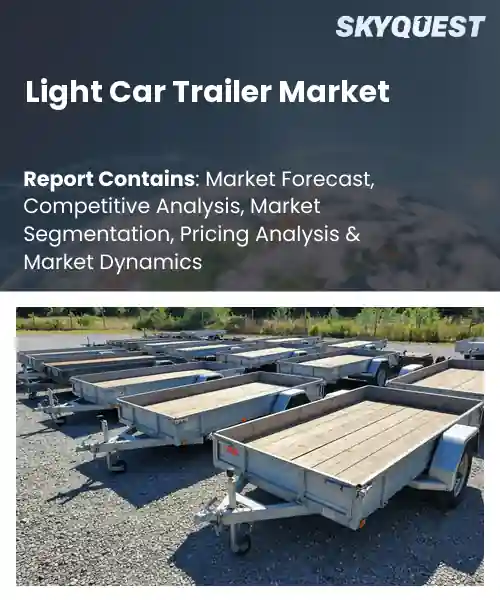
Light Car Trailer Market
Report ID: SQMIG25A2713
Report ID: SQMIG25A2713
[email protected]
USA +1 351-333-4748
Report ID:
SQMIG25A2713 |
Region:
Global |
Published Date: June, 2026
Pages:
157
|Tables:
114
|Figures:
77


Global Light Car Trailer Market size was valued at USD 1.55 Billion in 2024 and is poised to grow from USD 1.6 Billion in 2025 to USD 2.06 Billion by 2033, growing at a CAGR of 3.2% during the forecast period (2026-2033).
The light car trailer market comprises small, towable trailers designed for personal and light commercial use, and its primary driver is the rising preference for flexible transport solutions that reduce ownership costs and enable multiuse mobility. This market matters because it connects broader trends in vehicle downsizing, recreational activity growth, and lastmile logistics, which together reshape consumer and SME behavior. Historically the segment evolved from basic utility trailers to modular, lightweight designs using aluminum and composites, exemplified by European microcampers and North American utility models. Regulatory changes and fuel efficiency concerns accelerated adoption as consumers sought versatile lower emission options.
Building on those adoption dynamics, the key factor driving global expansion is technological convergence between materials innovation and electrified, connected vehicle platforms because lighter, smarter trailers become compatible with passenger EVs and commercial vans, which in turn expands use cases. For example, composite cargo trailers reduce tare weight, enabling longer EV range and permitting small businesses to replace larger trucks for last mile delivery, thereby lowering operating costs and urban emissions. Meanwhile telematics and modular cargo systems enable rental and sharing models that unlock seasonal recreational demand and flexible commercial fleets, producing concrete opportunities for manufacturers and platform operators globally.
How is IoT improving fleet management for the light car trailer market?
IoT is reshaping fleet management for light car trailers by turning towable units into connected assets with GPS location, condition sensors and telematics gateways. Key aspects include real time location, load and tire pressure monitoring and predictive maintenance driven by sensor signals. The current state shows growing retrofit adoption so rental fleets and small contractors gain visibility without replacing trailers. That shift improves utilization and reduces downtime while enabling remote locking and theft alerts. Examples range from simple asset trackers to integrated gateways that feed fleet platforms, making scheduling dispatch and maintenance more responsive and more reliable.
Geotab February 2026, launched GO Anywhere asset trackers with satellite connectivity which extend consistent location and condition reporting to light car trailers. This supports fleet efficiency by enabling reliable recovery after theft smoother rentals and proactive maintenance through continuous IoT fed insights.
Market snapshot - (2026-2033)
Global Market Size
USD 1.55 Billion
Largest Segment
Utility Trailers
Fastest Growth
Recreational Trailers
Growth Rate
3.2% CAGR
To get more insights on this market click here to Request a Free Sample Report
Global light car trailer market is segmented by product type, design type, axle type, end-use and region. Based on product type, the market is segmented into Utility Trailers, Recreational Trailers and Others. Based on design type, the market is segmented into Open Trailers and Enclosed Trailers. Based on axle type, the market is segmented into Single Axle and Multi Axle. Based on end-use, the market is segmented into Personal and Commercial. Based on region, the market is segmented into North America, Europe, Asia Pacific, Latin America and Middle East & Africa.
Utility Trailers segment dominates because their straightforward load carrying architecture aligns tightly with core user needs for flexible, low cost hauling. Buyers prioritize payload versatility and easy access, which encourages manufacturers to prioritize durable, modular frames and straightforward tie down systems. This causes supply chains to optimize for standardized chassis and aftermarket accessories, reinforcing the utility offering's market reach through proven reliability, lower operating complexity, and broad applicability across maintenance, delivery, and small contractor use.
However, Recreational Trailers are the most rapidly expanding area, driven by rising leisure vehicle ownership and demand for lifestyle oriented hauling solutions. Manufacturers innovate with comfort features, modular interiors, and lighter materials, unlocking new consumer segments and creating aftermarket opportunities that accelerate product diversification and premiumization across the market.
Enclosed Trailers segment leads because their protective, security focused design directly addresses buyer priorities around asset protection and controlled transport conditions. This drives manufacturers to invest in integrated lock systems, insulation, and customizable interiors, creating higher perceived value and attracting commercial clients with sensitive cargo needs. The result is intensified research and development and dealer focus on premium build quality and tailored configurations, which amplifies demand among users seeking reliability and protection.
Conversely, Open Trailers are witnessing the strongest growth momentum as buyers prioritize affordability, easier loading and reduced weight for flexible transport tasks. Innovations in lightweight materials and modular rack systems expand utility and cost effectiveness, creating rapid adoption in diverse applications and spawning novel accessory markets that accelerate future market expansion and product accessibility.
To get detailed segments analysis, Request a Free Sample Report
Europe dominates the global light car trailer market due to a deep manufacturing ecosystem, integrated supply chains, and long-established coachbuilding expertise. Strong demand from diverse end users, including recreational and commercial segments, is supported by extensive dealer networks and well-developed aftermarket services. Harmonized regulatory frameworks and rigorous safety standards raise product quality and encourage innovation in materials and towing technology. Buyers benefit from high levels of service and customization, while producers leverage proximity to major component suppliers and logistics hubs to optimize production and distribution across neighboring markets. A robust research and development culture fosters advances in lightweight materials, corrosion protection and modular designs that increase trailer versatility. Close collaboration between original equipment manufacturers and specialist fabricators accelerates product differentiation, while established logistics corridors support efficient cross-border movement and export orientation that further bolsters regional leadership.
Light Car Trailer Market in Germany is underpinned by advanced manufacturing, strong engineering expertise and a dense network of suppliers. Demand is driven by both leisure towing and professional transport needs. Manufacturers focus on precision engineering, durability and regulatory compliance while leveraging local R&D to refine materials and corrosion protection. Close ties between OEMs, fabricators and logistics providers support efficient production and timely aftermarket service across the region and innovation.
Light Car Trailer Market in United Kingdom benefits from a strong consumer base, active recreational culture and a flexible manufacturing landscape. Local suppliers enable customization and quick adaptation to buyer preferences. Emphasis on service networks and aftermarket support enhances ownership experience, while specialist fabricators and leasing channels broaden access. Collaboration with engineering firms fosters product refinement and adaptation to varied road and usage conditions across urban and rural markets environments.
Light Car Trailer Market in France is shaped by a balance of urban demand and countryside leisure activities, supporting a versatile product mix. Manufacturers emphasize corrosion resistance, comfort and refined finishes to meet discerning buyer expectations. Strong dealer networks and rental channels facilitate trial and access, while close cooperation between component suppliers and bodybuilders enables tailored solutions. Local firms focus on blending durability with styling to suit diverse user needs.
North America is experiencing rapid expansion of the light car trailer market driven by strong consumer appetite for outdoor recreation, flexible mobility solutions and an expanding rental and leasing ecosystem. Robust retail and distribution channels, together with an active aftermarket and service infrastructure, make ownership and maintenance more accessible. Manufacturers benefit from a diverse supplier base and targeted product segmentation that addresses urban users, weekend enthusiasts and commercial operators. Investment in material innovation, towing technology and dealer training enhances reliability and buyer confidence, while collaborative relationships between OEMs, fabricators and logistics providers streamline production and delivery across varied regional markets. Rising e-commerce and last mile delivery needs have driven demand for compact, maneuverable trailers. Broader access to financing and flexible ownership models reduces barriers for new buyers. Focus on modularity and durable finishes expands use case versatility, while established repair and parts networks lower ownership concerns and strengthen market confidence.
Light Car Trailer Market in United States is characterized by a broad user base spanning recreational enthusiasts, businesses and logistics operators. Product diversity ranges from compact utility models to specialized units tailored for trades. Dealer networks and rental channels support accessibility, while innovation in lightweight materials and towing systems responds to varied regional road conditions. Emphasis on aftersales service and parts availability enhances ownership appeal across urban and rural contexts.
Light Car Trailer Market in Canada is shaped by a mix of recreational towing culture and commercial needs across diverse geographies. Manufacturers emphasize durability, cold weather resilience and corrosion protection to match local conditions. Dealer and service networks focus on year round support and flexible financing options to expand market reach. Local fabricators often provide customized solutions for leisure and trade applications, supported by reliable parts supply and regional logistics.
Asia Pacific is strengthening its position in the light car trailer market through concentrated efforts in advanced manufacturing, material innovation and integration of compact, high precision designs. Japan and South Korea leverage strong engineering traditions and supplier specialization to produce trailers that prioritize build quality, corrosion management and efficient use of space. Rising domestic interest in leisure mobility and commercial last mile solutions encourages tailored product development, while export orientation and partnerships with global OEMs extend regional reach. Investments in modular platforms and lightweight construction techniques enable competitive differentiation, and focused dealer and aftersales structures support growing consumer confidence across urban and peri urban markets. Regional R&D centers accelerate adoption of corrosion resistant coatings, electronic integrations and compact suspension systems. Close work with logistics firms and regulators helps align product features with operational needs and safety expectations, strengthening competitive positioning across export and domestic channels.
Light Car Trailer Market in Japan benefits from precision engineering and compact design focus. Manufacturers prioritize corrosion protection, weight optimization and integration of electronics for enhanced functionality. Strong supplier networks enable high quality components and tight tolerances, while R&D centers push material and finish innovations. Dealers and service providers emphasize reliability and tailored aftersales programs. Product offerings often reflect urban space constraints and discerning buyer expectations for refinement and durability.
Light Car Trailer Market in South Korea reflects a strong manufacturing focus on precision, lightweight construction and integration of smart features. Local firms emphasize corrosion control and finish quality to meet rigorous buyer expectations. Collaboration between component suppliers and bodybuilders yields compact modular platforms suitable for urban and commercial uses. Dealer networks and aftermarket services support maintenance and customization, while export partnerships extend product reach into neighboring regional markets seamlessly.
To know more about the market opportunities by region and country, click here to
Buy The Complete Report
Increasing Recreational Vehicle Ownership
Urban Last Mile Logistics Needs
Complex Regulatory Compliance Requirements
Perceived High Ownership Costs
Request Free Customization of this report to help us to meet your business objectives.
The global light car trailer competitive landscape is defined by incumbent OEMs defending dealer networks while nimble startups push EV friendly, ultralight designs that increase competitive pressure. Strategies are concrete and visible: acquisitions such as Tentrax’s 2019 ownership change, tactical partnerships and PR/dealer tie-ups exemplified by Escapod, and product‑led tech innovation like Polydrops’ P17A with integrated battery and solar systems.
SkyQuest’s ABIRAW (Advanced Business Intelligence, Research & Analysis Wing) is our Business Information Services team that Collects, Collates, Correlates, and Analyses the Data collected by means of Primary Exploratory Research backed by robust Secondary Desk research.
As per SkyQuest analysis, the global light car trailer market is being propelled by rising recreational vehicle ownership, with one key driver being growing leisure vehicle adoption and a second driver being expanding urban last mile logistics needs, which together boost demand for versatile towable units. A major restraint is complex regulatory compliance requirements that increase development time and costs for manufacturers. Europe emerges as the dominating region thanks to its deep manufacturing ecosystem, integrated supply chains and advanced R&D, while Utility Trailers remain the dominating segment due to their payload versatility, low operating complexity and broad appeal among personal and commercial users.
| Report Metric | Details |
|---|---|
| Market size value in 2024 | USD 1.55 Billion |
| Market size value in 2033 | USD 2.06 Billion |
| Growth Rate | 3.2% |
| Base year | 2024 |
| Forecast period | (2026-2033) |
| Forecast Unit (Value) | USD Billion |
| Segments covered |
|
| Regions covered | North America (US, Canada), Europe (Germany, France, United Kingdom, Italy, Spain, Rest of Europe), Asia Pacific (China, India, Japan, Rest of Asia-Pacific), Latin America (Brazil, Rest of Latin America), Middle East & Africa (South Africa, GCC Countries, Rest of MEA) |
| Companies covered |
|
| Customization scope | Free report customization with purchase. Customization includes:-
|
To get a free trial access to our platform which is a one stop solution for all your data requirements for quicker decision making. This platform allows you to compare markets, competitors who are prominent in the market, and mega trends that are influencing the dynamics in the market. Also, get access to detailed SkyQuest exclusive matrix.
Table Of Content
Executive Summary
Market overview
Parent Market Analysis
Market overview
Market size
KEY MARKET INSIGHTS
COVID IMPACT
MARKET DYNAMICS & OUTLOOK
Market Size by Region
KEY COMPANY PROFILES
Methodology
For the Light Car Trailer Market, our research methodology involved a mixture of primary and secondary data sources. Key steps involved in the research process are listed below:
1. Information Procurement: This stage involved the procurement of Market data or related information via primary and secondary sources. The various secondary sources used included various company websites, annual reports, trade databases, and paid databases such as Hoover's, Bloomberg Business, Factiva, and Avention. Our team did 45 primary interactions Globally which included several stakeholders such as manufacturers, customers, key opinion leaders, etc. Overall, information procurement was one of the most extensive stages in our research process.
2. Information Analysis: This step involved triangulation of data through bottom-up and top-down approaches to estimate and validate the total size and future estimate of the Light Car Trailer Market.
3. Report Formulation: The final step entailed the placement of data points in appropriate Market spaces in an attempt to deduce viable conclusions.
4. Validation & Publishing: Validation is the most important step in the process. Validation & re-validation via an intricately designed process helped us finalize data points to be used for final calculations. The final Market estimates and forecasts were then aligned and sent to our panel of industry experts for validation of data. Once the validation was done the report was sent to our Quality Assurance team to ensure adherence to style guides, consistency & design.
Analyst Support
Customization Options
With the given market data, our dedicated team of analysts can offer you the following customization options are available for the Light Car Trailer Market:
Product Analysis: Product matrix, which offers a detailed comparison of the product portfolio of companies.
Regional Analysis: Further analysis of the Light Car Trailer Market for additional countries.
Competitive Analysis: Detailed analysis and profiling of additional Market players & comparative analysis of competitive products.
Go to Market Strategy: Find the high-growth channels to invest your marketing efforts and increase your customer base.
Innovation Mapping: Identify racial solutions and innovation, connected to deep ecosystems of innovators, start-ups, academics, and strategic partners.
Category Intelligence: Customized intelligence that is relevant to their supply Markets will enable them to make smarter sourcing decisions and improve their category management.
Public Company Transcript Analysis: To improve the investment performance by generating new alpha and making better-informed decisions.
Social Media Listening: To analyze the conversations and trends happening not just around your brand, but around your industry as a whole, and use those insights to make better Marketing decisions.
REQUEST FOR SAMPLE
 REQUEST FREE CUSTOMIZATION
Global Light Car Trailer Market size was valued at USD 1.55 Billion in 2024 and is poised to grow from USD 1.6 Billion in 2025 to USD 2.06 Billion by 2033, growing at a CAGR of 3.2% during the forecast period (2026-2033).
The global light car trailer competitive landscape is defined by incumbent OEMs defending dealer networks while nimble startups push EV friendly, ultralight designs that increase competitive pressure. Strategies are concrete and visible: acquisitions such as Tentrax’s 2019 ownership change, tactical partnerships and PR/dealer tie-ups exemplified by Escapod, and product‑led tech innovation like Polydrops’ P17A with integrated battery and solar systems. 'China International Marine Containers', 'Bernard Krone Holding', 'Wabash National Corporation', 'Schmitz Cargobull', 'EnTrans International', 'Mac Trailer Manufacturing', 'Heil Trailer International', 'Landoll Corporation', 'Trail King Industries', 'Pitts Trailers', 'Doepker Industries', 'Humbaur', 'Fontaine Trailer Company', 'East Manufacturing', 'Dennison Trailers', 'Bockmann Fahrzeugwerke', 'Ifor Williams Trailers', 'Big Tex Trailers', 'Aluma', 'Utility Trailer Manufacturing Company'
Increasing ownership of recreational vehicles and outdoor lifestyle preferences has expanded the need for auxiliary transport solutions, with light car trailers serving as a practical complement for carrying camping gear, bicycles, and other equipment. This consumer behavior encourages manufacturers and distributors to broaden product offerings and tailor features for convenience, durability, and modularity, which in turn creates stronger retail demand and greater dealer interest. The visible consumer adoption also supports marketing investments and partnerships that reinforce awareness, making trailers a more common choice for those seeking adaptable transport options.
Digital Connectivity Advancement: Integration of connectivity, telematics and fleet management platforms is reshaping light car trailer usage and services. Manufacturers are adding sensors and systems to enable remote diagnostics, predictive maintenance and integration with ride sharing and logistics networks. The development supports new service models such as subscription access, optimized routing and real time load monitoring, improving asset utilization and customer experience. Collaborations between trailer makers, software firms and mobility operators are driving product differentiation and creating aftermarket revenue tied to data services.
Why does Europe Dominate the Global Light Car Trailer Market? |@12


Want to customize this report? This report can be personalized according to your needs. Our analysts and industry experts will work directly with you to understand your requirements and provide you with customized data in a short amount of time. We offer $1000 worth of FREE customization at the time of purchase.
Feedback From Our Clients


 USA (+1) 351-333-4748

