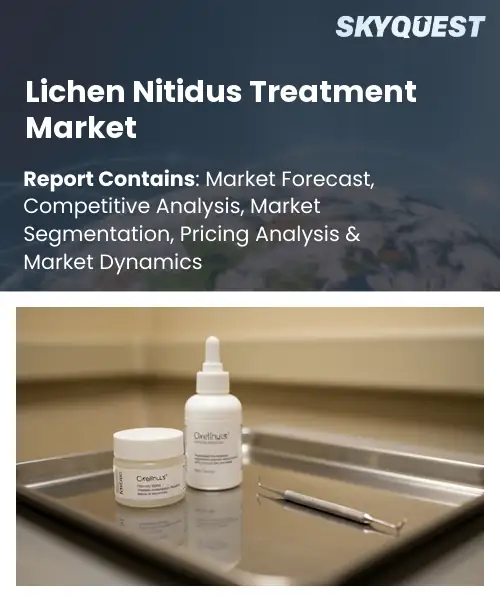
Lichen Nitidus Treatment Market
Report ID: SQMIG35I2784
Report ID: SQMIG35I2784
[email protected]
USA +1 351-333-4748
Report ID:
SQMIG35I2784 |
Region:
Global |
Published Date: June, 2026
Pages:
157
|Tables:
116
|Figures:
77


Global Lichen Nitidus Treatment Market size was valued at USD 310.0 Million in 2024 and is poised to grow from USD 323.73 Million in 2025 to USD 457.92 Million by 2033, growing at a CAGR of 4.43% during the forecast period (2026-2033).
The global lichen nitidus treatment market centers on therapies for a rare inflammatory skin condition characterized by pinpoint papules and pruritus, and the primary driver is rising diagnostic awareness among dermatologists and primary care physicians. This market matters because targeted therapies reduce the number of patients who experience complications from illness and improve the quality of life for patients who do experience complications; therefore, developing this market reflects the movement of clinicians from using empirical topical corticosteroids to use immunomodulators or phototherapy as long-term safer treatments. Moreover, over time, patient advocacy, improvements in dermatopathology, and more off-label uses for biologics have all contributed to an increase in research of both small-molecule and biologic drugs.
A key trend driving the global lichen nitidus treatment sector is the limited number of approved therapies, which causes clinicians and industry to pursue repurposing and incremental innovation that in turn creates commercial and clinical opportunities. As physicians document successful off-label use of topical immunomodulators and phototherapy in case reports, pharmaceutical companies respond by funding small trials and generating real-world evidence, and investors follow the data by supporting formulation improvements and distribution to specialty clinics. Consequently, expanded evidence leads payers to consider reimbursement pathways, enabling dermatology centers and teledermatology platforms to scale treatment access for patients who had few options.
How is AI Transforming Diagnosis and Treatment Personalization in the Lichen Nitidus Market?
Over time, artificial intelligence has changed the way physicians diagnose and customize treatment for patients suffering from Lichen Nitidus by using image-based lesion detection, digital pathology, and molecular profiling to decrease diagnostic uncertainty and facilitate physician access to information needed when selecting a treatment plan. Additionally, in an environment where there are limited therapeutic options and even less clinical guidance, AI powered tele-dermatology and full body imaging help physicians to recognize subtle changes, allowing them to determine the urgency of providing a biopsy for a patient. These technologies are being embedded into clinical workflows to improve efficiency and patient experience.
DermTech March 2026, expanded its DermTech Stratum service to include clinical trial support services, reflecting how genomic sampling and AI enabled workflows can accelerate diagnosis and enable more personalized treatment strategies for rare dermatologic conditions such as lichen nitidus.
Market snapshot - (2026-2033)
Global Market Size
USD 310.0 Million
Largest Segment
Antiemetic Therapies
Fastest Growth
Emerging Investigational Pipeline Molecules
Growth Rate
4.43% CAGR
To get more insights on this market click here to Request a Free Sample Report
Global lichen nitidus treatment market is segmented by drug therapy class, route of administration, end-user, distribution channel and region. Based on drug therapy class, the market is segmented into prokinetic agents, antiemetic therapies and emerging investigational pipeline molecules. Based on route of administration, the market is segmented into oral formulations, intravenous / parenteral injections and nasal sprays. Based on end-user, the market is segmented into hospitals & specialized clinics and gastroenterology centers. Based on distribution channel, the market is segmented into hospital pharmacies, retail pharmacies and online pharmacies. Based on region, the market is segmented into North America, Europe, Asia Pacific, Latin America and Middle East & Africa.
Based on the global lichen nitidus market growth, emerging investigational pipeline molecules segment dominates because concentrated R&D is shifting therapeutic focus toward disease-modifying approaches that target immune and molecular drivers of lichen nitidus rather than only symptomatic care. This focus attracts developer investment and specialist interest, which accelerates clinical program depth and translational insights; the resulting clinical signals and strategic partnerships steer commercial prioritization and create a feedback loop that concentrates market attention on novel candidates.
However, prokinetic agents are emerging as the most rapidly expanding area in lichen nitidus treatment due to repurposing efforts that address tolerability and absorption challenges associated with systemic therapeutics. Improved formulations and clinician willingness to use supportive pharmacology are driving adoption, enabling broader use of systemic regimens and creating new adjunctive care opportunities.
Based on the global lichen nitidus market growth, oral formulations segment dominates because many systemic treatment options for lichen nitidus are most practically delivered via pills or capsules, enabling chronic outpatient management and improving adherence. Formulary acceptance and patient choice is determined largely by prescriber knowledge of oral dosing, established manufacturing/distribution channels and cost-containment. All of these factors contribute to shape current prescriber behavior, as well as commercial strategies utilized in both clinical and pharmacy.
Meanwhile, nasal sprays are emerging as the most rapidly expanding delivery option in lichen nitidus treatment because they offer noninvasive, rapid absorption pathways that support reformulation of actives for quicker onset and improved tolerability. Advances in spray technology, targeted delivery research, and patient interest in convenient alternatives are fueling clinical exploration and novel product opportunities.
To get detailed segments analysis, Request a Free Sample Report
Based on the global lichen nitidus market share, North America dominance derives from an integrated combination of advanced clinical infrastructure, concentrated expert dermatology networks, and extensive commercial capabilities among established pharmaceutical and biotech companies. The identification and treatment of rare skin diseases are improved through clinician recognition and established treatment protocols. The access to new medications is available because of several consolidated distribution strategies and the strong collaboration between drug manufacturers and third party payers. Ongoing research in clinical medicine and collaboration between academic institutions and industry continue to provide a steady stream of new drugs. Advocacy from patient and professional societies reinforce guideline compliance of physicians and will further strengthen the area as the leading market driver.
Lichen nitidus treatment market in United States exhibits a mature ecosystem characterized by dense specialist networks and broad availability of dermatologic services. Care delivery spans academic centers and community practices, enabling rapid dissemination of clinical practice insights. The availability of access to new treatment options and working with physician and patient advocacy groups to build collaboration for generating real-world evidence and developing guidelines are supported by the structure of payers and reimbursement pathways, as well as by strong engagement from physicians with their respective patients.
Lichen nitidus treatment market in Canada operates within a publicly oriented healthcare framework that emphasizes equitable access and evidence based decision making. Provincial coverage mechanisms combined with centralized formulary policies significantly shape how treatments are available and how quickly they are adopted. Academic dermatology centres, networks of specialists, and universities assist with the training of clinicians as well as developing research in clinical practices. The collaboration of local stakeholders with international manufacturers facilitates the introduction of novel therapies for patients.
Based on global lichen nitidus regional forecast, rapid expansion in Europe is propelled by a combination of strong clinical tradition in dermatology, harmonized regulatory standards that facilitate cross border product availability, and active research investment in specialty care. Frameworks for national health technology assessment and payer engagement provide a pathway for producing evidence and preparing the market for new therapies. Regional collaborations between clinical groups, patients, and industry collaborators support the development of guidelines and increase public awareness of the importance of recognizing and treating appropriately. Regions with a strong biotech and pharmaceutical industry function as innovation hubs; substantially broadening access to therapy through innovative distribution networks across continents enables greater patient access to therapy and stimulates market competition.
Lichen nitidus treatment market in Germany stands out with comprehensive outpatient and hospital based dermatology services that support timely diagnosis and management. Funding provided through national research institutions and strategic alliances with private industry stimulates the development of new therapies and supports the activity of clinical trials. Well established channels for continuing medical education ensure that dermatologists remain informed about emerging options, reinforcing adoption and disciplined use of available therapies.
Lichen nitidus treatment market in United Kingdom benefits from an active clinical research environment and a dynamic interface between public health bodies and industry. Specialist clinics and regional centers of excellence facilitate concentrated care delivery and dissemination of best practices. Increased collaboration across different sectors, as well as increased engagement with digital health platforms for example, telemedicine will facilitate patient education and assist clinicians in making clinical decisions, thus accelerating the adoption of effective treatment options.
Lichen nitidus treatment market in France is characterized by strong academic dermatology programs and a commitment to integrated patient care. Hierarchical organization and management of health care systems impact on the pathway by which clinicians make decisions about patient care through their use of standardized methods of clinical assessment and reimbursement. Specialist associations and clinical networks (e.g., group practice organizations) are promoting the establishment of consensus around clinical management technology and methodologies through research programs that create new treatment possibilities.
As per global lichen nitidus regional outlook, Asia Pacific is strengthening its role through strategic investments in healthcare infrastructure, growing specialization in dermatology, and proactive regulatory modernization that supports market entry for advanced therapies. Pharma and biopharma companies in different parts of the world are actively collaborating on research and licensing agreements with international innovators to enable both the development and distribution of new drugs locally. Clinical expertise is increasing, diagnostic capabilities are improving in urban areas, and patients are becoming more aware of their health, leading to increased identification and therapy rates. Digital health adoption and targeted educational initiatives help facilitate provider-patient engagement and promote more uniform pathways to treatment and the market development process across major markets.
Lichen nitidus treatment market in Japan reflects a highly developed clinical research environment and strong regulatory pathways that support therapeutic innovation. The implementation of high-level management strategies in specialized dermatology clinics is driven by experienced practitioners in the area and the investment from pharmaceutical companies for local growth. The creation of evidence-based practice guidelines continues to be driven by collaboration between academia and the private sector. Providers and patients benefit from concentrated areas of medical expertise, which helps them access specialized care when needed and aids them in making informed decisions.
Lichen nitidus treatment market in South Korea is notable for an agile biotech ecosystem and rapid clinical innovation that facilitate access to new treatment modalities. Patients can improve their engagement level with their clinical care and monitoring through the use of digital technology, integrated hospitals and high standard of quality clinical practices. Over the past few years, training programs designed to develop specialists' clinical skills as well as a variety of research efforts have resulted in more clinicians becoming informed regarding new treatment options available today.
To know more about the market opportunities by region and country, click here to
Buy The Complete Report
Rising Patient Awareness and Diagnosis
Advances In Topical Therapeutics
Limited Awareness Among Primary Clinicians
High Cost Of Specialized Treatments
Request Free Customization of this report to help us to meet your business objectives.
The competitive landscape for global lichen nitidus treatment market outlook is consolidating as dermatology biotechs and specialty pharma pursue M&A and targeted partnerships to build topical capabilities. For examples include DermBiont’s acquisition of Chromaderm and Lilly’s buyout of Dermira, while digital entrants and DTC therapeutic brands scale tech-enabled care and formulation innovation to compete on access and differentiated topical therapies.
Top Player’s Company Profile
Recent Developments
SkyQuest’s ABIRAW (Advanced Business Intelligence, Research & Analysis Wing) is our Business Information Services team that Collects, Collates, Correlates, and Analyses the Data collected by means of Primary Exploratory Research backed by robust Secondary Desk research.
As per SkyQuest analysis, rising diagnostic awareness among dermatologists and primary care physicians is a key driver supporting expanded identification in the global lichen nitidus industry. A second driver is continuous advances in topical therapeutics that improve tolerability and adherence, encouraging broader clinician adoption. A notable restraint is limited awareness among primary clinicians which can delay referrals and constrain uptake. North America has an extensive clinical infrastructure, specialized physician networks, and a successful research pipeline that continues to be dominant in the USA and Canada. Emerging Investigational Pipeline Molecules are the primary focus of research and development in this category. This trend results in a major shift in interest from disease-modifying treatments to novel topical and systemic therapeutic approaches, leading to the development of new care pathways.
| Report Metric | Details |
|---|---|
| Market size value in 2024 | USD 310.0 Million |
| Market size value in 2033 | USD 457.92 Million |
| Growth Rate | 4.43% |
| Base year | 2024 |
| Forecast period | (2026-2033) |
| Forecast Unit (Value) | USD Million |
| Segments covered |
|
| Regions covered | North America (US, Canada), Europe (Germany, France, United Kingdom, Italy, Spain, Rest of Europe), Asia Pacific (China, India, Japan, Rest of Asia-Pacific), Latin America (Brazil, Rest of Latin America), Middle East & Africa (South Africa, GCC Countries, Rest of MEA) |
| Companies covered |
|
| Customization scope | Free report customization with purchase. Customization includes:-
|
To get a free trial access to our platform which is a one stop solution for all your data requirements for quicker decision making. This platform allows you to compare markets, competitors who are prominent in the market, and mega trends that are influencing the dynamics in the market. Also, get access to detailed SkyQuest exclusive matrix.
Table Of Content
Executive Summary
Market overview
Parent Market Analysis
Market overview
Market size
KEY MARKET INSIGHTS
COVID IMPACT
MARKET DYNAMICS & OUTLOOK
Market Size by Region
KEY COMPANY PROFILES
Methodology
For the Lichen Nitidus Treatment Market, our research methodology involved a mixture of primary and secondary data sources. Key steps involved in the research process are listed below:
1. Information Procurement: This stage involved the procurement of Market data or related information via primary and secondary sources. The various secondary sources used included various company websites, annual reports, trade databases, and paid databases such as Hoover's, Bloomberg Business, Factiva, and Avention. Our team did 45 primary interactions Globally which included several stakeholders such as manufacturers, customers, key opinion leaders, etc. Overall, information procurement was one of the most extensive stages in our research process.
2. Information Analysis: This step involved triangulation of data through bottom-up and top-down approaches to estimate and validate the total size and future estimate of the Lichen Nitidus Treatment Market.
3. Report Formulation: The final step entailed the placement of data points in appropriate Market spaces in an attempt to deduce viable conclusions.
4. Validation & Publishing: Validation is the most important step in the process. Validation & re-validation via an intricately designed process helped us finalize data points to be used for final calculations. The final Market estimates and forecasts were then aligned and sent to our panel of industry experts for validation of data. Once the validation was done the report was sent to our Quality Assurance team to ensure adherence to style guides, consistency & design.
Analyst Support
Customization Options
With the given market data, our dedicated team of analysts can offer you the following customization options are available for the Lichen Nitidus Treatment Market:
Product Analysis: Product matrix, which offers a detailed comparison of the product portfolio of companies.
Regional Analysis: Further analysis of the Lichen Nitidus Treatment Market for additional countries.
Competitive Analysis: Detailed analysis and profiling of additional Market players & comparative analysis of competitive products.
Go to Market Strategy: Find the high-growth channels to invest your marketing efforts and increase your customer base.
Innovation Mapping: Identify racial solutions and innovation, connected to deep ecosystems of innovators, start-ups, academics, and strategic partners.
Category Intelligence: Customized intelligence that is relevant to their supply Markets will enable them to make smarter sourcing decisions and improve their category management.
Public Company Transcript Analysis: To improve the investment performance by generating new alpha and making better-informed decisions.
Social Media Listening: To analyze the conversations and trends happening not just around your brand, but around your industry as a whole, and use those insights to make better Marketing decisions.
REQUEST FOR SAMPLE
 REQUEST FREE CUSTOMIZATION
Global Lichen Nitidus Treatment Market size was valued at USD 310.0 Million in 2024 and is poised to grow from USD 323.73 Million in 2025 to USD 457.92 Million by 2033, growing at a CAGR of 4.43% during the forecast period (2026-2033).
The competitive landscape for global lichen nitidus treatment is consolidating as dermatology biotechs and specialty pharma pursue M&A and targeted partnerships to build topical capabilities; examples include DermBiont’s acquisition of Chromaderm and Lilly’s buyout of Dermira, while digital entrants and DTC therapeutic brands scale tech-enabled care and formulation innovation to compete on access and differentiated topical therapies. 'Pfizer', 'Sanofi', 'GlaxoSmithKline', 'Merck & Co', 'AstraZeneca', 'Novartis', 'AbbVie', 'Johnson & Johnson', 'Bristol-Myers Squibb', 'Eli Lilly and Company', 'Teva Pharmaceutical Industries', 'Viatris', 'Sun Pharmaceutical Industries', 'Cipla', 'Dr. Reddy's Laboratories', 'Lupin', 'Aurobindo Pharma', 'Zydus Lifesciences', 'Hikma Pharmaceuticals', 'Leo Pharma'
Increased public awareness and improved clinical recognition of lichen nitidus lead to more patients seeking medical advice and treatment, broadening the addressable patient population and strengthening demand for therapeutic options. As clinicians become more familiar with diagnostic criteria, they are more likely to recommend appropriate therapies and follow-up, which supports adoption of existing treatments and encourages investment in tailored formulations. This dynamic fosters a more active treatment landscape, prompting manufacturers and care providers to prioritize access, education, and tailored patient support services.
Digital Diagnosis And Engagement: Adoption of teledermatology platforms, mobile symptom trackers, and patient portals is reshaping access and ongoing management strategies for lichen nitidus. Health systems, specialty clinics, and payers are emphasizing remote triage, adherence support, and virtual follow up to improve patient engagement and treatment continuity. Digital tools facilitate earlier specialist referrals, patient reported outcomes, and streamlined communication between multidisciplinary teams. Commercial stakeholders are investing in interoperable solutions that align with value based care models and enhance patient satisfaction while reducing clinical friction.
Why does North America Dominate the Global Lichen Nitidus Treatment Market? |@12


Want to customize this report? This report can be personalized according to your needs. Our analysts and industry experts will work directly with you to understand your requirements and provide you with customized data in a short amount of time. We offer $1000 worth of FREE customization at the time of purchase.
Feedback From Our Clients


 USA (+1) 351-333-4748

