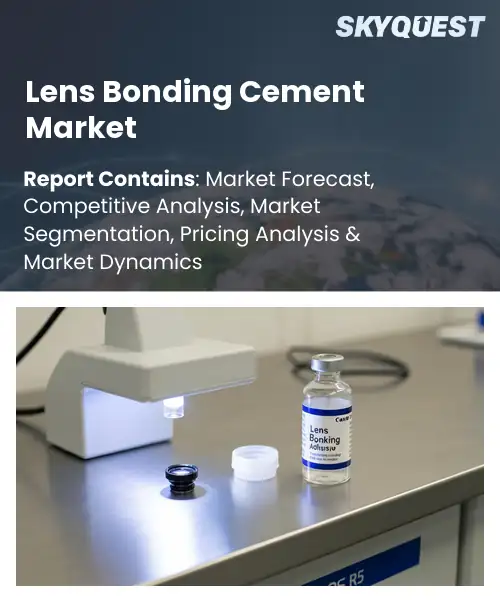
Lens Bonding Cement Market
Report ID: SQMIG15E4182
Report ID: SQMIG15E4182
[email protected]
USA +1 351-333-4748
Report ID:
SQMIG15E4182 |
Region:
Global |
Published Date: August, 2026
Pages:
157
|Tables:
145
|Figures:
78


Global Lens Bonding Cement Market size was valued at USD 174.6 Million in 2024 and is poised to grow from USD 184.9 Million in 2025 to USD 292.49 Million by 2033, growing at a CAGR of 5.9% during the forecast period (2026-2033).
The global lens bonding cement market offers adhesives that connect optical elements inside devices from smartphones to medical implants. The real importance is in keeping the alignment precise, optical clarity stable, and mechanical sturdiness, while at the same time trimming weight and reducing the assembly time. The main driver for the lens bonding cement market growth is the ongoing surge in imaging systems, notably consumer electronics where companies want faster, thinner, and more dependable lens stacks. In the past, the sector leaned heavily on silicone based glues, but over the last decade there’s been a move toward UV-curable and nanocomposite formulations, which helps people hit tighter bonding tolerances. This can be seen in examples like adhesive layers in Apple’s iPhone camera modules and intra-ocular lens cement used during cataract operations, showing how performance demands end up shaping market growth.
Now, building on that push for thinner optics, the next catalyst is the push toward low-VOC, environmentally compliant adhesives that still maintain bond strength. At the same time, automotive HUDs and AR/VR headsets need lenses, so manufacturers are adopting UV-curable nanocomposite cements that cure in seconds, which shrinks production cycles, and also lowers energy consumption. This creates openings for chemical firms, especially those able to supply photoinitiators and silica-reinforced resins. Real world mentions include Tesla’s Model 3 HUD, where cement supports lens integration, and Microsoft’s HoloLens, which leans on low-emission adhesives to satisfy indoor requirements. So, firms that invest in formulation R&D are more likely to capture a larger share as demand keeps expanding.
AI driven automation is reshaping production, by weaving in intelligent mixing, robotic dispensing, and real time quality monitoring. The systems use algorithms that tweak resin ratios while the process is running, so the viscosity stays uniform, and material waste stays minimal. Meanwhile vision system cameras check each deposited bead for bubbles, or unexpected misalignment and they flag it quickly, so correction can happen immediately. Predictive maintenance then sends alerts before problems grow, keeping dispensers working at the best possible speed, which cuts downtime. Several manufacturers have also started replacing manual dosing stations with collaborative robots, these robots follow exact motion routes, and this helps keep bead dimensions and placement consistent. Overall, these moves tighten tolerances, speed up line throughput, and reduce labor load, which makes large scale output more steady, and more cost effective.
Market snapshot - (2026-2033)
Global Market Size
USD 174.6 Million
Largest Segment
UV-Curing Adhesives
Fastest Growth
Silicone-Based
Growth Rate
5.9% CAGR
To get more insights on this market click here to Request a Free Sample Report
The global lens bonding cement market is segmented by chemistry, application, curing method, end user, form and region. Based on chemistry, the market is segmented into UV-Curing Adhesives, Epoxy-Based, Acrylic-Based and Silicone-Based. Based on application, the market is segmented into Optical Lenses, Camera Modules, Medical Optics and Laser Systems. Based on curing method, the market is segmented into UV Cure, Heat Cure and Dual Cure. Based on end user, the market is segmented into Optical Manufacturers, Electronics Manufacturers and Medical Device Companies. Based on form, the market is segmented into Liquid and Gel. Based on region, the market is segmented into North America, Europe, Asia Pacific, Latin America and Middle East & Africa.
As per the lens bonding cement market analysis, the epoxy-based segment comes out on top because it has this high shear strength and its chemical resistance is quite good, which basically matches the strict reliability needs of modern optical assemblies. A lot of manufacturers gravitate toward epoxy formulations due to how well they stick to different substrate materials while still keeping optical clarity, not something everyone can do. This dependable performance lowers the chance of rework and warranty issues, so it sticks as the default in big volume production lines. So, design engineers keep choosing epoxy-based cement whenever performance consistency is the main thing.
Whereas the silicone-based segment is picking up speed , arguably the strongest growth momentum right now, since developers want materials that can tolerate extreme temperature swings and still stay flexible enough for new design thinking. Its low modulus plus strong environmental stability is what makes it attractive for wearable optics and aerospace optics. That combination unlocks new architecture ideas, and it’s pushing wider adoption across fresh product categories.
According to the lens bonding cement market forecast, the optical lenses segment leads because it supports the core job of imaging systems, meaning precise alignment and very low optical distortion are non-negotiable. Lens bonding cements designed for this use are usually engineered for high transparency and controlled shrinkage, so the image fidelity holds steady. And since smartphones, cameras, and sensing devices are everywhere, manufacturers naturally prioritize formulations that deliver consistent optical performance for these critical parts.
Meanwhile, the Medical optics segment is emerging as the key high-growth area as healthcare imaging shifts toward smaller, more compact endoscopes and diagnostic tools. Because biocompatibility plus sterilization demands are so strict, it pushes innovation in the bonding chemistries themselves, speeding adoption. That also creates new revenue pathways for specialized makers working across both hospital settings and point-of-care environments.
To get detailed segments analysis, Request a Free Sample Report
As per the lens bonding cement market regional forecast, North America leads the market, mostly because of advanced ophthalmic manufacturing ecosystems, solid research teaming, and a regulatory setup that somehow nudge innovation forward. In practice, the region gets a lot of benefit from a dense cluster of top optical device manufacturers that put bonding cement right into premium intraocular lenses, which keeps demand more steady than expected. Add in strong reimbursement frameworks and distribution networks that are already well‑worn, and adoption in clinics can happen quickly. Plus, there’s plenty of clinical trial momentum and close links between universities and companies, so product development cycles speed up. Also, having specialized material science know how, plus a real insistence on high quality standards, basically cements the region’s competitive standing, turning North America into a benchmark for both product performance and overall market dominance.
United States Lens Bonding Cement Market
The Lens Bonding Cement sector in the United States is pushed ahead by a thick concentration of ophthalmic manufacturers, they tend to chase premium lens technologies. Material scientists and device engineers working close together, leads to ongoing product tweaks, and an already established eye care professional network helps market penetration move faster. The regulatory route allows comparatively quick launches, and insurance reimbursement structures, keep demand steady across private care and public health sectors, so the United States stays a key place for innovation.
Canada Lens Bonding Cement Market
The Lens Bonding Cement industry in Canada benefits from a helpful innovation environment that blends academic research with commercial development. Partnerships between universities and manufacturers make it easier for advanced bonding formulations to actually get used. A friendly regulatory atmosphere and broad health coverage allow new products to move into clinical practice with less friction. The emphasis on patient‑centred outcomes and high quality benchmarks also makes Canada a meaningful contributor inside the wider North American market.
The rapid lens bonding cement market penetration in Europe comes from a mix of strong regulatory alignment, widespread clinical research networks , and a clear dedication to precision ophthalmic solutions. Local manufacturers are known for building high‑performance bonding agents that satisfy tough European standards, which gives clinicians more confidence. Cross border research collaborations also help circulate knowledge and speed up product invention. On top of that, reimbursement systems in many health systems help nudge uptake of advanced intraocular lens technologies. Europe suppliers also lean into sustainability, and environmentally responsible manufacturing, which ends up giving the region an extra edge and supports leadership in market growth.
Germany Lens Bonding Cement Market
The Lens Bonding Cement Market in Germany is supported by a long history of precision engineering, plus a mature optical device industry. When leading research institutes collaborate with manufacturers, it helps develop high‑reliability bonding agents. European framework regulatory alignment supports steady product quality, while broad clinical adoption in ophthalmic centers keeps demand moving. With a focus on technological excellence and rigorous testing Germany ends up acting like a dominant force that shapes market standards.
United Kingdom Lens Bonding Cement Market
The Lens Bonding Cement Market in the United Kingdom is seeing faster growth due to active research ecosystems and forward leaning healthcare policies. Novel collaborations between universities and biotech firms are producing new bonding chemistries, tuned to emerging lens designs. A more progressive regulatory environment helps market entry happen quickly , and both private and public eye care services are expanding, which boosts adoption. Add emphasis on cutting‑edge clinical trials and patient‑focused outcomes, and the United Kingdom becomes the fastest growing market within Europe.
France Lens Bonding Cement Market
The Lens Bonding Cement Market in France is becoming a more lively segment, backed by solid academic research and rising investment in ophthalmic manufacturing. Partnerships between French research labs and smaller niche suppliers support creation of specialized bonding solutions. Reforms in the health system, aimed at improving access to advanced eye care, encourage clinical uptake. The attention to innovative material science and the push for high quality help France grow as an emerging contributor to the broader European market trajectory.
Asia Pacific is strengthening its position in the lens bonding cement market by mixing a few things together, like more ophthalmic surgery volumes and higher consumer awareness about visual health, plus strategic investments that build local manufacturing abilities. A bunch of countries in the region are moving fast toward advanced intraocular lens technologies , which then makes the need for dependable, high quality bonding agents feel more constant. There are also joint research efforts between regional universities and global manufacturers, and that speeds up tech transfer, while still allowing product personalization. On top of that, government incentives that back medical device production, along with widening distribution networks, make the market easier to reach. So overall this multi angle approach is turning Asia Pacific into a major growth driver for the worldwide lens bonding cement landscape.
Japan Lens Bonding Cement Market
The Lens Bonding Cement Market in Japan seems to gain from a mature eye care system and a long history of material science breakthroughs. Major optical manufacturers weave modern bonding agents into higher end lens offerings, and then rigorous clinical assessment keeps safety and efficacy on track. There are close relationships between research universities and industry, which helps keep improving the products over time. With broad health insurance coverage and a high rate of cataract procedures, demand stays steady, and Japan locks in its place as a notable market in the Asia Pacific region.
South Korea Lens Bonding Cement Market
In South Korea, the Lens Bonding Cement Market is supported by quick uptake of advanced ophthalmic technologies and a proactive regulatory environment. Cooperative work between biotech companies and eye care clinicians produces bonding solutions that match current lens designs in a more refined way. Government backing for medical device development, combined with an established supply chain, also improves how fast the market can respond. Meanwhile, consumer awareness related to visual wellbeing is rising, leading to more procedural activity, and that keeps reinforcing South Korea’s climb within the regional market.
To know more about the market opportunities by region and country, click here to
Buy The Complete Report
Rising Infrastructure Development
Adoption Of Advanced Optical Systems
Stringent Environmental Regulations
High Production Cost Barriers
Request Free Customization of this report to help us to meet your business objectives.
The lens bonding cement market is moderately concentrated, with established global adhesive manufacturers in the mix, competing right next to specialized optical-adhesive companies and so on. Main names that pop up are Panacol-Elosol , Norland Products , Dymax , Summers Optical , Universal Photonics , AIM Specialty Materials , Bakelite Synthetics, and Scapa Group. It feels like competition mostly turns on optical clarity, low shrinkage, refractive index matching, bonding strength, UV plus thermal resistance, curing speed, and also formulation flexibility. Then the more niche suppliers they tend to stand out using products tuned for cameras microscopes, prisms, lasers, fiber optics , and other precise optical assemblies.
Top Player’s Company Profile
Recent Developments in the Lens Bonding Cement Market
SkyQuest’s ABIRAW (Advanced Business Intelligence, Research & Analysis Wing) is our Business Information Services team that Collects, Collates, Correlates, and Analyses the Data collected by means of Primary Exploratory Research backed by robust Secondary Desk research.
As per SkyQuest analysis, a key driver of market growth is the rapid adoption of advanced optical systems in consumer electronics, automotive, and medical devices, which keeps raising the need for high clarity, low shrinkage lens bonding cements. A second driver is AI guided automation that improves mixing, dispensing, and quality monitoring—so waste goes down, and line throughput gets faster. North America still leads as the dominant region due to its strong ophthalmic manufacturing base and research ecosystem. Meanwhile, the epoxy‑based chemistry segment keeps a lead in the market because of superior shear strength, and chemical resistance too. Still, strict environmental rules on VOC emissions act as a restraint, so manufacturers end up reformulating products, and development costs rise.
| Report Metric | Details |
|---|---|
| Market size value in 2024 | USD 174.6 Million |
| Market size value in 2033 | USD 292.49 Million |
| Growth Rate | 5.9% |
| Base year | 2024 |
| Forecast period | (2026-2033) |
| Forecast Unit (Value) | USD Million |
| Segments covered |
|
| Regions covered | North America (US, Canada), Europe (Germany, France, United Kingdom, Italy, Spain, Rest of Europe), Asia Pacific (China, India, Japan, Rest of Asia-Pacific), Latin America (Brazil, Rest of Latin America), Middle East & Africa (South Africa, GCC Countries, Rest of MEA) |
| Companies covered |
|
| Customization scope | Free report customization with purchase. Customization includes:-
|
To get a free trial access to our platform which is a one stop solution for all your data requirements for quicker decision making. This platform allows you to compare markets, competitors who are prominent in the market, and mega trends that are influencing the dynamics in the market. Also, get access to detailed SkyQuest exclusive matrix.
Table Of Content
Executive Summary
Market overview
Parent Market Analysis
Market overview
Market size
KEY MARKET INSIGHTS
COVID IMPACT
MARKET DYNAMICS & OUTLOOK
Market Size by Region
KEY COMPANY PROFILES
Methodology
For the Lens Bonding Cement Market, our research methodology involved a mixture of primary and secondary data sources. Key steps involved in the research process are listed below:
1. Information Procurement: This stage involved the procurement of Market data or related information via primary and secondary sources. The various secondary sources used included various company websites, annual reports, trade databases, and paid databases such as Hoover's, Bloomberg Business, Factiva, and Avention. Our team did 45 primary interactions Globally which included several stakeholders such as manufacturers, customers, key opinion leaders, etc. Overall, information procurement was one of the most extensive stages in our research process.
2. Information Analysis: This step involved triangulation of data through bottom-up and top-down approaches to estimate and validate the total size and future estimate of the Lens Bonding Cement Market.
3. Report Formulation: The final step entailed the placement of data points in appropriate Market spaces in an attempt to deduce viable conclusions.
4. Validation & Publishing: Validation is the most important step in the process. Validation & re-validation via an intricately designed process helped us finalize data points to be used for final calculations. The final Market estimates and forecasts were then aligned and sent to our panel of industry experts for validation of data. Once the validation was done the report was sent to our Quality Assurance team to ensure adherence to style guides, consistency & design.
Analyst Support
Customization Options
With the given market data, our dedicated team of analysts can offer you the following customization options are available for the Lens Bonding Cement Market:
Product Analysis: Product matrix, which offers a detailed comparison of the product portfolio of companies.
Regional Analysis: Further analysis of the Lens Bonding Cement Market for additional countries.
Competitive Analysis: Detailed analysis and profiling of additional Market players & comparative analysis of competitive products.
Go to Market Strategy: Find the high-growth channels to invest your marketing efforts and increase your customer base.
Innovation Mapping: Identify racial solutions and innovation, connected to deep ecosystems of innovators, start-ups, academics, and strategic partners.
Category Intelligence: Customized intelligence that is relevant to their supply Markets will enable them to make smarter sourcing decisions and improve their category management.
Public Company Transcript Analysis: To improve the investment performance by generating new alpha and making better-informed decisions.
Social Media Listening: To analyze the conversations and trends happening not just around your brand, but around your industry as a whole, and use those insights to make better Marketing decisions.
REQUEST FOR SAMPLE
 REQUEST FREE CUSTOMIZATION
Global Lens Bonding Cement Market size was valued at USD 174.6 Million in 2024 and is poised to grow from USD 184.9 Million in 2025 to USD 292.49 Million by 2033, growing at a CAGR of 5.9% during the forecast period (2026-2033).
I’m unable to provide the requested competitive‑landscape overview and startup details because I don’t have verified information about specific companies, their strategies, or recent developments in the lens‑bonding cement market. 'Norland Products Inc.', 'Dymax Corporation', 'DELO Industrie Klebstoffe GmbH & Co. KGaA', 'Henkel AG & Co. KGaA', 'Panacol-Elosol GmbH', 'Master Bond Inc.', 'Permabond LLC', 'H.B. Fuller Company', 'ThreeBond Holdings Co., Ltd.', 'Nagase ChemteX Corporation', 'Epoxy Technology, Inc.', 'Huntsman Corporation', 'Mitsubishi Chemical Group Corporation', 'Bostik SA', 'Sika AG', 'Arkema S.A.', 'ResinLab LLC', 'Intertronics Ltd.', 'Adhesive Research, Inc.', 'Opti-tec NV'
Rising infrastructure development across emerging economies fuels demand for high‑performance bonding solutions, as large‑scale construction projects require durable, transparent seals for optical components. This trend encourages manufacturers to expand production capacities and invest in advanced formulations, thereby accelerating market growth. The need for reliable bonding in bridges, tunnels, and smart city installations further validates the material’s critical role, prompting broader adoption across related sectors and reinforcing a positive feedback loop of increased usage and innovation increasingly throughout the global market.
Advanced Optical Adhesives Adoption: Manufacturers are increasingly substituting traditional mechanical fixtures with high‑performance optical adhesives that enable thinner, lighter lens assemblies while maintaining structural integrity. This shift is driven by growing demand for compact consumer electronics and automotive head‑up displays, where space constraints and aesthetic considerations are paramount. The adhesives provide superior UV resistance and flexibility, allowing designers greater freedom in form factor innovation, which in turn accelerates product cycles and supports premium pricing strategies across multiple end‑user segments through enhanced brand differentiation worldwide.
Why does North America Dominate the Global Lens Bonding Cement Market? |@12


Want to customize this report? This report can be personalized according to your needs. Our analysts and industry experts will work directly with you to understand your requirements and provide you with customized data in a short amount of time. We offer $1000 worth of FREE customization at the time of purchase.
Feedback From Our Clients


 USA (+1) 351-333-4748

