LED Neon Lights Market
Report ID: SQMIG20D2643
Report ID: SQMIG20D2643
[email protected]
USA +1 351-333-4748
Report ID:
SQMIG20D2643 |
Region:
Global |
Published Date: June, 2026
Pages:
157
|Tables:
204
|Figures:
80


Global Led Neon Lights Market size was valued at USD 2.10 Billion in 2024 and is poised to grow from USD 2.25 Billion in 2025 to USD 3.92 Billion by 2033, growing at a CAGR of 7.19% during the forecast period (2026-2033).
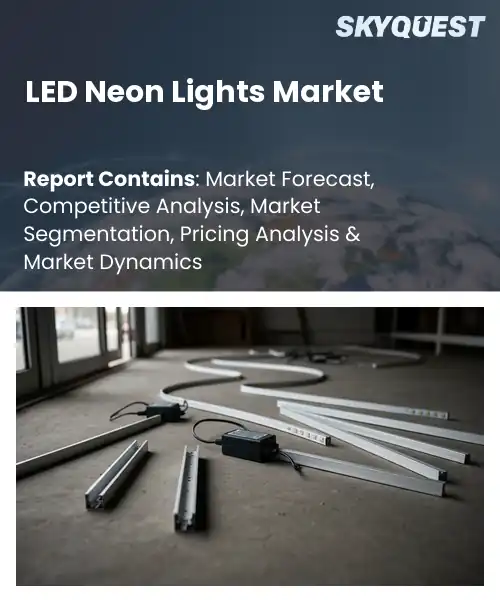
The LED neon lights market trends covers flexible, low-voltage lighting that mimics traditional glass neon but with greater energy efficiency, durability and design flexibility. This is important because cities, retailers and designers are increasingly looking for sustainable lighting that cuts operating costs and maintenance burdens while allowing for new aesthetic effects such as storefront fascia, experiential retail installations and immersive hospitality interiors. Starting with early LED strips and moving to advanced phosphor-converted and COB technologies, the development was followed and regulatory energy standards accelerated adoption by penalizing inefficient lighting. The main driver is the declining component prices, greater luminous efficacy and the growing environmental awareness of commercial end users worldwide.
A key element behind the global LED neon lights market growth is the maturity of flexible LED modules and integrated control systems that reduce installation complexity and enable dynamic lighting effects that were not possible with glass neon. Therefore, architects and brand managers are choosing LED neon for programmable storefront facades, wayfinding in transit hubs and programmable stage designs, and these real-world use cases are driving demand for custom length runs, color tuning and DMX-compatible fixtures. Retrofits are more attractive to facility managers with lower life-cycle costs and provide opportunities for suppliers and integrators to generate recurring revenue streams such as maintenance contracts and predictive analytics and sustainability.
How is IoT Improving Energy Efficiency in the LED Neon Lights Market?
The Internet of Things is revolutionizing energy consumption in the LED neon lights market share by integrating networked sensors, controls and analytics with intrinsically energy-efficient LED technology. Key features include real time dimming, occupancy sensing, adaptive brightness and centralized orchestration. The current state is seeing increasing adoption in retail, hospitality and architectural signage where visual impact needs to be balanced with lower operating costs. IoT delivers system-level visibility that allows operators to tune scenes, monitor fixture health and enable predictive maintenance. Examples include smart neon strips that dim with daylight, and connected signage platforms that reduce wasted run time while maintaining design intent.
Signify May 2026 Expanded its Wi Fi smart lighting portfolio to add neon flexible light strips that operate without an extra hub. This move makes IoT enabled scheduling, adaptive dimming and remote monitoring easier to access, helping installations to use less energy and scale across commercial and residential projects.
Market snapshot - (2026-2033)
Global Market Size
USD 2.1 Billion
Largest Segment
Flexible LED Neon Lights
Fastest Growth
Customized LED Neon Lights
Growth Rate
7.19% CAGR
To get more insights on this market click here to Request a Free Sample Report
Global LED neon lights market is segmented by product type, installation type, voltage type, application, color type, distribution channel, end user and region. Based on by product type, the market is segmented into flexible LED neon lights, rigid LED neon lights, LED neon sign boards and customized LED neon lights. Based on by installation type, the market is segmented into indoor LED neon lights, outdoor LED neon lights and waterproof LED neon lights. Based on by voltage type, the market is segmented into low voltage LED neon lights and high voltage LED neon lights. Based on by application, the market is segmented into architectural lighting, retail & commercial signage, hospitality & entertainment, residential decoration, automotive lighting, event & stage lighting and others. Based on by color type, the market is segmented into single color LED neon lights, RGB LED neon lights and tunable white LED neon lights. Based on by distribution channel, the market is segmented into online retail, specialty lighting stores, electrical & hardware stores, direct sales and others. Based on by end user, the market is segmented into residential users, commercial users and industrial users. Based on region, the market is segmented into North America, Europe, Asia Pacific, Latin America and Middle East & Africa.
Flexible LED neon lights segment is leading owing to its flexible nature and light weight construction which enables continuous, complex linear designs, that other offerings cannot match. Such versatility reduces installation complexity and time, meets the expectations of designers for seamless illumination and reduces handling and shipping costs. Consequently, flexible products are favoured by manufacturers and specifiers for an ever-wider range of signage, architectural and decorative uses, enhancing supply chain focus and uptake overall.
However, the fastest growing area is customized LED neon lights as the demand for personalized branding and personalized decor is rising. Digital design tools and modular fabrication reduce turnaround and cost, opening up the market to smaller businesses and consumers. “This wave of personalization creates premium opportunities and encourages suppliers to offer configurable online solutions.
The single color LED neon lights segment is the largest as the simplicity and predictable performance of these lights meet the basic requirements of most signage and decorative applications. Stable color output and simple control offers low manufacturing complexity and long term reliable operation. Buyers want a durable and cost effective product for large scale deployments. This drives suppliers to standardize production and distribution around single color products which results in broad availability and wide spread specification across commercial and residential projects.
Meanwhile, demand for dynamic programmable color effects in retail, hospitality and events is driving the fastest growing category of RGB LED neon lights. It is compatible with controllers and smart systems for animated signage and synchronized displays which attracts the designers. This interactivity invests in control ecosystems and creates new experiential applications that grow market opportunity.
To get detailed segments analysis, Request a Free Sample Report
Asia Pacific dominance is a result of a combination of strong manufacturing capabilities, design innovation and concentrated consumer demand across major economies. Fast-growing cities and busy commercial areas often use a lot of decorative and architectural lighting, and a long-standing supply chain of electronics makes it easy to produce cheaply and adopt new technology quickly. Local manufacturers focus on customization, energy efficiency and new form factors that appeal to lighting designers and retail brands. Government programs supporting smart city development and urban revitalization are indirectly driving demand for flexible, low-maintenance signage and façade illumination. Local designers, fabricators and LED component suppliers work together to speed up product evolution and market entry. The main producers are also oriented towards exports, which increases the regional influence to set pricing benchmarks and design trends that influence the dynamics of the global market.
LED neon lights market penetration in Japan is propelled by mature design ecosystem, strong electronics manufacturing base and propelling premium applications in retail, hospitality and public art installations. The demand for custom neon is fueled by a focus on craftsmanship and quality finishes. Local companies focus on integration with smart lighting controls and resilient materials suitable for urban environments. The interaction between creative studios and lighting manufacturers drives innovation, affecting design preferences and deployment strategies.
LED neon lights market outlook in South Korea leverages advanced electronics knowledge with urban shopping and entertainment districts, driving demand for innovative signage and immersive lighting. To meet designer expectations, manufacturers are looking at slim form factors, color fidelity and integration with digital controls. This collaboration between tech companies and creative agencies is a good thing. It enables faster development of prototypes and specialization in environments. This ecosystem enables the enhancement of visual effects and durable solutions suitable for high-traffic commercial usages.
The North America expansion is fueled by a mix of consumer-facing demand for experiential retail and entertainment environments, strategic adoption by signage and branding agencies, and advances in lighting control ecosystems. Venue owners and architects are specifying LED neon alternatives for façades, wayfinding, and interior accents, focusing on customizable aesthetics and energy-efficient alternatives to traditional neon. The existence of a mature distribution network and specialised fabrication shops enables customised installation and aftercare, thus increasing customer confidence. Cross-sector applications in hospitality, commercial real estate and themed attractions, and active collaboration between installers and technology providers, are driving accelerated adoption. Market maturity also drives the focus on quality, regulatory compliance, and integrated controls, making North America a key adopter of refined, high-performance LED neon solutions.
LED neon lights market forecast in United States is witnessing huge adoption in retail, hospitality and entertainment driven by need for unique signage and immersive environment. Robust supply chain enables custom fabrication and integration with smart building systems. Installers and manufacturers are concerned with durability and color fidelity to live up to the brand. Municipal permitting and building codes favor low maintenance, energy efficient alternatives. This causes managers and designers to choose LED neon for indoor and outdoor applications.
LED neon lights market regional forecast in Canada is propelled by adoption in retail, hospitality and outdoor wayfinding, aided by a network of specialized fabricators. Durability and weather-resistant construction are aligned with local climate considerations while designers are looking for flexible, energy-efficient solutions with consistent color performance. Tailored offerings are promoted by collaboration between lighting consultants, sign makers and property owners. It’s a practical philosophy, with an emphasis on aftercare and dependability for use in urban and suburban deployments.
Europe is about design-led applications, regulators are about efficiency and safety, and a lively network of lighting designers and specialized manufacturers all help make Europe stronger. The market players focus on high quality, accurate color rendering and sustainability of materials targeting upscale retail, cultural spaces and architectural projects. Cross-border cooperation in design and construction ecosystems enables the transfer of knowledge and supports standardised installation and maintenance practices. National design traditions and heritage preservation efforts also encourage quiet, low-impact lighting solutions that mimic neon aesthetics, while avoiding the usual disadvantages. Research clusters and small-scale manufacturers focus on product refinement and customization, allowing for unique finishes and installation techniques favored by bespoke projects. Consistent delivery and increasing uptake of LED neon solutions across a range of building types and conservation-sensitive applications are supported by investments in training for installers and closer alignment with building standards.
LED neon lights market regional outlook Germany emphasizes engineering quality, robust manufacturing, and compliance with stringent safety and performance standards, producing reliable, long-lasting solutions. Designers and sign makers collaborate closely with component suppliers to achieve precise color matching and durable housings. Demand is driven by modern commercial corridors, public infrastructure projects, and industrial branding needs that require resilient installations. A focus on lifecycle management and serviceability reinforces preference for LED neon alternatives.
LED neon lights market analysis in United Kingdom leverages a strong creative sector and historic centers where conservation and retail needs favor sensitive lighting. Design consultancies specify color-accurate, low-profile systems that replicate neon aesthetics while meeting heritage guidelines. Local fabricators deliver bespoke solutions for hospitality and performance venues. Emphasis on integration with smart controls and specialist installation practices supports refined visual presentations across contemporary developments and restored properties and urban regeneration projects.
LED neon lights industry in France is influenced by artistic heritage and retail innovation, driving demand for expressive lighting that complements architectural character. Designers and makers prioritize craftsmanship, fine detailing, and color nuance to achieve visual impact. Workshops and small manufacturers offer customized fabrication for galleries, boutiques, and cultural landmarks. Focus on aesthetic integration, careful installation, and maintenance practices supports adoption in settings where visual authenticity is essential, including heritage sites.
To know more about the market opportunities by region and country, click here to
Buy The Complete Report
Rising Demand For Energy Efficiency
Advancements In Flexible Lighting Technology
Higher Initial Costs Than Alternatives
Compatibility Limitations Across Lighting Systems
Request Free Customization of this report to help us to meet your business objectives.
Consolidation, brand partnerships, and product innovation are the main competitive factors in the global LED neon lights market. One example of the M&A strategy within lighting companies is Signify’s acquisition of Cooper Lighting to gain distribution and portfolio scale. Specialist brands differentiate themselves through partnerships with designers and artist licenses, as with Yellowpop and the Keith Haring Foundation, or through pushing silicone LED neon flex and addressable RGB pixel technologies, manufacturers say.
Top Player’s Company Profile
Recent Developments in the LED Neon Lights Market
SkyQuest’s ABIRAW (Advanced Business Intelligence, Research & Analysis Wing) is our Business Information Services team that Collects, Collates, Correlates, and Analyses the Data collected by means of Primary Exploratory Research backed by robust Secondary Desk research. As per SkyQuest analysis, the global LED neon lights market is primarily propelled by the rising energy efficiency demand which is complemented by the reducing component costs and enhanced luminous efficacy. The development of flexible lighting technology, enabling complex and customizable designs, further enhances the market growth. LED neon lights are leading the market due to their flexibility, ability to be bent and easy installation. Asia Pacific is leading the market due to strong manufacturing, urbanization and export orientation. The higher upfront purchase and installation costs compared to conventional alternatives remain a major restraint and can hamper the uptake among price sensitive buyers. The opportunities are smart integration and IoT-enabled control systems that lower operating expenses and open up recurring service revenues.
| Report Metric | Details |
|---|---|
| Market size value in 2024 | USD 2.1 Billion |
| Market size value in 2033 | USD 3.92 Billion |
| Growth Rate | 7.19% |
| Base year | 2024 |
| Forecast period | (2026-2033) |
| Forecast Unit (Value) | USD Billion |
| Segments covered |
|
| Regions covered | North America (US, Canada), Europe (Germany, France, United Kingdom, Italy, Spain, Rest of Europe), Asia Pacific (China, India, Japan, Rest of Asia-Pacific), Latin America (Brazil, Rest of Latin America), Middle East & Africa (South Africa, GCC Countries, Rest of MEA) |
| Companies covered |
|
| Customization scope | Free report customization with purchase. Customization includes:-
|
To get a free trial access to our platform which is a one stop solution for all your data requirements for quicker decision making. This platform allows you to compare markets, competitors who are prominent in the market, and mega trends that are influencing the dynamics in the market. Also, get access to detailed SkyQuest exclusive matrix.
Table Of Content
Executive Summary
Market overview
Parent Market Analysis
Market overview
Market size
KEY MARKET INSIGHTS
COVID IMPACT
MARKET DYNAMICS & OUTLOOK
Market Size by Region
KEY COMPANY PROFILES
Methodology
For the LED Neon Lights Market, our research methodology involved a mixture of primary and secondary data sources. Key steps involved in the research process are listed below:
1. Information Procurement: This stage involved the procurement of Market data or related information via primary and secondary sources. The various secondary sources used included various company websites, annual reports, trade databases, and paid databases such as Hoover's, Bloomberg Business, Factiva, and Avention. Our team did 45 primary interactions Globally which included several stakeholders such as manufacturers, customers, key opinion leaders, etc. Overall, information procurement was one of the most extensive stages in our research process.
2. Information Analysis: This step involved triangulation of data through bottom-up and top-down approaches to estimate and validate the total size and future estimate of the LED Neon Lights Market.
3. Report Formulation: The final step entailed the placement of data points in appropriate Market spaces in an attempt to deduce viable conclusions.
4. Validation & Publishing: Validation is the most important step in the process. Validation & re-validation via an intricately designed process helped us finalize data points to be used for final calculations. The final Market estimates and forecasts were then aligned and sent to our panel of industry experts for validation of data. Once the validation was done the report was sent to our Quality Assurance team to ensure adherence to style guides, consistency & design.
Analyst Support
Customization Options
With the given market data, our dedicated team of analysts can offer you the following customization options are available for the LED Neon Lights Market:
Product Analysis: Product matrix, which offers a detailed comparison of the product portfolio of companies.
Regional Analysis: Further analysis of the LED Neon Lights Market for additional countries.
Competitive Analysis: Detailed analysis and profiling of additional Market players & comparative analysis of competitive products.
Go to Market Strategy: Find the high-growth channels to invest your marketing efforts and increase your customer base.
Innovation Mapping: Identify racial solutions and innovation, connected to deep ecosystems of innovators, start-ups, academics, and strategic partners.
Category Intelligence: Customized intelligence that is relevant to their supply Markets will enable them to make smarter sourcing decisions and improve their category management.
Public Company Transcript Analysis: To improve the investment performance by generating new alpha and making better-informed decisions.
Social Media Listening: To analyze the conversations and trends happening not just around your brand, but around your industry as a whole, and use those insights to make better Marketing decisions.
REQUEST FOR SAMPLE
 REQUEST FREE CUSTOMIZATION
Global Led Neon Lights Market size was valued at USD 2.1 Billion in 2024 and is poised to grow from USD 2.25 Billion in 2025 to USD 3.92 Billion by 2033, growing at a CAGR of 7.19% during the forecast period (2026-2033).
Competitive dynamics in the global LED neon lights market center on consolidation, brand collaborations, and product innovation. Large lighting firms pursue M&A to secure distribution and portfolio scale as Signify’s acquisition of Cooper Lighting illustrates. Specialist brands deploy partnerships with designers and artist licenses as Yellowpop did with the Keith Haring Foundation, while manufacturers push silicone LED neon flex and addressable RGB pixel technologies to differentiate offerings. 'Signify', 'OSRAM', 'Samsung Electronics', 'LEDVANCE', 'Acuity Brands', 'GE Lighting', 'Neo-Neon Holdings', 'Environmental Lights', 'Elemental LED', 'Govee', 'Havells India', 'Wipro Lighting', 'NVC Lighting', 'Opple Lighting', 'MLS Co.', 'Lumenpulse', 'Sengled', 'Unilumin Group', 'Litecraft', 'Aura LED'
Customization And Flexible Form Factors: Demand for unique branded environments and architectural creativity is driving preference for bendable, cuttable LED neon solutions that enable bespoke signage and sculptural lighting. Designers, retailers and experiential marketers value the ability to adapt light profiles to irregular geometries and dynamic installations, reducing dependence on rigid tubing. Manufacturers offering modular systems and design services improve product differentiation, accelerate specification, and enable closer collaboration between creative and technical teams, opening new commercial and high end residential applications.
Why does Asia Pacific Dominate the Global LED Neon Lights Market? |@12


Want to customize this report? This report can be personalized according to your needs. Our analysts and industry experts will work directly with you to understand your requirements and provide you with customized data in a short amount of time. We offer $1000 worth of FREE customization at the time of purchase.
Feedback From Our Clients


 USA (+1) 351-333-4748

