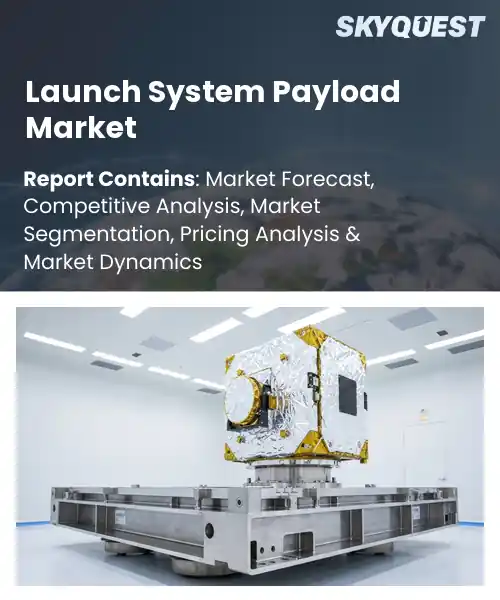
Launch System Payload Market
Report ID: SQMIG20A2801
Report ID: SQMIG20A2801
[email protected]
USA +1 351-333-4748
Report ID:
SQMIG20A2801 |
Region:
Global |
Published Date: July, 2026
Pages:
157
|Tables:
147
|Figures:
78


Global Launch System Payload Market size was valued at USD 2.18 Billion in 2024 and is poised to grow from USD 2.46 Billion in 2025 to USD 6.45 Billion by 2033, growing at a CAGR of 12.8% during the forecast period (2026-2033).
The global launch system payload market encompasses the commercial and governmental demand for transporting satellites, scientific instruments, and deep‑space probes aboard rockets. Its significance lies in enabling communications, Earth observation, and navigation services that underpin modern economies. Historically the sector evolved from Cold‑War‑era expendable launch vehicles to today’s mixed fleet of reusable first‑stages and small‑sat rideshare solutions. The primary driver has been the exponential rise in satellite constellations, exemplified by SpaceX’s Starlink and OneWeb projects that collectively aim to deploy thousands of low‑Earth‑orbit units. These networks demand frequent, cost‑effective launches, compelling manufacturers to lower per‑kilogram prices and improve turnaround times globally. A second pivotal factor shaping the market is the convergence of commercial launch providers with emerging low‑cost propulsion technologies, which together generate a feedback loop of affordability and demand. When launch costs drop, satellite operators can afford larger constellations, which in turn increase launch volume and stimulate further price competition among firms such as Rocket Lab, Arianespace, and Blue Origin. This effect is evident in the 2023‑2024 surge of rideshare missions, where payloads ranging from Earth‑imaging cubesats to lunar lander prototypes share a single Falcon 9 flight, reducing individual mission expenses by up to 40 percent, while enhancing schedule reliability for diverse customers globally.
How is AI-driven automation reshaping the launch system payload market?
AI-driven automation is redefining the launch system payload market by embedding intelligent software into every stage of the value chain. Machine‑learning models now generate optimal payload configurations, predict structural stresses, and streamline integration processes, cutting design cycles dramatically. Automated factories equipped with AI‑guided robotics assemble rockets with higher precision, reducing human error and material waste. Real‑time data analytics enable dynamic mission planning, allowing operators to adjust trajectories and payload schedules on the fly. These capabilities collectively accelerate time‑to‑orbit, lower costs, and improve reliability, making the market more attractive to satellite operators and fostering rapid innovation across the ecosystem.Relativity Space, 2026, showcases this shift as its fully AI‑controlled production line for the Terran R vehicle shortens build times and enhances payload flexibility, directly supporting market expansion and operational efficiency.
Market snapshot - (2026-2033)
Global Market Size
USD 2.18 Billion
Largest Segment
Satellites
Fastest Growth
Human Spaceflight Payloads
Growth Rate
12.8% CAGR
To get more insights on this market click here to Request a Free Sample Report
Global launch system payload market is segmented by payload type, launch vehicle, orbit, end user, payload mass and region. Based on payload type, the market is segmented into Satellites, Cargo, Scientific Instruments and Human Spaceflight Payloads. Based on launch vehicle, the market is segmented into Small Launch Vehicles, Medium Launch Vehicles and Heavy Launch Vehicles. Based on orbit, the market is segmented into Low Earth Orbit (LEO), Medium Earth Orbit (MEO), Geostationary Orbit (GEO) and Deep Space Missions. Based on end user, the market is segmented into Commercial, Government, Defense and Research Organizations. Based on payload mass, the market is segmented into Small Payloads, Medium Payloads and Heavy Payloads. Based on region, the market is segmented into North America, Europe, Asia Pacific, Latin America and Middle East & Africa.
Satellites segment dominates because it fulfills the core commercial and governmental demand for orbital services, providing revenue streams that sustain launch providers. The broad utility of communication, imaging and navigation functions drives consistent payload pipelines, encouraging manufacturers to prioritize satellite integration. Its established supply chains and reliability expectations reinforce investor confidence, making it the central pillar of the launch system payload market and enabling continuous mission scheduling across global networks.
However, Scientific instruments segment is witnessing the strongest growth momentum because planetary exploration and Earth observation research demand specialized payloads. Advances in miniaturization and data fidelity encourage mission planners to allocate more mass to these instruments, expanding opportunities for launch slots. This acceleration fuels market diversification and creates revenue channels for providers.
Medium launch vehicles segment dominates because they strike a balance between payload capacity and cost efficiency, meeting the sweet spot for most commercial satellite constellations and governmental missions. Their proven reliability and flexible performance envelope attract repeat customers, fostering long term launch contracts. This alignment with diverse mission requirements consolidates their central role in shaping the launch system payload market by offering scalable services that adapt to evolving orbital architectures and customer schedules.
Meanwhile, Small launch vehicles segment is emerging as the key high growth area because development cycles and reusable technologies lower entry barriers for niche payloads and constellations. Growing demand for rideshare opportunities and access to low Earth orbit drives investment in miniature boosters. This surge expands launch cadence and opens market niches for providers.
To get detailed segments analysis, Request a Free Sample Report
North America maintains its leadership in the launch system payload market through a combination of mature aerospace infrastructure, deep capital ecosystems, and a concentration of legacy and emerging launch providers. The region benefits from a robust supply chain that spans advanced materials, propulsion technologies, and high‑precision manufacturing, enabling rapid development cycles and reliable payload integration. Strong collaboration between government agencies, research institutions, and private enterprises fuels continuous innovation, while a culture of risk‑tolerant investment supports ambitious commercial and defense missions. Additionally, the presence of major launch sites with favorable geographic locations provides operational flexibility and high launch cadence, reinforcing the region’s ability to meet diverse customer requirements across satellite, scientific, and exploratory domains. The ecosystem also attracts top engineering talent from global universities, fostering a pipeline of expertise that sustains long‑term competitiveness.
Launch System Payload Market in United States is anchored by a dense network of launch service providers that span both established and innovative firms. The country leverages extensive research facilities, a strong venture capital environment, and a regulatory framework that encourages rapid certification. Close proximity between manufacturing hubs and launch complexes reduces logistics complexity, while collaborative programs with defense and commercial sectors drive continuous refinement of payload integration processes globally.
Launch System Payload Market in Canada benefits from an aerospace community that emphasizes reliability and cost efficiency. The nation’s launch sites offer advantageous latitudinal positions for polar and sun‑synchronous missions, attracting satellite operators. Government incentives and partnerships with research institutions nurture propulsion research, while a skilled workforce supports manufacturing. This blend of location, supportive policy, and expertise positions Canada as a valuable contributor to the broader North American launch ecosystem.
Europe’s launch system payload market is propelled by a coordinated emphasis on sustainability, technological diversification, and strong governmental backing. Collaborative frameworks across the continent encourage joint development of reusable launch vehicles and advanced payload integration techniques, reducing cost barriers for commercial customers. The presence of mature satellite manufacturing clusters creates a seamless supply chain that accelerates time‑to‑orbit. Policy instruments that prioritize strategic autonomy and space security stimulate investment in indigenous propulsion and navigation capabilities. Moreover, a vibrant ecosystem of research universities and specialized suppliers fuels continuous innovation, positioning Europe as a competitive hub for both governmental and private payload missions. The region also benefits from a dense network of launch sites that provide varied orbital inclinations, enabling tailored mission profiles for a wide array of customers. Cross‑border regulatory harmonization further simplifies certification processes, encouraging multinational collaborations and expanding market reach.
Launch System Payload Market in Germany is characterized by an emphasis on engineering excellence and launch solutions. The country’s industrial base supplies components for propulsion and avionics, while research programs with European agencies accelerate technology readiness. Government incentives promote development of reusable stages, and a network of test facilities supports prototyping. This blend of depth and supportive policy enables Germany to play a key role in Europe’s evolving payload ecosystem.
Launch System Payload Market in United Kingdom is driven by a mix of launch firms and initiatives. The regulatory environment encourages certification and supports models such as small‑sat rideshare services. Strong ties between universities and industry foster research in propulsion and payload integration, while investment in launch sites expands access to trajectories. This ecosystem accelerates market entry for payload providers and reinforces United Kingdom’s reputation as a growing launch hub.
Launch System Payload Market in France remains dominant through a national space program and a mature industrial base. The country hosts launch facilities that provide access to a broad range of orbits, attracting both governmental and commercial customers. Strong collaboration between aerospace giants, specialized suppliers, and research institutes drives improvement in propulsion efficiency and payload handling. Supportive policy frameworks and investments ensure France sustains leadership role within Europe’s launch ecosystem.
Asia Pacific is rapidly strengthening its position in the launch system payload market by leveraging a combination of emerging launch providers, strategic geographic advantages, and increasing governmental commitment to space capabilities. The region’s proximity to equatorial and high‑latitude launch sites enables efficient access to a wide spectrum of orbital inclinations, attracting a diverse set of satellite operators. Growing investment in reusable launch technologies and advanced propulsion systems reduces cost barriers and enhances mission flexibility. Collaborative initiatives between national space agencies and private enterprises foster a vibrant ecosystem of research, testing, and manufacturing. This confluence of technical innovation, supportive policy, and market demand positions Asia Pacific as a key contributor to the global launch landscape. The growing demand for constellations supporting communications, earth observation, and navigation services further fuels regional launch activity. Additionally, the emergence of dedicated small‑sat launch vehicles expands access for niche payloads, reinforcing the region’s comprehensive service offering.
Launch System Payload Market in Japan benefits from an aerospace heritage and a skilled engineering workforce. The country operates launch sites that provide efficient trajectories to low‑earth orbits, supporting a wide range of commercial and scientific missions. Strong collaboration between government agencies, research universities, and private launch firms drives innovation in reusable rockets and payload adapters. This ecosystem enables Japan to deliver reliable launch services within Asia Pacific regional market.
Launch System Payload Market in South Korea is propelled by government programs and an expanding private sector. The launch facilities offer access to a variety of orbital inclinations, making them attractive for regional satellite operators. Investment in propulsion and launch vehicle technologies reduces cost and improves time. Cooperation between universities, research institutes, and industry accelerates technology transfer, positioning South Korea as a contributor to the broader Asia Pacific launch ecosystem.
To know more about the market opportunities by region and country, click here to
Buy The Complete Report
Increasing Demand for Small Satellites
Reusable Launch Vehicle Advancements
Regulatory Uncertainty Across Jurisdictions
High Development Costs for New Payloads
Request Free Customization of this report to help us to meet your business objectives.
The launch system payload market is shaped by fierce competition among emerging launch providers, satellite operators and integration specialists, driving rapid technology adoption, strategic partnerships and consolidation. Companies such as Moonshot Space are leveraging $12 million funding to accelerate electromagnetic launch technology, while Y Combinator‑backed ventures closed a $170 million Series A in March 2026 to scale payload‑service platforms, illustrating how capital inflows and M&A activity intensify market rivalry and spur innovation.
Top Player’s Company Profile
Recent Developments
SkyQuest’s ABIRAW (Advanced Business Intelligence, Research & Analysis Wing) is our Business Information Services team that Collects, Collates, Correlates, and Analyses the Data collected by means of Primary Exploratory Research backed by robust Secondary Desk research. As per SkyQuest analysis the global launch system payload market is projected to expand from $2.46 billion in 2025 to $6.45 billion by 2033, driven primarily by the soaring demand for small satellites that push providers to offer flexible, cost‑effective rideshare options. A second catalyst is the rapid progress in reusable launch‑vehicle technology, which lowers launch costs and accelerates cadence, further widening the addressable market. The satellites segment remains the dominant payload type, underpinning the majority of commercial and governmental revenue streams, while North America continues to lead the market thanks to its mature infrastructure, deep capital pools and dense launch‑site network. However, regulatory uncertainty across jurisdictions still hampers investment timelines and could temper growth.
| Report Metric | Details |
|---|---|
| Market size value in 2024 | USD 2.18 Billion |
| Market size value in 2033 | USD 6.45 Billion |
| Growth Rate | 12.8% |
| Base year | 2024 |
| Forecast period | (2026-2033) |
| Forecast Unit (Value) | USD Billion |
| Segments covered |
|
| Regions covered | North America (US, Canada), Europe (Germany, France, United Kingdom, Italy, Spain, Rest of Europe), Asia Pacific (China, India, Japan, Rest of Asia-Pacific), Latin America (Brazil, Rest of Latin America), Middle East & Africa (South Africa, GCC Countries, Rest of MEA) |
| Companies covered |
|
| Customization scope | Free report customization with purchase. Customization includes:-
|
To get a free trial access to our platform which is a one stop solution for all your data requirements for quicker decision making. This platform allows you to compare markets, competitors who are prominent in the market, and mega trends that are influencing the dynamics in the market. Also, get access to detailed SkyQuest exclusive matrix.
Table Of Content
Executive Summary
Market overview
Parent Market Analysis
Market overview
Market size
KEY MARKET INSIGHTS
COVID IMPACT
MARKET DYNAMICS & OUTLOOK
Market Size by Region
KEY COMPANY PROFILES
Methodology
For the Launch System Payload Market, our research methodology involved a mixture of primary and secondary data sources. Key steps involved in the research process are listed below:
1. Information Procurement: This stage involved the procurement of Market data or related information via primary and secondary sources. The various secondary sources used included various company websites, annual reports, trade databases, and paid databases such as Hoover's, Bloomberg Business, Factiva, and Avention. Our team did 45 primary interactions Globally which included several stakeholders such as manufacturers, customers, key opinion leaders, etc. Overall, information procurement was one of the most extensive stages in our research process.
2. Information Analysis: This step involved triangulation of data through bottom-up and top-down approaches to estimate and validate the total size and future estimate of the Launch System Payload Market.
3. Report Formulation: The final step entailed the placement of data points in appropriate Market spaces in an attempt to deduce viable conclusions.
4. Validation & Publishing: Validation is the most important step in the process. Validation & re-validation via an intricately designed process helped us finalize data points to be used for final calculations. The final Market estimates and forecasts were then aligned and sent to our panel of industry experts for validation of data. Once the validation was done the report was sent to our Quality Assurance team to ensure adherence to style guides, consistency & design.
Analyst Support
Customization Options
With the given market data, our dedicated team of analysts can offer you the following customization options are available for the Launch System Payload Market:
Product Analysis: Product matrix, which offers a detailed comparison of the product portfolio of companies.
Regional Analysis: Further analysis of the Launch System Payload Market for additional countries.
Competitive Analysis: Detailed analysis and profiling of additional Market players & comparative analysis of competitive products.
Go to Market Strategy: Find the high-growth channels to invest your marketing efforts and increase your customer base.
Innovation Mapping: Identify racial solutions and innovation, connected to deep ecosystems of innovators, start-ups, academics, and strategic partners.
Category Intelligence: Customized intelligence that is relevant to their supply Markets will enable them to make smarter sourcing decisions and improve their category management.
Public Company Transcript Analysis: To improve the investment performance by generating new alpha and making better-informed decisions.
Social Media Listening: To analyze the conversations and trends happening not just around your brand, but around your industry as a whole, and use those insights to make better Marketing decisions.
REQUEST FOR SAMPLE
 REQUEST FREE CUSTOMIZATION


Want to customize this report? This report can be personalized according to your needs. Our analysts and industry experts will work directly with you to understand your requirements and provide you with customized data in a short amount of time. We offer $1000 worth of FREE customization at the time of purchase.
Feedback From Our Clients


 USA (+1) 351-333-4748

