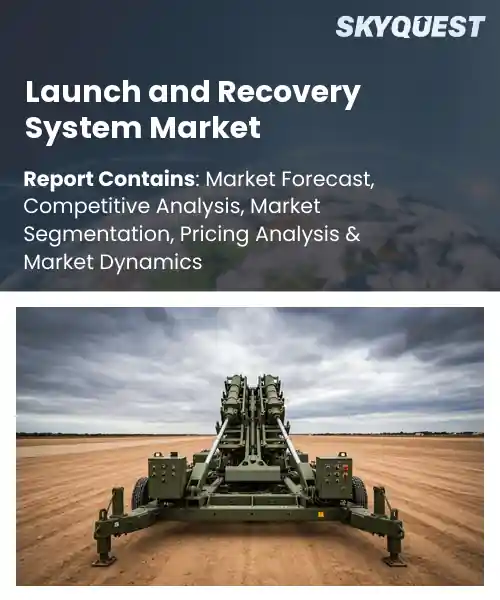
Launch and Recovery System Market
Report ID: SQMIG20A2828
Report ID: SQMIG20A2828
[email protected]
USA +1 351-333-4748
Report ID:
SQMIG20A2828 |
Region:
Global |
Published Date: August, 2026
Pages:
157
|Tables:
119
|Figures:
77


Global Launch And Recovery System Market size was valued at USD 4.62 Billion in 2024 and is poised to grow from USD 5.22 Billion in 2025 to USD 13.77 Billion by 2033, growing at a CAGR of 12.9% during the forecast period (2026-2033).
The major factor responsible for the global rise in the launch and recovery system market is the rising need for UAVs in both the defense and commercial industries. This includes such launch and recovery systems like catapults, arresting gear, and autonomous pallets that can be used to release and recover payload from locations like aircraft carrier decks, isolated bases, or roofs. Previously, launch and recovery systems were only available for manned aircraft carriers; however, with the rising purchase of UAVs since 2000, light-weight systems have had to be developed. The electromagnetic aircraft launch system employed by the U.S. Navy for carrier-based drones is an example.
Another important trend contributing to market growth is the emergence of autonomous marine platforms that require integration of launch and recovery equipment. In order to replace manned ships with unmanned surface and underwater vehicles, naval services as well as offshore oil-gas companies are seeking for reliable and compact catapults along with winch-based recovery systems resistant to waves. The economic benefit of lower labor costs and lower fuel expenditures motivates the development of equipment capable of launching UAVs from a deck of a moving ship during high wave activity. For instance, the Norwegian Coast Guard recently installed a hydraulic catapult aboard its patrol cutter in order to launch sea search UAVs.
How is AI-driven Automation Reshaping the Launch and Recovery System Market?
AI-powered automation is bringing new life to launch and recovery systems through the use of intelligent sensors, real-time analytics, and autonomous feedback loops in the deck hardware and recovery gear. The technologies are enabling predictive maintenance, shortened cycle times, and adaptive positioning based on sea state changes, which do not require any human input. In such a case, operators will be dependent on machine learning algorithms, which are used to predict the wear and tear of components and optimize the hydraulic pressure applied during launches. Such an approach will enable better integration with the navigational software aboard the vessel, hence creating coordinated launching operations. The adoption of the digital twin technology and edge computing will ensure resilience in the ecosystem while fulfilling mission requirements.
Market snapshot - (2026-2033)
Global Market Size
USD 4.62 Billion
Largest Segment
Crane Launch Systems
Fastest Growth
A-Frame Systems
Growth Rate
12.9% CAGR
To get more insights on this market click here to Request a Free Sample Report
Global launch and recovery system market is segmented by system type, platform, application, end user and region. Based on system type, the market is segmented into Crane Launch Systems, Ramp Launch Systems, A-Frame Systems and Davit Systems. Based on platform, the market is segmented into Naval Vessels, Offshore Vessels and Research Vessels. Based on application, the market is segmented into Unmanned Surface Vehicles, Unmanned Underwater Vehicles, Rescue Boats and ROV Operations. Based on end user, the market is segmented into Defense, Offshore Energy and Research Organizations. Based on region, the market is segmented into North America, Europe, Asia Pacific, Latin America and Middle East & Africa.
The crane launch system category dominates owing to their ability to offer the greatest payload capabilities and accuracy for positioning of large unmanned platforms in varied vessels. The reliability of the systems matches that of the maritime environment in terms of the continuous operation of launching and recovering unmanned systems without requiring downtime. Crane systems have well-established technology and reliable vendors, thus making them ideal for military and offshore energy companies which require reliable performance.
Ramp launch systems are experiencing the most rapid growth owing to their modular nature that enables fast installation and reconfigurability to undertake varied missions. The low weight and fast installation of ramp systems are attracting new entrants into the market who prefer the cost effective systems.
USV is dominating since it is the most utilized autonomous platform which needs to be launched and recovered very often. Its ability to do multiple functions makes the market for its handling equipment more dynamic. In order to achieve fast turnaround and efficient usage of the equipment, it is more attractive to develop handling systems tailored to the needs of USVs.
In addition, the high growth area is represented by rescue boats due to increased regulations concerning the safety of the coastal zones as well as increased humanitarian aid initiatives. Advanced recovery systems allow launching boats in harsh conditions, thus making them more attractive to potential customers.
To get detailed segments analysis, Request a Free Sample Report
The leading standing of North America in the global Launch and Recovery System market can be attributed to the mature aerospace industry base, substantial military budget, and presence of a rich ecosystem of original equipment manufacturers and service providers. The U.S. features an aggregation of major launch vehicle projects and research organizations that ensure constant technological advancement in the field of recovery system development. Canada provides its competitive edge through expertise in composite materials and regulatory framework conducive to testing and commercialization activities. Cross-border collaboration provides ample opportunities for knowledge exchange and joint business initiatives, thus ensuring supply chain stability. The region also features efficient funding and incentive systems that reduce barriers to entry for new market entrants and geographical closeness to major spaceports.
Launch & Recovery System Market in the United States features integration with commercial launch services providers and security-related projects. There is a wide range of research labs, testing facilities, and manufacturing plants supporting the innovation cycle. Closely coordinated work of defense organizations and private sector innovators makes conditions ripe for development of cutting-edge recovery technologies, while the well-developed supply chain guarantees the availability of components. Regulatory bodies provide safety and certification assistance for new players.
Canada Launch and Recovery System Market leverages expertise in composite materials and a research ecosystem anchored by universities and government labs. Proximity to major North American launch sites enables testing and iterative improvement of recovery mechanisms. Incentive programs foster participation from tech firms, while regulatory bodies maintain rigorous safety standards that facilitate market entry. The combination of cost‑effective engineering capabilities and supportive policy environment positions Canada as an essential contributor to regional supply chains.
The European Launch and Recovery Systems market is experiencing rapid growth owing to strategic investment plans, established infrastructure, and sustainability. Cooperative structures among member countries allow companies to collaborate on projects and utilize each other’s testing sites. The presence of prominent aerospace companies along with innovative startups creates an environment that favors the transfer of technology. Regulatory alignment helps overcome the obstacles and facilitates the certification process, while financial incentives from governments promote the use of new recovery technologies in both commercial and military missions. The growing interest in satellite constellations and space logistics drives the growth of the market in Europe. Public-private partnerships are another factor contributing to the success of the industry; research programs are aligned with business goals and the development of new technologies is encouraged by government initiatives.
Launch and Recovery System Market in Germany is emerging through strong engineering talent and a growing network of specialized suppliers. Close ties between research institutes and automotive manufacturers enable cross‑industry innovation in lightweight structures and automation. Government initiatives focus on developing modular recovery solutions that can support both national defense and commercial launch activities. Access to European test ranges and a collaborative industrial policy foster rapid prototyping, positioning Germany as an increasingly important contributor to the regional supply chain.
Launch and Recovery System Market in the United Kingdom is experiencing the fastest growth in Europe, driven by a startup ecosystem and defense investment. The country benefits from research universities that produce recovery technologies, particularly in handling and diagnostics. Collaboration between government agencies and commercial players accelerates test‑flight campaigns and reduces time to market. Coastal test sites and maritime expertise enhance the United Kingdom’s ability to develop and certify recovery systems for a range of launch operators.
Launch & Recovery System Market in France is still the most dominating one owing to the presence of a strong legacy of aerospace industry along with an entire industrial infrastructure. There exists an intimate collaboration between the leading aerospace integrators and state agencies which facilitates innovations in terms of precision in recovery and refurbishing. Favorable government policy ensures that there is adequate funding for the co-development initiatives, as well as promotes the export of French expertise. Certified organizations provide strong safety standards, whereas a supplier base ensures availability of key components.
Asia Pacific is gaining traction in the market for Launch and Recovery Systems due to the region's fast industrialization, government policies, and growth in the commercial launch segment. Countries within the region are making significant investments in test centers and promoting collaboration between established aerospace companies and technology startups. The focus on automation, robotics, and advanced materials will hasten the production of efficient recovery systems that can support high-frequency launches. Collaboration within the region will foster knowledge exchange and standardization, and the close proximity to satellite constellations will drive demand for recovery services.
Japanese Market for Launch and Recovery Systems is fortunate enough to have an excellent tradition of precision engineering and a developed space program. Closely working government agencies responsible for space and top-notch manufacturing companies encourage innovation in designing of small recovery systems and reusability of parts. Having an opportunity to use robotic technology and knowledge of artificial intelligence, it is possible to develop autonomous recovery system and thereby decrease the turnaround time.
Market for Launch & Recovery Systems in South Korea is developing based on targeted government initiatives along with an active private sector that prioritizes modularity and speed of production. Strong industrial foundation of South Korea related to semiconductors and electronics helps in developing highly sophisticated sensors and real-time monitoring systems. Collaboration between aerospace companies and defense contractors facilitates the quick qualification of new recovery ideas. Coastal test ranges along with favorable regulations help in quick deployment of solutions.
To know more about the market opportunities by region and country, click here to
Buy The Complete Report
Increasing Adoption of Cloud Solutions
Regulatory Support for Remote Work
High Initial Capital Expenditure
Limited Interoperability with Legacy Systems
Request Free Customization of this report to help us to meet your business objectives.
The Launch and Recovery System market across the world is very competitive, and is becoming more so based on reusable launches, quick turnaround, payload capacity, and efficient recovery. The competitive advantage that SpaceX currently holds is due to its proven and reusable Falcon 9 system, as well as its high rate of launches. Blue Origin, alongside other new entrants into the market, are attempting to compete with existing players by developing their own reusable heavy lift systems. Propulsive landing, stage recovery, reusability, quick launches, payload capacity, and quick turnaround are among the competitive factors that companies must deal with.Technological reliability, recovery rates, production efficiency, launch sites, government contracts, and cost-effective launches are some of the major competitive advantages.
SkyQuest’s ABIRAW (Advanced Business Intelligence, Research & Analysis Wing) is our Business Information Services team that Collects, Collates, Correlates, and Analyses the Data collected by means of Primary Exploratory Research backed by robust Secondary Desk research.
As per SkyQuest analysis, the key driver for the global launch and recovery system market is the rising requirement of unmanned aerial vehicles in both defense and commercial industries, which in turn creates a huge need for launch systems. Another very important driver is the advent of AI-enabled automation featuring intelligent sensors and predictive maintenance. This helps in increasing the efficiency of the cycle and makes it safer. The crane launch systems sub-segment dominates the launch and recovery system market on account of its high payload capability and reliability. In addition, the North America region continues to dominate the market owing to its developed aerospace industry and high defense budget.
| Report Metric | Details |
|---|---|
| Market size value in 2024 | USD 4.62 Billion |
| Market size value in 2033 | USD 13.77 Billion |
| Growth Rate | 12.9% |
| Base year | 2024 |
| Forecast period | (2026-2033) |
| Forecast Unit (Value) | USD Billion |
| Segments covered |
|
| Regions covered | North America (US, Canada), Europe (Germany, France, United Kingdom, Italy, Spain, Rest of Europe), Asia Pacific (China, India, Japan, Rest of Asia-Pacific), Latin America (Brazil, Rest of Latin America), Middle East & Africa (South Africa, GCC Countries, Rest of MEA) |
| Companies covered |
|
| Customization scope | Free report customization with purchase. Customization includes:-
|
To get a free trial access to our platform which is a one stop solution for all your data requirements for quicker decision making. This platform allows you to compare markets, competitors who are prominent in the market, and mega trends that are influencing the dynamics in the market. Also, get access to detailed SkyQuest exclusive matrix.
Table Of Content
Executive Summary
Market overview
Parent Market Analysis
Market overview
Market size
KEY MARKET INSIGHTS
COVID IMPACT
MARKET DYNAMICS & OUTLOOK
Market Size by Region
KEY COMPANY PROFILES
Methodology
For the Launch and Recovery System Market, our research methodology involved a mixture of primary and secondary data sources. Key steps involved in the research process are listed below:
1. Information Procurement: This stage involved the procurement of Market data or related information via primary and secondary sources. The various secondary sources used included various company websites, annual reports, trade databases, and paid databases such as Hoover's, Bloomberg Business, Factiva, and Avention. Our team did 45 primary interactions Globally which included several stakeholders such as manufacturers, customers, key opinion leaders, etc. Overall, information procurement was one of the most extensive stages in our research process.
2. Information Analysis: This step involved triangulation of data through bottom-up and top-down approaches to estimate and validate the total size and future estimate of the Launch and Recovery System Market.
3. Report Formulation: The final step entailed the placement of data points in appropriate Market spaces in an attempt to deduce viable conclusions.
4. Validation & Publishing: Validation is the most important step in the process. Validation & re-validation via an intricately designed process helped us finalize data points to be used for final calculations. The final Market estimates and forecasts were then aligned and sent to our panel of industry experts for validation of data. Once the validation was done the report was sent to our Quality Assurance team to ensure adherence to style guides, consistency & design.
Analyst Support
Customization Options
With the given market data, our dedicated team of analysts can offer you the following customization options are available for the Launch and Recovery System Market:
Product Analysis: Product matrix, which offers a detailed comparison of the product portfolio of companies.
Regional Analysis: Further analysis of the Launch and Recovery System Market for additional countries.
Competitive Analysis: Detailed analysis and profiling of additional Market players & comparative analysis of competitive products.
Go to Market Strategy: Find the high-growth channels to invest your marketing efforts and increase your customer base.
Innovation Mapping: Identify racial solutions and innovation, connected to deep ecosystems of innovators, start-ups, academics, and strategic partners.
Category Intelligence: Customized intelligence that is relevant to their supply Markets will enable them to make smarter sourcing decisions and improve their category management.
Public Company Transcript Analysis: To improve the investment performance by generating new alpha and making better-informed decisions.
Social Media Listening: To analyze the conversations and trends happening not just around your brand, but around your industry as a whole, and use those insights to make better Marketing decisions.
REQUEST FOR SAMPLE
 REQUEST FREE CUSTOMIZATION
Global Launch And Recovery System Market size was valued at USD 4.62 Billion in 2024 and is poised to grow from USD 5.22 Billion in 2025 to USD 13.77 Billion by 2033, growing at a CAGR of 12.9% during the forecast period (2026-2033).
Top Player’s Company Profile 'L3Harris Technologies, Inc.', 'Curtiss-Wright Corporation', 'MacGregor Group', 'Palfinger AG', 'Kongsberg Maritime', 'Rolls-Royce Holdings plc', 'Babcock International Group PLC', 'Huisman Equipment B.V.', 'Parker Hannifin Corporation', 'NOV Inc.', 'SEAONICS AS', 'Vestdavit AS', 'SMST Designers & Constructors B.V.', 'Fassmer GmbH & Co. KG', 'Hydramarine', 'Thyssenkrupp Marine Systems GmbH', 'Liebherr-International AG', 'Forum Energy Technologies, Inc.', 'Cargotec Corporation', 'TTS Group ASA'
The shift toward cloud‑based launch platforms enables faster deployment cycles and seamless scalability, allowing organizations to respond swiftly to market demands while minimizing infrastructure constraints. By leveraging centralized data repositories and automated testing environments, companies reduce manual intervention, accelerate product introductions, and improve overall operational efficiency. This technological empowerment fosters confidence among stakeholders, encouraging broader investment in launch and recovery solutions that can integrate with diverse digital ecosystems, thereby propelling market expansion across global industries and service providers worldwide today continually.
Ai‑Driven Launch Optimization: Manufacturers are increasingly integrating advanced AI algorithms into launch and recovery systems to predict optimal deployment parameters, adjust thrust patterns in real time, and minimize wear on hardware. These intelligent platforms learn from each mission, refining safety protocols and enhancing precision without requiring extensive manual reprogramming. The resulting agility shortens preparation cycles, improves mission success rates, and supports rapid adaptation to evolving threat environments, positioning AI as a catalyst for sustained competitive advantage across defense and commercial aerospace sectors globally.
Why does North America Dominate the Global Launch and Recovery System Market? |@12


Want to customize this report? This report can be personalized according to your needs. Our analysts and industry experts will work directly with you to understand your requirements and provide you with customized data in a short amount of time. We offer $1000 worth of FREE customization at the time of purchase.
Feedback From Our Clients


 USA (+1) 351-333-4748

