Laser Cleaning Machine Market
Report ID: SQMIG20I2652
Report ID: SQMIG20I2652
[email protected]
USA +1 351-333-4748
Report ID:
SQMIG20I2652 |
Region:
Global |
Published Date: February, 2026
Pages:
157
|Tables:
146
|Figures:
78


Global Laser Cleaning Machine Market size was valued at USD 296 Million in 2024 and is poised to grow from USD 333.59 Million in 2025 to USD 868.17 Million by 2033, growing at a CAGR of 12.7% during the forecast period (2026-2033).
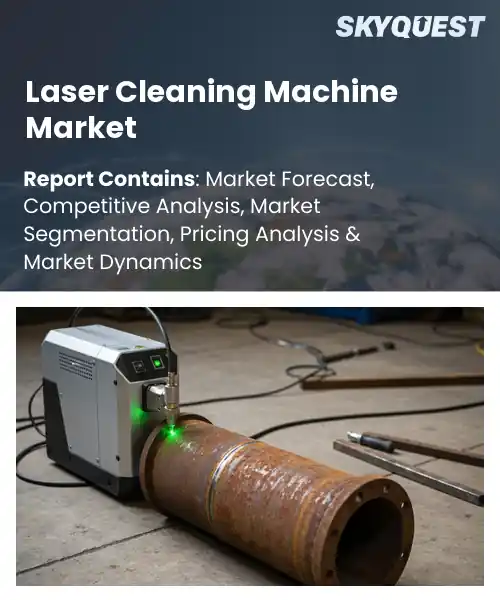
The laser cleaning machine market has experienced tremendous growth because of the rising need for environmentally friendly, precise and non-contact surface cleaning methods across many different types of industries. Laser cleaning machines utilize very high-intensity pulses of laser energy to remove rust, paint oxide, and grease from metal and nonmetal surfaces without causing any damage to the supporting material. This gives laser cleaning a considerable edge over traditional cleaning methods (such as chemical cleaning, abrasive blasting or mechanical scraping) because of the following reasons: they generate almost no waste products; use very few or no hazardous chemicals; require little or no maintenance; and have a far higher operational efficiency than their conventional counterparts.
Many of the main drivers behind laser cleaning technology adoption are the automotive and aerospace industries, as manufacturers need high precision cleaning processes to properly prepare for welding, refurbish components, maintain their molds, as well as to treat surfaces. In industrial manufacturing sectors, a rise in the level of automation has also driven demand for more advanced maintenance solutions that will help reduce equipment downtime. Other sectors that are now using laser cleaning technologies at a growing rate include shipbuilding, electronics, cultural heritage restoration and the energy industry; all of which have applications that are both delicate and considered valuable.
How is AI Improving Efficiency in the Laser Cleaning Machine Market?
Artificial intelligence has enhanced productivity in the laser cleaning equipment market through integration of adaptive process control along with vision-based inspection within the same system and proven data-driven optimization methods. Important factors include correlation of adjusted beam power/scanning patterns to the condition of a substrate surface; detection/monitoring of defects in real-time via camera/sensor technology; predictive/preventative maintenance based on telemetry from equipment; etc. OEMs/Integrators are now incorporating smart software into their machines (as opposed to relying exclusively on manual tuning) which allows for easier incorporation into manufacturing assembly line operations, thus reducing cycle time associated with outfitting and operating those machinery components. In many cases, businesses are utilizing AI models combined with laser heads to reduce set-up time and number of reworks while still meeting required surface characteristics needed for downstream welding/coating processes.
Market snapshot - (2026-2033)
Global Market Size
USD 0.8 Billion
Largest Segment
Handheld Type
Fastest Growth
Table Type
Growth Rate
6.9% CAGR
To get more insights on this market click here to Request a Free Sample Report
Global laser cleaning machine market is segmented into product, technology type, power rating, application, end-user industry and region. Based on product, the market is segmented into handheld type, table type and others. Based on technology type, the market is segmented into fiber laser, CO2 laser and Nd:YAG laser. Based on power rating, the market is segmented into low power, medium power, and high power. Based on application, the market is segmented into metal cleaning, paint removal, surface preparation, and others. Based on end-user industry, the market is segmented into automotive, manufacturing, aerospace, and others. Based on region, the market is segmented into North America, Europe, Asia Pacific, Latin America and Middle East & Africa.
The fiber laser segment has the largest laser cleaning machine market share because they have many advantages over other types of lasers: efficiency, compactness, low maintenance, and excellent beam quality. Fiber lasers provide precise control, stable performance, and a longer operating life compared to traditional CO₂ lasers and Nd:YAG lasers. Also, they are more energy-efficient and more suitable for industrial automation, making them ideal for automotive, aerospace, and heavy manufacturing industries.
As per laser cleaning machine market forecast, the Nd:YAG laser segment has been steadily increasing in size, especially for specialized and precision cleaning applications. They are well suited for applications needing controlled pulse energy or for fine surface treatments, such as electronics and heritage restoration. However, fiber lasers are expected to grow at a quicker pace than Nd:YAG lasers due to the wider industrial applications and continuing technology advancements.
As per laser cleaning machine market analysis, the medium power segment has a considerable market share due to the machines' ability to complete tasks efficiently and cost-effectively and to accommodate a wide variety of cleaning applications. These machines are used to clean many types of industrial workpieces, especially in automotive component cleaning, maintaining molding tools, and refurbishing industrial equipment. Therefore, they meet the needs of many medium-sized industrial application markets.
As per laser cleaning machine market outlook, the high-power segment has the highest growth rate since high power laser cleaning systems are increasingly utilized in incredibly large industrial facilities, including shipbuilding, oil and gas, large infrastructure maintenance, and aerospace. In addition to altitudes with thick rust, coatings, and residual industrial debris, a growing demand for industrial automation and the need for high-speed surface treatment will drive continuing growth in this segment.
To get detailed segments analysis, Request a Free Sample Report
One of the main reasons for the predominance of the Asia Pacific region in laser cleaning machine markets is the high density of advanced manufacturing sectors and early adopters of precision surface processing. Extensive clusters of electronic, automotive, shipbuilding, and heavy equipment manufacturers provide a consistent need for non-abrasive, highly accurate cleaning solutions that integrate into automated systems. Alignment of the region's leadership in laser component manufacturing with many system integrators close by provides shorter innovation cycles and greater cost effectiveness for end-users.
The use of laser cleaning machines in Japan is largely driven by the need for precision, reliability, and very tight integration into complex production systems. Manufacturers in Japan place emphasis on high-quality machines that will provide years of reliable service and that are very easily integrated into existing automated platforms used in semiconductor manufacturing, electronics manufacturing, and precision tooling. Strong cooperation between suppliers and end-users in Japan is providing for the many custom needs associated with niche applications.
The South Korean laser cleaning machine market benefits from close ties between advanced electronic manufacturers and local laser technology suppliers. Due to the need for high speed, repeatable processes and compact systems in the densely populated manufacturing facilities of South Korea, there is a strong emphasis by both local OEMs and integrators on providing solutions specifically tailored to the needs of semiconductor manufacturing, display manufacturing, and automotive components.
As per laser cleaning machine industry analysis, the rapid growth within Europe is fueled by the need for sustainability, modernizing the current generation of industry and keeping processes environmentally friendly through low waste chemical-free products. All types of industries including automotive, aerospace, shipbuilding, and energy are searching for better technology to decrease their carbon footprint, while providing better safety and more accurate processing of materials; this will create an increase in interest towards laser-based cleaning methods. The presence of existing plants available for retrofitting, along with skilled labour to support these types of installations, and increased familiarity in working with lasers are contributing factors to increased acceptance and use. Collaboration between research groups and both the manufacturers and end users of equipment has helped provide credibility to newly developed applications. Regional leadership in standards/quality assurance also helps investors make informed decisions due to less perceived technical risk and allows conservative purchasing agencies to have a broader acceptance of this type of application.
The Germany laser cleaning machine market benefits from the country's well-developed machinery and automotive industries, which require high-performance solutions with high throughput. Buyers of laser cleaning machines will favor systems with established reliability, compatibility with other systems, and low maintenance needs. Collaboration between universities and industrial businesses will help to develop applications in the aerospace and automotive industries as well as precision manufacturing.
The laser cleaning machine market in the UK is growing rapidly due to the use of laser cleaning machines for conserving heritage buildings, carrying out specialized maintenance, and the strength of the contracting sector. In the UK, customers are likely to prefer flexible, portable laser cleaning machines and service-oriented solutions to perform work in situ (i.e., on site) that includes architectural restoration, repairing ships, and producing niche products.
The laser cleaning machine market in France is expanding, particularly in the aerospace, maritime, and cultural heritage conservation sectors. Increasing awareness and acceptance of environmentally friendly cleaning technologies, as well as the targeting of pilot projects with end users, are growing the overall acceptance of laser cleaning machines in France. Collaboration between local integrators and research organizations is demonstrating the effectiveness of using laser cleaning machines for preparing surfaces and restoring surfaces. Users are also showing a preference for quality and technical support; this is making them inclined to partner with established manufacturers of laser cleaning equipment, as well as for new projects that might incorporate the use of laser cleaning technology.
North America is strengthening its role through a focus on advanced applications, service innovation, and integration with broader automation and inspection ecosystems.Technology development centers and system integrators are focused on creating customized solutions specifically for aerospace, defense, energy, and high-value manufacturing customers, where precision and documentation are of the utmost importance. The growth of this sector is also supported using diverse business models for procurement, including rental, contract opportunities and capital equipment purchases coupled with service level agreements to decrease adoption barriers for those users with limited access to capital financing.
As per laser cleaning machine market regional forecast, the United States market has a strong demand coming from all sectors of aerospace, defense, and energy, which all require documented precision parts cleaning and surface preparation. System integrators and service providers will provide complete turnkey solutions with lasers and robotics, which can automate entire workflows and include inspections with their respective processes. Researchers have partnered with their respective governments to validate these applications and will utilize various methods to procure the machines either through capital or contractual services.
As per laser cleaning machine market regional outlook, the Canada market is characterized by success in resource processing, ship repair and aerospace maintenance, where there are strong environmental concerns and material degradation has considerable potential. Service-oriented business models will allow companies to take advantage of the latest cleaning technologies without significant capital expenditures, while the research partnerships with the post-secondary academic institutions will enable the development of localized cleaning technologies.
To know more about the market opportunities by region and country, click here to
Buy The Complete Report
Rising Demand in Industrial Surface Preparation
Laser cleaning systems allow manufacturers to remove contaminants and coatings with high precision and without causing damage to the original surface. Therefore, these systems can prepare surfaces ahead of time with minimal physical labour and rework, thus increasing throughput and reliability in production processes. This allows manufacturers to achieve efficiencies and enhanced component longevity. As manufacturers focus on lean manufacturing systems, the increased adoption of laser cleaning systems will also help manufacturers maintain consistent quality. Laser cleaning machines' ability to work on a variety of materials, including metals, composites, and delicate surfaces, will help manufacturers utilize this technology in a wide range of manufacturing processes, creating a rising demand for these machines and their related support services.
Manufacturers now have access to more advanced laser source designs and beam delivery methods, which have improved reliability, reduced maintenance costs, and significantly increased laser cleaning applications, making these systems attractive to a wider range of end users. The increased beam control and output stability of new laser source technology allows for faster, cleaner contamination removal, without damaging the substrates that are being cleaned, and will make it easier to incorporate these systems into existing production lines. Therefore, manufacturers are beginning to perceive lower total cost of ownership and more predictable operating characteristics than with traditional cleaning methods. Additionally, as manufacturers continue to improve their modular design features and user-friendly interfaces, the procurement barriers to these types of systems are disappearing, resulting in increased adoption within the automotive, aerospace, and heritage conservation sectors.
Small-scale companies and budget-sensitive businesses may be discouraged from making a purchase by the large upfront costs of laser cleaning devices and installation of safety measures. Thus, market entry would be constrained. Even when the long-term advantages of laser robotic cleaning are apparent, companies frequently favor less costly traditional cleaning systems due to budgetary restrictions; as a result, the shifting to laser cleaning is an ongoing process. The high initial investment required to purchase laser cleaning equipment also extends the amount of time required to decide on purchases; demonstration projects or pilot programs frequently need to be conducted prior to the sale of any laser cleaning systems. Nevertheless, many people do not believe they will see an appropriate return on investment from laser cleaning purchases, therefore constraining the wider adoption of laser robotic cleaners, and creating a moderating effect on near-term growth in the market.
Regulatory guidelines and safety standards have become increasingly complex due to increasing numbers of regulations, differing levels of classification, and differing levels of regulatory authorities in differing regions; thereby increasing the cost and complexity to end-users. For end-users, complying with requirements for eye and skin protection, establishing exclusion zones, and ensuring operator certification involves substantial procedural modifications, and ongoing compliance efforts (e.g., audits) that lengthen the timeframe for deploying the laser cleaning systems. Manufacturers and end-users have been faced with uncertainty as some jurisdictions have not provided sufficient clarity regarding regulations, or several jurisdictions have provided continually shifting regulations. Consequently, manufacturers and end-users have demonstrated conservative purchasing behavior (i.e., reliance on established, conventional methods of cleaning). Therefore, these barriers to compliance also create a significant barrier to rapid growth of the laser cleaning marketplace, despite the technological advantages associated with cleaning the laser cleaning systems.
Request Free Customization of this report to help us to meet your business objectives.
The competitive environment for laser cleaning is changing as both large companies and specialized companies are acquiring other companies, partnering with distributors, and creating new products. The IPG Photonics acquisition of cleanLASER and the growth of Laser Photonics through the purchase of CMS assets both demonstrate this, and Raycus is working with manufacturers of laser equipment to automate the tire mold and industrial cleaning process.
Industry 4.0 Integration: Connected laser cleaning systems are becoming more popular due to their use in digital workflows and automated factories. The machines providereal-time monitoring, secure remote access, and standardized interface options for predictive maintenance, seamless coordination with MES and ERP systems. These developments are providing opportunities for more uptime production equipment and improved process control, while providing traceability of the quality results from line to line. Additionally, manufacturers are differentiating their products in the marketplace by embedding their software platforms and services into their products, while end users are seeking scalable solutions for continued improvement and flexibility in their manufacturing operations.
Growing Preference for Eco-Friendly Cleaning Technologies: The market trend toward laser cleaning is driven by the preference of the marketplace for green alternatives to the use of chemical solvents or abrasive methods, supported by corporate sustainability programs and supply chain pressures. The use of laser technology results in less waste related to consumables, the reduction of hazardous effluent produced, and making the handling of end-of-life materials easier to help support circular manufacturing. Additionally, OEM's and service providers are striving to minimize their environmental impact and extend the life cycle benefits of their products throughout the purchasing process. At the same time, end-users seek suppliers who have verifiable sustainability credentials and utilize processes that produce cleaner products with reduced costs.
SkyQuest’s ABIRAW (Advanced Business Intelligence, Research & Analysis Wing) is our Business Information Services team that Collects, Collates, Correlates, and Analyses the Data collected by means of Primary Exploratory Research backed by robust Secondary Desk research.
As per SkyQuest analysis, the global laser cleaning machine market is largely driven by strict environmental regulations and the need for precision maintenance that does not require contact. Additionally, rapid advancements in fiber laser technologies and robotics reducing operating costs for fiber laser machines and expanding the range of applications or uses will also drive laser cleaning machine market growth. However, the high initial cost of acquiring laser cleaning machines will limit the number of smaller companies that can purchase them and therefore bond procurement cycles. The Asia Pacific region is the largest market due to the presence of many manufacturing centers, good access to reliable local suppliers and established production supply chains that can quickly meet demand, and the fact that fiber lasers are the most widely utilized type of laser cleaning technology based on their ability to provide the highest quality beam, efficiently and therefore quickly clean surfaces at much lower cost and with little effort to incorporate into existing automated processes.
| Report Metric | Details |
|---|---|
| Market size value in 2024 | USD 0.8 Billion |
| Market size value in 2033 | USD 1.46 Billion |
| Growth Rate | 6.9% |
| Base year | 2024 |
| Forecast period | (2026-2033) |
| Forecast Unit (Value) | USD Billion |
| Segments covered |
|
| Regions covered | North America (US, Canada), Europe (Germany, France, United Kingdom, Italy, Spain, Rest of Europe), Asia Pacific (China, India, Japan, Rest of Asia-Pacific), Latin America (Brazil, Rest of Latin America), Middle East & Africa (South Africa, GCC Countries, Rest of MEA) |
| Companies covered |
|
| Customization scope | Free report customization with purchase. Customization includes:-
|
To get a free trial access to our platform which is a one stop solution for all your data requirements for quicker decision making. This platform allows you to compare markets, competitors who are prominent in the market, and mega trends that are influencing the dynamics in the market. Also, get access to detailed SkyQuest exclusive matrix.
Table Of Content
Executive Summary
Market overview
Parent Market Analysis
Market overview
Market size
KEY MARKET INSIGHTS
COVID IMPACT
MARKET DYNAMICS & OUTLOOK
Market Size by Region
KEY COMPANY PROFILES
Methodology
For the Laser Cleaning Machine Market, our research methodology involved a mixture of primary and secondary data sources. Key steps involved in the research process are listed below:
1. Information Procurement: This stage involved the procurement of Market data or related information via primary and secondary sources. The various secondary sources used included various company websites, annual reports, trade databases, and paid databases such as Hoover's, Bloomberg Business, Factiva, and Avention. Our team did 45 primary interactions Globally which included several stakeholders such as manufacturers, customers, key opinion leaders, etc. Overall, information procurement was one of the most extensive stages in our research process.
2. Information Analysis: This step involved triangulation of data through bottom-up and top-down approaches to estimate and validate the total size and future estimate of the Laser Cleaning Machine Market.
3. Report Formulation: The final step entailed the placement of data points in appropriate Market spaces in an attempt to deduce viable conclusions.
4. Validation & Publishing: Validation is the most important step in the process. Validation & re-validation via an intricately designed process helped us finalize data points to be used for final calculations. The final Market estimates and forecasts were then aligned and sent to our panel of industry experts for validation of data. Once the validation was done the report was sent to our Quality Assurance team to ensure adherence to style guides, consistency & design.
Analyst Support
Customization Options
With the given market data, our dedicated team of analysts can offer you the following customization options are available for the Laser Cleaning Machine Market:
Product Analysis: Product matrix, which offers a detailed comparison of the product portfolio of companies.
Regional Analysis: Further analysis of the Laser Cleaning Machine Market for additional countries.
Competitive Analysis: Detailed analysis and profiling of additional Market players & comparative analysis of competitive products.
Go to Market Strategy: Find the high-growth channels to invest your marketing efforts and increase your customer base.
Innovation Mapping: Identify racial solutions and innovation, connected to deep ecosystems of innovators, start-ups, academics, and strategic partners.
Category Intelligence: Customized intelligence that is relevant to their supply Markets will enable them to make smarter sourcing decisions and improve their category management.
Public Company Transcript Analysis: To improve the investment performance by generating new alpha and making better-informed decisions.
Social Media Listening: To analyze the conversations and trends happening not just around your brand, but around your industry as a whole, and use those insights to make better Marketing decisions.
REQUEST FOR SAMPLE
 REQUEST FREE CUSTOMIZATION
Global Laser Cleaning Machine Market size was valued at USD 0.8 Billion in 2024 and is poised to grow from USD 0.86 Billion in 2025 to USD 1.46 Billion by 2033, growing at a CAGR of 6.9% during the forecast period (2026-2033).
Competitive landscape in laser cleaning is consolidating as incumbents and specialist entrants pursue acquisitions, distribution partnerships and product innovation. Examples include IPG Photonics acquiring cleanLASER and Laser Photonics expanding via CMS asset buys, while suppliers like Raycus partner with equipment makers to automate tire mold and industrial cleaning lines. Competition is driven by industrial demand for chemical free, automated surface preparation and faster on site maintenance. 'CleanLasers LLC', 'Coherent Inc.', 'TRUMPF GmbH + Co. KG', 'LaserClean Technologies', 'JPT Opto-electronics', 'Rofin-Sinar Technologies', 'United Global Technologies', 'NLB Corp.', 'LPKF Laser & Electronics AG', 'Axiom Laser', 'Fujifilm Manufacturing Europe B.V.', 'Laser Innovations', 'ALPHA LASER GmbH', 'WZ Laser', 'RAYLASE GmbH', 'OptiMATE Laser', 'High Efficiency Laser Systems Inc.', 'Laser Photonics', 'Newport Corporation', 'IPG Photonics Corporation'
Laser cleaning systems offer precise, nonabrasive removal of contaminants and coatings, enabling manufacturers to prepare surfaces quickly while preserving base materials. This capability reduces the need for manual labor and repeat processing, improving throughput and reliability in production workflows. As industries prioritize efficiency and component longevity, adoption of laser cleaning supports lean manufacturing objectives and consistent quality outcomes. The technology's adaptability across metals, composites, and delicate substrates encourages integration into varied processes, which in turn sustains demand growth for machines and associated support services.
One of the main reasons for the predominance of the Asia Pacific region in laser cleaning machine markets is the high density of advanced manufacturing sectors and early adopters of precision surface processing. Extensive clusters of electronic, automotive, shipbuilding, and heavy equipment manufacturers provide a consistent need for non-abrasive, highly accurate cleaning solutions that integrate into automated systems.


Want to customize this report? This report can be personalized according to your needs. Our analysts and industry experts will work directly with you to understand your requirements and provide you with customized data in a short amount of time. We offer $1000 worth of FREE customization at the time of purchase.
Feedback From Our Clients


 USA (+1) 351-333-4748

