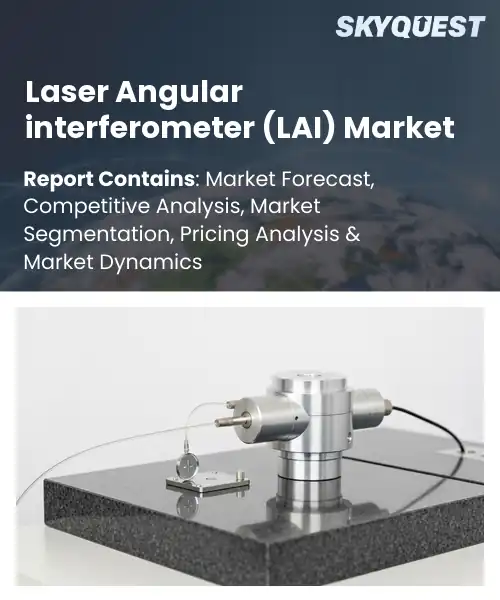
Laser Angular interferometer (LAI) Market
Report ID: SQMIG45J2417
Report ID: SQMIG45J2417
[email protected]
USA +1 351-333-4748
Report ID:
SQMIG45J2417 |
Region:
Global |
Published Date: February, 2026
Pages:
157
|Tables:
95
|Figures:
76


Global Laser Angular Interferometer (LAI) Market size was valued at USD 157.05 Million in 2024 and is poised to grow from USD 165.3 Million in 2025 to USD 248.91 Million by 2033, growing at a CAGR of 5.25% during the forecast period (2026-2033).
Laser angular interferometers (LAIs) are precision metrology instruments that measure angular displacement and rotation. Their use of interfometric methods allows for near sub-arcsecond and nanoradian precision; therefore, they satisfy fulfil the very technical requirements of modern manufacturing and research. Moreover, as deterministic metrology reduces scrap and rework, the commercial market for LAIs in precision manufacturing is expected to expand.
The evolution of the category of precision angular measurement from mechanical and encoder type methods to optical interferometry over the last thirty years has been facilitated by technological advances in stabilized lasers, heterodyne detection, and digital signal processing (DSP). Examples of applications that have driven supplier innovation and user demand include aligning wafer steppers, phasing telescope mirrors, and calibrating precision rotary tables.
The integration of precision angular measurement into the motion control systems of automated machinery is a key factor that will continue to shape the global market for LAIs. This integration of interferometric angular measurements directly allows for closed-loop compensation, ultimately increasing throughput and yield in the production of high-value products.
As fabs and optical manufacturers look for real-time, angular measurement corrections, suppliers of LAIs are responding to their customers' demands by developing advanced technologies, such as compact fiber-optically coupled sensors, embedded/DSP FPGA processing, and networked diagnostics, that will reduce the installation complexity and total cost of ownership of these systems and will accelerate the adoption of LAIs in the precision manufacturing and optics industries.
How is AI Enhancing Measurement Accuracy In The Laser Angular Interferometer (LAI) Market?
Laser angular interferometers (LAIs) utilize coherent laser wavefronts to measure minute angular displacements, with their measurements being improved through artificial intelligence (AI) methodologies that extent from cleaning up the interference patterns to isolating true measurements from the noise that interferes with those measurements. An example of how AI impacts the accuracy of measurement is in the use of machine learning (ML) models that automatically detect fringe displacement anomalies and real time drift correction of the interferometer measurements, combined with the fusion of inertial sensors to mitigate systematic errors. The overall effect these technologies have on LAI products is the transfer of LAI products from being specialized laboratory measurement instruments to integrated factory measurement tools that require reduced operator expertise and yield higher levels of consistent alignment and calibration. Integrating automation in conjunction with LAIs provides additional market benefits through increased productivity and accuracy of automated assembly processes for both high-performance optical components manufacturing and LAIs utilizing automated fringe analysis and adaptive filtering to reduce measurement setup time while facilitating practical measurement of angular metrology applications.
Market snapshot - (2026-2033)
Global Market Size
USD 157.05 Million
Largest Segment
High-Precision LAI
Fastest Growth
Compact LAI
Growth Rate
5.25% CAGR
To get more insights on this market click here to Request a Free Sample Report
Global laser angular interferometer (LAI) market is segmented into product type, application, end-user and region. Based on product type, the market is segmented into high-precision LAI, standard LAI and compact LAI. Based on application, the market is segmented into aerospace & defense, industrial metrology, semiconductor manufacturing, research & development, robotics & automation and medical equipment calibration. Based on end-user, the market is segmented into aerospace companies, automotive manufacturers, semiconductor companies, precision engineering firms and research institutes & laboratories. Based on region, the market is segmented into North America, Europe, Asia Pacific, Latin America and Middle East & Africa.
As per laser angular interferometer (LAI) market outlook, the compact LAI segment is the dominant form of LAI, allowing use with limited geometry devices and in mobile environments which would not be feasible with traditional forms of interferometry. Similarly, the the design community supports the use of the compact LAI in devices due to the simplicity of mounting, reducing cables throughout the device, and the overall complexity of the system reduces the time to develop products and creates less risk in integrating the component, encouraging OEM's and integrate to adopt the use of compact units and create and foster supply chain ecosystems around compact LAI.
The high-precision LAI segment is seeing the greatest growth as the requirement for ultra-fine angular measurements in advanced manufacturing, and research requires investment in instrumentations to deliver improved stability and resolution. Advances in stabilization technologies, environmental correction methods and signal processing continue to make high precision applicable to sophisticated inspection and alignment functions generating a multitude of high-value opportunities, greatly accelerating product development to market.
As per laser angular interferometer (LAI) market analysis, semiconductor manufacturing segment dominates because wafer fabrication and lithography impose the most exacting angular tolerances and throughput requirements, driving equipment OEMs to require interferometers with exceptional stability, traceability and cleanroom compatibility. These requirements push OEMs to look for interferometers that have high stability, traceability, and cleanroom compatibility to manufacture semiconductors. The demands of the semiconductor manufacturing segment are guiding LAI manufacturers’ product development efforts toward thermal robustness, tightly controlled calibration procedures, and easy integration into automated process control systems. This is also guiding the vendor community on product roadmaps and investment in specific LAI features.
As per laser angular interferometer (LAI) market forecast, research & development is emerging as the key high-growth area because exploration of novel optical architectures and metrology drives demand for versatile, customizable LAI platforms. Additionally, experimental usage of laser angular interferometers (LAIs) in precision optics, advanced materials, and prototyping will accelerate multiple iterations to production timelines, promote modular solutions, and create pathways to new application opportunities, which will ultimately expand the total addressable market and create additional supplier value propositions.
To get detailed segments analysis, Request a Free Sample Report
As per laser angular interferometer (LAI) market regional forecast, the market has been significantly impacted by the Asia Pacific region, which has large manufacturing capabilities, concentrated demand for precision measurement technologies, and an ecosystem that encourages rapid commercialization. The existence of vertically integrated industrial clusters within the electronics, semiconductor, and advanced optics industries creates a continuous need for high accuracy of angular measurements. In addition, the presence of well-established contract manufacturers and OEMs provides significant opportunities for scale and integration. The significant investment from both the public and private sectors in applied research, the collaboration between academic institutions and industry, and the high level of engineering expertise in the region have contributed to the increased speed of refinement and adoption of products.
The laser angular interferometer (LAI) market in Japan has the benefit of a highly concentrated cluster of precision optoelectronics and semiconductor manufacturing companies that utilize advanced Laser Angular Interferometers for highly repeatable and reliable angular measurement. In addition, there are ample engineering resources, combined with close collaboration between universities and industry, that support the continued refinement of Laser Angular Interferometers. Japan based OEMs emphasize product quality and support, which also results in a high degree of design reliability and regular local service support systems.
The laser angular interferometer (LAI) market in South Korea also benefits from the country’s ability to provide robust capabilities for electronic manufacturing, semiconductor processing, and precision measuring instrument production. The collaboration between high tech manufacturers and their suppliers enables a rapid rate of customization for embedded metrology applications. The availability of comprehensive research and development centers along with contract manufacturers facilitates the prototyping and scaling of laser angular interferometer products quickly.
As a result of concentrated demand from precision-driven industries, and a mature ecosystem supporting industrial automation, the laser angular interferometer (LAI) market is expanding rapidly across North America. The level of activity occurring in aerospace, defense, medical devices, and high-end manufacturing has placed an emphasis on ultra-precise angular metrology & has driven the adoption of interferometric solutions by both system integrators & independent instrumentation houses.
As per laser angular interferometer (LAI) market regional outlook, the demand for laser angular interferometer (LAI) products in the United States is driven by an innovation ecosystem incorporating research institutions, defense contractors, & original equipment manufacturers (OEMs). Stringent performance requirements in aerospace, semiconductor lithography, & medical imaging demand that providers offer customizable interferometric solutions. Additionally, extensive service and calibration support networks make it possible to implement LAIs in manufacturing facilities. Strong relationships between system integrators and end-users enhance the pace of implementation of LAIs in automated production & testing environments.
The maturity of optical engineering capabilities within Canada enhances the use of interferometric devices for angular sensing. Industry/university collaborations support applied research in the field. Rugged product designs and straightforward calibration are priorities for many manufacturers to accommodate the demanding conditions experienced by industries such as mining, aerospace, and industrial automation.
As per laser angular interferometer (LAI) industry analysis, through engineering expertise, collaborative research networks, and high-precision manufacturing, Europe’s position in the laser angular interferometer (LAI) market is becoming more robust. Photonics clusters at national and regional levels provide specialized suppliers with high-quality components/subsystems; at the same time, cross-border partnerships enable suppliers to share their technical capabilities and accelerate the diffusion of best practices. Strong demand from automotive, aerospace, and instrument manufacturers creates a robust market for advanced angular metrology. As a result, suppliers must place emphasis on their reliability and provide traceability when certifying or supplying their products as the use of stringent industrial standards is mandated. Close collaboration between technologists located within technology centers and systems of integrators allows for the creation of modular and interoperable solutions that are adaptable to various types of workflows used by industry. Additionally, extensive service ecosystems along with increased focus on certification provide a lower barrier to adoption, making Europe’s Angular Interferometer market a thriving and innovative one.
Germany has benefited from a legacy of precision engineering, well-established relationships between the machine tool, automotive, and optics sectors, and a commitment to producing high-precision products for steep factory environments. To this end, vendors provide robust, high-accuracy solutions designed to perform under the harshest factory conditions, backed by comprehensive testing and calibration support and infrastructure. In addition, close cooperation among industrial research institutions and component suppliers fosters the speedy industry refinement of these products.
In the United Kingdom, the emerging photonics industry has provided the platform for the establishment of a burgeoning start-up community that is encouraging and expediting new developments in interferometric sensing technology. Within the marketplace, the presence of system integrators and test laboratories that provide custom-designed solutions to aerospace, defense and high-value manufacturing clients enables rapid proliferation of new solutions. Modular and interoperable instruments and available calibration services provide a competitive advantage while reducing physical impediments to deployment. Close collaboration between academia, suppliers and end users facilitates validation and commercial adoption across complex measurement workflows.
In France, manufacturers benefit from a well-established optical and photonics industry, supported by several engineering organizations and institutes. Manufacturers deliver high-quality precision calibration work through well-designed precision calibration modules and components targeted for applications in the aerospace, scientific and advanced manufacturing sectors. Integration of systems and components, precise execution of calibrations and comprehensive post-sale support improve customer loyalty and enhance confidence in the companies' products.
To know more about the market opportunities by region and country, click here to
Buy The Complete Report
Rising Demand for Precision Metrology
Manufacturers and researchers are benefiting from the increased accuracy and repeatability of measurement that LAI systems offer. The ability to achieve precise control over tolerances results in improved quality products produced from complex assemblies. In turn, this accuracy results in reduced rework and enables advanced materials and miniaturized components through real-time angular displacement feedback. As production and R&D emphasis shift toward precision, LAI instruments play an integral role in optimizing processes, facilitating integration into automated measurement workflows, and assisting engineers by refining their designs/assemblies; thus, creating long-term demand for angular interferometry solutions.
Advancements In Lasers and Optics
The development of laser sources and improvements in beam stability and optical component manufacturing create higher performance and better usability for LAI systems, while simultaneously decreasing required maintenance/calibration work. Improved coherence and wavelength control provide more accurate angular measurements in a wider range of environmental conditions, enabling LAI systems to be deployed outside of specialized metrology laboratories. With advancements also occurring with more compact electronics and improved software, these developments will lower barriers to the integration of LAI systems into both industrial equipment and research instruments, encouraging a wider range of users to adopt precision angular measurement techniques as part of automated inspection and process control systems.
The complexity of LAI systems and their associated high initial costs limit their use by smaller manufacturers or researchers because they require highly specialized installation and alignment expertise, as well as adequate environmental controls, to achieve optimal performance. Ongoing maintenance and a need for training increase the cost of operation, making it difficult for those organizations that have limited capital or personnel resources to utilize LAIs. These factors also reduce the size of the available market for LAIs to only highly resourced users and impede LAI market penetration into cost-sensitive market segments, even with known advantages of measurement accuracy and known additional complexities associated with using LAIs.
The lack of common standards for LAI device interface methods, calibration procedures, and data formats creates challenges for achieving seamless integration between disparate manufacturing and metrology environments, which increases the project risk and customization requirements. Customers have longer validation times and are potentially at risk of vendor lock-in when custom LAIs related to their specific application are used. These uncertainties severely hamper procurement decisions and slow cross-industry interoperability. Their presence prevents both system integrators and end users from making commitments to deploy LAIs until well-defined standards and compatibility frameworks have emerged.
Request Free Customization of this report to help us to meet your business objectives.
The market is characterized by competitive pressures from applications such as semiconductor lithography and space optics, and as a result, LAI vendors have been forced to consolidate, partner with other suppliers, and quickly differentiate products through innovations that are immune to wavelength and vibration. Zygo recently launched the Qualifire product in 2024, and 4D Technology has released the AccuFiz SWIR, both of which demonstrate consolidation activity through Onto Innovation's acquisition of 4D to enhance its metrology capability.
Miraex: Established in 2019, Miraex's primary goal is to commercialize photonic integrated sensors and fibre-optic interferometric measurement modules that provide safe, highly sensitive optical measurements of vibrations, accelerations, temperature, and electric fields, and are suitable for predictive maintenance and process monitoring in extreme environments. They have transitioned from an EPFL laboratory spin-off to commercial prototypes, obtained early-stage financing and grants, and validated sensor modules through partnerships with utilities and heavy industry for application in ATEX and explosion risk environments.
Shinephi: Shinephi is the newest company in this space, having been established in 2025, and their main goal is to develop industrialized compact interferometric phase-imaging instruments through the use of lateral shearing interferometry to provide high sensitivity, high throughput metrology for semiconductor and Nano fabrication inspection processes.
Miniaturization Driving Portability: The evolution of optical devices and compact laser sources has led to smaller LAI modules that can be used for portable and embedded applications, thereby allowing for angle measurements to be made in-situ on assembly lines, during field inspections, and on mobile platforms. Smaller physical size and lower power consumption make it easier for these measurement devices to be integrated with robots and handheld metrology systems (e.g., laser distance meters) that have traditionally operated in a laboratory setting but have now expanded their usage into other application domains. The continued transition to modular/robust designs will further drive these products’ use and acceptance in constrained spaces and will provide further laser angular interferometer (LAI) market growth through sectors that are focused on quality control and real-time feedback at the point of care, thereby creating new opportunities for instrument manufacturers to commercialize this technology.
AI Enabled Signal Processing: Integration of advanced algorithms and machine learning into LAI products has provided integrated signal processing features that improve the ability of these systems to extract useful information from the raw signals received; they help eliminate background noise, or at a minimum reduce it, and improve the repetition rate of detectable anomalies, which results in higher reliability of measurements taken in challenging environments. The ability to interpret the data captured with smart data allows for predictive maintenance and adaptive calibration, thereby providing less operator dependence and accelerating deployment of LAI devices. The software-centric aspect of LAI systems allows manufacturers to differentiate their products through features such as cloud-based connectivity; remote diagnostics; and remote updating of firmware.
SkyQuest’s ABIRAW (Advanced Business Intelligence, Research & Analysis Wing) is our Business Information Services team that Collects, Collates, Correlates, and Analyses the Data collected by means of Primary Exploratory Research backed by robust Secondary Desk research.
As per SkyQuest analysis, the global industry is being shaped primarily by increasing demand for precision measurement methods to produce tighter tolerances and less scrap in semiconductor, optical, and aerospace manufacturing, and high system complexity and cost continue to be barriers for smaller companies to adopt. The compact LIA segment will continue to grow rapidly because their smaller size and easier integration into embedded and handheld applications are advantageous, especially for machine builders. The second important factor driving the LAI industry is AI-based signal processing technologies that provide better fringe correction, improved noise reduction, and real-time correction and shift LAIs to being more integrated into factories with less-skilled workers. The market shows a geographically diversified laser angular interferometer (LAI) market share, with Asia Pacific leading, and North America and Europe holding significant portions of the market due to the strong presence of precision engineering, aerospace, and semiconductor manufacturing industries. A major laser angular interferometer (LAI) market trend is the growing demand for ultra-precision measurement technologies in semiconductor manufacturing, aerospace engineering, nanotechnology research, and advanced industrial automation.
| Report Metric | Details |
|---|---|
| Market size value in 2024 | USD 157.05 Million |
| Market size value in 2033 | USD 248.91 Million |
| Growth Rate | 5.25% |
| Base year | 2024 |
| Forecast period | (2026-2033) |
| Forecast Unit (Value) | USD Million |
| Segments covered |
|
| Regions covered | North America (US, Canada), Europe (Germany, France, United Kingdom, Italy, Spain, Rest of Europe), Asia Pacific (China, India, Japan, Rest of Asia-Pacific), Latin America (Brazil, Rest of Latin America), Middle East & Africa (South Africa, GCC Countries, Rest of MEA) |
| Companies covered |
|
| Customization scope | Free report customization with purchase. Customization includes:-
|
To get a free trial access to our platform which is a one stop solution for all your data requirements for quicker decision making. This platform allows you to compare markets, competitors who are prominent in the market, and mega trends that are influencing the dynamics in the market. Also, get access to detailed SkyQuest exclusive matrix.
Table Of Content
Executive Summary
Market overview
Parent Market Analysis
Market overview
Market size
KEY MARKET INSIGHTS
COVID IMPACT
MARKET DYNAMICS & OUTLOOK
Market Size by Region
KEY COMPANY PROFILES
Methodology
For the Laser Angular interferometer (LAI) Market, our research methodology involved a mixture of primary and secondary data sources. Key steps involved in the research process are listed below:
1. Information Procurement: This stage involved the procurement of Market data or related information via primary and secondary sources. The various secondary sources used included various company websites, annual reports, trade databases, and paid databases such as Hoover's, Bloomberg Business, Factiva, and Avention. Our team did 45 primary interactions Globally which included several stakeholders such as manufacturers, customers, key opinion leaders, etc. Overall, information procurement was one of the most extensive stages in our research process.
2. Information Analysis: This step involved triangulation of data through bottom-up and top-down approaches to estimate and validate the total size and future estimate of the Laser Angular interferometer (LAI) Market.
3. Report Formulation: The final step entailed the placement of data points in appropriate Market spaces in an attempt to deduce viable conclusions.
4. Validation & Publishing: Validation is the most important step in the process. Validation & re-validation via an intricately designed process helped us finalize data points to be used for final calculations. The final Market estimates and forecasts were then aligned and sent to our panel of industry experts for validation of data. Once the validation was done the report was sent to our Quality Assurance team to ensure adherence to style guides, consistency & design.
Analyst Support
Customization Options
With the given market data, our dedicated team of analysts can offer you the following customization options are available for the Laser Angular interferometer (LAI) Market:
Product Analysis: Product matrix, which offers a detailed comparison of the product portfolio of companies.
Regional Analysis: Further analysis of the Laser Angular interferometer (LAI) Market for additional countries.
Competitive Analysis: Detailed analysis and profiling of additional Market players & comparative analysis of competitive products.
Go to Market Strategy: Find the high-growth channels to invest your marketing efforts and increase your customer base.
Innovation Mapping: Identify racial solutions and innovation, connected to deep ecosystems of innovators, start-ups, academics, and strategic partners.
Category Intelligence: Customized intelligence that is relevant to their supply Markets will enable them to make smarter sourcing decisions and improve their category management.
Public Company Transcript Analysis: To improve the investment performance by generating new alpha and making better-informed decisions.
Social Media Listening: To analyze the conversations and trends happening not just around your brand, but around your industry as a whole, and use those insights to make better Marketing decisions.
REQUEST FOR SAMPLE
 REQUEST FREE CUSTOMIZATION
Global Laser Angular Interferometer (Lai) Market size was valued at USD 157.05 Million in 2024 and is poised to grow from USD 165.3 Million in 2025 to USD 248.91 Million by 2033, growing at a CAGR of 5.25% during the forecast period (2026-2033).
Competition in the global LAI market is driven by application-specific demand from semiconductor lithography and space optics, forcing vendors to pursue consolidation, supplier partnerships and rapid product differentiation through wavelength and vibration-immune innovations. Recent concrete moves include Zygo’s 2024 Qualifire product launch and 4D Technology’s AccuFiz SWIR production release, while consolidation activity is illustrated by Onto Innovation’s acquisition of 4D to broaden metrology capabilities. 'Renishaw plc', 'Keyence Corporation', 'Mitutoyo Corporation', 'Bosch Rexroth AG', 'OptiFDTD', 'Zygo Corporation', 'Nanosys Inc.', 'Holo/Or Ltd.', 'Melles Griot', 'Edmund Optics Inc.', 'Laserfarer GmbH', 'Laserglow Technologies', '4D Technology Corporation', 'Photon Focus AG', 'Heidenhain Corporation', 'SIOS Messtechnik GmbH', 'Teledyne Technologies', 'Ametek Inc.', 'Thorlabs Inc.', 'Newport Corporation'
The adoption of LAI systems by manufacturers and research laboratories enhances measurement accuracy and repeatability, enabling tighter tolerance control and improved product quality across complex assemblies. This capability reduces rework and supports advanced materials and component miniaturization by providing real-time angular displacement feedback. As production and R&D prioritize precision, LAI instruments become integral to process optimization, facilitating integration with automated inspection workflows and enabling engineers to refine designs and assembly processes, thereby driving sustained demand for angular interferometry solutions.
Miniaturization Driving Portability: Advances in optical components and compact laser sources are enabling smaller LAI modules for portable and embedded use, allowing in situ angular measurements across assembly lines, field inspections, and mobile platforms. Reduced footprint and power consumption facilitate integration with robotics and handheld metrology, broadening addressable applications beyond lab environments. The shift toward modular, ruggedized designs increases adoption in constrained spaces and accelerates demand from sectors prioritizing on site quality control and real time feedback, creating new commercialization pathways for instrument manufacturers.
As per laser angular interferometer (LAI) market regional forecast, the market has been significantly impacted by the Asia Pacific region, which has large manufacturing capabilities, concentrated demand for precision measurement technologies, and an ecosystem that encourages rapid commercialization.


Want to customize this report? This report can be personalized according to your needs. Our analysts and industry experts will work directly with you to understand your requirements and provide you with customized data in a short amount of time. We offer $1000 worth of FREE customization at the time of purchase.
Feedback From Our Clients


 USA (+1) 351-333-4748

