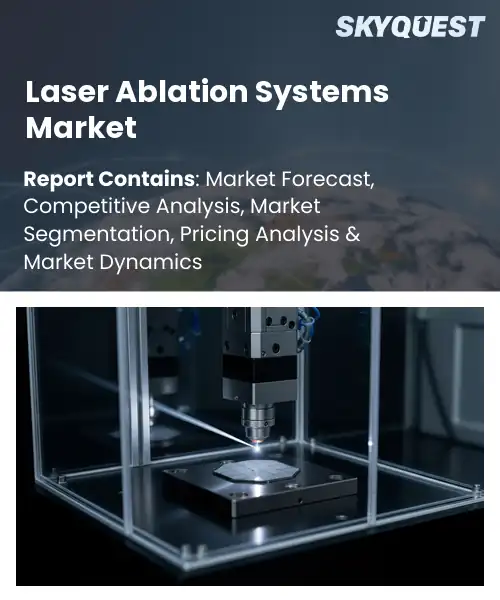
Laser Ablation Systems Market
Report ID: SQMIG35C2035
Report ID: SQMIG35C2035
[email protected]
USA +1 351-333-4748
Report ID:
SQMIG35C2035 |
Region:
Global |
Published Date: July, 2026
Pages:
157
|Tables:
154
|Figures:
78


Global Laser Ablation Systems Market size was valued at USD 2.6 Billion in 2024 and is poised to grow from USD 2.84 Billion in 2025 to USD 5.74 Billion by 2033, growing at a CAGR of 9.2% during the forecast period (2026-2033).
Rising demand for precision manufacturing, increasing adoption of laser-based material processing, rising investments in semiconductor and electronics production, advancements in ultrafast laser technologies, and expanding applications in medical device manufacturing are driving sales of laser ablation systems.
The growth of laser ablation equipment usage in the fabrication of semiconductors, electronics, medical devices as well as the manufacturing of batteries and scientific research is helping to widen the market. Significant investments in novel ultrafast femtosecond and picosecond laser machinery, inline quality inspection and fully automatic production methods are another factor driving the market. Ongoing improvements in laser accuracy and automation, in-situ metrology and high-speed processing of the material are all enhancing the efficiency and quality of manufacturing. With a increasing need for micromachining and high-performance industrial manufacturing, new opportunities in the market are likely to emerge. High demand for high-precision, non-contact material processing, coupled with increasing adoption of advanced manufacturing technologies, is expected to primarily drive laser ablation systems market growth.
On the contrary, high equipment acquisition costs, complex system integration, shortage of skilled operators, and substantial maintenance requirements are anticipated to slow down laser ablation systems market penetration through 2033.
How is AI Enhancing Precision And Throughput In Laser Ablation Systems?
AI is advancing the laser ablation systems market by enabling the technologies to be more precise, automated, and better at optimizing treatments. Machine learning algorithms can control and monitor the laser energy in real time, while image analysis software enables precise targeting and reduces the chance of operation error. AI allows for adaptive beam control, automatic feature detection and provides the ability to continually monitor the process so laser ablation systems can maintain quality and consistency.
Market snapshot - (2026-2033)
Global Market Size
USD 2.6 Billion
Largest Segment
Solid-State Lasers
Fastest Growth
Femtosecond Lasers
Growth Rate
9.2% CAGR
To get more insights on this market click here to Request a Free Sample Report
Global laser ablation systems market is segmented by type, application, end user, mode of operation, portability, and region. Based on type, the market is segmented into solid-state lasers, excimer lasers, femtosecond lasers, fiber lasers, CO₂ lasers, and others. Based on application, the market is segmented into ophthalmology, dermatology & aesthetic medicine, dentistry, cardiology, oncology, gynecology, orthopedics, neurosurgery, urology, and others. Based on end user, the market is segmented into hospitals, ambulatory surgical centers (ASCs), specialty clinics, academic & research institutes, and others. Based on mode of operation, the market is segmented into contact laser ablation systems and non-contact laser ablation systems. Based on portability, the market is segmented into fixed systems and portable systems. Based on region, the market is segmented into North America, Europe, Asia Pacific, Latin America, and Middle East & Africa.
The femtosecond lasers segment is anticipated to account for the highest global laser ablation systems market share in the future. Femtosecond pulses provide submicron accuracy with negligible heat induction resulting in highly predictable tissue ablation in sensitive applications. They can produce less collateral damage and healing time than other laser types, making them the choice of practitioners and designers. New designs in pulse shaping, beam delivery, and real-time visualization will make them more widely adopted in applications requiring precise ablation and consistent results.
However, fiber lasers are emerging as the fastest growing subsegment because of its lightweight, small, high efficiency, and less nature of maintenance, a widening application of expanding in a minimally invasive approach, and portable platform. Further development of the wavelength availability and power scalability would promote further expansion in entirely distinct clinical research and open new applications and presents an opportunity for manufacturers to produce more affordable and flexible methods.
The ophthalmology segment is expected to lead the global laser ablation systems market revenue generation across the study period. Demand for accurate corneal and refractive treatments has driven the need for lasers providing highly predictable tissue saving ablation results with a high degree of repeatability. Clinical pathways and clinician/clinical preferences for procedures remain largely unchanged for driving use through surgical centers and clinics to meet their needs. Manufacturers increase the clinical uses supported by their technology through gaining approval for ophthalmic applications and further developing the technology. Advances in imaging guided ablation planning and procedure specific disposables keep ophthalmology as dominant clinical use.
However, dermatology & aesthetic medicine is witnessing the strongest growth momentum as per this laser ablation systems industry analysis, owing to growing consumer preference for less invasive laser-based skin and aesthetic treatments enhances utilization of ablative-resurfacing and lesion removal specific lasers. The development of fractional technology delivery, cooling devices and hybrid energy platforms, along with expanded indications, generate new clinical opportunities and market entry points, spurring market growth and growth diversification.
To get detailed segments analysis, Request a Free Sample Report
Technological expertise, dense manufacturing ecosystems, and strong integration between research institutions and industry are helping support the demand for laser ablation systems across Asia Pacific. Strong demand for medical, industrial and electronics applications supports continued improvements and incremental development of ablation hardware and software. Regional supply chains will enable rapid commercialization and time to market for new configurations, while a well-established pool of experienced engineering talent should improve system miniaturization, automation and process control. Existing collaborative networks between universities, contract electronics manufacturers and equipment suppliers will promote continuous adaptation and new applications development. Governments in key ablation markets which are already supporting high precision equipment and advanced manufacturing will continue to promote capital expenditure and plant modernization. Local customer service provisions and unique training programs will continue to compete on in-region price and service reputation, deepening relationships with customers and encouraging long-term adoption.
Laser ablation system demand in Japan benefits from concentrated advanced research centers and precision manufacturing expertise that support system innovation and quality control. Strong collaboration between academic laboratories and industrial users accelerates application validation for electronics and medical devices. Domestic suppliers focus on compact, high precision systems and integrated process solutions. Comprehensive service networks and training programs enhance adoption among original equipment manufacturers and processors, creating a supportive ecosystem for refinement.
Sales of laser ablation systems in South Korea leverage strong electronics manufacturing clusters and advanced materials research that improve system performance and process integration. Industry collaborations facilitate unique solutions in fields of semiconductors and display by precession. Local vendors ensure quick service response and application development support, which decreased obstacles of implementation for industrial users. Focusing on small modular fabrication design patterns and automation encourages a long-term adoption by factory, as well as within the in-house team, to improve process control.
Concentrated investment in advanced manufacturing and a strong innovation pipeline spanning medical devices, semiconductor fabrication, and materials research support steady sales of laser ablation systems in the region. Proximity of research centers and key industrial end users enable pilots to be readily adopted, systematically tested, and adapted for specific manufacturing processes. Business models focused on direct services, and extensive aftermarket support reduces operational risk for smaller manufacturers and contract processors, broadening prospective customer base. Focus on advanced process automation, precision process monitoring, and the linking of laser systems with additive and subtractive manufacturing platforms to reinforce the compelling value of the technology. Co-operation between laser equipment suppliers, system integrators, and end users accelerates application development and commercialization, while procurement practices of large OEMs seek assured systems which benefit from on-site customer support. Path to commercialization from laboratory methods is supported by clear pathways through appropriate regulations, and proven paths for commercialization.
Laser ablation systems market in the United States is driven by demand from medical device manufacturers, semiconductor fabs, and research institutions that incubate new applications. An experienced supplier network can deliver a range of system architectures and integration services with robust aftermarket support. Collaborative pilot projects and early-adopter programs will simplify system validation and strengthen various routes to market. A mature engineering workforce and a comprehensive machine tool environment allow for flexibility and customization. Buyers prefer proven performance and local technical assistance.
Demand for laser ablation systems in Canada is shaped by an ecosystem of specialized contract manufacturers, university research labs, and medical device clusters seeking precise material processing solutions. Local suppliers emphasize system reliability, service response, and integration-support, since the buyers are widespread among industrial users. Research collaboration can support customization for a regional application, and government programs/consortia open the way to commercialization. Applications are more likely when local suppliers support training and provide local technical support.
Coordinated efforts in technology development, standards alignment, and deep specialization across industrial clusters are helping boost steady demand for laser ablation systems in Europe. Established engineering skill bases and prestigious research institutions bring continuous advancements in beam delivery, motion control and process monitoring to maximize accuracy and reproducibility. Collaboration between equipment manufacturers and users in predominantly regulated industries such as medical or aerospace fields to ensure strict validation and compliance with quality standards. Focus on interoperability and modular architecture allows easy integration with in-house or wider digital manufacturing networks. Regional supplier networks with local service capabilities drive mass deployment in many manufacturing segments, while government funded partnership initiatives optimize application evolution and ensure transfer from proof of concept to mass application. Regulatory harmonization and certification programs minimize international replication of supply base, enhancing customer access to a wider customer base. Energy efficiency and sustainability driven equipment optimization maximizes the competitiveness of lower footprint technology.
Laser ablation system demand in Germany benefits from a strong precision engineering base and extensive ties between equipment manufacturers and automotive and medical suppliers. Focus on process reliability and integrated industrial grade enhances acceptance in manufacturing. Local system integrators deliver individualized automation and control solutions; testing facilities and research centers help develop applications. Existing vocational training and engineering talent pools strengthen supplier capacities and provide service and maintenance.
Adoption of laser ablation systems in the United Kingdom benefits from concentrated expertise in precision optics and engineering, supporting niche system development for clinical and laboratory workflows. Robust connections between research institutes/hospitals and equipment vendors have led to faster translational initiatives and regulatory convergence. To fill various niches local integrators, concentrate on automation and process control monitoring, service vendors on Maintenance and application support. Concept of technology transfer center and collaborative pilot facilities enhance identification of relevant process parameters for industrial adoption.
Laser ablation system sales in France draw strength from applied research in photonics and materials science that informs beam delivery and process analytics. National research centers and engineering schools work with industry partners to adapt techniques for into established equipment with performance and safety standards. Machine vendors prefer building up modular concept, integration with production lines supporting automotive and medical supply chains. Service networks and training companies support adoption to dedicated contract manufacturers prefer detailed processing.
To know more about the market opportunities by region and country, click here to
Buy The Complete Report
Advancements In Laser Precision
Expansion Of Clinical Applications
High Equipment Acquisition Costs
Regulatory Approval and Reimbursement
Request Free Customization of this report to help us to meet your business objectives.
Competition in the global laser ablation systems market is driven by consolidation, targeted clinical and industrial partnerships, and product differentiation through advanced optics and guidance integration. Notable strategic moves include acquisitions such as AngioDynamics acquiring Eximo to add a 355 nanometer atherectomy platform, Medtronic’s earlier Visualase purchase to expand MRI guided thermal ablation, and CLS partnering with Exact Imaging for image guided focal prostate ablation, shaping IP led competition and specialized platform roadmaps.
SkyQuest’s ABIRAW (Advanced Business Intelligence, Research & Analysis Wing) is our Business Information Services team that Collects, Collates, Correlates, and Analyses the Data collected by means of Primary Exploratory Research backed by robust Secondary Desk research.
As per SkyQuest analysis, high adoption of laser-based material processing, rising investments in semiconductor and electronics production, and advancements in ultrafast laser technologies are anticipated to drive the demand for laser ablation systems going forward. However, high equipment acquisition costs and complex system integration are slated to slow down the adoption of laser ablation systems in the future. Asia Pacific is slated to spearhead the demand for laser ablation systems owing to strong presence of advanced manufacturing industries, increasing adoption of laser technologies in healthcare and electronics, robust research and development investments, and the presence of leading laser system manufacturers. AI-powered laser process optimization and integration of automated imaging and real-time control technologies are anticipated to be key trends driving the laser ablation systems market in the long run.
| Report Metric | Details |
|---|---|
| Market size value in 2024 | USD 2.6 Billion |
| Market size value in 2033 | USD 5.74 Billion |
| Growth Rate | 9.2% |
| Base year | 2024 |
| Forecast period | (2026-2033) |
| Forecast Unit (Value) | USD Billion |
| Segments covered |
|
| Regions covered | North America (US, Canada), Europe (Germany, France, United Kingdom, Italy, Spain, Rest of Europe), Asia Pacific (China, India, Japan, Rest of Asia-Pacific), Latin America (Brazil, Rest of Latin America), Middle East & Africa (South Africa, GCC Countries, Rest of MEA) |
| Companies covered |
|
| Customization scope | Free report customization with purchase. Customization includes:-
|
To get a free trial access to our platform which is a one stop solution for all your data requirements for quicker decision making. This platform allows you to compare markets, competitors who are prominent in the market, and mega trends that are influencing the dynamics in the market. Also, get access to detailed SkyQuest exclusive matrix.
Table Of Content
Executive Summary
Market overview
Parent Market Analysis
Market overview
Market size
KEY MARKET INSIGHTS
COVID IMPACT
MARKET DYNAMICS & OUTLOOK
Market Size by Region
KEY COMPANY PROFILES
Methodology
For the Laser Ablation Systems Market, our research methodology involved a mixture of primary and secondary data sources. Key steps involved in the research process are listed below:
1. Information Procurement: This stage involved the procurement of Market data or related information via primary and secondary sources. The various secondary sources used included various company websites, annual reports, trade databases, and paid databases such as Hoover's, Bloomberg Business, Factiva, and Avention. Our team did 45 primary interactions Globally which included several stakeholders such as manufacturers, customers, key opinion leaders, etc. Overall, information procurement was one of the most extensive stages in our research process.
2. Information Analysis: This step involved triangulation of data through bottom-up and top-down approaches to estimate and validate the total size and future estimate of the Laser Ablation Systems Market.
3. Report Formulation: The final step entailed the placement of data points in appropriate Market spaces in an attempt to deduce viable conclusions.
4. Validation & Publishing: Validation is the most important step in the process. Validation & re-validation via an intricately designed process helped us finalize data points to be used for final calculations. The final Market estimates and forecasts were then aligned and sent to our panel of industry experts for validation of data. Once the validation was done the report was sent to our Quality Assurance team to ensure adherence to style guides, consistency & design.
Analyst Support
Customization Options
With the given market data, our dedicated team of analysts can offer you the following customization options are available for the Laser Ablation Systems Market:
Product Analysis: Product matrix, which offers a detailed comparison of the product portfolio of companies.
Regional Analysis: Further analysis of the Laser Ablation Systems Market for additional countries.
Competitive Analysis: Detailed analysis and profiling of additional Market players & comparative analysis of competitive products.
Go to Market Strategy: Find the high-growth channels to invest your marketing efforts and increase your customer base.
Innovation Mapping: Identify racial solutions and innovation, connected to deep ecosystems of innovators, start-ups, academics, and strategic partners.
Category Intelligence: Customized intelligence that is relevant to their supply Markets will enable them to make smarter sourcing decisions and improve their category management.
Public Company Transcript Analysis: To improve the investment performance by generating new alpha and making better-informed decisions.
Social Media Listening: To analyze the conversations and trends happening not just around your brand, but around your industry as a whole, and use those insights to make better Marketing decisions.
REQUEST FOR SAMPLE
 REQUEST FREE CUSTOMIZATION
Global Laser Ablation Systems Market size was valued at USD 2.6 Billion in 2024 and is poised to grow from USD 2.84 Billion in 2025 to USD 5.74 Billion by 2033, growing at a CAGR of 9.2% during the forecast period (2026-2033).
Competition in the global laser ablation systems market is driven by consolidation, targeted clinical and industrial partnerships, and product differentiation through advanced optics and guidance integration. Notable strategic moves include acquisitions such as AngioDynamics acquiring Eximo to add a 355 nanometer atherectomy platform, Medtronic’s earlier Visualase purchase to expand MRI guided thermal ablation, and CLS partnering with Exact Imaging for image guided focal prostate ablation, shaping IP led competition and specialized platform roadmaps. 'Coherent Corp.', 'Lumentum Operations LLC', 'MKS Instruments, Inc.', 'IPG Photonics Corporation', 'TRUMPF SE + Co. KG', 'Han's Laser Technology Industry Group Co., Ltd.', 'Jenoptik AG', 'Laserstar Technologies Corporation', 'FOBA Laser Marking + Engraving (ALLTEC Angewandte Laserlicht Technologie GmbH)', 'Trotec Laser GmbH', 'SCANLAB GmbH', 'Amplitude SAS', 'Lumibird SA', 'NKT Photonics A/S', 'Oxford Lasers Ltd.', 'EKSPLA UAB', 'El.En. S.p.A.', 'Asclepion Laser Technologies GmbH', 'Cutera, Inc.', 'LISA Laser Products OHG GmbH'
Improved laser precision has expanded the range of clinical and industrial procedures that can reliably use ablation, leading to greater acceptance among practitioners and manufacturers. Higher spatial accuracy minimizes collateral damage and enhances repeatability, which supports adoption in sensitive applications and encourages development of specialized systems. Manufacturers respond by refining product portfolios and pursuing cross sector applications, while end users invest in training and integration. Together these dynamics create a positive feedback loop that sustains product innovation and broadens market demand.
Ai-Enabled Process Optimization: Integration of advanced machine learning and sensor-driven feedback is enabling laser ablation systems to adapt processing parameters in real time, improving consistency across variable materials and complex geometries. Closed-loop control and image-based monitoring facilitate adaptive ablation profiles that reduce rework and extend tool uptime. This trend accelerates adoption in high-precision manufacturing environments where consistent micro-scale performance and process traceability are critical, while encouraging partnerships between equipment vendors and software providers to deliver turnkey, application-specific solutions that simplify deployment, scale operations.
Why does Asia Pacific Dominate the Global Laser Ablation Systems Market? |@12


Want to customize this report? This report can be personalized according to your needs. Our analysts and industry experts will work directly with you to understand your requirements and provide you with customized data in a short amount of time. We offer $1000 worth of FREE customization at the time of purchase.
Feedback From Our Clients


 USA (+1) 351-333-4748

