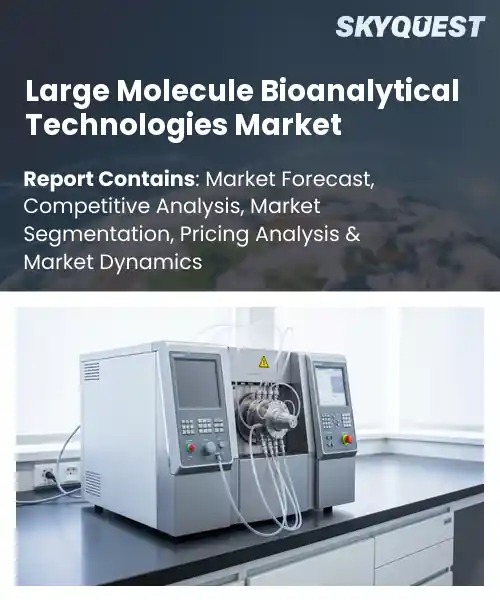
Large Molecule Bioanalytical Technologies Market
Report ID: SQMIG35J2339
Report ID: SQMIG35J2339
[email protected]
USA +1 351-333-4748
Report ID:
SQMIG35J2339 |
Region:
Global |
Published Date: May, 2026
Pages:
157
|Tables:
119
|Figures:
77


Global Large Molecule Bioanalytical Technologies Market size was valued at USD 2.22 Billion in 2024 and is poised to grow from USD 2.46 Billion in 2025 to USD 5.52 Billion by 2033, growing at a CAGR of 10.62% during the forecast period (2026-2033).
The primary driver of the large molecule bioanalytical technologies market is the rapid expansion of biologic therapeutics, which demands analytical platforms to characterize complex macromolecules such as monoclonal antibodies, gene therapies, and recombinant proteins. This market encompasses instrumentation, assays, software and contract testing services that quantify identity, purity, potency and pharmacokinetics, and it matters because global regulatory agencies require detailed molecular evidence to approve and monitor these products. Over the past two decades the field evolved from basic immunoassays to high resolution mass spectrometry, illustrated by adoption of LC MS for peptide mapping and ligand binding assays for PK studies.
Regulatory expectations and complexity constitute a key trend driving the global large molecule bioanalytical technologies sector, because stricter comparability and safety requirements force sponsors to invest in advanced bioanalytical solutions, which expands demand for high sensitivity assays, automation and data tools. For example, biosimilar developers require analytical comparability studies that drive uptake of orthogonal methods such as intact mass analysis and multi attribute methods, while cell and gene therapy programs create needs for specialized assays to measure vector copy number and transgene expression. Consequently contract research organizations scale capabilities and vendors rapidly innovate, producing a reinforcing cycle of technology adoption, higher service revenues and improved patient safety.
How Is AI Enhancing Assay Sensitivity in the Large Molecule Bioanalytical Technologies Market?
The large molecule bioanalytical market is benefitting from AI's ability to enhance assay sensitivity via improved detection of weak signal detection and background noise separation. Three main concepts associated with ai and linear methods are, intelligent signal processing, pattern recognition and model driven assay optimization, all of these improve the selection of reagents and sample processing in the laboratory. AI is now embedded in both the instrument and data-analysis pipeline, it decreases the potential for false positives, while enabling the detection of subtle biomarker signals. The growing trends of improving reliability in the measurement of complex proteins/biologics and improving the efficiency and reproducibility of laboratory work will provide analysts with greater confidence to work with difficult sample types.
In Jan 2026, Bio-Techne launched Simple Plex ultrasensitive assays on the Ella platform and AI driven analysis complements this by extracting faint signals and automating parameter tuning. The combined effect supports market growth and operational efficiency by improving detection of low abundance biomarkers and reducing repeat testing.
Market snapshot - (2026-2033)
Global Market Size
USD 2.22 Billion
Largest Segment
ELISA (Ligand Binding Assays)
Fastest Growth
Flow Cytometry
Growth Rate
10.62% CAGR
To get more insights on this market click here to Request a Free Sample Report
Global large molecule bioanalytical technologies market is segmented by technology, application, molecule type, end-user and region. Based on technology, the market is segmented into LC-MS/MS, ELISA (Ligand Binding Assays), Flow Cytometry, Electrochemiluminescence (ECL) and SPR (Surface Plasmon Resonance). Based on application, the market is segmented into PK/PD Studies, Immunogenicity Assessment and Biomarker Quantification. Based on molecule type, the market is segmented into Monoclonal Antibodies, Peptides and Fusion Proteins. Based on end-user, the market is segmented into CROs, Pharma & Biotech and Academic Institutes. Based on region, the market is segmented into North America, Europe, Asia Pacific, Latin America and Middle East & Africa.
What Role do LC-MS/MS Play in Large Molecule Bioanalytical Technologies?
Based on the global large molecule bioanalytical technologies market growth, LC-MS/MS segment dominates because its unmatched specificity and structural resolution make it essential for characterizing complex large molecules and their metabolites across development workflows. The ability to produce reliable quantitation as well as structural confirmation is contributing to the large-scale use of mass spectrometry to provide robust workflows and flexibility in the analysis of different types of samples. An established regulatory acceptance and integration with state-of-the-art methods for sample preparation contribute to the key role of mass spectrometry as a core technology that has created barriers to replace and supported long-term commitments to mass spectrometry equipment.
However, electrochemiluminescence is emerging as the most rapidly expanding technology because its broad dynamic range and compatibility with multiplexed assays accelerate sensitive detection for large biologics. Innovations in reagent chemistry and instrument automation are driving adoption across preclinical and clinical workflows, widening application scope and creating new opportunities for high throughput immunoassays and translational biomarker studies.
How is Immunogenicity Assessment Shaping Large Molecule Bioanalytical Technologies?
Immunogenicity assessment segment stands out because its centrality to safety evaluation forces comprehensive assay development for detecting antidrug antibodies and neutralizing responses. There is a need to invest in sensitive workflows and standard reagents because of the demand for proven validated workflows and harmonized methodologies. Because of the regulatory environment regarding the mitigation of immunogenicity risks and the need to deconvolute complex immune responses with large molecule therapies, there is a need to invest resources in immunogenicity testing capacity.
Meanwhile, biomarker quantification is emerging as the fastest growing application as demand for translational and personalized large molecule therapies expands need for precise pharmacodynamic readouts. Advances in multiplex assays and sensitive platforms enable broader biomarker panels across studies, attracting cross functional adoption and unlocking opportunities for companion diagnostics, patient stratification, and adaptive development strategies.
To get detailed segments analysis, Request a Free Sample Report
Why does North America Dominate the Global Large Molecule Bioanalytical Technologies Market?
As per the global large molecule bioanalytical technologies market share, North America dominates the global large molecule bioanalytical technologies market due to a dense concentration of advanced biopharmaceutical companies, well developed clinical research infrastructure, and a robust ecosystem of contract research organizations and specialized analytical service providers. Strong regulatory frameworks and established pathways for complex biologic development incentivize investment in high end instrumentation and bioanalytical method development. Innovative centers are located nearby, which have close ties to researchers, companies, and clinical partners, making it easier for them to work together and increase their ability to rapidly adopt new assay technologies. A mature supply chain for reagents, skilled labor pools trained in complex molecular analytics, and a focus on precision medicine applications collectively reinforce sustained leadership and high uptake of next generation bioanalytical approaches. Significant investment in automation, high throughput platforms and data analytics, together with strong intellectual property frameworks, underpin continuous innovation and enable rapid scale up of complex assays for therapeutic development.
United States Large Molecule Bioanalytical Technologies Market
Large molecule bioanalytical technologies market in United States benefits from a dense network of biotechnology hubs, mature contract research infrastructure and laboratory capacity. Strong collaboration between industry and academic centers accelerates method development. Regulatory clarity and availability of specialized analytical service providers support translation of complex biologics into clinical studies. Focus on automation, high resolution platforms and bioinformatics expertise solidifies the country role in advancing sensitive biomarker and therapeutic analytics capabilities.
Canada Large Molecule Bioanalytical Technologies Market
Large molecule bioanalytical technologies market in Canada features strong academic research centers, clusters and contract research ecosystem that supports complex biologic development. National emphasis on translational research and partnerships with industry enhances analytical method innovation. Local service providers specialize in bioanalytical assay validation, immunogenicity testing and mass spectrometry applications. Facilitating regulatory dialogue and having a highly-skilled laboratory workforce can support faster and more efficient development pathways as well as the adoption of advanced technologies into therapeutic programs.
How are Assay Platforms Advancing Bioanalytical Capabilities in Europe?
Based on global large molecule bioanalytical technologies regional forecast, Europe is rapidly expanding in the industry due to interconnected translational research networks, established manufacturing clusters, and coordinated regulatory frameworks that support complex biologic development. An extensive network of specialized service suppliers and contract analysis labs enable scalable method selection and cross-border development. Innovation in assay platforms, biophysical characterization and mass spectrometry is being made possible through both public-private partnerships and regional centres of excellence. Additionally, skilled workforce pools, effective technology transfer from academic research labs and integrated clinical trial networks help expedite the translation and adoption of advanced analytics for a variety of therapeutic areas; thus, building momentum for the European marketplace. Increasing investor interest in precision medicine and complex modalities fuels partnerships among instrument vendors and software developers to develop integrated workflows. Harmonized standards and collaborative regulatory science initiatives across member states reduce barriers for cross border assay validation and commercial deployment, supporting sustained market development and wider clinical integration of sophisticated bioanalytical solutions.
Germany Large Molecule Bioanalytical Technologies Market
Large molecule bioanalytical technologies market in Germany is anchored by a pharmaceutical and biotechnology manufacturing base, analytical know how, and a network of specialized contract research laboratories. Strong engineering heritage supports development of precision instrumentation and automation solutions, while collaboration between industry and research institutes accelerates assay translation. Regulatory engagement and established quality systems facilitate method validation, enabling Germany to serve as a central hub for complex biologic analytics within Europe.
United Kingdom Large Molecule Bioanalytical Technologies Market
Large molecule bioanalytical technologies market in United Kingdom benefits from a dynamic biotech startup scene and strong industry academic partnerships that translate novel assays into practice. Integrated clinical networks and trial recruitment support method validation and clinical application. Expansion of specialized contract laboratories and investment in sensitive platforms fuels market momentum. Collaborative initiatives linking diagnostics, therapeutics and informatics strengthen the United Kingdom role as a growth market for complex biologic analytics.
France Large Molecule Bioanalytical Technologies Market
Large molecule bioanalytical technologies market in France is emerging through public support for biotechnology, strong university research programs and clusters of specialized service providers. Emphasis on translational research and collaboration with clinical centers underpins assay development for complex biologics. There is growing local knowledge on how to conduct assays using immune assays and biophysical techniques, in addition to using mass spectrometry techniques. Partnerships between startup companies, contract laboratories, and pharmaceutical companies are supporting these advancements in the use of advanced bioanalytical technologies throughout therapeutic development.
Why are Expanding Clinical Research Networks Important for Complex Assays in Asia Pacific?
As per global large molecule bioanalytical technologies regional outlook, Asia Pacific is strengthening its position in the industry through steady enhancement of research infrastructure, growing contract research capacity, and targeted government support for life sciences innovation. Biopharmaceutical regional centers are currently augmenting their capacities via investment in advanced instrumentation, high throughput workflows and data analytical capabilities to support the increased demands from both domestic and international biopharmaceutical developers. Cross-border partnerships with established global companies will help to accelerate the technology transfer rate and assist in the standardization of methods. Skills development programs and the expansion of clinical research networks will enhance the capacity to support complex assay methodologies, while an appropriately developed service and instrument provider ecosystem will facilitate the overall acceptance and use of sophisticated bioanalytical methodologies throughout therapeutic development.
Japan Large Molecule Bioanalytical Technologies Market
Large molecule bioanalytical technologies market in Japan combines analytical instrument manufacturing, technical expertise and a strong pharmaceutical research base to support complex biologic analytics. Industrial research centers and contract laboratories collaborate with academic institutions to refine sensitive assay formats and biophysical characterization methods. Regulatory dialogue and focus on quality systems enable rigorous method validation. Collaboration with global partners and investment in data driven analytics support Japan role in precision bioanalytical services.
South Korea Large Molecule Bioanalytical Technologies Market
Large molecule bioanalytical technologies market in South Korea leverages a strong biotechnology manufacturing sector, government initiatives and contract research capabilities to enhance complex biologic analytics. Collaboration among industry, research institutes and clinical centers accelerates assay development and validation. Focus on biosimilar testing and cell and gene therapy analytics, with adoption of automation and informatics, supports scalable workflows. Collaboration with Partnering Service Providers (PSPs) globally will allow for the implementation of advanced bioanalytical solutions, as well as an enhancement in the overall technologies transferred through collaboration.
To know more about the market opportunities by region and country, click here to
Buy The Complete Report
Drivers
Increasing Biologics Development
Technological Advancements In Instrumentation
Restraints
Complex Regulatory Requirements
Limited Skilled Workforce Availability
Request Free Customization of this report to help us to meet your business objectives.
Competitive landscape in global large molecule bioanalytical technologies market outlook is marked by consolidation and platform differentiation as firms pursue M&A, strategic partnerships, and proprietary instrumentation to capture bioprocess analytics demand. Examples include Danaher's acquisition of Cytiva and Thermo Fisher's purchase of PPD that expanded service portfolios, while instrument firms deploy in line analytics like RedShift BioAnalytics HaLCon to win bioprocess contracts.
Top Player’s Company Profile
Recent Developments
SkyQuest’s ABIRAW (Advanced Business Intelligence, Research & Analysis Wing) is our Business Information Services team that Collects, Collates, Correlates, and Analyses the Data collected by means of Primary Exploratory Research backed by robust Secondary Desk research.
As per SkyQuest analysis, the global large molecule bioanalytical technologies industry is being driven primarily by rapid expansion of biologic therapeutics that require advanced characterization and regulatory evidence, supported further by technological advancements in instrumentation and AI-enabled assay sensitivity. Growth is tempered by complex regulatory requirements that lengthen development timelines and demand extensive validation. North America remains the dominant region due to concentrated biopharma hubs, mature CRO networks and strong investment in high-end platforms, while LC-MS/MS stands out as the dominant technology because of its specificity and structural resolution. Together these forces encourage vendor innovation, scaling of contract services and wider adoption of integrated, automated workflows.
| Report Metric | Details |
|---|---|
| Market size value in 2024 | USD 2.22 Billion |
| Market size value in 2033 | USD 5.52 Billion |
| Growth Rate | 10.62% |
| Base year | 2024 |
| Forecast period | (2026-2033) |
| Forecast Unit (Value) | USD Billion |
| Segments covered |
|
| Regions covered | North America (US, Canada), Europe (Germany, France, United Kingdom, Italy, Spain, Rest of Europe), Asia Pacific (China, India, Japan, Rest of Asia-Pacific), Latin America (Brazil, Rest of Latin America), Middle East & Africa (South Africa, GCC Countries, Rest of MEA) |
| Companies covered |
|
| Customization scope | Free report customization with purchase. Customization includes:-
|
To get a free trial access to our platform which is a one stop solution for all your data requirements for quicker decision making. This platform allows you to compare markets, competitors who are prominent in the market, and mega trends that are influencing the dynamics in the market. Also, get access to detailed SkyQuest exclusive matrix.
Table Of Content
Executive Summary
Market overview
Parent Market Analysis
Market overview
Market size
KEY MARKET INSIGHTS
COVID IMPACT
MARKET DYNAMICS & OUTLOOK
Market Size by Region
KEY COMPANY PROFILES
Methodology
For the Large Molecule Bioanalytical Technologies Market, our research methodology involved a mixture of primary and secondary data sources. Key steps involved in the research process are listed below:
1. Information Procurement: This stage involved the procurement of Market data or related information via primary and secondary sources. The various secondary sources used included various company websites, annual reports, trade databases, and paid databases such as Hoover's, Bloomberg Business, Factiva, and Avention. Our team did 45 primary interactions Globally which included several stakeholders such as manufacturers, customers, key opinion leaders, etc. Overall, information procurement was one of the most extensive stages in our research process.
2. Information Analysis: This step involved triangulation of data through bottom-up and top-down approaches to estimate and validate the total size and future estimate of the Large Molecule Bioanalytical Technologies Market.
3. Report Formulation: The final step entailed the placement of data points in appropriate Market spaces in an attempt to deduce viable conclusions.
4. Validation & Publishing: Validation is the most important step in the process. Validation & re-validation via an intricately designed process helped us finalize data points to be used for final calculations. The final Market estimates and forecasts were then aligned and sent to our panel of industry experts for validation of data. Once the validation was done the report was sent to our Quality Assurance team to ensure adherence to style guides, consistency & design.
Analyst Support
Customization Options
With the given market data, our dedicated team of analysts can offer you the following customization options are available for the Large Molecule Bioanalytical Technologies Market:
Product Analysis: Product matrix, which offers a detailed comparison of the product portfolio of companies.
Regional Analysis: Further analysis of the Large Molecule Bioanalytical Technologies Market for additional countries.
Competitive Analysis: Detailed analysis and profiling of additional Market players & comparative analysis of competitive products.
Go to Market Strategy: Find the high-growth channels to invest your marketing efforts and increase your customer base.
Innovation Mapping: Identify racial solutions and innovation, connected to deep ecosystems of innovators, start-ups, academics, and strategic partners.
Category Intelligence: Customized intelligence that is relevant to their supply Markets will enable them to make smarter sourcing decisions and improve their category management.
Public Company Transcript Analysis: To improve the investment performance by generating new alpha and making better-informed decisions.
Social Media Listening: To analyze the conversations and trends happening not just around your brand, but around your industry as a whole, and use those insights to make better Marketing decisions.
REQUEST FOR SAMPLE
 REQUEST FREE CUSTOMIZATION
Global Large Molecule Bioanalytical Technologies Market size was valued at USD 2.22 Billion in 2024 and is poised to grow from USD 2.46 Billion in 2025 to USD 5.52 Billion by 2033, growing at a CAGR of 10.62% during the forecast period (2026-2033).
Competitive landscape in global large molecule bioanalytical technologies is marked by consolidation and platform differentiation as firms pursue M&A, strategic partnerships, and proprietary instrumentation to capture bioprocess analytics demand. Examples include Danaher's acquisition of Cytiva and Thermo Fisher's purchase of PPD that expanded service portfolios, while instrument firms deploy in line analytics like RedShift BioAnalytics HaLCon to win bioprocess contracts. 'Covance (Labcorp)', 'Quintiles (IQVIA)', 'PPD (Thermo Fisher)', 'WuXi AppTec', 'Pacific Biosciences', 'Charles River Laboratories', 'SGS SA', 'Intertek Group', 'Cyprotex (Evotec)', 'BioAgilytix', 'PRA Health Sciences (ICON)', 'Frontage Laboratories', 'LabCorp Drug Development', 'Q2 Solutions (IQVIA)', 'ICON plc', 'KBI Biopharmaceuticals', 'Immunologix Laboratories', 'Shionogi USA', 'Pacific BioLabs', 'Analytical Biological Services'
The expanding pipeline of therapeutic proteins and antibodies is intensifying demand for reliable large molecule bioanalytical methods that can characterize complex structures and support regulatory submissions. This drives investment in specialized assays, platform development, and service offerings that address specific challenges such as higher order structure analysis, immunogenicity assessment, and stability testing. As sponsors prioritize accurate characterization to de-risk development and accelerate decision making, laboratories and technology providers scale capabilities and innovate service models, thereby expanding market opportunities and adoption of advanced bioanalytical technologies.
Integrated Multi Omics Platforms: Integrated multi omics platforms are driving demand for bioanalytical technologies by enabling molecular characterization across proteomic, genomic, and metabolomic layers. Convergence fosters richer biomarker discovery, contextualized immunogenicity and stability assessment, and streamlined workflows. Manufacturers and service providers are responding with interoperable instruments and data pipelines, encouraging cross disciplinary collaboration and standardized protocols. The trend accelerates platform adoption in translational and clinical programs, creating opportunities for solutions that deliver integrated insights, improve decision making throughout development and support faster milestone execution.
Why does North America Dominate the Global Large Molecule Bioanalytical Technologies Market? |@12


Want to customize this report? This report can be personalized according to your needs. Our analysts and industry experts will work directly with you to understand your requirements and provide you with customized data in a short amount of time. We offer $1000 worth of FREE customization at the time of purchase.
Feedback From Our Clients


 USA (+1) 351-333-4748

