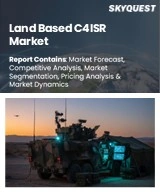
Land Based C4ISR Market
Report ID: SQMIG20A2515
Report ID: SQMIG20A2515
[email protected]
USA +1 351-333-4748
Report ID:
SQMIG20A2515 |
Region:
Global |
Published Date: December, 2025
Pages:
189
|Tables:
117
|Figures:
72


Global Land Based C4ISR Market size was valued at USD 31.5 billion in 2024 and is poised to grow from USD 33.48 billion in 2025 to USD 54.59 billion by 2033, growing at a CAGR of 6.3% during the forecast period (2026-2033).
The market is witnessing substantial growth, driven by the increasing demand for situational awareness on the battlefield in real-time, effective capabilities in command and control, and coordinated efforts across ground defense forces. As threats are becoming more dynamic and asymmetric, the modern military is implementing more integrated C4ISR systems in order to improve responsiveness to operational situations, minimize enemy decision time, and ensure secure flow of information. Increased geopolitical tensions, border conflicts, and rising cross-border security threats, particularly in Eastern Europe, the Middle East, Europe, and the Indo-Pacific will continue to pose threats to defense modernization. Governments across the globe are heavily investing in land-based C4ISR capabilities, including sensor networks, tactical communication systems, AI-powered reconnaissance tools, and battlefield management software. Furthermore, the integration of technologies such as artificial intelligence, 5G, and advanced radar into C4ISR architecture is improving decision-making accuracy and force interoperability, thus creating new growth opportunities.
Yet, there are some market restraints. Even though there are significant unfulfilled needs, the high start-up cost for the infrastructure and equipment is still a key barrier to entry, particularly in developing countries. Furthermore, the issue of interoperability between multiple vendor systems can cause integration inefficiency. Cybersecurity threats against communications networks remain a substantial risk, necessitating a solution to ensure the data is protected. Despite these constraints, increasing defense budgets and technological upgrades in major economies such as the U.S., India, and China are expected to sustain long-term growth. Emerging economies are also showing growing interest in customized and cost-effective land-based C4ISR platforms, reflecting a broader shift toward localized defense production and modernization.
How are Emerging Technologies like AI and IOT Transforming the Land Based C4ISR Market?
The global land-based C4ISR sector is experiencing a rise in the use of AI and IoT by facilitating intelligent decision-making, predictive analysis, and improved situational awareness. AI process real-time battlefield data from various sources (UAVs, radars, and sensors) to provide actionable information and automated responses to mission-critical requirements. At the same time, IoT networks would enable connectivity between devices and systems, allowing them to communicate on a continuous basis, resulting in synchronized operations between command centers and forces in the field. These capabilities will decrease human error, reduce response times, and significantly improve detection of threats and coordination of forces in complex terrain.
In 2025, the U.S. Army granted a contract to Palantir Technologies to upgrade its TITAN (Tactical Intelligence Targeting Access Node) ground station capabilities with AI and IoT. The purpose was to provide commanders with a single interface to fuse and visualize data from a variety of sources, including satellites, unmanned aerial vehicles (UAVs) and ground sensors, providing commanders the ability to identify threats more rapidly and commit resources to address those threats precisely. The upgraded TITAN system used AI powered fusion models to understand what was occurring on the battlefield in real time, while the IoT-based connectivity ensured that deployed units and command posts could reliably communicate with each other. This project marks a significant shift towards more intelligent and adaptive battlefield intelligence systems to support land operations.
Market snapshot - 2026-2033
Global Market Size
USD 30.92 Billion
Largest Segment
Electronics
Fastest Growth
Software
Growth Rate
5.5% CAGR
To get more insights on this market click here to Request a Free Sample Report
Global Land Based C4ISR Market is segmented by System Type, Application, Platform, Component, End User and region. Based on System Type, the market is segmented into Command and Control, Communications, Electronic Warfare, Intelligence and Surveillance and Reconnaissance. Based on Application, the market is segmented into Battlefield Surveillance, Border Surveillance, Force Protection, Logistics Management and Target Acquisition. Based on Platform, the market is segmented into Stationary Infrastructure, Tracked Vehicles, Unmanned Ground Vehicles and Wheeled Vehicles. Based on Component, the market is segmented into Hardware and Software. Based on End User, the market is segmented into Defense Forces, Emergency Services, Homeland Security Agencies and National Law Enforcement. Based on region, the market is segmented into North America, Europe, Asia Pacific, Latin America and Middle East & Africa.
According to the global land based C4ISR market forecast, the electronics segment is a dominant portion of the land-based C4ISR market because sensors, radars, electronic warfare systems, and surveillance modules are critical for modern militaries. Electronic components form the backbone of situational awareness/ intelligence-gathering frameworks. Ground-based radars, GPS systems, and signal intelligence modules are increasingly being deployed into armored vehicles, field units, in order to monitor threats and enemy movements, in real-time. Further contributing to the dominance of this segment is the growing investment in next-generation electronic countermeasure systems.
The communications segment is anticipated to be the fastest-growing in the forecast period, propelled by the rising need for real-time, secure, and multi-channel communications across ground forces. Modern battlefield strategies depend heavily on uninterrupted data transfer between command centers and front-line units. The use of newer technologies, including software-defined radios (SDRs), tactical mesh networks, and satellite communication, is becoming very common.
The military segment dominates the application landscape owing to increasing military modernization programs, border security initiatives, and deployment of smart command-and-control platforms. Land forces use C4ISR systems extensively for coordination within the area of operations, intelligence collection, and threats. Growing defense budgets are further advancing the systems’ adoption of integrated, multi-disciplined C4ISR technologies. Command, Control, Communicating, Computers, Intelligence, Surveillance, and Reconnaissance (C4ISR) systems will play an increasingly greater role in ensuring operational superiority across the spectrum of warfare defined by conventional and asymmetric. Advanced surveillance tools, alongside electronic warfare systems, and command infrastructure, will be more and more common in air land operations.
The fastest application segment in the land-based C4ISR landscape is disaster management. Governments and humanitarian organizations are increasingly turning to C4ISR solutions as part of an emergency coordination, terrain management, and situational awareness strategy for natural disasters and crisis conditions. IoT-based sensors positioned in the field, unmanned ground systems, and mobile command centers help inform and increase situational awareness to facilitate quick rescue operations and coordination of disaster management or humanitar aid units.
To get detailed segments analysis, Request a Free Sample Report
As per the global land based C4ISR market analysis, North America is the leading region in the global land based C4ISR market, primarily due to its long-established military infrastructure, consistent defense budget allocation, and focus on technology-driven modernization. The area advantages from advanced AI, IoT, and sensor-based technologies in land defense systems, and strong collaboration between defense ministries and research institutions allows for rapid integration of next-generation C4ISR solutions. With cross-domain integration philosophies, effective real-time visualization of the battlefield, and modern electronic warfare capabilities, North America is further advancing its leading position.
The U.S. is leading in the deployment and operationalization of advanced land-based C4ISR capabilities. The entire Army has a command and control communication system that possesses surveillance frameworks that come together for situational awareness of rapidly evolving threats together with the data being seamlessly fused on behalf of ground forces. Emphasis is placed on developing adaptive command systems that can function efficiently across multiple terrains and conflict scenarios. Ground-based platforms are increasingly being integrated with long-range detection sensors, encrypted data channels, and automated decision-support tools, ensuring maximum operational efficiency.
Canada is emerging as a rapidly advancing market within North America, propelled by its national security goals and increasing involvement in collaborative defense programs. The country has emphasized updating its ground operations infrastructure with the use of mobile command systems, improved field communications and real-time intelligence monitoring capabilities. Investments in Arctic security, border surveillance, and disaster response infrastructures have helped facilitate the coming on board of flexible C4ISR platforms, demonstrating Canada's increasing focus on self-sustaining and interoperable military systems.
The land-based C4ISR market is booming across Europe; driven by increased regional tensions along with multinational military engagements, and increased spending in integrated battlefield technologies. Countries in Europe are transitioning from disconnected, historical, and ISR-informed ground operations to more connected, real-time, data informed ground operations that prioritize system-wide interoperability and threat intelligence deconfliction across allied forces. Additionally, countries are increasing their focus on electronic warfare preparedness, counter-terrorism approaches, and crisis response capabilities, all of which are accelerating the fielding of advanced C4ISR solutions across European armed forces.
Germany occupies a key role across the continent within Europe’s land based C4ISR picture largely due to its attention to digitizing the battlefield and automating ground command operations. Germany reinforced land surveillance networks, border intelligence structures, and field communications frameworks to match the corresponding emerging threats and joint operational needs. These capabilities are implemented with the aim of closing the coordination gap between command units, improve situational awareness, and accelerate time-sensitive decision-making in high-stakes ground operations.
The U.K. is progressing rapidly with the adoption of land-based C4ISR via a well-defined approach to digital transformation of its ground operations. The enhancement of operational capability is being led by the application of mobile intelligence systems, sensors in reconnaissance vehicles, and AI-supported situational analysis processes. All of these systems will improve the coordination of the field level and command level decision timelines and operational agility. Their focus is on creating flexible C4ISR ecosystems that function across urban and remote combat zones positions it as the fastest-growing adopter in the European region.
France plays a critical role in shaping Europe’s C4ISR market through its balanced focus on homeland security, joint EU operations, and overseas missions. The nation is engaging in modernizing its land forces to incorporate digital command structures with a focus on securing communications, battlefield mapping tools, and tactical coordination systems. The modernization efforts are aimed at strategic autonomy and compatibility with NATO and EU defense structures. France's dedication to innovation and defense preparedness makes it a unique European contributor to the evolving C4ISR capabilities.
The Asia Pacific region is becoming an increasingly strategic region in the land-based C4ISR market due to regional conflicts, border disputes, and a growing emphasis on domestic defense innovation. Across the region, countries are investing in sophisticated C4ISR capabilities to maintain territorial integrity, manage threat assessment, and achieve autonomous technological disposition. As AI-enabled decision-making, command coordination in real time, and cybersecure networks evolve, the field of land operations throughout the Asia Pacific will change.
Japan leads the regional market due to its strategic focus on enhancing ground force readiness through robust intelligence, surveillance, and communication capabilities. Emphasis is placed on creating interoperable, high-speed data networks and automated ground surveillance systems that can function seamlessly across joint and independent missions. Japan's army has utilized networked sensors, multi-domain command platforms, and predictive analytics engines that facilitate real-time decision-making. These efforts are also consistent with a broader shift towards the use of rapid-response strategies across the operational contexts of the nation itself and the allied operations with Japan.
South Korea is rapidly becoming a key growth market in the land-based C4ISR space due to its evolving security dynamics and strategic military reforms. The country is integrating real-time surveillance, encrypted tactical communication systems, and advanced battlefield coordination platforms across its ground forces. These enhancements are driven by the need for increased self-sufficiency, quicker situational response, and high-level coordination between mobile units and centralized command centers across complex terrain and high-risk zones.
To know more about the market opportunities by region and country, click here to
Buy The Complete Report
Rising Demand for Real-Time Situational Awareness
Military Modernization and Digitization Programs
High Initial Costs of Deployment and Maintenance
Integration Complexity and Interoperability Challenges
Request Free Customization of this report to help us to meet your business objectives.
The C4ISR market on land is intensely competitive and focused on defense solution providers, with an emphasis on differentiated technology and systems integration capabilities. Investment in artificial intelligence (AI) based situational awareness platforms, multi-domain command interface capability, and field deployable sensor networks to enhance ground force readiness is prioritized by specific companies. Recent and contemporary strategies include cross-border collaboration for a collective development of system, deploying modular architectures for flexibility in upgrades, and teaming with governments to develop their own developing capability and capacity. In the European region there is a shift towards cross-national C4ISR interoperability initiatives, while in the Asia Pacific region there is a focus by national regional companies developing command and control nature systems for the terrain to serve border intervention and rapid deployment requirements.
As per the global land based C4ISR industry analysis, the startup scene is rapidly evolving, driven by innovations in AI-driven analytics, modular systems, and cost-effective solutions. New market entrants are placing emphasis on iterative development cycles, using open-source intelligence and lightweight platforms to serve specific military and defense requirements. These startups are developing AI-enabled threat detection networks, seeking to improve real-time battlefield intelligence. A number of startups are integrating the use of Internet of Things (IoT) sensors with C4ISR (command, control, communications, computers, intelligence, surveillance, and reconnaissance) framework to deliver scalable capabilities for counterinsurgency in urban environments. Market entrants are also partnering with defense contractors to pilot new communications networks and services that emphasize interoperability and cybersecurity. Their approach to the military market emphasizes rapid prototyping and customer-tailored solutions that, in some cases, outpace larger vendors in flexibility and innovation.
SkyQuest’s ABIRAW (Advanced Business Intelligence, Research & Analysis Wing) is our Business Information Services team that Collects, Collates, Correlates, and Analyses the Data collected by means of Primary Exploratory Research backed by robust Secondary Desk research.
As per SkyQuest analysis, The global land-based C4ISR market is experiencing strong growth spurred by the emergence of AI and IoT technologies. AI improves decision-making by allowing for predictive analysis and by autonomously being able to detect threats; IoT creates connectivity and allows real-time sharing of data among battlefield systems. The key drivers for the market include increasing geopolitical tensions, states increasing their allocation to defense budgets, and a desire for interoperable network-centric warfare solutions. There are restraints on the market that might hold it back such as implementation costs, cybersecurity risks and regulatory challenges around cross-border technology transfers.
In spite of these challenges, the combination of AI and IoT is prepared to innovate military capacity using scalable / adaptive C4ISR. The focus on modernization, and the new startups often effort to out-innovate the larger organizations involved in DOD, limits growth and drives innovation in new modular and lower-cost systems. As nations prioritize smart defense infrastructure and land-based C4ISR, while weighing technological advances, technology will evolve with strategic and operational resilience forward.
| Report Metric | Details |
|---|---|
| Market size value in 2024 | USD 31.5 billion |
| Market size value in 2033 | USD 54.59 billion |
| Growth Rate | 6.3% |
| Base year | 2024 |
| Forecast period | 2026-2033 |
| Forecast Unit (Value) | USD Billion |
| Segments covered |
|
| Regions covered | North America (US, Canada), Europe (Germany, France, United Kingdom, Italy, Spain, Rest of Europe), Asia Pacific (China, India, Japan, Rest of Asia-Pacific), Latin America (Brazil, Rest of Latin America), Middle East & Africa (South Africa, GCC Countries, Rest of MEA) |
| Companies covered |
|
| Customization scope | Free report customization with purchase. Customization includes:-
|
To get a free trial access to our platform which is a one stop solution for all your data requirements for quicker decision making. This platform allows you to compare markets, competitors who are prominent in the market, and mega trends that are influencing the dynamics in the market. Also, get access to detailed SkyQuest exclusive matrix.
Table Of Content
Executive Summary
Market overview
Parent Market Analysis
Market overview
Market size
KEY MARKET INSIGHTS
COVID IMPACT
MARKET DYNAMICS & OUTLOOK
Market Size by Region
KEY COMPANY PROFILES
Methodology
For the Land Based C4ISR Market, our research methodology involved a mixture of primary and secondary data sources. Key steps involved in the research process are listed below:
1. Information Procurement: This stage involved the procurement of Market data or related information via primary and secondary sources. The various secondary sources used included various company websites, annual reports, trade databases, and paid databases such as Hoover's, Bloomberg Business, Factiva, and Avention. Our team did 45 primary interactions Globally which included several stakeholders such as manufacturers, customers, key opinion leaders, etc. Overall, information procurement was one of the most extensive stages in our research process.
2. Information Analysis: This step involved triangulation of data through bottom-up and top-down approaches to estimate and validate the total size and future estimate of the Land Based C4ISR Market.
3. Report Formulation: The final step entailed the placement of data points in appropriate Market spaces in an attempt to deduce viable conclusions.
4. Validation & Publishing: Validation is the most important step in the process. Validation & re-validation via an intricately designed process helped us finalize data points to be used for final calculations. The final Market estimates and forecasts were then aligned and sent to our panel of industry experts for validation of data. Once the validation was done the report was sent to our Quality Assurance team to ensure adherence to style guides, consistency & design.
Analyst Support
Customization Options
With the given market data, our dedicated team of analysts can offer you the following customization options are available for the Land Based C4ISR Market:
Product Analysis: Product matrix, which offers a detailed comparison of the product portfolio of companies.
Regional Analysis: Further analysis of the Land Based C4ISR Market for additional countries.
Competitive Analysis: Detailed analysis and profiling of additional Market players & comparative analysis of competitive products.
Go to Market Strategy: Find the high-growth channels to invest your marketing efforts and increase your customer base.
Innovation Mapping: Identify racial solutions and innovation, connected to deep ecosystems of innovators, start-ups, academics, and strategic partners.
Category Intelligence: Customized intelligence that is relevant to their supply Markets will enable them to make smarter sourcing decisions and improve their category management.
Public Company Transcript Analysis: To improve the investment performance by generating new alpha and making better-informed decisions.
Social Media Listening: To analyze the conversations and trends happening not just around your brand, but around your industry as a whole, and use those insights to make better Marketing decisions.
REQUEST FOR SAMPLE
 REQUEST FREE CUSTOMIZATION
Global Land Based C4ISR Market size was valued at USD 30.92 Billion in 2023 poised to grow from USD 32.62 Billion in 2024 to USD 50.07 Billion by 2032, growing at a CAGR of 5.5% in the forecast period (2025-2032).
The C4ISR market on land is intensely competitive and focused on defense solution providers, with an emphasis on differentiated technology and systems integration capabilities. Investment in artificial intelligence (AI) based situational awareness platforms, multi-domain command interface capability, and field deployable sensor networks to enhance ground force readiness is prioritized by specific companies. Recent and contemporary strategies include cross-border collaboration for a collective development of system, deploying modular architectures for flexibility in upgrades, and teaming with governments to develop their own developing capability and capacity. In the European region there is a shift towards cross-national C4ISR interoperability initiatives, while in the Asia Pacific region there is a focus by national regional companies developing command and control nature systems for the terrain to serve border intervention and rapid deployment requirements. 'Elbit Systems (Israel)', 'Hewlett Packard Enterprise (USA)', 'Thales Group (France)', 'Honeywell (USA)', 'Oshkosh Corporation (USA)', 'BAE Systems (UK)', 'Textron (USA)', 'SAIC (USA)', 'L3Harris Technologies (USA)', 'Raytheon Technologies (USA)', 'Northrop Grumman (USA)', 'Rockwell Collins (USA)', 'Leonardo (Italy)', 'Lockheed Martin (USA)', 'General Dynamics (USA)'
Today's battlefields require quick and precise decision-making, which has driven a demand for real-time situational awareness from more advanced C4ISR systems. C4ISR systems now return sensor data, surveillance feeds, and tactical intelligence to present a complete picture of visibility on the battlefield. The ability to make better decisions faster results from improved situational awareness, which leads to faster threat detection, efficient coordination among units, and increased likelihood of successful missions. The driver is particularly evident in regions with asymmetric threats or border tensions that require a quick intelligence and response capability.
Integration of Artificial Intelligence for Predictive Battlefield Intelligence: Artificial intelligence is transforming the management of the C4ISR systems for ground forces in terms of data, threats, and mission planning. AI algorithms use current sensor feeds, historical ablities, and other environmental information to provide likelihoods and weigh warning notification. AI-enabled decision-support tools are also streamlining operational planning by reducing human error and shortening response times.
Why is North America the Dominating Region in the Land Based C4ISR Market?


Want to customize this report? This report can be personalized according to your needs. Our analysts and industry experts will work directly with you to understand your requirements and provide you with customized data in a short amount of time. We offer $1000 worth of FREE customization at the time of purchase.
Feedback From Our Clients


 USA (+1) 351-333-4748

