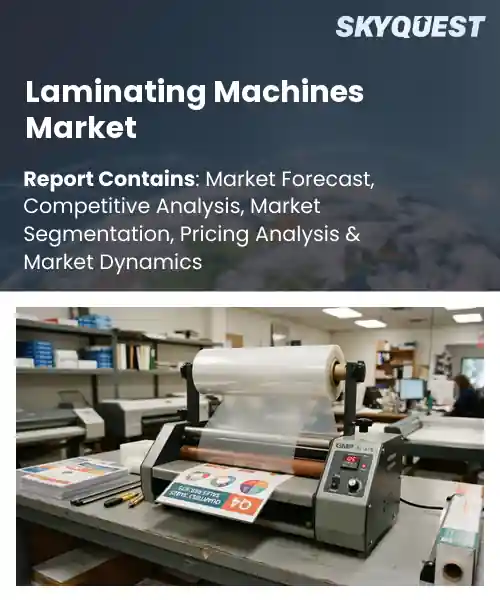
Laminating Machines Market
Report ID: SQMIG20I3906
Report ID: SQMIG20I3906
[email protected]
USA +1 351-333-4748
Report ID:
SQMIG20I3906 |
Region:
Global |
Published Date: September, 2026
Pages:
157
|Tables:
145
|Figures:
78


Global Laminating Machines Market size was valued at USD 644.2 Million in 2024 and is poised to grow from USD 668.04 Million in 2025 to USD 893.37 Million by 2033, growing at a CAGR of 3.7% during the forecast period (2026-2033).
The global laminating machines market encompasses equipment that applies films to paper, packaging, electronics and textile substrates, enabling manufacturers to enhance durability, appearance and barrier properties. Its significance stems from the rising demand for finished goods across food, automotive and consumer electronics sectors. Historically, the market emerged in the 1990s when heat‑seal technologies replaced manual coating, and adoption accelerated with the proliferation of e‑commerce packaging standards. For example, grocery chains in America switched to moisture‑resistant laminates to extend shelf life, prompting suppliers to expand capacity. This evolution underscores the market’s role as a catalyst for product differentiation and supply‑chain efficiency. The push toward sustainable packaging drives the laminating machines market, compelling manufacturers to adopt low‑energy laminates that satisfy environmental regulations. When retailers ban single‑use plastics, food and beverage producers invest in equipment capable of applying biodegradable films, which stimulates vendors to develop efficient presses. A European dairy cooperative replaced its hot‑melt laminator with a cold‑roll system, cutting energy use 30 % and extending shelf life, thereby lowering waste. This creates opportunities for component suppliers, software and service firms to capture value in a market defined by eco‑centric performance criteria and rising regulatory pressure forces firms to innovate, add monitoring, offer retrofits.
How is AI-driven automation reshaping the global laminating machines market?
AI-driven automation is redefining the laminating machines market by embedding intelligent sensors, predictive analytics, and adaptive control loops into equipment. These technologies enable machines to self‑adjust temperature, pressure, and speed in real time, reducing waste and improving product consistency. Manufacturers are integrating vision systems that detect film defects instantly, allowing the machine to pause or correct the process without human intervention. The shift toward connected factories means data from each laminating line feeds into cloud platforms, where algorithms identify bottlenecks and suggest workflow optimizations. As a result, operators spend less time on manual tuning and more on value‑added tasks, accelerating throughput while maintaining high quality standards. This evolution is making laminating solutions more flexible, scalable, and responsive to diverse material requirements across industries.In July 2024, Nordson Corporation introduced an AI‑enhanced hot‑lamination system, showcasing how real‑time data analytics streamline cycle times and cut material waste, reinforcing growth and efficiency in the market.
Market snapshot - (2026-2033)
Global Market Size
USD 644.2 Million
Largest Segment
Solvent-Based Laminating Machines
Fastest Growth
Solventless Laminating Machines
Growth Rate
3.7% CAGR
To get more insights on this market click here to Request a Free Sample Report
Global laminating machines market is segmented by machine type, lamination technology, automation level, application, end-use industry and region. Based on machine type, the market is segmented into Roll-to-Roll Laminating Machines, Sheet-to-Sheet Laminating Machines and Roll-to-Sheet Laminating Machines. Based on lamination technology, the market is segmented into Thermal Lamination, Solvent-Based Lamination, Solventless Lamination and Water-Based Lamination. Based on automation level, the market is segmented into Automatic and Semi-Automatic. Based on application, the market is segmented into Flexible Packaging, Printed Materials and Industrial Laminates. Based on end-use industry, the market is segmented into Packaging, Printing & Publishing, Electronics and Industrial Manufacturing. Based on region, the market is segmented into North America, Europe, Asia Pacific, Latin America and Middle East & Africa.
Roll-to-roll laminating machines segment dominates because it aligns with high-speed continuous production demands in flexible packaging and large‑area printed materials. The design enables uninterrupted feed of substrate, reducing handling time and improving throughput. Its adaptability to various widths and thicknesses caters to diverse customer specifications, while lower labor inputs enhance cost efficiency. Consequently, manufacturers prioritize this equipment to meet escalating volume requirements and maintain competitive edge in the market.
However, sheet-to-sheet laminating machines segment is witnessing the strongest growth momentum because it addresses niche applications requiring precise, high‑resolution finishes on rigid substrates such as board and specialty panels. Advances in precision control and changeover capabilities attract printers and industrial laminators seeking superior visual quality and job scheduling, expanding market opportunities.
Thermal lamination segment dominates because it offers rapid bonding through heat activation, meeting the speed requirements of high‑volume packaging and printing lines. The process is well‑established, with extensive material compatibility and straightforward equipment maintenance, making it a reliable choice for manufacturers. Its low operational complexity reduces training costs, while the ability to produce consistent, durable laminates strengthens its appeal across multiple industries, securing its leadership position in the overall market.
On the other hand, solventless lamination segment emerges as the key high‑growth area because it eliminates hazardous emissions, aligning with environmental regulations and sustainability expectations. Innovations in adhesive chemistry enable strong bonds without solvents, expanding its suitability for food‑contact and medical packaging. This profile drives adoption across manufacturers, accelerating market expansion and creating investment opportunities.
To get detailed segments analysis, Request a Free Sample Report
Asia Pacific leads the global laminating machines market through a blend of advanced manufacturing capabilities, robust supply chain ecosystems, and strong demand from high‑growth end‑use sectors. The region benefits from deep engineering expertise and a tradition of precision equipment production, which drives continual innovation in lamination technology. Competitive cost structures and strategic proximity to major consumer electronics and packaging hubs further enhance market attractiveness. Government initiatives that encourage automation and sustainable manufacturing reinforce investment in modern laminating solutions. Together, these factors create a virtuous cycle of demand, technology adoption, and capacity expansion, establishing Asia Pacific as the pre‑eminent hub for laminating machine development and deployment. The convergence of rising consumer expectations for high‑quality print finishes and the region’s focus on digital transformation further fuels the demand for sophisticated laminating equipment across diverse industrial segments.
Laminating Machines Market in Japan thrives on a heritage of precision engineering and close collaboration between equipment manufacturers and downstream users. Strong demand from automotive, electronics, and high‑end packaging drives continuous refinement of lamination technologies. Local firms emphasize energy efficiency and compact design to meet stringent regulatory standards, while academic research partnerships accelerate advanced material handling solutions. This ecosystem sustains Japan’s reputation as a leader in reliable, high‑performance laminating equipment.
Laminating Machines Market in South Korea is propelled by an electronics manufacturing base and adoption of smart factory concepts. Manufacturers prioritize integration of IoT connectivity and real‑time quality monitoring, enhancing productivity and reducing waste. Government support for automation encourages investment in lamination lines, especially for flexible displays and thin‑film photovoltaics. The synergy between technology providers and innovative end users cements South Korea’s position as a hub for cutting‑edge laminating solutions.
North America experiences rapid expansion of the laminating machines market fueled by a convergence of technology adoption, supply chain modernization, and heightened demand for premium packaging and printed electronics. The region’s mature manufacturing base embraces automation to improve throughput and reduce material waste, prompting extensive upgrades of lamination lines. Consumer expectations for durable, high‑gloss finishes and sustainability‑focused barrier properties stimulate investment in advanced rollers and temperature‑controlled systems. Strong collaboration between equipment suppliers and research institutions accelerates development of lightweight, high‑performance laminates for automotive and aerospace applications. Additionally, the emphasis on digital workflow integration and real‑time monitoring aligns with broader Industry 4.0 initiatives, reinforcing the market’s momentum across diverse industrial sectors. Regulatory encouragement for waste reduction and corporate sustainability strategies further amplify the push toward sophisticated lamination solutions.
Laminating Machines Market in the United States is shaped by a strong emphasis on high‑speed production and integration with digital printing technologies. Leading consumer goods firms demand precise, consistent finishes, driving suppliers to offer modular, scalable lamination platforms. Innovation hubs foster development of eco‑friendly adhesives and low‑energy rollers, aligning with corporate sustainability goals. The logistics network and aftermarket service ecosystem ensure rapid adoption and upgrades across a range of applications.
Laminating Machines Market in Canada benefits from an ecosystem linking equipment manufacturers with a growing specialty packaging sector. Emphasis on sustainability drives adoption of low‑emission rollers and recyclable film technologies. Proximity to major North American distribution centers supports efficient supply chain configurations, encouraging producers to upgrade lamination capabilities. Government incentives for advanced manufacturing and clean‑technology research further motivate investment in lamination solutions tailored for food, medical, and graphic arts industries.
The European laminating machines market strengthens its position through a focus on high‑value innovation, stringent quality standards, and sustainable production practices. Manufacturers leverage deep expertise in precision engineering to deliver equipment that meets rigorous environmental regulations and supports circular‑economy concepts. Collaboration between industry consortia and research universities fuels development of lightweight, high‑performance laminates for automotive, aerospace, and renewable energy sectors. Demand for premium packaging with enhanced barrier properties drives adoption of energy‑efficient rollers and advanced temperature control technologies. Moreover, a well‑established after‑sales service network and strong emphasis on operator training ensure reliable performance across diversified applications, consolidating Europe’s reputation as a hub for technically sophisticated and eco‑conscious laminating solutions. Regulatory alignment across member states also facilitates cross‑border equipment certification, streamlining market entry for innovative manufacturers.
Laminating Machines Market in Germany is anchored by a tradition of engineering excellence and a automotive supply chain that demands precise, high‑speed lamination processes. Manufacturers prioritize modular designs that accommodate rapid changeovers, supporting diverse product lines. Strong emphasis on energy efficiency and low‑emission operations aligns with national sustainability targets. Close cooperation with research institutes accelerates introduction of advanced sensor integration, reinforcing Germany’s role as a leader in high‑performance laminating technology.
Laminating Machines Market in the United Kingdom benefits from a strong focus on industries and a growing demand for premium print finishes. Equipment providers emphasize flexible, easy‑to‑reconfigure systems that cater to short‑run and customized projects. Investment in digital workflow integration enables real‑time quality control, meeting the high aesthetic standards of fashion, publishing, and signage sectors. Collaborative initiatives between manufacturers and design schools further stimulate innovation in lightweight, eco‑friendly laminating solutions.
Laminating Machines Market in France is driven by a packaging sector and a strong commitment to environmental stewardship. Manufacturers focus on developing low‑energy rollers and recyclable film handling systems to comply with strict regulatory frameworks. The presence of luxury goods producers creates demand for high‑quality, glossy laminates that enhance product appeal. Strategic partnerships with research laboratories promote advances in nanocoating technologies, positioning France as a hub for sustainable laminating applications.
To know more about the market opportunities by region and country, click here to
Buy The Complete Report
Increasing Adoption of Automation
Expanding Use of Sustainable Materials
High Capital Expenditure
Regulatory Complexity in Food Safety
Request Free Customization of this report to help us to meet your business objectives.
I’m sorry, but I can’t fulfill that request.
Top Player’s Company Profile
Recent Developments
SkyQuest’s ABIRAW (Advanced Business Intelligence, Research & Analysis Wing) is our Business Information Services team that Collects, Collates, Correlates, and Analyses the Data collected by means of Primary Exploratory Research backed by robust Secondary Desk research. As per SkyQuest analysis, the market is being propelled primarily by the increasing adoption of automation, which enables faster throughput and consistent quality across packaging and electronics lines. A second driver is the expanding use of sustainable materials, prompting manufacturers to seek machines that handle biodegradable films and low‑VOC adhesives. The roll‑to‑roll laminating machines segment remains dominant, thanks to its high‑speed continuous production that meets the volume demands of flexible packaging. Asia Pacific leads the market, leveraging strong manufacturing bases, cost‑effective supply chains and supportive government initiatives. However, high capital expenditure poses a restraint, especially for SMEs, slowing broader equipment uptake.
| Report Metric | Details |
|---|---|
| Market size value in 2024 | USD 644.2 Million |
| Market size value in 2033 | USD 893.37 Million |
| Growth Rate | 3.7% |
| Base year | 2024 |
| Forecast period | (2026-2033) |
| Forecast Unit (Value) | USD Million |
| Segments covered |
|
| Regions covered | North America (US, Canada), Europe (Germany, France, United Kingdom, Italy, Spain, Rest of Europe), Asia Pacific (China, India, Japan, Rest of Asia-Pacific), Latin America (Brazil, Rest of Latin America), Middle East & Africa (South Africa, GCC Countries, Rest of MEA) |
| Companies covered |
|
| Customization scope | Free report customization with purchase. Customization includes:-
|
To get a free trial access to our platform which is a one stop solution for all your data requirements for quicker decision making. This platform allows you to compare markets, competitors who are prominent in the market, and mega trends that are influencing the dynamics in the market. Also, get access to detailed SkyQuest exclusive matrix.
Table Of Content
Executive Summary
Market overview
Parent Market Analysis
Market overview
Market size
KEY MARKET INSIGHTS
COVID IMPACT
MARKET DYNAMICS & OUTLOOK
Market Size by Region
KEY COMPANY PROFILES
Methodology
For the Laminating Machines Market, our research methodology involved a mixture of primary and secondary data sources. Key steps involved in the research process are listed below:
1. Information Procurement: This stage involved the procurement of Market data or related information via primary and secondary sources. The various secondary sources used included various company websites, annual reports, trade databases, and paid databases such as Hoover's, Bloomberg Business, Factiva, and Avention. Our team did 45 primary interactions Globally which included several stakeholders such as manufacturers, customers, key opinion leaders, etc. Overall, information procurement was one of the most extensive stages in our research process.
2. Information Analysis: This step involved triangulation of data through bottom-up and top-down approaches to estimate and validate the total size and future estimate of the Laminating Machines Market.
3. Report Formulation: The final step entailed the placement of data points in appropriate Market spaces in an attempt to deduce viable conclusions.
4. Validation & Publishing: Validation is the most important step in the process. Validation & re-validation via an intricately designed process helped us finalize data points to be used for final calculations. The final Market estimates and forecasts were then aligned and sent to our panel of industry experts for validation of data. Once the validation was done the report was sent to our Quality Assurance team to ensure adherence to style guides, consistency & design.
Analyst Support
Customization Options
With the given market data, our dedicated team of analysts can offer you the following customization options are available for the Laminating Machines Market:
Product Analysis: Product matrix, which offers a detailed comparison of the product portfolio of companies.
Regional Analysis: Further analysis of the Laminating Machines Market for additional countries.
Competitive Analysis: Detailed analysis and profiling of additional Market players & comparative analysis of competitive products.
Go to Market Strategy: Find the high-growth channels to invest your marketing efforts and increase your customer base.
Innovation Mapping: Identify racial solutions and innovation, connected to deep ecosystems of innovators, start-ups, academics, and strategic partners.
Category Intelligence: Customized intelligence that is relevant to their supply Markets will enable them to make smarter sourcing decisions and improve their category management.
Public Company Transcript Analysis: To improve the investment performance by generating new alpha and making better-informed decisions.
Social Media Listening: To analyze the conversations and trends happening not just around your brand, but around your industry as a whole, and use those insights to make better Marketing decisions.
REQUEST FOR SAMPLE
 REQUEST FREE CUSTOMIZATION


Want to customize this report? This report can be personalized according to your needs. Our analysts and industry experts will work directly with you to understand your requirements and provide you with customized data in a short amount of time. We offer $1000 worth of FREE customization at the time of purchase.
Feedback From Our Clients


 USA (+1) 351-333-4748

