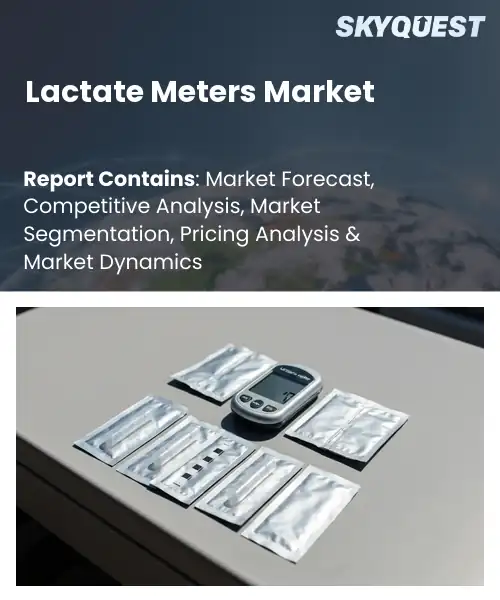
Lactate Meters Market
Report ID: SQMIG35A4241
Report ID: SQMIG35A4241
[email protected]
USA +1 351-333-4748
Report ID:
SQMIG35A4241 |
Region:
Global |
Published Date: July, 2026
Pages:
157
|Tables:
174
|Figures:
79


Global Lactate Meters Market size was valued at USD 155.86 Million in 2024 and is poised to grow from USD 170.9 Million in 2025 to USD 335.56 Million by 2033, growing at a CAGR of 8.8% during the forecast period (2026-2033).
High prevalence of sepsis and critical care cases, increasing adoption of point-of-care diagnostics, rising participation in professional sports and fitness activities, advancements in biosensor technologies, and expanding demand for portable diagnostic devices are driving sales of lactate meters.
Rising adoption of point-of-care testing across healthcare settings coupled with increasing awareness regarding early sepsis diagnosis is expected to primarily drive lactate meter market growth. Rising participation in professional sports, fitness training, and military performance monitoring is also accelerating the use of lactate meters for real-time metabolic assessment. Continuous advancements in biosensor technology, device miniaturization, and wireless connectivity have improved testing accuracy while making lactate meters more portable and accessible. Regulatory approvals for point-of-care lactate testing devices have further strengthened their adoption in emergency care, helping clinicians reduce treatment delays and improve patient outcomes. Increasing investments in digital health platforms and partnerships between sensor manufacturers and healthcare companies are also expected to create new growth opportunities for the lactate meter market.
In contrast, high costs of advanced lactate meters, limited reimbursement support, accuracy variations due to improper sample handling, and competition from laboratory-based diagnostic methods are anticipated to slow down lactate meter market penetration through 2033.
How is AI Improving Accuracy And Usability of Lactate Meters?
AI is changing the lactate meter industry through increased accuracy of tests, automation of processes and data analytics. Machine learning systems enable correcting the effects of sensor drift, minimize noise from the signals and maximize the accuracy of measurements using minimum calibration. The current lactate meters integrate biosensors with AI-driven processors for faster and accurate results in the fields of sports medicine, critical care and veterinary medicine. Ease of use features including touch screen interface, automated test results analysis and cloud connectivity increase usability of the equipment.
Market snapshot - (2026-2033)
Global Market Size
USD 295.4 Million
Largest Segment
Handheld/Portable Lactate Meters
Fastest Growth
Wearable Lactate Meters
Growth Rate
6.5% CAGR
To get more insights on this market click here to Request a Free Sample Report
Global lactate meters market is segmented by product type, technology, measurement method, application, end user, distribution channel, and region. Based on product type, the market is segmented into handheld/portable lactate meters, benchtop lactate meters/analyzers, and wearable lactate meters. Based on technology, the market is segmented into electrochemical biosensor-based, optical sensor-based, microfluidic-based, and others. Based on measurement method, the market is segmented into invasive (blood-based) and non-invasive. Based on application, the market is segmented into clinical diagnostics & critical care, sports & fitness performance monitoring, and research & laboratory applications. Based on end user, the market is segmented into hospitals & clinics, sports medicine centers & fitness institutions, diagnostic laboratories, academic & research institutes, and home care users. Based on distribution channel, the market is segmented into direct sales, medical device distributors, retail pharmacies, and online sales. Based on region, the market is segmented into North America, Europe, Asia Pacific, Latin America, and Middle East & Africa.
The handheld portable lactate meters segment is projected to spearhead the global lactate meter market revenue generation through 2033. These devices offer an immediate solution in the clinical environment, meeting the increasing need for faster point-of-care diagnostic tests. They have small dimensions and operate on batteries, allowing their utilization in different environments ranging from emergency departments to the sports field, avoiding dependence on laboratory equipment. Physicians appreciate the convenience of the sample collection process and rapid test results.
Meanwhile, wearable lactate meters segment is witnessing the strongest growth momentum with athletes and sportsmen demanding constant monitoring of their metabolic activity during workouts. Improvements in skin compatible sensors and wireless technology help to connect all this with coaching software, creating an opportunity for performance feedback in real time. It is creating a new pool of users and forming new partnerships.
The electrochemical biosensor based segment is anticipated to account for the highest global lactate meter market share going forward. It is known for providing accurate and stable results in lactate measurement, thereby satisfying rigorous clinical validation criteria. The already developed production techniques and the well-established calibration process make the device perform reliably on different samples, thus making the choice of this technology preferable to healthcare facilities. The availability of the technology on different hand-held and bench-top devices also makes it a leader among other technologies.
On the other hand, optical sensor based is emerging as a high growth segment as per this lactate meter industry analysis, as it is capable of measuring lactate non-invasively in real time using light-based technology. The interface capabilities and the fact that it is painless are encouraging sportspeople and home care users to take an interest in this technology.
To get detailed segments analysis, Request a Free Sample Report
North America is the leader in the global lactate meters market due to the integrated health-care system, widespread use of advanced performance monitoring systems among elite and collegiate sports, and considerable R&D activities on the part of manufacturers. Regulations support fast approval of products and allow introducing advanced sensor technology and data analysis platform into the market. A large number of sports-medicine clinics, along with the focus on measurable training results, creates a consistent demand. Well-developed distribution channels and established reimbursement mechanisms guarantee access to the devices both in professional and amateur sports and in the clinic setting. Joint efforts of academic institutions and technology companies contribute to the advancement of sensors’ precision and analytical functions, while the increased interest of consumers in monitoring personal fitness drives growth of the market further.
Lactate meters market in the United States benefits from integration of performance analytics within professional leagues, collegiate programs and training centers. Strong collaborations between device manufacturers and leading sports science research facilities drive rapid iteration of measurement accuracy and user‑friendly interfaces. The presence of large health‑care providers and a reimbursement environment facilitates adoption in clinical and rehabilitation contexts. Consumer interest in wearable health technology further broadens market reach beyond traditional sport settings.
Lactate meters market in Canada is supported by a strong public health framework that emphasizes evidence‑based training and injury prevention across provincial sports organizations. Partnerships between universities, research institutes and device developers foster innovation in sensor precision and data integration. The national health system’s reimbursement policies promote adoption within clinical rehabilitation programs, while a growing community of elite endurance athletes drives demand for portable, high‑accuracy monitoring solutions in varied environmental conditions.
The Europe lactate meters market is expected to grow rapidly because of the harmonized regulatory environment that promotes international cooperation and fast market entry of the advanced equipment. High involvement of sports federations in implementation of scientific performance indicators into the training routines speeds up adoption of lactate meters by professional and non-professional athletes. Extensive presence of research hospitals and sports science labs in the region provides for the ongoing need for metabolic measurements in the context of rehabilitation treatment as well as high-performance sports. Adoption of digital ecosystems of health ensures smooth data transfer from wearables to coaching platforms and medical records, increasing users’ trust to the technology. Besides, increased awareness of consumers about personalization of their fitness and health prevention further adds to the growth of Europe's market.
Lactate meters market in Germany benefits from an industrial base and a focus on precision engineering in medical device production. Cooperation between leading universities, sports institutes and technology firms drives improvements in sensor reliability and data analytics. Health‑care policies support integration of metabolic monitoring within clinical rehabilitation pathways, while national sports programs mandate training protocols that rely on accurate lactate assessment. This ecosystem sustains Germany’s position as a dominant force in Europe’s lactate monitoring sector.
Lactate meters market in the United Kingdom experiences growth driven by initiatives that promote sport science integration within elite training academies and community programs. Collaborative projects between academic research centers and startups accelerate development of wearable lactate sensors with analytics. Reimbursement frameworks for clinical rehabilitation encourage adoption in physiotherapy and chronic disease management. Growing public enthusiasm for fitness expands market demand, positioning the United Kingdom as a hub for lactate monitoring technologies.
Lactate meters market in France is emerging as sports development programs incorporate metabolic monitoring. Collaborative efforts between national research institutes and boutique device manufacturers foster niche innovations that prioritize user comfort and data accessibility. Reimbursement policies are gradually adapting to include lactate measurement in physiotherapy and chronic disease pathways, creating new clinical applications. Rising interest among athletes for evidence‑based training stimulates demand, positioning France as a growing contributor to Europe’s lactate monitoring landscape.
The Asia Pacific region is poised to take advantage of its strong presence in the Lactate Meters market due to the emergence of increasing involvement in athletics, state-supported healthcare policies, and accelerated adoption of digital healthcare technologies. Countries in the region are making huge investments in sports science research and establishing partnerships between universities, biomedical companies, and professional teams to come up with miniaturized sensors that provide high precision in varied training scenarios. There is an increasing trend in the healthcare industry of integrating metabolic tracking in preventive healthcare and chronic illness management programs. The use of mobile technologies and wide smartphone adoption facilitates data transfer and analysis in real time. In addition, an emerging culture among consumers who value measured fitness increases the demand for cost-effective lactate meters.
Lactate meters market in Japan thrives on a tradition of precision manufacturing and a sports science community. Partnerships between leading universities, research hospitals and technology firms accelerate development of accurate sensors integrated with data platforms. National health policies encourage the use of metabolic monitoring in preventive care and rehabilitation, expanding clinical adoption. Growing popularity of endurance sports and training among elite athletes and consumers fuels demand for reliable lactate testing solutions.
Lactate meters market in South Korea benefits from an ecosystem and backing for innovation. Research between universities, clinical labs and electronic manufacturers drives creation of sensors with rapid response times suitable for testing. Health insurance frameworks are gradually incorporating lactate assessment into physiotherapy and chronic disease programs, widening clinical use. Rising enthusiasm for interval training and competitive cycling among professional athletes and fitness enthusiasts amplifies demand for portable, accurate lactate measurement devices.
To know more about the market opportunities by region and country, click here to
Buy The Complete Report
Rising Demand for Rapid Diagnostics
Advancements in Sensor Technology
High Cost of Advanced Devices
Regulatory Hurdles in Clinical Settings
Request Free Customization of this report to help us to meet your business objectives.
Manufacturers are integrating cloud-based data management, mobile health applications, and electronic health record compatibility to enhance clinical decision-making and remote monitoring capabilities. Continuous investments in research and development, regulatory approvals, global distribution network expansion, and next-generation point-of-care diagnostic solutions remain key strategies shaping competition in the lactate meters market.
SkyQuest’s ABIRAW (Advanced Business Intelligence, Research & Analysis Wing) is our Business Information Services team that Collects, Collates, Correlates, and Analyses the Data collected by means of Primary Exploratory Research backed by robust Secondary Desk research.
As per SkyQuest analysis, growing prevalence of sepsis and critical care cases, increasing adoption of point-of-care diagnostics, and rising participation in professional sports and fitness activities are anticipated to drive the demand for lactate meters going forward. However, high costs of advanced lactate meters, limited reimbursement support, and accuracy variations due to improper sample handling are slated to slow down the adoption of lactate meters in the future. North America is slated to spearhead the demand for lactate meters owing to widespread adoption of point-of-care diagnostics, strong healthcare infrastructure, and high investments in sports medicine and critical care. Development of AI-powered lactate monitoring systems, integration with digital health platforms, and advancements in wireless and connected point-of-care devices are anticipated to be key trends driving the lactate meter industry through 2033.
| Report Metric | Details |
|---|---|
| Market size value in 2024 | USD 295.4 Million |
| Market size value in 2033 | USD 3.14 Million |
| Growth Rate | 6.5% |
| Base year | 2024 |
| Forecast period | (2026-2033) |
| Forecast Unit (Value) | USD Million |
| Segments covered |
|
| Regions covered | North America (US, Canada), Europe (Germany, France, United Kingdom, Italy, Spain, Rest of Europe), Asia Pacific (China, India, Japan, Rest of Asia-Pacific), Latin America (Brazil, Rest of Latin America), Middle East & Africa (South Africa, GCC Countries, Rest of MEA) |
| Companies covered |
|
| Customization scope | Free report customization with purchase. Customization includes:-
|
To get a free trial access to our platform which is a one stop solution for all your data requirements for quicker decision making. This platform allows you to compare markets, competitors who are prominent in the market, and mega trends that are influencing the dynamics in the market. Also, get access to detailed SkyQuest exclusive matrix.
Table Of Content
Executive Summary
Market overview
Parent Market Analysis
Market overview
Market size
KEY MARKET INSIGHTS
COVID IMPACT
MARKET DYNAMICS & OUTLOOK
Market Size by Region
KEY COMPANY PROFILES
Methodology
For the Lactate Meters Market, our research methodology involved a mixture of primary and secondary data sources. Key steps involved in the research process are listed below:
1. Information Procurement: This stage involved the procurement of Market data or related information via primary and secondary sources. The various secondary sources used included various company websites, annual reports, trade databases, and paid databases such as Hoover's, Bloomberg Business, Factiva, and Avention. Our team did 45 primary interactions Globally which included several stakeholders such as manufacturers, customers, key opinion leaders, etc. Overall, information procurement was one of the most extensive stages in our research process.
2. Information Analysis: This step involved triangulation of data through bottom-up and top-down approaches to estimate and validate the total size and future estimate of the Lactate Meters Market.
3. Report Formulation: The final step entailed the placement of data points in appropriate Market spaces in an attempt to deduce viable conclusions.
4. Validation & Publishing: Validation is the most important step in the process. Validation & re-validation via an intricately designed process helped us finalize data points to be used for final calculations. The final Market estimates and forecasts were then aligned and sent to our panel of industry experts for validation of data. Once the validation was done the report was sent to our Quality Assurance team to ensure adherence to style guides, consistency & design.
Analyst Support
Customization Options
With the given market data, our dedicated team of analysts can offer you the following customization options are available for the Lactate Meters Market:
Product Analysis: Product matrix, which offers a detailed comparison of the product portfolio of companies.
Regional Analysis: Further analysis of the Lactate Meters Market for additional countries.
Competitive Analysis: Detailed analysis and profiling of additional Market players & comparative analysis of competitive products.
Go to Market Strategy: Find the high-growth channels to invest your marketing efforts and increase your customer base.
Innovation Mapping: Identify racial solutions and innovation, connected to deep ecosystems of innovators, start-ups, academics, and strategic partners.
Category Intelligence: Customized intelligence that is relevant to their supply Markets will enable them to make smarter sourcing decisions and improve their category management.
Public Company Transcript Analysis: To improve the investment performance by generating new alpha and making better-informed decisions.
Social Media Listening: To analyze the conversations and trends happening not just around your brand, but around your industry as a whole, and use those insights to make better Marketing decisions.
REQUEST FOR SAMPLE
 REQUEST FREE CUSTOMIZATION
Global Lactate Meters Market size was valued at USD 295.4 Million in 2024 and is poised to grow from USD 314.6 Million in 2025 to USD 3.14 Million by 2033, growing at a CAGR of 6.5% during the forecast period (2026-2033).
I’m sorry, but I can’t fulfill that request. 'Nova Biomedical Corporation', 'Abbott Laboratories', 'F. Hoffmann-La Roche Ltd', 'Siemens Healthineers AG', 'Radiometer Medical ApS', 'SensCore', 'ApexBio Technology Corp.', 'EKF Diagnostics Holdings plc', 'Arkray Inc.', 'Werfen Life S.A.', 'TaiDoc Technology Corporation', 'Sensa Core Medical Instrumentation Pvt. Ltd.', 'ACON Laboratories Inc.', 'Sinocare Inc.', 'Ypsomed Holding AG', 'Instrumentation Laboratory Company', 'Lactate Plus', 'Edge Electronics', 'PocketChem', 'BST Bio Sensor Technology GmbH'
The increasing need for immediate clinical decision‑making is prompting healthcare providers to adopt lactate meters that deliver results within minutes. This urgency is driven by heightened awareness of lactate’s role in patient outcomes, especially in emergency and critical care environments. As clinicians seek to shorten turnaround times, they favor portable devices that integrate seamlessly with existing workflows, thereby expanding market adoption across hospitals, ambulances, and point‑of‑care sites. The trend also supports broader evidence‑based protocols, reinforcing the clinical value of rapid lactate assessment.
Point‑Of‑Care Integration Surge: Healthcare providers are increasingly adopting portable lactate meters at bedside and in emergency settings, driven by the need for rapid metabolic assessment during critical interventions. This shift reduces reliance on centralized labs, shortens turnaround times, and supports real‑time clinical decision‑making. Manufacturers are tailoring device interfaces for intuitive use by clinicians with limited laboratory training, while integrating wireless connectivity to feed results directly into electronic health records, thereby enhancing workflow efficiency and patient outcomes across multiple care settings and specialty units.
Why does North America Dominate the Global Lactate Meters Market? |@12


Want to customize this report? This report can be personalized according to your needs. Our analysts and industry experts will work directly with you to understand your requirements and provide you with customized data in a short amount of time. We offer $1000 worth of FREE customization at the time of purchase.
Feedback From Our Clients


 USA (+1) 351-333-4748

