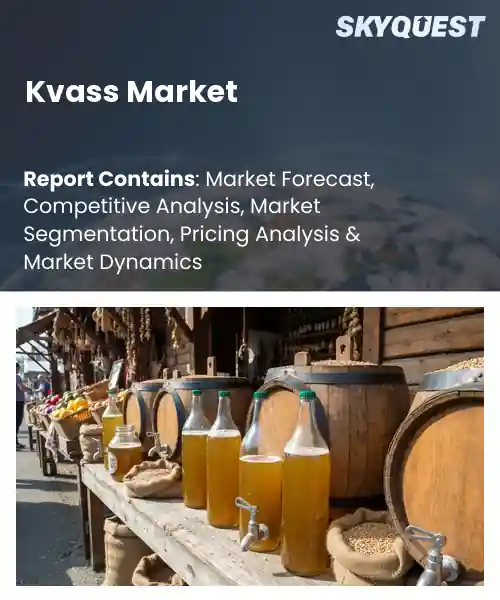
Kvass Market
Report ID: SQMIG30G2091
Report ID: SQMIG30G2091
[email protected]
USA +1 351-333-4748
Report ID:
SQMIG30G2091 |
Region:
Global |
Published Date: February, 2026
Pages:
157
|Tables:
178
|Figures:
78


Global Kvass Market size was valued at USD 1.0 Billion in 2024 and is poised to grow from USD 1.07 Billion in 2025 to USD 1.82 Billion by 2033, growing at a CAGR of 6.9% during the forecast period (2026-2033).
The global kvass market outlook experiences fundamental changes because consumers now prefer traditional drinks which contain low alcohol content while providing functional benefits. Kvass serves as a fermented rye bread drink from Eastern European tradition which functions both as a mainstream soft drink and as a symbol of cultural heritage. Russian and Ukrainian and Polish markets evolved to industrial production when home and street vendors stopped producing kvass, which led to breweries starting to distribute kvass through supermarkets. The post-Soviet commercialization together with the worldwide wellness trend brought about new product development, which included flavored drinks and probiotic drinks, and this expansion enabled products to enter fresh retail markets and new international territories.
Moreover, the global Kvass market growth depends on product innovation and distribution expansion because these two elements create business opportunities. Retailers display kvass in chilled sections after producers create flavored or probiotic products to satisfy wellness needs, which drives testing by health-conscious consumers. Supermarkets and e-commerce channels enable products to reach more customers, which leads to lower product prices and allows businesses to create private label products and conduct international trade. The practical uses of kvass include its function as a mixer in bars and its availability as a probiotic option in health stores and its distribution in kegs to street vendors during summer. This practice allows businesses to convert traditional cultural elements into tangible economic growth, which creates opportunities for international market expansion.
The global kvass industry achieves better quality control through IoT technology, which delivers continuous monitoring of operational procedures together with automatic system notifications. The system employs sensors to monitor fermentation temperature and pH and carbonation levels, while it performs real-time sampling to detect microbial contamination and verify packaging integrity. The interest in fermented beverages is rising among consumers, but small to mid-sized businesses struggle with their products because they produce inconsistent batches that spoil quickly. The organization boosts batch uniformity plus product security through its implementation of cloud functional sensors together with biosensor systems and its biosensor systems at organizational grounds. Scientists studying fermented beverages developed practical biosensor systems which combine AI technology to track product quality from the manufacturing stage to the distribution stage.
Market snapshot - (2026-2033)
Global Market Size
USD 1.0 Billion
Largest Segment
Traditional Kvass
Fastest Growth
Craft Kvass
Growth Rate
6.9% CAGR
To get more insights on this market click here to Request a Free Sample Report
The global kvass market is segmented based on kvass type, flavor type, packaging type, price point, distribution channel, consumer demographics, and region. By kvass type, the market is categorized into traditional kvass, flavored kvass, craft kvass, and non-alcoholic kvass. Based on flavor type, it is segmented into apple, lemon, cherry, mint, beets, strawberry, and others. In terms of packaging type, the market includes bottles, cans, kegs, and pouches. Based on price point, it is divided into premium and mass segments. By distribution channel, the market is segmented into supermarkets, convenience stores, e-commerce, and food service. Based on consumer demographics, it is classified into children, young adults, middle-aged adults, and senior citizens. Regionally, the market is segmented into North America, Europe, Asia Pacific, Latin America, and the Middle East & Africa.
As per the global Kvass market analysis, the flavored segment leads the industry because its diverse flavor options and easy-to-drink taste attract customers beyond traditional consumers, which results in increased trial purchases and faster product turnover. The dual effects of product development together with marketing efforts create distinct product differences that retailers support through their decision to provide premium shelf space in retail stores and online stores. The cycle of continuous product visibility together with new flavor development and simple product access helps these products succeed in all retail channels and at all times of customer usage.
However, the strongest growth in Craft Kvass occurs because artisanal production together with experimental brewing methods to create beverages which attract premium-seeking consumers and beverage enthusiasts. Specialty outlets and food service establishments use clear storytelling and elevated ingredient sourcing to showcase better products which lead to category expansion and premium line brand development across multiple consumption occasions.
According to the global Kvass market forecast, the canning systems function as operational systems which handle product movement between multiple locations, and they distribute products across various retail channels while packaging innovations deliver better product visibility and product protection benefits to customers who use multiple channels to purchase products. Retailers prefer this combination of operational efficiency together with consumer-friendly features and flexible marketing options because it provides them with ongoing product visibility during both unplanned and planned customer purchasingactivities.
Whereas the sector which develops pouches experiences its most rapid growth because their lightweight design enables direct consumer delivery and portable use cases to emerge as new market opportunities. The market for value-conscious customers who want products with reduced environmental impact and products which work with multiple pack types for their online shopping needs, drives up product testing, while providing smaller businesses with efficient distribution growth.
To get detailed segments analysis, Request a Free Sample Report
As per the kvass market regional forecast, the market in Europe maintains its global leadership because of its strong cultural ties to fermented drinks and its developed retail systems and traditional production methods which create brand loyalty among customers. Through product development and flavor expansion and premium market positioning, kvass transformed from local heritage to become a common product available in supermarkets establishments. The combination of strong distribution networks in cities and country areas, together with functioning trade and export systems, creates a situation where products can be found everywhere. The marketing efforts between local producers and craft breweries and foodservice operators create experiences for customers to enjoy. The regulatory systems and quality benchmarks which multiple core markets implement, establish consumer trust and support international business relationships, helping European countries to establish themselves as trendsetters of kvass production and consumer behavior. Sustainable production methods create market advantages which help businesses maintain their viability over time.
The German kvass industry combines artisanal fermentation methods with modern retail business practices to boost consumer knowledge and product acceptance. The producers focus on delivering top ingredient quality while creating delicate taste profiles and sophisticated product design to capture the interest of urban customers. The trial process and brand trust development are supported by convenience store distribution and dedicated coffee shops and specially designed retail occasions. The culinary partnerships with professional chefs build authentic brand value, which enables the brand to gain acceptance among all customer groups.
The kvass market in the United Kingdom, thrives because of its active craft beverage scene which works together with its existing retail distribution networks to help customers discover products. The producers and small breweries use natural fermentation methods together with unique flavor development and premium product design to attract urban consumers who visit bars and restaurants. The restaurant partnerships and event hosting create tasting events which build cultural significance across diverse consumer groups and the marketing campaigns improve consumer perception of healthiness and traditional aspects of kvass.
The kvass industry in France, benefits from its rich culinary background together with consumer willingness to try fermented foods which match both formal dining and informal eating situations. The artisanal producers and specialty retailers use product origins together with natural fermentation methods and food pairing recommendations to help restaurants and retailers use kvass in their menus and product offerings. The cross-regional events together with chef partnerships and boutique distribution channels, enable product sampling and premium brand positioning, which help both conventional consumers and younger audiences, to accept the product in urban and regional markets.
The kvass market in Asia Pacific expands quickly because consumers now prefer beverages that contain low sugar and functional ingredients and fermented traditional beverages, and they want to try new flavor combinations. Urban residents want both health advantages from their drinks and authentic artisanal drinks which lead local producers and international brands to create new flavor profiles with special packaging solutions. The modern retail and e commerce platforms enable customers to discover products, while the partnerships with cafes and lifestyle venues position brands as aspirational. The key markets show cultural acceptance of fermentation practices which leads to kvass product acceptability, and the active marketing practices between wellness and culinary pairing and premium craft identity draw well-off consumers who care about their health. The improvements in local supply chains together with regional product development capabilities enable businesses to expand their market presence while remainingadaptable to changing demands. The combination of these elements drives customers to adopt new products while businesses expand into multiple markets.
The Japanese kvass market demonstrates strong growth potential because people there highly value both fermentation and product development skills which serve kvass operations. The producers focus on delivering top ingredient quality while creating delicate taste profiles and sophisticated product design to capture the interest of urban customers. The convenience store network together with specialty coffee shops and special retail occasions, create chances for customers to experience products, which helps the brand build trust, through culinary partnerships, while they extend their customer base and generate repeat purchases.
The South Korean kvass market exists because people there have strong interest in functional beverages which also fit their local taste preferences. The brands use modern flavor changes together with product packaging and influencer campaigns to capture the attention of urban customers. The visibility of products and the chance for customers to try them out are supported by distribution through contemporary retail stores, convenience stores, and café collaborations. The business partners work together with beverage innovators to create special events which build value for customers. This makes it more appealing to use kvass in their daily routines.
North America uses artisanal innovation and retail expansion plus health-oriented experiential marketing to develop its kvass market for customers who appreciate both health and craft products. Craft breweries and beverage startups create new kvass flavors by using local ingredients to change traditional kvass recipes whereas specialty retailers and upscale foodservice establishments display artisanal variants together with regular products. E-commerce, together with subscription services, expands business reach while chef and mixologist partnerships develop premium applications. Cultural diversity plus global flavor acceptance enables consumers to sample products which supply chain efficiency and quality control focus, making it possible to distribute products to more locations. The combination of these elements increases market visibility while establishing kvass as a standard beverage through different consumer pathways. Education programs which focus on specific groups together with product sampling events help people become more familiar with the material.
The United States Kvass Market draws strength from the active craft beverage sector which attracts consumers who seek fermented drinks with health benefits. Craft breweries and specialty makers create regional dishes by modifying recipes through natural fermentation which develops fresh flavors while using clear product labels. Specialty stores and natural food retailers together with trade locations help customers find premium products through their distribution network. Experiential events and tasting programs create customer loyalty through authentic product experiences which restaurateurs and lifestyle brands use to increase their brand visibility in the market.
The Canadian Kvass Market uses its diverse consumer base and effective natural retail networks to build interest in fermented drinks. Local craft producers use their sustainable practices and small batch techniques to show their ingredient sourcing to environmentally conscious customers. The distribution network, which includes natural food stores and independent grocers plus café partnerships, helps customers try products while building brand recognition. Indian cooking experts who partner with targeted sampling programs, help increase product awareness while supporting the process of making kvass a standard beverage choice.
To know more about the market opportunities by region and country, click here to
Buy The Complete Report
Rising Consumer Health Awareness
People now prefer probiotic drinks which use natural ingredients for digestive health support because they understand the benefits of functional drinks, clean labels, and these special probiotic beverages. Manufacturers use traditional fermentation methods with low sugar content and natural flavorings to create products which meet customer needs in health-conscious markets. The connection to health priorities helps brands stand out in the market, which leads to companies making bigger production runs and promotional activities and health influencer partnerships that reach more customers while speeding up market entry for various customer groups.
Expansion of Retail Distribution
E-commerce platforms and physical storefronts enable customers to find kvass products more easily, which helps brands reach customers who live in both city and town areas. The increased product visibility at grocery stores and convenience stores and specialty beverage shops leads to more consumers making unplanned purchases, which helps to create repeat customers through easier product discovery and access. Targeted in-store promotions together with optimized merchandising and distributor partnerships, educate shoppers about kvass products while putting them next to popular drinks, which encourages product testing. The retail expansion process creates better product access which enables brands to expand their business operations while retailers gain better product display capabilities which enables them to reach more markets and maintain ongoing product category growth.
High Fermentation Complexity
The unpredictable nature of complex fermentation methods prevents brewers from producing kvass at scale, which leads to quality control challenges during manufacturing operations. Artisanal methods and raw material sensitivity together with the need for accurate process management, create operational limitations which prevent new producers from joining while established manufacturers face production challenges. The operation needs skilled workers together with special tools and thorough quality control processes, which leads to business growth delays and product stability issues on shop shelves. The process which needs to produce identical tasting products with safe standards throughout all production runs creates challenges which prevent companies from extending their product distribution to additional markets.
Raw Material Supply Constraints
Kvass production depends on specific raw materials and seasonal components which create obstacles for market development because product availability and quality change throughout the annual cycle. The traditional substrates which include specialty yeasts and natural flavorings must be obtained from limited suppliers who create a supply interruption risk because of their small number of delivery options. Long-term contracts become harder to manage because of these restrictions, which lead manufacturers to lose their ability to boost production capacity while facing higher chances of product changes that could drive customers away. The unpredictable nature of supply operations causes companies to postpone building large production sites, which leads to slow market growth.
Request Free Customization of this report to help us to meet your business objectives.
The global kvass market experiences higher competition because traditional beverage companies engage in acquisitions and regional mergers, while craft and nonalcoholic companies create unique products. Coca Cola establishes local kvass producer acquisitions as a primary business strategy, and regional brewers establish specialty kvass brand acquisitions as their main operational focus. Coca Cola acquisitions and Olvi plc buying Piebalgas alus and Funky Monkey’s Kolo Cola launch and Lesaffre’s starter culture work serve as evidence for this situation.
Premiumization and Flavor Innovation: Consumers are trading mass market options for premium kvass variants that emphasize novel flavors, small batch production and traditional brewing techniques. Brands create unique flavor profiles through botanical infusions and fruit blends and barrel aging techniques to attract buyers who want new tastes. Packaging and storytelling focus on provenance and craftsmanship to justify pricing. This trend supports partnerships with chefs and mixologists through in-store sampling experiences and product editions which improve brand loyalty while increasing retail value in both retail and hospitality settings.
Health Positioning and Functional Appeal: Producers are repositioning kvass from traditional refreshment toward a functional wellness beverage which emphasizes natural fermentation together with live cultures and clean label ingredient requirements. Marketing emphasizes digestive health, reduced sweetness and use of botanicals, adaptogens to meet health-focused preferences. Retail stores maintainproduct line wellness through expert nutritional partnerships which help build product trustworthiness. The company uses transparent storytelling together with responsible packaging design to attract consumers who want to find alternatives to sugary soft drinks and alcohol-free adult beverages.
SkyQuest’s ABIRAW (Advanced Business Intelligence, Research & Analysis Wing) is our Business Information Services team that Collects, Collates, Correlates, and Analyses the Data collected by means ofPrimary Exploratory Research backed by robust Secondary Desk research.
As per SkyQuest analysis, the global kvass market grows through consumer demand for functional low-alcohol traditional beverages, which drives market expansion through product innovation and wider distribution. Growth faces challenges because production requires complex fermentation processes which disrupt both quality control and production expansion. Europe maintains its dominant status because deep cultural ties and advanced retail systems exist, while flavored kvass leads the market because its tasty flavors attract new customers who prefer taste-based product development. The premiumization trend combined with functional product aspects and supply chain development will lead to commercial success through cultural heritage transformation into profitable business operations.
| Report Metric | Details |
|---|---|
| Market size value in 2024 | USD 1.0 Billion |
| Market size value in 2033 | USD 1.82 Billion |
| Growth Rate | 6.9% |
| Base year | 2024 |
| Forecast period | (2026-2033) |
| Forecast Unit (Value) | USD Billion |
| Segments covered |
|
| Regions covered | North America (US, Canada), Europe (Germany, France, United Kingdom, Italy, Spain, Rest of Europe), Asia Pacific (China, India, Japan, Rest of Asia-Pacific), Latin America (Brazil, Rest of Latin America), Middle East & Africa (South Africa, GCC Countries, Rest of MEA) |
| Companies covered |
|
| Customization scope | Free report customization with purchase. Customization includes:-
|
To get a free trial access to our platform which is a one stop solution for all your data requirements for quicker decision making. This platform allows you to compare markets, competitors who are prominent in the market, and mega trends that are influencing the dynamics in the market. Also, get access to detailed SkyQuest exclusive matrix.
Table Of Content
Executive Summary
Market overview
Parent Market Analysis
Market overview
Market size
KEY MARKET INSIGHTS
COVID IMPACT
MARKET DYNAMICS & OUTLOOK
Market Size by Region
KEY COMPANY PROFILES
Methodology
For the Kvass Market, our research methodology involved a mixture of primary and secondary data sources. Key steps involved in the research process are listed below:
1. Information Procurement: This stage involved the procurement of Market data or related information via primary and secondary sources. The various secondary sources used included various company websites, annual reports, trade databases, and paid databases such as Hoover's, Bloomberg Business, Factiva, and Avention. Our team did 45 primary interactions Globally which included several stakeholders such as manufacturers, customers, key opinion leaders, etc. Overall, information procurement was one of the most extensive stages in our research process.
2. Information Analysis: This step involved triangulation of data through bottom-up and top-down approaches to estimate and validate the total size and future estimate of the Kvass Market.
3. Report Formulation: The final step entailed the placement of data points in appropriate Market spaces in an attempt to deduce viable conclusions.
4. Validation & Publishing: Validation is the most important step in the process. Validation & re-validation via an intricately designed process helped us finalize data points to be used for final calculations. The final Market estimates and forecasts were then aligned and sent to our panel of industry experts for validation of data. Once the validation was done the report was sent to our Quality Assurance team to ensure adherence to style guides, consistency & design.
Analyst Support
Customization Options
With the given market data, our dedicated team of analysts can offer you the following customization options are available for the Kvass Market:
Product Analysis: Product matrix, which offers a detailed comparison of the product portfolio of companies.
Regional Analysis: Further analysis of the Kvass Market for additional countries.
Competitive Analysis: Detailed analysis and profiling of additional Market players & comparative analysis of competitive products.
Go to Market Strategy: Find the high-growth channels to invest your marketing efforts and increase your customer base.
Innovation Mapping: Identify racial solutions and innovation, connected to deep ecosystems of innovators, start-ups, academics, and strategic partners.
Category Intelligence: Customized intelligence that is relevant to their supply Markets will enable them to make smarter sourcing decisions and improve their category management.
Public Company Transcript Analysis: To improve the investment performance by generating new alpha and making better-informed decisions.
Social Media Listening: To analyze the conversations and trends happening not just around your brand, but around your industry as a whole, and use those insights to make better Marketing decisions.
REQUEST FOR SAMPLE
 REQUEST FREE CUSTOMIZATION
Global Kvass Market size was valued at USD 1.0 Billion in 2024 and is poised to grow from USD 1.07 Billion in 2025 to USD 1.82 Billion by 2033, growing at a CAGR of 6.9% during the forecast period (2026-2033).
Competition in the global kvass market is intensifying as legacy beverage groups pursue acquisitions and regional consolidation while craft and nonalcoholic innovators drive product differentiation. Major moves include Coca Cola buying local kvass producers and regional brewers acquiring specialty kvass brands, while producers experiment with flavored kvass variants and starter culture partnerships to scale consistent fermentation. Examples include Coca Cola acquisitions, Olvi plc buying Piebalgas alus, Funky Monkey’s Kolo Cola launch, and Lesaffre’s starter culture work. 'CARLSBERG GROUP', 'COCA-COLA COMPANY', 'PEPSICO', 'KVASS BEVERAGES', 'GUBERNIJA', 'OCHAKOVO', 'MALTRA FOODS', 'ALL STARS BEVERAGES', 'BALTIKA BREWERIES', 'Kvasovaya Company (RU)', 'TRADITIONAL KVASS BREWERY', 'EUROPEAN KVASS COMPANY', 'RUSSIAN KVASS INC.', 'AMBIENTE BEVERAGES', 'KVASS ARTISAN', 'MOSKOVSKAYA KVASS COMPANY', 'KVASS HOUSE', 'SLAVIAN KVASS', 'VODIAMKVASS'
Kvass benefits from growing consumer interest in digestive health and natural ingredients, as increased awareness around probiotics, clean labels, and functional beverages encourages trial and repeat purchases. Manufacturers emphasize traditional fermentation, low sugar content, and natural flavorings to align with wellness-driven preferences, which supports product development, targeted marketing, and placements in health-oriented retail channels. This alignment with health priorities enhances brand differentiation and motivates investment in larger production runs, promotional activities, and collaborations with health influencers, thereby expanding consumer reach and accelerating market adoption across diverse demographics.
Premiumization And Flavor Innovation: Consumers are trading mass market options for premium kvass variants that emphasize novel flavors, small batch production and traditional brewing techniques. Brands are experimenting with botanical infusions, fruit blends and barrel aging to create distinct sensory profiles that appeal to buyers seeking novel tastes. Packaging and storytelling focus on provenance and craftsmanship to justify pricing. This trend encourages collaboration with chefs and mixologists, in store sampling and editions that foster brand loyalty and elevate value across retail and hospitality channels.
As per the kvass market regional forecast, the market in Europe maintains its global leadership because of its strong cultural ties to fermented drinks and its developed retail systems and traditional production methods which create brand loyalty among customers.


Want to customize this report? This report can be personalized according to your needs. Our analysts and industry experts will work directly with you to understand your requirements and provide you with customized data in a short amount of time. We offer $1000 worth of FREE customization at the time of purchase.
Feedback From Our Clients


 USA (+1) 351-333-4748

