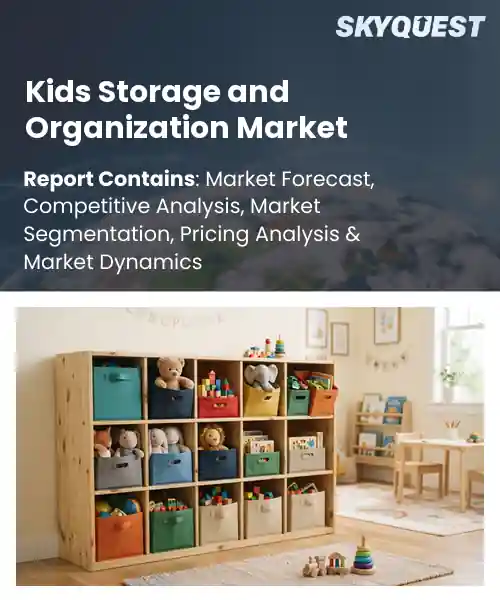
Kids Storage and Organization Market
Report ID: SQMIG25I2207
Report ID: SQMIG25I2207
[email protected]
USA +1 351-333-4748
Report ID:
SQMIG25I2207 |
Region:
Global |
Published Date: August, 2026
Pages:
157
|Tables:
148
|Figures:
78


Global Kids Storage And Organization Market size was valued at USD 4.62 Billion in 2024 and is poised to grow from USD 4.9 Billion in 2025 to USD 7.88 Billion by 2033, growing at a CAGR of 6.1% during the forecast period (2026-2033).
The Global Kids Storage and Organization market comprises products such as modular shelving, labeled bins, and multifunctional furniture designed to keep children’s belongings tidy and accessible. Its relevance stems from rising household density, parental concern for safety, and educational philosophies that link orderly spaces to cognitive development. Historically, the market was dominated by plastic containers, but the past decade has witnessed a shift toward stylish, space‑saving solutions that blend Scandinavian aesthetics with child‑friendly features. For instance, a leading Scandinavian brand introduced a stackable wardrobe that converts into a play tent, echoing the broader trend of multifunctionality driven by living constraints. Digital parenting platforms have become the main catalyst accelerating growth in the Global Kids Storage and Organization market because they link consumers with curated product recommendations and seamless e‑commerce. When parents browse apps that highlight space‑optimization tips, they are prompted to buy modular units that sync with smart‑home sensors, creating a feedback loop that boosts demand. This synergy opens opportunities for manufacturers to embed RFID tags for inventory tracking, allowing families to locate missing toys via a mobile app. Consequently, firms that fuse design with IoT see faster sales cycles, while retailers enjoy significant higher basket values and repeat purchases.
How is AI-driven automation reshaping the kids' storage and organization market?
AI-driven automation is turning the kids' storage and organization market into a smarter, more adaptable space. Sensors embedded in shelves and bins can detect when items are removed or added, prompting mobile apps to suggest optimal placement or remind parents of missing pieces. Machine‑learning algorithms analyze usage patterns, enabling products to reconfigure themselves for seasonal toys or growing collections without manual effort. Voice‑activated assistants now guide children to locate specific items, making cleanup a game rather than a chore. These technologies not only streamline daily routines but also create data‑rich ecosystems that manufacturers can use to design more intuitive, space‑saving solutions, driving higher engagement and loyalty among families.
Market snapshot - (2026-2033)
Global Market Size
USD 4.62 Billion
Largest Segment
Storage Bins & Baskets
Fastest Growth
Under-Bed Storage
Growth Rate
6.1% CAGR
To get more insights on this market click here to Request a Free Sample Report
Global kids storage and organization market is segmented by product type, material, application, end user, distribution channel and region. Based on product type, the market is segmented into Storage Bins & Baskets, Toy Chests & Boxes, Shelving Units, Closet Organizers and Under-Bed Storage. Based on material, the market is segmented into Plastic, Wood, Fabric and Metal. Based on application, the market is segmented into Toy Storage, Clothing Storage and Book & School Supply Storage. Based on end user, the market is segmented into Infants & Toddlers, Children and Teenagers. Based on distribution channel, the market is segmented into Specialty Stores, Home Improvement Stores, Department Stores and Online Retail. Based on region, the market is segmented into North America, Europe, Asia Pacific, Latin America and Middle East & Africa.
Fabric segment dominates because its softness, flexibility, and vibrant designs resonate with parents seeking safe, attractive options for young children. The material’s washable nature addresses hygiene concerns, while its lightweight construction facilitates easy relocation in dynamic bedroom environments. These attributes align with the growing emphasis on multifunctional, child‑friendly spaces, prompting designers to prioritize fabric‑based bins, baskets, and soft closets that enhance visual appeal and promote organized play.
However, Plastic segment emerges as the fastest growing because advances in sustainable resin formulations and vibrant molding techniques are attracting eco‑conscious families. The durability and stackable design of plastic containers meet the demand for space‑saving solutions, while bright colors stimulate children’s engagement, accelerating market expansion and new product development.
Toy Storage application dominates because it directly addresses the core challenge of clutter in children’s environments, providing dedicated solutions that simplify tidying routines. Parents value the ability to categorize playthings, reducing stress and promoting safety. The emotional connection children have with their toys fuels demand for attractive, accessible containers, encouraging manufacturers to integrate playful aesthetics with functional design, thereby cementing toy storage as a central market driver.
On the other hand, Book & School Supply Storage experiences the strongest growth momentum because remote learning and organized study habits increase demand for structured shelving and bins. Innovative designs that blend educational themes with modular functionality attract parents and students, driving market expansion and prompting brands to broaden their product portfolios.
To get detailed segments analysis, Request a Free Sample Report
North America leads the market through a combination of mature retail ecosystems, strong consumer focus on home organization, and high disposable income that fuels demand for specialized children’s storage solutions. Innovative design firms based in the region continuously introduce multifunctional and aesthetically appealing products that resonate with safety‑conscious parents. Robust distribution channels, ranging from large‑scale home‑goods chains to online platforms, ensure broad accessibility. Cultural emphasis on tidy living spaces and early childhood development further reinforces purchase intentions, while the presence of major manufacturers accelerates product availability and variety.
Kids Storage and Organization Market in the United States thrives on a culture that values efficient use of space and design‑driven solutions. Retailers emphasize modular systems that grow with children, and e‑commerce platforms provide extensive customization options. Parents prioritize durability and child‑friendly materials, driving demand for premium offerings. The market benefits from strong brand loyalty and ongoing product innovation that aligns with evolving lifestyle trends.
Kids Storage and Organization Market in Canada reflects a blend of practicality and aesthetic sensibility, with consumers seeking solutions that suit both limited space and seasonal lifestyle changes. Emphasis on sustainable materials influences purchasing decisions, encouraging manufacturers to adopt eco‑friendly approaches. Retail networks combine traditional stores with digital channels, offering parents convenient access to a range of functional designs that support organized family environments.
Europe’s expansion is propelled by heightened awareness of child development benefits linked to organized spaces and a growing preference for minimalist home interiors. Legislative focus on safety standards raises expectations for high‑quality storage products, prompting manufacturers to innovate with ergonomic and child‑centric designs. Cross‑border trade within the region facilitates diffusion of trends, while strong design heritage in select countries fuels demand for stylish yet functional solutions. Environmental consciousness drives the adoption of recyclable and responsibly sourced materials, aligning with broader sustainability goals across the continent.
Kids Storage and Organization Market in Germany is characterized by rigorous design standards and a preference for engineered durability. Consumers value precision‑crafted products that combine functionality with contemporary aesthetics. Local manufacturers emphasize modularity and adaptability, ensuring that storage solutions can evolve with a child’s age. Retail channels blend specialized boutiques with established home‑goods chains, providing extensive product reach and fostering consumer confidence.
Kids Storage and Organization Market in the United Kingdom experiences rapid uptake due to an increasing focus on small‑space living and the desire for aesthetically cohesive homes. Trend‑forward parents seek versatile storage that complements interior décor while supporting organized play environments. Online marketplaces and fast‑fashion home retailers accelerate product turnover, delivering fresh design concepts that resonate with a dynamic consumer base.
Kids Storage and Organization Market in France is emerging as designers integrate classic craftsmanship with modern functionality. French consumers appreciate elegant forms that maintain a child‑friendly environment, encouraging brands to blend heritage techniques with innovative materials. Boutique retailers and curated online platforms introduce niche offerings that highlight both style and practicality, fostering gradual market growth.
Asia Pacific advances its position through a convergence of rising urbanization, evolving family structures, and increasing parental investment in organized living environments. Compact housing solutions drive demand for space‑saving storage designs that maximize limited square footage. Cultural emphasis on education and orderly surroundings fuels interest in products that support tidy study and play areas. Local manufacturers leverage cutting‑edge manufacturing techniques to produce affordable yet stylish options, while digital commerce platforms expand market reach across diverse demographics.
Kids Storage and Organization Market in Japan is shaped by a deep respect for efficient use of space and refined aesthetics. Consumers favor compact, multifunctional units that blend seamlessly with minimalist interiors. High attention to safety and non‑toxic materials guides product development, while traditional retail outlets and sophisticated e‑commerce sites provide broad access to innovative designs.
Kids Storage and Organization Market in South Korea reflects a dynamic blend of tech‑savvy purchasing habits and a strong design culture. Parents seek sleek, modular solutions that align with contemporary living spaces and support organized routines. The market benefits from rapid online adoption and collaborations between local designers and global brands, delivering cutting‑edge products that meet high expectations for functionality and style.
To know more about the market opportunities by region and country, click here to
Buy The Complete Report
Growing Demand for Organized Spaces
Adoption of Modular Storage Solutions
High Cost of Premium Products
Limited Availability in Rural Areas
Request Free Customization of this report to help us to meet your business objectives.
The market is shaped by established players expanding through strategic acquisitions and tech‑driven product lines, while newer entrants leverage partnerships with e‑commerce platforms to accelerate distribution. Recent M&A activity includes a major furniture retailer acquiring a boutique kids‑storage brand to broaden its design portfolio, and a leading online marketplace forming a joint venture with a smart‑organizer startup to integrate IoT‑enabled storage solutions into its home‑goods offering. These moves intensify competition and drive innovation across design, functionality, and digital integration.
SkyQuest’s ABIRAW (Advanced Business Intelligence, Research & Analysis Wing) is our Business Information Services team that Collects, Collates, Correlates, and Analyses the Data collected by means of Primary Exploratory Research backed by robust Secondary Desk research.
As per SkyQuest analysis, the Global Kids Storage and Organization market is being propelled primarily by a growing demand for organized spaces that support children’s independence and safety, while the adoption of modular storage solutions offers a second boost by allowing products to evolve as kids grow. North America remains the dominant region, driven by mature retail channels and high disposable income, and the toy‑storage application leads the segment landscape as parents prioritize dedicated solutions for clutter reduction. However, the market’s expansion is tempered by the high cost of premium products, which can deter price‑sensitive families and slow broader adoption. Overall, these dynamics shape a robust yet nuanced growth trajectory.
| Report Metric | Details |
|---|---|
| Market size value in 2024 | USD 4.62 Billion |
| Market size value in 2033 | USD 7.88 Billion |
| Growth Rate | 6.1% |
| Base year | 2024 |
| Forecast period | (2026-2033) |
| Forecast Unit (Value) | USD Billion |
| Segments covered |
|
| Regions covered | North America (US, Canada), Europe (Germany, France, United Kingdom, Italy, Spain, Rest of Europe), Asia Pacific (China, India, Japan, Rest of Asia-Pacific), Latin America (Brazil, Rest of Latin America), Middle East & Africa (South Africa, GCC Countries, Rest of MEA) |
| Companies covered |
|
| Customization scope | Free report customization with purchase. Customization includes:-
|
To get a free trial access to our platform which is a one stop solution for all your data requirements for quicker decision making. This platform allows you to compare markets, competitors who are prominent in the market, and mega trends that are influencing the dynamics in the market. Also, get access to detailed SkyQuest exclusive matrix.
Table Of Content
Executive Summary
Market overview
Parent Market Analysis
Market overview
Market size
KEY MARKET INSIGHTS
COVID IMPACT
MARKET DYNAMICS & OUTLOOK
Market Size by Region
KEY COMPANY PROFILES
Methodology
For the Kids Storage and Organization Market, our research methodology involved a mixture of primary and secondary data sources. Key steps involved in the research process are listed below:
1. Information Procurement: This stage involved the procurement of Market data or related information via primary and secondary sources. The various secondary sources used included various company websites, annual reports, trade databases, and paid databases such as Hoover's, Bloomberg Business, Factiva, and Avention. Our team did 45 primary interactions Globally which included several stakeholders such as manufacturers, customers, key opinion leaders, etc. Overall, information procurement was one of the most extensive stages in our research process.
2. Information Analysis: This step involved triangulation of data through bottom-up and top-down approaches to estimate and validate the total size and future estimate of the Kids Storage and Organization Market.
3. Report Formulation: The final step entailed the placement of data points in appropriate Market spaces in an attempt to deduce viable conclusions.
4. Validation & Publishing: Validation is the most important step in the process. Validation & re-validation via an intricately designed process helped us finalize data points to be used for final calculations. The final Market estimates and forecasts were then aligned and sent to our panel of industry experts for validation of data. Once the validation was done the report was sent to our Quality Assurance team to ensure adherence to style guides, consistency & design.
Analyst Support
Customization Options
With the given market data, our dedicated team of analysts can offer you the following customization options are available for the Kids Storage and Organization Market:
Product Analysis: Product matrix, which offers a detailed comparison of the product portfolio of companies.
Regional Analysis: Further analysis of the Kids Storage and Organization Market for additional countries.
Competitive Analysis: Detailed analysis and profiling of additional Market players & comparative analysis of competitive products.
Go to Market Strategy: Find the high-growth channels to invest your marketing efforts and increase your customer base.
Innovation Mapping: Identify racial solutions and innovation, connected to deep ecosystems of innovators, start-ups, academics, and strategic partners.
Category Intelligence: Customized intelligence that is relevant to their supply Markets will enable them to make smarter sourcing decisions and improve their category management.
Public Company Transcript Analysis: To improve the investment performance by generating new alpha and making better-informed decisions.
Social Media Listening: To analyze the conversations and trends happening not just around your brand, but around your industry as a whole, and use those insights to make better Marketing decisions.
REQUEST FOR SAMPLE
 REQUEST FREE CUSTOMIZATION
Global Kids Storage And Organization Market size was valued at USD 4.62 Billion in 2024 and is poised to grow from USD 4.9 Billion in 2025 to USD 7.88 Billion by 2033, growing at a CAGR of 6.1% during the forecast period (2026-2033).
The market is shaped by established players expanding through strategic acquisitions and tech‑driven product lines, while newer entrants leverage partnerships with e‑commerce platforms to accelerate distribution. Recent M&A activity includes a major furniture retailer acquiring a boutique kids‑storage brand to broaden its design portfolio, and a leading online marketplace forming a joint venture with a smart‑organizer startup to integrate IoT‑enabled storage solutions into its home‑goods offering. These moves intensify competition and drive innovation across design, functionality, and digital integration. 'IKEA', 'The Container Store Group, Inc.', 'Whitmor, Inc.', 'Pottery Barn Kids', 'Wayfair Inc.', 'Target Corporation', 'Walmart Inc.', 'Home Depot, Inc.', 'Lowe's Companies, Inc.', 'KidKraft', 'Delta Children', '3 Sprouts', 'mDesign', 'Honey-Can-Do International LLC', 'ClosetMaid', 'South Shore Furniture', 'Step2 Company, LLC', 'Tot Tutors', 'Melissa & Doug', 'Room Copenhagen'
Parents are increasingly seeking organized environments that support children’s independence and safety, prompting families to invest in dedicated storage solutions. This desire is driven by heightened awareness of clutter’s impact on development and the convenience of easy‑access systems. As households adopt more structured play areas, demand for versatile, aesthetically pleasing organizers expands, encouraging manufacturers to broaden product lines and innovate designs that cater to diverse age groups and living spaces, thereby fueling overall market growth. Through sustained consumer interest, brand loyalty strengthens and market visibility rises.
Sustainable Materials Driving Design: Parents increasingly prioritize eco‑friendly products, prompting manufacturers to adopt recycled plastics, organic fabrics, and biodegradable components in children’s storage solutions. This shift not only aligns with broader environmental concerns but also enhances brand perception among socially conscious families. Companies are highlighting certifications and transparent supply chains, creating a narrative that combines safety, durability, and sustainability. As schools and childcare centers adopt green procurement policies, demand for responsibly sourced storage items expands, encouraging further innovation in low‑impact manufacturing processes and market.
Why does North America Dominate the Global Kids Storage and Organization Market? |@12


Want to customize this report? This report can be personalized according to your needs. Our analysts and industry experts will work directly with you to understand your requirements and provide you with customized data in a short amount of time. We offer $1000 worth of FREE customization at the time of purchase.
Feedback From Our Clients


 USA (+1) 351-333-4748

