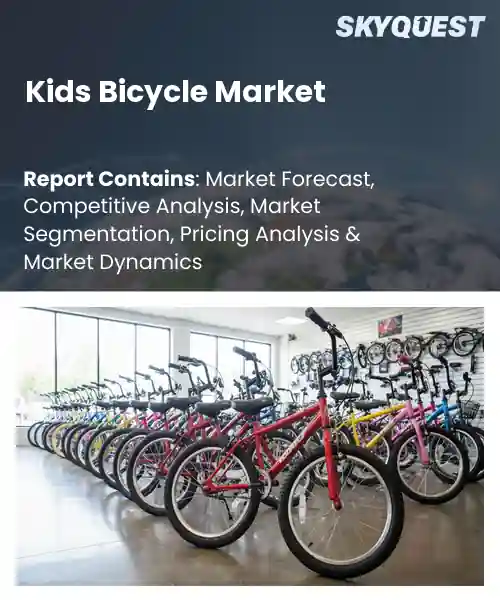
Kids Bicycle Market
Report ID: SQMIG25J2226
Report ID: SQMIG25J2226
[email protected]
USA +1 351-333-4748
Report ID:
SQMIG25J2226 |
Region:
Global |
Published Date: June, 2026
Pages:
157
|Tables:
172
|Figures:
79


Global Kids Bicycle Market size was valued at USD 7.5 Billion in 2024 and is poised to grow from USD 8.03 Billion in 2025 to USD 13.79 Billion by 2033, growing at a CAGR of 7.0% during the forecast period (2026-2033).
The kids bicycle market is largely driven by increasing parental focus on active lifestyles and childhood development, shifting demand from simple transportation to purpose-designed products that facilitate safety, skill building and outdoor play. This market, which consists of bicycles, balance bikes, protective gear and accessories for infants through preteens, is important because early mobility fosters motor skills, social interaction and long-term fitness habits and represents a large consumer segment for sporting goods companies. The last ten years have seen brands expand their offerings with lightweight materials and adjustable parts; brand collaborations have increased appeal across price points.
The major growth factor of the global kids bicycle market is the increased expansion of e-commerce penetration along with stringent safety regulations. The combination provides a distribution scale and perceived value to purchase and is based on product diversification. The online marketplaces allow targeted marketing and parents find niche products such as adjustable balance bikes or lightweight aluminum models, which means higher conversion rates and repeat purchases. Helmet standards encourage manufacturers to include protective gear, which boosts average order values. This allows retailers and brands to invest in localised logistics and subscription services for seasonal upgrades, transforming regulatory pressure and digital reach into revenue and retention opportunities.
How is IoT enhancing safety features in the kids bicycle market?
IoT is revolutionizing safety in the kids bicycle market through small sensors, always-on connectivity and caregiver apps. Key features include location tracking and geofencing that alert parents if a child leaves a safe zone, impact sensing that provides automatic alerts following a crash, and connected lighting and brake sensors that increase visibility. Today’s market is a hybrid of purpose built children wearables and add on trackers so bikes become part of a wider safety ecosystem. Manufacturers are reacting to growing demand for connected accessories and to mature low power network options making reliable monitoring practical.
Huawei launched Watch Kids X1 in May 2026 with built in GPS and SOS features demonstrating how IoT wearables complement bikes by delivering instant location and emergency alerts and by boosting caregiver confidence and market appeal.
Market snapshot - (2026-2033)
Global Market Size
USD 7.5 Billion
Largest Segment
Pedal Bikes
Fastest Growth
Electric Kids Bikes
Growth Rate
7.0% CAGR
To get more insights on this market click here to Request a Free Sample Report
Global kids bicycle market is segmented by product type, wheel size, age group, material, distribution channel, end-user and region. Based on product type, the market is segmented into Balance Bikes, Pedal Bikes and Electric Kids Bikes. Based on wheel size, the market is segmented into Below 12 inches, 12–16 inches, 16–20 inches and Above 20 inches. Based on age group, the market is segmented into 1–3 Years, 3–5 Years, 5–8 Years and 8–12 Years. Based on material, the market is segmented into Steel, Aluminum and Carbon Fiber. Based on distribution channel, the market is segmented into Offline Retail Stores and Online/E-commerce. Based on end-user, the market is segmented into Boys, Girls and Unisex. Based on region, the market is segmented into North America, Europe, Asia Pacific, Latin America and Middle East & Africa.
Balance Bikes segment is expected to be the dominant segment. The no pedal frames help in accelerating toddler motor skill development and parental confidence creating early adoption as the preferred beginner tool. Because they are light, easy to use and have safety features, there is less to learn and manufacturers and retailers concentrate on design improvement and safety certification. Demand is driven by educator and therapist endorsement as essential early mobility aids, leading to widespread distribution and category leadership.
However Electric Kids Bikes are seeing the strongest growth as battery assisted riding widens appeal and extends usable age increasing perceived value. Innovation in lighter batteries, built in safety cutoffs and adjustable assistance that encourages parental investment, and lifestyle changes that include outdoor family activities and demand for premium longer lasting models, create new product and service opportunities.
The 12-16 inches segment leads the way, reflecting the crucial transition period where children move from balance to pedal riding, providing the perfect mix of maneuverability and stability that comforts caregivers and educators. They are widely stocked by retailers, and their popularity has led to standardized frame geometries and focused design investment from manufacturers that emphasize durable, lightweight builds and approachable ergonomics. This reduces friction for purchase decisions and reinforces the bike’s central role in early riding progression.
But the fastest growing segment is 16-20 inch bikes as families are looking for longer lasting and performance ready youth models. Smaller geometry, lighter materials and accessory compatibility boost retailer confidence, while growing youth interest in sport and trail riding creates demand for premium offerings and aftermarket upgrades.
To get detailed segments analysis, Request a Free Sample Report
Asia Pacific is the largest region in the global kids bicycle market driven by the confluence of consumer culture, manufacturing capacity, urban infrastructure trends and focused product innovation. Local manufacturers provide design flexibility and cost effective production. This allows a large variety of model ranges to suit local tastes. The increasing focus on active childhood, adoption of safety standards and improved retail ecosystems including specialty stores and online platforms bolster market depth. Demand dynamics are favorable by public and private efforts to promote cycling for recreation and short-trip mobility. Rapid product diffusion is also facilitated by a distribution network linking urban and regional centres and local brand partnerships with international licensors. These structural strengths and ecosystem linkages maintain a leading regional position and create a competitive landscape that shapes product strategies globally.
The kids’ bikes market in Japan is built on safety, integrated into city living with advanced designs. Local manufacturers provide engineered components and certified safety features; retailers provide curated assortments for families and educational programs. People are culturally wanting small durable bikes with built in accessories. The retail experience is driven by partnerships between schools, community centres and brands demanding the highest standards of reliable performance, accessible after sales care and consistent service quality across all channels, nationwide.
High tech features and urban mobility trends are driving the South Korea Kids Bicycle Market The domestic brands are working on light weight materials and modern styling while the aftermarket channels are working on customization and safety accessories. For the digitally-inclined caregiver, retail experiences combine the best of physical showrooms with digital engagement. Government and community support brand outreach for healthy activity promotion programs. The market values design innovation, warranty and refresh cycles.
The kids bicycle market in Europe is growing fast, thanks to a combination of policy support, changing consumer preferences for active lifestyles and a strong retail infrastructure. Market visibility is enhanced by urban planning in favor of cycling, the increasing importance of child safety standards and a growing variety through specialty retailers and online channels. Established manufacturers compete on heritage design and premium positioning while new entrants compete on innovation, lightweight materials and user friendly assembly. Cross border distribution, brand collaborations, licensing partners and educational initiatives drive market penetration Consumers will demand multifunctional models to satisfy different commuting and recreational needs, which will lead to more product diversification and more marketing efforts in the European markets. Brand appeal increases with sustainability focus and accessible after sales service, while localized marketing and community cycling programs drive trial and adoption across markets.
In Germany, the kids bike market is marked by a strong demand for quality and safety certified bikes, and a liking for robust engineering. Good manufacturers and specialty shops emphasize rugged parts and rigorous testing for varied terrain. Retail channels combine an experienced sales force with technical service offerings, which adds to consumer confidence. Community cycling projects and regional policies that promote active mobility create friendly settings. We are positioning the product on longevity, repairability and performance.
UK Kids Bicycle Market: Dynamic Channel Evolution with High Digital Adoption & Experiential Retail Concepts Brands are looking at lightweight design, modular accessories, community event and school partnerships to connect. Caregivers are drawn to safety certifications and messaging around outdoor activity, fueling demand for premium lifestyle models. Service flexibility (such as repairs and customization) and an omnichannel distribution allow trial and a stronger relationship with the brand across segments and demographics.
Kids Bicycle Market Demand for Design-forward Models and Sustainable Materials to Rise in France Local brands and retailers are playing with aesthetics, eco-friendly elements and modularity to suit different use cases Community efforts and cycling advocacy groups support family events and school programs that teach safe cycling practices. Retailers are using curated in-store experiences coupled with digital storytelling to attract caregivers looking for style, safety and environmental responsibility.
Product innovation, new retail formats and community engagement are creating a niche for the kids bicycle market in North America. In order to meet the expectations of caregivers, designers and brands are focusing on multi-functionality in design, enhanced safety systems and ease of assembly. Retailers are designing experiential formats that promote fitting and safety. Online platforms provides more choice and easier fulfilment. We partner with schools, park groups and cycling advocates to create bottom-up demand and normalize active mobility for kids. Ownership economics and brand loyalty are enhanced by a focus on service networks, local repair options and after-market accessories, making the region a critical battleground for differentiated offerings and omnichannel strategies. Caregivers like the sustainability and light weight, and the wider market likes the inclusive sizing and styling. Locally the design is tailored to the site and way of life. Strategic licensing partnerships boost product diversification and brand awareness.
U.S. Kids Bicycle Market Powers Diverse Consumer Segments Value Safety Innovation and Ownership Models. To attract active families, brands are focusing on adjustable geometry, integrated safety systems and accessories. The fixtures can be found in specialty shops and have a strong Internet sales presence. Participation is fueled by school partnerships, park organizations and youth programs. Ownership and brand loyalty is driven by service networks and local repair capability across markets.
The Canadian kids’ bike market is a blend of city demand and use on all terrains. Custom all-weather parts, flexible sizing and durable frames for domestic and international brands. Retail strategies include neighborhood stores, seasonal pop-up events and online fulfillment to reach dispersed populations. Skills development is underpinned by partnerships with outdoor organisations and school programmes. Buying choices are also influenced by the emphasis on warranty, availability of service and ethical procurement of material.
To know more about the market opportunities by region and country, click here to
Buy The Complete Report
Rising Health And Fitness Awareness
Innovation In Safety And Design
High Production And Material Costs
Growing Regulatory Compliance Requirements
Request Free Customization of this report to help us to meet your business objectives.
The global kids bicycle market is competitive with competition being fought over channel control, product differentiation and tech adoption as competitors fight to own premium direct to consumer segments and retail distribution. Woom, looking for money to expand, moved European assembly to Poland to speed up growth. Kids e bikes were added to the catalogues of distributors such as Tucker Powersports. Mini electric models, modular balance bikes are the focus of startups.
SkyQuest’s ABIRAW (Advanced Business Intelligence, Research & Analysis Wing) is our Business Information Services team that Collects, Collates, Correlates and Analyses the Data collected by means of Primary Exploratory Research backed by robust Secondary Desk research.
According to SkyQuest, the kids bicycle market is being driven by the increasing focus on active lifestyles and childhood development among parents, which is shifting demand toward safety and skill-building products. A second driver is the convergence of growing e-commerce penetration with more stringent safety regulations that increase reach and raise average order values. The Balance Bikes segment is the most preferred for toddlers as a starter solution. Asia Pacific remains the top region with the strongest manufacturing capacity, supportive policies and deep retail ecosystems. A notable restraint for the market requiring strategic sourcing and value-focused design responses is high production and material costs that pressure pricing, margins and the pace of product innovation.
| Report Metric | Details |
|---|---|
| Market size value in 2024 | USD 7.5 Billion |
| Market size value in 2033 | USD 13.79 Billion |
| Growth Rate | 7.0% |
| Base year | 2024 |
| Forecast period | (2026-2033) |
| Forecast Unit (Value) | USD Billion |
| Segments covered |
|
| Regions covered | North America (US, Canada), Europe (Germany, France, United Kingdom, Italy, Spain, Rest of Europe), Asia Pacific (China, India, Japan, Rest of Asia-Pacific), Latin America (Brazil, Rest of Latin America), Middle East & Africa (South Africa, GCC Countries, Rest of MEA) |
| Companies covered |
|
| Customization scope | Free report customization with purchase. Customization includes:-
|
To get a free trial access to our platform which is a one stop solution for all your data requirements for quicker decision making. This platform allows you to compare markets, competitors who are prominent in the market, and mega trends that are influencing the dynamics in the market. Also, get access to detailed SkyQuest exclusive matrix.
Table Of Content
Executive Summary
Market overview
Parent Market Analysis
Market overview
Market size
KEY MARKET INSIGHTS
COVID IMPACT
MARKET DYNAMICS & OUTLOOK
Market Size by Region
KEY COMPANY PROFILES
Methodology
For the Kids Bicycle Market, our research methodology involved a mixture of primary and secondary data sources. Key steps involved in the research process are listed below:
1. Information Procurement: This stage involved the procurement of Market data or related information via primary and secondary sources. The various secondary sources used included various company websites, annual reports, trade databases, and paid databases such as Hoover's, Bloomberg Business, Factiva, and Avention. Our team did 45 primary interactions Globally which included several stakeholders such as manufacturers, customers, key opinion leaders, etc. Overall, information procurement was one of the most extensive stages in our research process.
2. Information Analysis: This step involved triangulation of data through bottom-up and top-down approaches to estimate and validate the total size and future estimate of the Kids Bicycle Market.
3. Report Formulation: The final step entailed the placement of data points in appropriate Market spaces in an attempt to deduce viable conclusions.
4. Validation & Publishing: Validation is the most important step in the process. Validation & re-validation via an intricately designed process helped us finalize data points to be used for final calculations. The final Market estimates and forecasts were then aligned and sent to our panel of industry experts for validation of data. Once the validation was done the report was sent to our Quality Assurance team to ensure adherence to style guides, consistency & design.
Analyst Support
Customization Options
With the given market data, our dedicated team of analysts can offer you the following customization options are available for the Kids Bicycle Market:
Product Analysis: Product matrix, which offers a detailed comparison of the product portfolio of companies.
Regional Analysis: Further analysis of the Kids Bicycle Market for additional countries.
Competitive Analysis: Detailed analysis and profiling of additional Market players & comparative analysis of competitive products.
Go to Market Strategy: Find the high-growth channels to invest your marketing efforts and increase your customer base.
Innovation Mapping: Identify racial solutions and innovation, connected to deep ecosystems of innovators, start-ups, academics, and strategic partners.
Category Intelligence: Customized intelligence that is relevant to their supply Markets will enable them to make smarter sourcing decisions and improve their category management.
Public Company Transcript Analysis: To improve the investment performance by generating new alpha and making better-informed decisions.
Social Media Listening: To analyze the conversations and trends happening not just around your brand, but around your industry as a whole, and use those insights to make better Marketing decisions.
REQUEST FOR SAMPLE
 REQUEST FREE CUSTOMIZATION
Global Kids Bicycle Market size was valued at USD 7.5 Billion in 2024 and is poised to grow from USD 8.03 Billion in 2025 to USD 13.79 Billion by 2033, growing at a CAGR of 7.0% during the forecast period (2026-2033).
Competitive dynamics in the global kids bicycle market focus on channel control, product differentiation and technology adoption as rivals race to own premium direct to consumer segments and retail distribution. Woom pursued growth funding and moved European assembly to Poland to accelerate expansion. Distributors such as Tucker Powersports expanded catalogs to include kids e bikes. Startups emphasize mini electric models and modular balance bikes. 'Giant Manufacturing Co. Ltd.', 'Trek Bicycle Corporation', 'Specialized Bicycle Components', 'Merida Industry Co., Ltd.', 'Accell Group', 'Dorel Industries', 'Pacific Cycle', 'Hero Cycles Ltd.', 'Atlas Cycles', 'Avon Cycles', 'Woom Bikes', 'Frog Bikes', 'Islabikes', 'Guardian Bikes', 'Cleary Bikes', 'Raleigh Bikes', 'Huffy Corporation', 'Scott Sports', 'Cannondale', 'Cube Bikes'
Increasing parental emphasis on childhood physical activity and well-being has encouraged manufacturers and retailers to expand product offerings and marketing efforts toward active play and outdoor cycling experiences for children. This heightened focus prompts investment in diverse designs, safer frames, and engaging features that appeal to both parents and kids, broadening consumer interest and purchase intent. As awareness of health benefits grows, demand shifts toward bicycles as lifestyle tools, stimulating category expansion and encouraging retailers to prioritize assortment and visibility.
Eco-Conscious Product Design: Manufacturers increasingly prioritize sustainably sourced materials, recyclable components and low-impact manufacturing processes to meet rising environmental expectations among parents and caregivers. Design emphasis shifts to durability, modularity and repairability to extend product life and reduce waste, while brands communicate transparent supply chain practices to build trust. This trend also encourages innovation in non-toxic finishes and biodegradable packaging, influencing product aesthetics and price positioning, and creating differentiation opportunities for companies that align bicycles with family lifestyle values around sustainability and responsibility.
Why does Asia Pacific Dominate the Global Kids Bicycle Market? |@12


Want to customize this report? This report can be personalized according to your needs. Our analysts and industry experts will work directly with you to understand your requirements and provide you with customized data in a short amount of time. We offer $1000 worth of FREE customization at the time of purchase.
Feedback From Our Clients


 USA (+1) 351-333-4748

