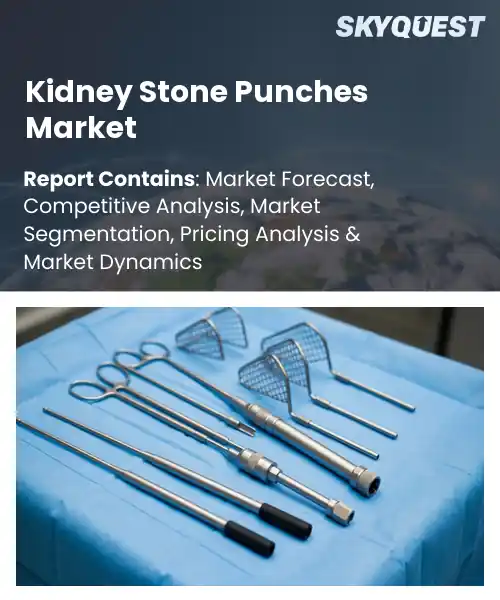
Kidney Stone Punches Market
Report ID: SQMIG35E2070
Report ID: SQMIG35E2070
[email protected]
USA +1 351-333-4748
Report ID:
SQMIG35E2070 |
Region:
Global |
Published Date: March, 2026
Pages:
157
|Tables:
141
|Figures:
78


Global Kidney Stone Punches Market size was valued at USD 870.8 Million in 2024 and is poised to grow from USD 948.3 Million in 2025 to USD 1875.73 Million by 2033, growing at a CAGR of 8.9% during the forecast period (2026-2033).
Growing prevalence of kidney stones, increasing adoption of minimally invasive procedures, rising demand for advanced urological instruments, advancements in endourology techniques, and expansion of ambulatory surgical centers are driving sales of kidney stone punches.
As the healthcare sector looks for products to minimize the operating time and improve the outcome of the operations, manufacturers are introducing ergonomic single-use punches and advanced grasping systems. Hospitals are increasingly using single-use punches to minimize the cost of sterilization and the risks of infections. For instance, large hospitals use single-use punches for complex operations, whereas small centers use cost-effective single-use punches for routine operations. This has created new business opportunities in emerging markets and has encouraged differentiation in products and bundled solutions. Growing incidence of urolithiasis worldwide coupled with increasing preference for minimally invasive treatments are expected to primarily drive kidney stone punches market growth.
On the contrary, high costs of advanced surgical instruments, limited access to specialized urology care in developing regions, risk of procedural complications, regulatory challenges, and lack of skilled professionals are expected to slow down kidney stone punches market penetration going forward.
How is AI Improving Clinical Outcomes of Kidney Stone Punches?
Artificial intelligence is helping improve patient outcomes in the kidney stone punches market. AI can assist in improving diagnostic and treatment procedures for patients. AI imaging can assist in locating kidney stones more precisely. Recurrence probability can be predicted using AI models. AI can guide surgeons during procedures to locate kidney stones precisely and avoid damaging tissues. AI can automate measurements for patients and hospitals for predictive purposes.
In October 2025, Johnson & Johnson partnered with NVIDIA to bring AI into its Monarch urology platform. This uses simulation and anatomy modeling to improve procedure planning and real-time decision support, increasing accuracy, efficiency, and overall patient outcomes.
Market snapshot - (2026-2033)
Global Market Size
USD 870.8 Million
Largest Segment
Laser Devices
Fastest Growth
Laser Devices
Growth Rate
8.9% CAGR
To get more insights on this market click here to Request a Free Sample Report
Global kidney stone punches market is segmented by product type, age group, gender, end user, distribution channel, and region. Based on product type, the market is segmented into laser devices and mechanical devices. Based on age group, the market is segmented into adults and pediatrics. Based on gender, the market is segmented into male and female. Based on end user, the market is segmented into hospitals, urology clinics, ambulatory surgical centers, and others. Based on distribution channel, the market is segmented into online retail and offline retail. Based on region, the market is segmented into North America, Europe, Asia Pacific, Latin America, and Middle East & Africa.
The laser devices segment is estimated to lead the global kidney stone punches market revenue generation across the study period. High clinician preference for precision energy delivery that fragments a broad range of stone types while limiting collateral tissue impact, helps this segment maintain its dominant stance. Better procedural results, enhanced patient recovery, and clinical reliability continue to solidify the high market share of this segment. The integration with endoscopic platforms, vendor innovation, and training activities create a self-reinforcing cycle to improve procedural efficiency and clinician confidence with laser-based kidney stone punch systems.
However, mechanical devices segment is growing at the fastest pace due to factors like lower acquisition costs, easier maintenance, and their suitability for use in outpatient facilities; advancements in small, minimally invasive design technologies, as well as manufacturers' focus on cost-effective workflows, are fueling adoption by smaller facilities, thereby expanding their use and creating procurement opportunities for affordable kidney stone punch technology.
The ambulatory surgical centers segment is slated to account for the largest global kidney stone punches market share in the future. Shift to outpatient urologic care favors compact, procedure-specific kidney stone punch equipment that aligns with ASCs’ focus on throughput thereby cementing this segment’s dominance. Better cost containment, flexibility in the operating schedule, and efficiency in the operating procedure are some of the key reasons why ASCs seek advanced kidney stone punches. The acceptance of outpatient services by the payer and the operating priorities of ASCs in terms of rapid turnover and minimal inpatient resources add to the ASC purchase and basic demand for optimized punch technologies.
Meanwhile, urology clinics are the fastest growing segment as per this kidney stone punches industry analysis. Specialist practices invest in advanced kidney stone punch technologies to broaden service offerings, which creates new business scope in the long run. Clinician-led purchasing, focused vendor engagement, and procedural specialization creates new opportunities. Increased volumes and encouraged adoption of tailored devices, creates concentrated demand and attractive opportunities for manufacturers targeting clinic-level solutions.
To get detailed segments analysis, Request a Free Sample Report
Clinical infrastructure, concentrated investment in urology solutions, and widespread adoption by major healthcare institutions are helping support consistent kidney stone punches demand in this region. Presence of multinational manufacturers and contract research organizations will assist in innovation through iteration and conducting clinical evaluations to ensure that the product meets clinical standards. Clinicians are very familiar with interventional procedures that utilize these devices; therefore, they will be eager to take advantage of new innovative products, particularly since they prefer minimally invasive options to treat patients. The development of collaborative relationships between hospitals, academic centers, and manufacturers ensures that there is sufficient evidence available to assess the effectiveness of products used for kidney stones. The existence of coordinated regulatory pathways and engagement with payers also assist to create a favorable condition for new entries into this marketplace; therefore, continued availability of these products, as well as the willingness by clinicians to apply them to their patients, and the amount of diversity among suppliers will reinforce North America’s market leadership position. Professional education programs and patient education initiatives enhance the rates of diagnosis and treatment collectively, which also bolsters the high share of this region.
Clinical specialization, dense network of urology centers, and strong engagement from major manufacturers allows United States to lead kidney stone punches demand. Existing infrastructure in terms of reimbursement and distribution helps in the penetration of kidney stone punches. The presence of academic centers and patient advocacy groups helps maintain a positive business environment. High-end infrastructure in hospitals and key opinion leaders facilitate the adoption of new technologies.
Integrated public care delivery, regional centers, and collaborative procurement are shaping sales of kidney stone punches in Canada. Professional organizations working with academic hospitals drive training and evidence generation. This is all part of an ecosystem where a company can engage with stakeholders and shape products to meet the various needs and interests. Clinical networks have a strong emphasis on minimally invasive techniques and guideline-based care, which will have a positive impact on clinician adoption.
Harmonized regulatory standards, increasing cross border collaboration among clinical centers, and growing emphasis on early diagnosis are shaping adoption of kidney stone punches in European countries. High concentration of specialty manufacturers and a competitive supply base support the development of new products and provides opportunities for new products to be developed locally. Professional networks operating at a pan European level as well as guideline committees support knowledge transfer and standardization in clinical practice and assist with the diffusion of new treatment options. Investment by health care systems in training and awareness programs enhances their patient referral patterns and their acceptance of new treatments. Strategic purchasing and tendering within the health care systems helps to create predictable entry paths for health care technology. Industry partnerships with academic institutions supporting clinical research and the collection of real-world evidence also helps to accelerate the implementation of new technologies and their market development across the major European countries.
Robust device manufacturing base, advanced hospital infrastructure, and clear clinical guidelines are shaping demand for kidney stone punches in Germany. Procurement mechanisms that focus on outcomes support the adoption of clinically validated technologies. This enables the supplier to enter the market and build working relationships. Increasing partnerships between industry and academia to drive research activity and specific training interventions also create a new business scope.
Innovation friendly clinical networks, private sector involvement, and flexible procurement shapes adoption of kidney stone punches in the United Kingdom. The focus on multidisciplinary care and minimally invasive techniques has driven uptake by clinicians. The collaborative approach between hospitals, incubators, and research centers has accelerated the refinement of products.
Strengthened clinical networks, targeted investment in urology centers, and increasing focus on guideline-based care pathways supports high sales of kidney stone punches in France. Training and early evaluation centers have been developed in the regional hubs, and the purchasing process has been shifted to clinical value. Industry and academic hospital partnerships have been developed to generate evidence and educate clinicians.
Rapid clinical modernization, strategic investments in healthcare infrastructure, and increasing local capability in medical device development are creating new business scope for kidney stone punches providers. Regional and international manufacturers are entering into partnerships to modify existing medical device products so that they are more suited to the demographics and delivery systems of patients in different countries. Increasing hospital capacities with specialized urology programs creates additional options for both diagnostics and therapeutics that are available in that region. Collaborations among regional and international investigators are also adding to the evidence base for specific areas of research and product development which are applicable to specific countries. Training programs and the transfer of knowledge from expert institutions also improve clinician competence in performing minimally invasive procedures. Evolution of procurement strategies that are more focused on value based care, in addition to the increased awareness among patients with respect to their rights and responsibilities, create additional opportunities for adoption of these medical devices by physicians. Regulatory conversations and collaborative efforts at regional harmonization of regulations are creating an environment for more rapid market integration, and thus the ability for companies to realize the economies of scale for market-entry costs into multiple countries.
Advanced clinical practice, a strong medical technology sector, and regulatory standards are shaping procurement of kidney stone punches in Japan. High standards of medical expertise and well-organized referral systems facilitate the adoption of advanced medical therapies. Interaction between medical device manufacturers and academic hospitals helps in the evaluation of new technologies. Preference for kidney stone punches emphasizing safety and effectiveness is high in the country.
Robust technology adoption, strong ties between industry and academic centers, and a supportive clinical research environment boosts consistent demand for kidney stone punches in South Korea. Domestic industry presence contributes to a diversified supplier landscape. Preference for minimally invasive procedures in hospitals and clinics among urology patients is slated to create a new business scope going forward. Such market attributes are favorable for market entry and allow manufacturers to tailor products according to patient care requirements.
To know more about the market opportunities by region and country, click here to
Buy The Complete Report
Rising Prevalence Of Urolithiasis
The growing occurrence of kidney stone disease has increased the demand for diagnostic and treatment options, thereby boosting investment in kidney stone punches. This is because the occurrence of kidney stones among different age groups has increased, hence the need for effective tools for their removal without causing tissue damage. This continuous demand for effective tools for the removal of kidney stones will continue to boost the market by encouraging manufacturers to produce different types of kidney stone punches, thereby enhancing their usage by different buyers.
Advances In Minimally Invasive Devices
Technological advancements in terms of minimally invasive urological device technology have improved the efficiency and accuracy of kidney stone punches in terms of engaging tissues and minimizing damage during procedures. Such advancements in device technology have increased the willingness and confidence of medical practitioners to use these punches in clinical procedures, thereby promoting their use in hospitals and clinics. With advancements in device technology, there is a greater need for hospitals and clinics to acquire efficient kidney stone punches, thereby boosting kidney stone punches market outlook.
Limited Reimbursement and Coverage
Unclear or limited reimbursements for urological treatments and equipment used in these treatments can also influence purchasing within hospitals and clinics, thereby restricting the procurement of specialized kidney stone punches despite the medical advantages offered by these equipment. This state of reimbursements for various treatments has led to procurement hesitance among various administrators and medical professionals, thus influencing the market growth of kidney stone punches in a slow manner. This has also led manufacturers to show little interest in spending on market entry costs in these markets.
High Cost Of Advanced Instruments
Acquisition and maintenance costs for advanced kidney stone punches and matching endoscopic technology may discourage small facilities and outpatient clinics from investing in these products. This may limit overall market penetration as facilities may opt for alternative solutions. Capital outlays may be a challenge for facilities as priorities are set for other important needs. This may encourage facilities to opt for alternative solutions instead of investing in these products. There may be pressure on manufacturers to prove the value of these products to facilities as a means to offset these high costs.
Request Free Customization of this report to help us to meet your business objectives.
Competitive landscape is shifting toward consolidation and platform plays as incumbents acquire fragment management assets and investors fund ureteroscopic system startups. Strategic moves include FARCO-PHARMA's acquisition of Purenum for hydrogel fragment capture and a surge in venture funding for ureteroscopic platforms exemplified by Ventaris Surgical. Market pressure from disposable scopes and intrarenal monitoring is accelerating tech partnerships and licensing deals.
SkyQuest’s ABIRAW (Advanced Business Intelligence, Research & Analysis Wing) is our Business Information Services team that Collects, Collates, Correlates, and Analyses the Data collected by means of Primary Exploratory Research backed by robust Secondary Desk research.
As per SkyQuest analysis, rising incidence of kidney stones, increasing adoption of minimally invasive urological procedures, and growing demand for advanced surgical instruments are anticipated to drive the demand for kidney stone punches going forward. However, high costs of advanced devices, limited access to specialized urology care, and risk of procedural complications are slated to slow down the adoption of kidney stone punches in the future. North America is slated to spearhead the demand for kidney stone punches owing to advanced healthcare infrastructure, high procedural volumes, and early adoption of innovative urology technologies. Integration of AI-driven imaging, advancements in minimally invasive tools, and growing use of robotic-assisted urology systems are anticipated to be key trends driving the kidney stone punches industry in the future.
| Report Metric | Details |
|---|---|
| Market size value in 2024 | USD 870.8 Million |
| Market size value in 2033 | USD 1875.73 Million |
| Growth Rate | 8.9% |
| Base year | 2024 |
| Forecast period | (2026-2033) |
| Forecast Unit (Value) | USD Million |
| Segments covered |
|
| Regions covered | North America (US, Canada), Europe (Germany, France, United Kingdom, Italy, Spain, Rest of Europe), Asia Pacific (China, India, Japan, Rest of Asia-Pacific), Latin America (Brazil, Rest of Latin America), Middle East & Africa (South Africa, GCC Countries, Rest of MEA) |
| Companies covered |
|
| Customization scope | Free report customization with purchase. Customization includes:-
|
To get a free trial access to our platform which is a one stop solution for all your data requirements for quicker decision making. This platform allows you to compare markets, competitors who are prominent in the market, and mega trends that are influencing the dynamics in the market. Also, get access to detailed SkyQuest exclusive matrix.
Table Of Content
Executive Summary
Market overview
Parent Market Analysis
Market overview
Market size
KEY MARKET INSIGHTS
COVID IMPACT
MARKET DYNAMICS & OUTLOOK
Market Size by Region
KEY COMPANY PROFILES
Methodology
For the Kidney Stone Punches Market, our research methodology involved a mixture of primary and secondary data sources. Key steps involved in the research process are listed below:
1. Information Procurement: This stage involved the procurement of Market data or related information via primary and secondary sources. The various secondary sources used included various company websites, annual reports, trade databases, and paid databases such as Hoover's, Bloomberg Business, Factiva, and Avention. Our team did 45 primary interactions Globally which included several stakeholders such as manufacturers, customers, key opinion leaders, etc. Overall, information procurement was one of the most extensive stages in our research process.
2. Information Analysis: This step involved triangulation of data through bottom-up and top-down approaches to estimate and validate the total size and future estimate of the Kidney Stone Punches Market.
3. Report Formulation: The final step entailed the placement of data points in appropriate Market spaces in an attempt to deduce viable conclusions.
4. Validation & Publishing: Validation is the most important step in the process. Validation & re-validation via an intricately designed process helped us finalize data points to be used for final calculations. The final Market estimates and forecasts were then aligned and sent to our panel of industry experts for validation of data. Once the validation was done the report was sent to our Quality Assurance team to ensure adherence to style guides, consistency & design.
Analyst Support
Customization Options
With the given market data, our dedicated team of analysts can offer you the following customization options are available for the Kidney Stone Punches Market:
Product Analysis: Product matrix, which offers a detailed comparison of the product portfolio of companies.
Regional Analysis: Further analysis of the Kidney Stone Punches Market for additional countries.
Competitive Analysis: Detailed analysis and profiling of additional Market players & comparative analysis of competitive products.
Go to Market Strategy: Find the high-growth channels to invest your marketing efforts and increase your customer base.
Innovation Mapping: Identify racial solutions and innovation, connected to deep ecosystems of innovators, start-ups, academics, and strategic partners.
Category Intelligence: Customized intelligence that is relevant to their supply Markets will enable them to make smarter sourcing decisions and improve their category management.
Public Company Transcript Analysis: To improve the investment performance by generating new alpha and making better-informed decisions.
Social Media Listening: To analyze the conversations and trends happening not just around your brand, but around your industry as a whole, and use those insights to make better Marketing decisions.
REQUEST FOR SAMPLE
 REQUEST FREE CUSTOMIZATION
Global Kidney Stone Punches Market size was valued at USD 870.8 Million in 2024 and is poised to grow from USD 948.3 Million in 2025 to USD 1875.73 Million by 2033, growing at a CAGR of 8.9% during the forecast period (2026-2033).
Competitive landscape is shifting toward consolidation and platform plays as incumbents acquire fragment management assets and investors fund ureteroscopic system startups. Strategic moves include FARCO-PHARMA's acquisition of Purenum for hydrogel fragment capture and a surge in venture funding for ureteroscopic platforms exemplified by Ventaris Surgical. Market pressure from disposable scopes and intrarenal monitoring is accelerating tech partnerships and licensing deals. 'Boston Scientific', 'Medtronic', 'Olympus Corporation', 'Cook Medical', 'C.R. Bard', 'ConMed Corporation', 'Johnson & Johnson', 'Siemens Healthineers', 'Stryker Corporation', 'Braun Melsungen AG', 'Merit Medical Systems', 'Terumo Corporation', 'B. Braun Medical Inc.', 'Asahi Intecc', 'Endo Pharmaceuticals', 'CeramTec', 'Karl Storz', 'Hologic', 'Richard Wolf GmbH', 'Aesculap Inc.'
The increasing incidence of kidney stone disease has expanded demand for diagnostic and therapeutic solutions, prompting greater investment in kidney stone punches and related instruments. As more patients present with calculi across diverse age groups and comorbidities, clinicians seek reliable tools that enable efficient stone removal with minimal tissue trauma. This sustained clinical need encourages manufacturers to develop specialized punches, improve availability, and support training initiatives, thereby reinforcing market expansion through broader product uptake and heightened procurement by healthcare providers.
𝐃𝐢𝐠𝐢𝐭𝐚𝐥 𝐖𝐨𝐫𝐤𝐟𝐥𝐨𝐰 𝐈𝐧𝐭𝐞𝐠𝐫𝐚𝐭𝐢𝐨𝐧: Healthcare providers and device manufacturers are aligning to create seamless digital workflows that improve case planning, imaging interoperability, and post-procedure follow up. Integration of cloud-based imaging, electronic health records, and treatment planning tools enhances coordination between urologists, interventional radiologists, and support staff. This trend drives greater procedural efficiency, predictable patient pathways, and training frameworks. Market participants emphasize compatibility and service partnerships to reduce operational friction, enable remote consultations, and facilitate outcome tracking that supports continuous quality improvement across care settings.
The existence of coordinated regulatory pathways and engagement with payers also assist to create a favorable condition for new entries into this marketplace; therefore, continued availability of these products, as well as the willingness by clinicians to apply them to their patients, and the amount of diversity among suppliers will reinforce North America’s market leadership position


Want to customize this report? This report can be personalized according to your needs. Our analysts and industry experts will work directly with you to understand your requirements and provide you with customized data in a short amount of time. We offer $1000 worth of FREE customization at the time of purchase.
Feedback From Our Clients


 USA (+1) 351-333-4748

