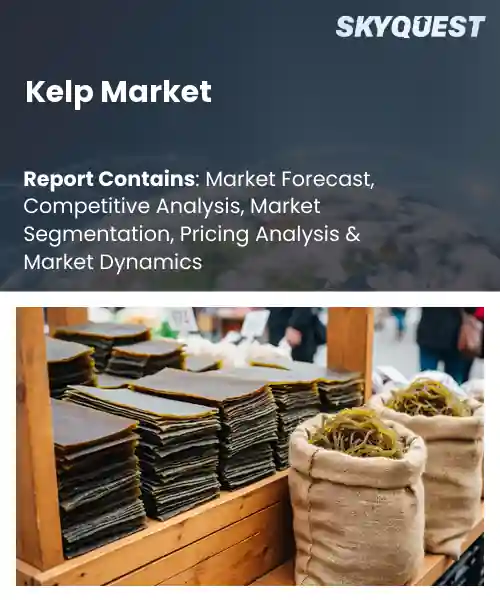
Kelp Market
Report ID: SQMIG20I2917
Report ID: SQMIG20I2917
[email protected]
USA +1 351-333-4748
Report ID:
SQMIG20I2917 |
Region:
Global |
Published Date: April, 2026
Pages:
157
|Tables:
89
|Figures:
76


Global Kelp Market size was valued at USD 942.1 Million in 2024 and is poised to grow from USD 1015.58 Million in 2025 to USD 948.7 Million by 2033, growing at a CAGR of 7.8% during the forecast period (2026-2033).
The primary driver of the kelp market is rising demand for sustainable marine biomass that provides food, industrial ingredients, and ecosystem services, compelling governments and companies invest in cultivation. The market covers wild harvest and aquaculture of brown macroalgae for human food, animal feed, fertilizers, hydrocolloids, and new bio-based materials, which explains its cross-sector relevance. Initially centered on East Asian culinary and traditional uses, kelp production has industrialized through innovations such as rope-and-line farming and automated harvesting, while examples from Norway and Maine demonstrate scalable methods. As a result, processing capacity expanded and attracted downstream manufacturers to the supply chain.A central factor accelerating global kelp market growth is technological and institutional enabling that reduces production costs and creates monetizable co-benefits, which in turn unlocks diverse commercial pathways. As improved seeding, mechanized harvesting, and cold-chain processing lowered unit costs, processors could viably produce alginate and kelp extracts, enabling food manufacturers and bioproduct firms to substitute synthetic additives. In practice, kelp-based biostimulants have been adopted by arable farmers to increase resilience and yields, while coastal aquaculture projects earn payments for nutrient removal and carbon sequestration, supplying additional revenue that incentivizes further farm expansion and private investment and catalyzing downstream manufacturing growth.
How is AI improving yield forecasting in the kelp market?
AI is improving kelp yield forecasting by linking environmental sensing with predictive learning. Key aspects include combining satellite and drone imagery with in situ sensors and computer vision to estimate canopy health and biomass. Current systems train machine learning models on historical growth patterns and real time sensor streams to predict optimal harvest windows and detect anomalies. In a market facing seasonal variability and supply chain challenges these forecasts help farms plan harvests and coordinate logistics. Examples range from satellite based kelp detection to underwater imagery used to refine local growth models and inform buyer planning.GreenWave February 2026, published a State of the Kelp Industry report highlighting farmer facing apps and data pipelines. Pairing those tools with AI driven forecasts helps farms better time harvests and match supply to market demand which supports efficiency and scalable market growth.
Market snapshot - (2026-2033)
Global Market Size
USD 942.1 Million
Largest Segment
Frozen Octopus (Largest Volume)
Fastest Growth
Processed & Canned
Growth Rate
7.8% CAGR
To get more insights on this market click here to Request a Free Sample Report
Global kelp market is segmented by product form, distribution channel, species focus and region. Based on product form, the market is segmented into Frozen Octopus (Largest Volume), Fresh/Chilled Octopus and Processed & Canned. Based on distribution channel, the market is segmented into Food Service (HoReCa), Retail (Supermarkets/Specialty Seafood Stores) and Online Meat & Seafood Platforms. Based on species focus, the market is segmented into Octopus Vulgaris (Common Octopus) and Others (Giant Pacific/Red Octopus). Based on region, the market is segmented into North America, Europe, Asia Pacific, Latin America and Middle East & Africa.
Frozen Octopus segment dominates because its large-volume, cold-chain processing creates consistent industrial demand for kelp-derived inputs and services. Centralized freezing and processing hubs encourage integration of kelp products as stabilizers, packaging components and feed additives, while reliable throughput reduces seasonality and supports steady procurement. These operational efficiencies and procurement scale incentivize suppliers and processors to prioritize kelp sourcing, reinforcing kelp market liquidity.
However, Processed & Canned is witnessing the strongest growth momentum as convenience and shelf stability expand kelp ingredient applications in sauces, brines and preservatives. Manufacturers are innovating with kelp-derived umami and texturizing agents to extend product portfolios, unlocking new retail and ready-to-eat channels and accelerating demand for scalable kelp supply chains.
Online Meat & Seafood Platforms segment dominates because direct-to-consumer digital channels efficiently introduce kelp-based offerings alongside proteins, enabling rapid consumer education and trial. Detailed provenance, certification and recipe content reduce purchase friction while data-driven merchandising concentrates demand for niche kelp products. Seamless logistics and subscription models stabilize orders for kelp suppliers, encouraging innovation and investment across the value chain and reinforcing online channels as primary commercialization pathways for the kelp market.
Meanwhile, Retail (Supermarkets/Specialty Seafood Stores) is emerging as the key high-growth area as curated in-store experiences and private-label kelp offerings drive mainstream visibility. Retailers' category management and cross-merchandising with fresh seafood expand use cases, while supplier partnerships and shelf-ready innovations accelerate kelp product trial among broader consumer cohorts and create durable retail demand.
To get detailed segments analysis, Request a Free Sample Report
Asia Pacific dominance reflects a convergence of favorable natural endowments, cultural familiarity with seaweed, and advanced industry capabilities concentrated in Japan and South Korea. Coastal geographies support reliable cultivation while long standing culinary and industrial use creates steady demand across food, nutraceutical, cosmetic, and bioproduct segments. Strong links between research institutions and commercial producers drive innovation in breeding, processing, and value added formulation. Established processing infrastructure and logistics enable efficient movement from farm to market, while policy frameworks and community expertise support sustainable expansion. Private sector investment and vertically integrated supply chains reinforce quality control and traceability, positioning the region as a global leader in both raw material supply and high value kelp derived ingredients.
Kelp Market in Japan is characterized by deep cultivation heritage and refined processing practices that underpin premium product positioning. Industry participants prioritize rigorous quality control and traceability, integrating kelp into both traditional cuisine and contemporary functional foods. Collaborative research networks support advances in extraction and preservation, while established processors enable development of specialized ingredients for food and cosmetic applications. Consumer familiarity with seaweed and mature export channels sustain demand for innovative kelp based offerings.
Kelp Market in South Korea leverages intensive aquaculture practices and a strong focus on strain improvement to expand product diversity. Partnerships between research institutes and commercial firms accelerate processing innovation and formulation work for cosmetics and nutraceuticals. Coastal community expertise and coordinated policy support contribute to supply stability, while dynamic private sector activity drives value addition and market outreach, targeting both domestic consumers and international ingredient buyers.
Rapid expansion in Europe is propelled by heightened interest in sustainable, locally sourced marine ingredients and coordinated efforts to scale aquaculture and processing capacity. Stakeholders across Germany, United Kingdom, and France are investing in pilot projects and commercial ventures that link cultivation with food manufacturing, feed development, and green chemistry applications. Improved regulatory clarity and cross sector collaboration encourage commercialization, while research funding supports cultivation methods suited to European waters. Emphasis on certification, standardization, and supply chain integration builds buyer confidence, and consumer trends toward clean label and environmentally responsible products create demand pull. Industry actors are increasingly focused on creating resilient regional supply networks that combine environmental stewardship with market oriented innovation.
Kelp Market in Germany is emerging through concentrated research efforts and pilot initiatives aimed at adapting cultivation to local coastal conditions. Industry interest centers on integrating kelp into food innovation, biobased materials, and agricultural inputs, with collaboration between start ups and research institutions to establish reliable supply chains. Attention to sustainability benchmarks and certification helps position new entrants, while regional networks work to connect producers with processors and end users.
Kelp Market in United Kingdom is experiencing rapid expansion driven by supportive policy direction for aquaculture and active engagement from private investors and coastal communities. Market participants prioritize scalable farming systems and downstream value chain development to serve food, feed, and bioactive markets. Research partnerships enhance strain selection and processing knowhow, while focus on traceability and environmental stewardship strengthens consumer and buyer confidence. Agile companies are moving quickly to commercialize kelp derived products and establish trade links.
Kelp Market in France maintains a dominant position rooted in long standing seaweed traditions and extensive coastal expertise. French producers benefit from established processing capabilities and well developed product channels in culinary, cosmetic, and agricultural sectors. Institutional support and regional knowhow facilitate vertically integrated supply chains that emphasize provenance and quality. Ongoing collaboration between traditional harvesters and modern aquaculture enterprises enables diversification into higher value applications and sustains leadership within the European landscape.
North America is strengthening its position through coordinated research, pilot cultivation projects, and growing interest from food and ingredient companies in the United States and Canada. Efforts focus on adapting cultivation methods to Atlantic and Pacific environments, building processing capacity, and developing quality and sustainability standards that meet market expectations. Partnerships among universities, Indigenous communities, and industry stakeholders foster knowledge exchange and community engagement. Market actors explore multiple value chains including nutraceuticals, feed ingredients, and restoration linked products to enhance economic resilience. Investment in logistics, certification frameworks, and collaboration with early adopter buyers supports commercialization and gradual establishment of reliable regional supply for kelp derived ingredients.
Kelp Market in United States is evolving through targeted research initiatives and pilot scale cultivation that adapt technologies to diverse coastal settings. Collaboration among academic centers, industry innovators, and coastal communities supports development of processing and distribution capabilities. Growing interest from food formulators and ingredient buyers is prompting investments in supply chain transparency and quality assurance, while entrepreneurs pursue novel product formats and partnerships to integrate kelp derived ingredients into mainstream channels.
Kelp Market in Canada is strengthening via concerted coastal stewardship, Indigenous partnerships, and applied research that advance cultivation best practices. Canadian producers focus on building resilient supply chains and aligning product development with sustainability objectives, supplying ingredients for food, cosmetics, and soil health applications. Development of processing infrastructure and quality frameworks enhances market readiness, and collaborative approaches foster community benefit alongside commercial growth.
To know more about the market opportunities by region and country, click here to
Buy The Complete Report
Rising Demand For Functional Foods
Growing Use In Pharmaceuticals
Environmental Variability and Risks
Regulatory Uncertainty and Complexity
Request Free Customization of this report to help us to meet your business objectives.
Competitive landscape in the global kelp market is shifting as established aquaculture firms and emergent startups pursue consolidation through acquisitions, strategic supply partnerships, and product innovation. Examples include Ocean Rainforest securing government support to expand kelp farms and Oceanium raising investment to scale ingredient processing. Market drivers tied to competition include brand-level supply agreements, vertical integration of farming and processing, and seeding and processing technology advances.
Top Player’s Company Profile
Recent Developments
SkyQuest’s ABIRAW (Advanced Business Intelligence, Research & Analysis Wing) is our Business Information Services team that Collects, Collates, Correlates, and Analyses the Data collected by means of Primary Exploratory Research backed by robust Secondary Desk research. As per SkyQuest analysis, the key driver is rising demand for sustainable marine biomass for food, industrial ingredients and ecosystem services, and a second driver is technological and institutional enabling such as mechanized farming and AI-driven yield forecasting that lower costs and open commercial pathways. The primary restraint is environmental variability and regulatory uncertainty that heighten operational and investment risk. The dominating region is Asia Pacific thanks to long-standing seaweed traditions, processing capacity and R&D, while the dominating segment by volume is Frozen Octopus which anchors cold-chain processing and steady industrial demand. Overall, integration across supply chains and product diversification underpin near-term market momentum.
| Report Metric | Details |
|---|---|
| Market size value in 2024 | USD 942.1 Million |
| Market size value in 2033 | USD 948.7 Million |
| Growth Rate | 7.8% |
| Base year | 2024 |
| Forecast period | (2026-2033) |
| Forecast Unit (Value) | USD Million |
| Segments covered |
|
| Regions covered | North America (US, Canada), Europe (Germany, France, United Kingdom, Italy, Spain, Rest of Europe), Asia Pacific (China, India, Japan, Rest of Asia-Pacific), Latin America (Brazil, Rest of Latin America), Middle East & Africa (South Africa, GCC Countries, Rest of MEA) |
| Companies covered |
|
| Customization scope | Free report customization with purchase. Customization includes:-
|
To get a free trial access to our platform which is a one stop solution for all your data requirements for quicker decision making. This platform allows you to compare markets, competitors who are prominent in the market, and mega trends that are influencing the dynamics in the market. Also, get access to detailed SkyQuest exclusive matrix.
Table Of Content
Executive Summary
Market overview
Parent Market Analysis
Market overview
Market size
KEY MARKET INSIGHTS
COVID IMPACT
MARKET DYNAMICS & OUTLOOK
Market Size by Region
KEY COMPANY PROFILES
Methodology
For the Kelp Market, our research methodology involved a mixture of primary and secondary data sources. Key steps involved in the research process are listed below:
1. Information Procurement: This stage involved the procurement of Market data or related information via primary and secondary sources. The various secondary sources used included various company websites, annual reports, trade databases, and paid databases such as Hoover's, Bloomberg Business, Factiva, and Avention. Our team did 45 primary interactions Globally which included several stakeholders such as manufacturers, customers, key opinion leaders, etc. Overall, information procurement was one of the most extensive stages in our research process.
2. Information Analysis: This step involved triangulation of data through bottom-up and top-down approaches to estimate and validate the total size and future estimate of the Kelp Market.
3. Report Formulation: The final step entailed the placement of data points in appropriate Market spaces in an attempt to deduce viable conclusions.
4. Validation & Publishing: Validation is the most important step in the process. Validation & re-validation via an intricately designed process helped us finalize data points to be used for final calculations. The final Market estimates and forecasts were then aligned and sent to our panel of industry experts for validation of data. Once the validation was done the report was sent to our Quality Assurance team to ensure adherence to style guides, consistency & design.
Analyst Support
Customization Options
With the given market data, our dedicated team of analysts can offer you the following customization options are available for the Kelp Market:
Product Analysis: Product matrix, which offers a detailed comparison of the product portfolio of companies.
Regional Analysis: Further analysis of the Kelp Market for additional countries.
Competitive Analysis: Detailed analysis and profiling of additional Market players & comparative analysis of competitive products.
Go to Market Strategy: Find the high-growth channels to invest your marketing efforts and increase your customer base.
Innovation Mapping: Identify racial solutions and innovation, connected to deep ecosystems of innovators, start-ups, academics, and strategic partners.
Category Intelligence: Customized intelligence that is relevant to their supply Markets will enable them to make smarter sourcing decisions and improve their category management.
Public Company Transcript Analysis: To improve the investment performance by generating new alpha and making better-informed decisions.
Social Media Listening: To analyze the conversations and trends happening not just around your brand, but around your industry as a whole, and use those insights to make better Marketing decisions.
REQUEST FOR SAMPLE
 REQUEST FREE CUSTOMIZATION


Want to customize this report? This report can be personalized according to your needs. Our analysts and industry experts will work directly with you to understand your requirements and provide you with customized data in a short amount of time. We offer $1000 worth of FREE customization at the time of purchase.
Feedback From Our Clients


 USA (+1) 351-333-4748

