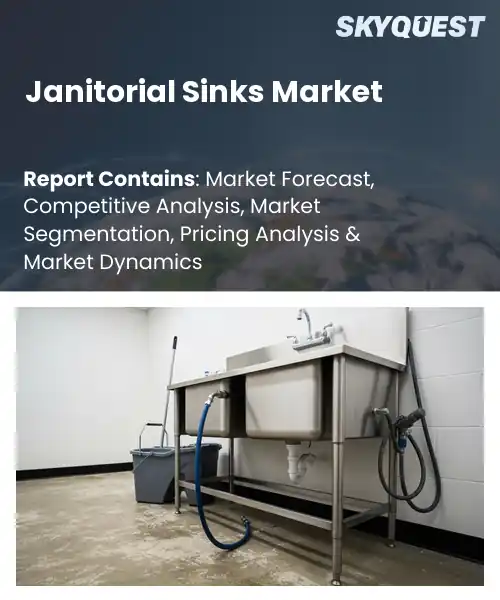
Janitorial Sinks Market
Report ID: SQMIG20C2279
Report ID: SQMIG20C2279
[email protected]
USA +1 351-333-4748
Report ID:
SQMIG20C2279 |
Region:
Global |
Published Date: July, 2026
Pages:
157
|Tables:
117
|Figures:
77


Global Janitorial Sinks Market size was valued at USD 382.5 Million in 2024 and is poised to grow from USD 400.55 Million in 2025 to USD 582.4 Million by 2033, growing at a CAGR of 4.72% during the forecast period (2026-2033).
Regulatory compliance and sustainability mandates now represent the growth catalyst for the janitorial sinks market, driving both product innovation and geographic expansion. When municipalities enforce separate grey‑water disposal, facilities must install compliant sinks, directly boosting sales of touch‑free faucets and recycler‑compatible basins. In response, manufacturers are introducing smart sensors that reduce water consumption by up to 30 percent, offering tangible cost savings for distributors, grocery chains that operate dozens of cleaning stations. These advancements open opportunities in emerging economies where construction of commercial complexes accelerates, creating a pipeline of demand for durable, low‑maintenance sink solutions aligning with strict environmental global standards.
The primary growth factor lies in tightening safety regulations paired with increasing demand for environmentally responsible cleaning practices, which compels institutions to upgrade existing wash stations. As hospitals adopt infection‑control protocols that require separate decontamination areas, the need for stainless‑steel, corrosion‑resistant basins surges, prompting suppliers to expand capacity and introduce modular designs that fit varied floor plans. This cause‑and‑effect chain fuels investment in automated dispenser technology, lowering labor costs for large facilities like universities that manage multiple campuses. Consequently, the market experiences a virtuous cycle: compliance pressures stimulate product diversification, which in turn accelerates adoption across sectors seeking both regulatory adherence and operational efficiency.
How is IoT-enabled monitoring reshaping efficiency in the Janitorial sinks market?
IoT‑enabled monitoring is turning janitorial sinks into data‑rich assets that help facilities run cleaner and more efficiently. Sensors embedded in the sink detect water usage, temperature and chemical levels, sending real‑time alerts to maintenance teams. This visibility lets managers schedule refills only when needed, avoid over‑use of cleaning agents and quickly spot leaks before they cause damage. By linking sink data to broader building management systems, operators can coordinate cleaning cycles with occupancy patterns, reducing downtime and conserving resources. The technology also supports sustainability goals, as the precise control of water and chemicals lowers waste and improves compliance with environmental standards.
Ecolab announced an IoT‑enabled SmartSink solution in March 2023, which integrates sensor data with its cleaning management platform, allowing users to monitor sink performance remotely and optimize supply usage, thereby boosting operational efficiency in the janitorial sinks market.
Market snapshot - (2026-2033)
Global Market Size
USD 382.5 Million
Largest Segment
Stainless Steel
Fastest Growth
Molded Plastic
Growth Rate
4.72% CAGR
To get more insights on this market click here to Request a Free Sample Report
Global janitorial sinks market is segmented by material, mounting, end-use, distribution and region. Based on material, the market is segmented into Stainless Steel, Terrazzo, Fiberglass and Molded Plastic. Based on mounting, the market is segmented into Floor-Mounted and Wall-Mounted. Based on end-use, the market is segmented into Commercial Buildings, Healthcare Facilities and Schools & Institutions. Based on distribution, the market is segmented into Plumbing Suppliers, Online and Direct to Contractors. Based on region, the market is segmented into North America, Europe, Asia Pacific, Latin America and Middle East & Africa.
Stainless steel segment dominates with large janitorial sinks market share because its inherent corrosion resistance, smooth non‑porous surface, and ease of cleaning align perfectly with the rigorous hygiene standards of janitorial environments. These attributes reduce maintenance downtime and extend product lifespan, prompting specifiers to favor stainless steel for high‑traffic areas. Moreover, its aesthetic appeal complements modern facility design, reinforcing its preference among architects and procurement teams across the market and operational budgets.
As per janitorial sinks market outlook, fiberglass segment is witnessing the strongest growth momentum as manufacturers introduce lightweight, cost‑effective designs that simplify installation in retrofit projects. Its resistance to chemicals and ability to be molded into ergonomic shapes attract budget‑conscious buyers, accelerating adoption in new construction and expanding the overall market opportunity for janitorial sinks.
As per janitorial sinks market analysis, healthcare facilities segment leads because infection control protocols demand sinks that can withstand frequent disinfection without degrading. The requirement for seamless stainless surfaces, backflow protection, and ergonomic height ensures patient safety and staff efficiency. These stringent specifications drive procurement policies toward specialized janitorial sinks, creating a robust demand pipeline that elevates this segment above others in the market through long‑term contracts and heightened compliance monitoring, including regular instrument validation processes.
Meanwhile, schools & institutions segment emerges as the key high‑growth segment as educational campuses upgrade sanitation infrastructure to meet new public health guidelines. The push for affordable, space‑efficient sinks with durability drives manufacturers to tailor modular solutions, stimulating broader adoption across K‑12 and higher‑education facilities and fueling market expansion.
To get detailed segments analysis, Request a Free Sample Report
The dominance of North America drives from a mature commercial infrastructure that emphasizes stringent hygiene standards across a broad spectrum of facilities. Advanced manufacturing capabilities provide high‑quality, customizable sink solutions that meet demanding regulatory requirements. Strong procurement channels link suppliers with large institutional buyers, fostering long‑term relationships and consistent demand. Innovation in water‑efficient designs and durable materials is propelled by well‑funded research initiatives, reinforcing the region’s reputation for reliability. Additionally, a culture of proactive maintenance and sustainability drives continuous replacement cycles, ensuring that North American markets remain at the forefront of product adoption and set benchmarks for global competitors.
As per janitorial sinks market regional outlook, United States benefits from extensive institutional networks that prioritize stringent health and safety protocols. The presence of leading manufacturers accelerates the rollout of ergonomic and water‑saving designs tailored to diverse building types. Procurement practices favor long‑term supplier partnerships, which reinforce consistency in product quality and delivery. Emphasis on sustainability fuels interest in recyclable materials and efficient fixtures, reinforcing the market’s forward‑looking posture.
As per janitorial sinks market regional forecast, Canada reflects a strong alignment with national building codes that stress environmental stewardship and user safety. Local distributors collaborate closely with manufacturers to customize solutions for harsh climate considerations, ensuring durability and performance. The market’s growth is supported by public‑sector investment in facility upgrades that prioritize modern, hygienic fixtures. A proactive approach to maintenance and an emphasis on energy‑efficient technologies sustain a stable demand environment.
Europe’s rapid expansion is driven by rigorous environmental directives and a deep‑rooted commitment to public health standards across its varied economies. Regulatory frameworks encourage the adoption of water‑conserving fixtures, prompting manufacturers to innovate with eco‑friendly materials and modular designs. The region’s dense network of educational, healthcare, and corporate facilities creates a fertile landscape for frequent upgrades and retrofits. Collaborative industry clusters promote knowledge sharing, accelerating the diffusion of best practices and cutting‑edge technology. Consumer awareness regarding hygiene and sustainability further fuels demand, positioning Europe as a dynamic arena where quality, compliance, and ecological responsibility intersect to shape market momentum.
As per janitorial sinks industry analysis, Germany leads the continent through a combination of engineering excellence and strict compliance with environmental standards. German manufacturers emphasize precision engineering, delivering high‑performance sinks that integrate water‑saving features without compromising durability. The market benefits from strong institutional procurement policies that favor reliable, locally sourced products. A focus on innovative design and material efficiency aligns with national sustainability goals, reinforcing Germany’s position as a benchmark for quality and regulatory adherence.
United Kingdom experiences accelerated growth as public and private sectors prioritize modern hygiene solutions. Investment in facility refurbishment drives the replacement of legacy fixtures with ergonomically designed, water‑efficient sinks. Manufacturers respond to market demand with flexible product lines that address diverse building typologies, from historic structures to contemporary office spaces. A proactive regulatory environment encourages adoption of standards that enhance safety and sustainability, propelling the market’s rapid expansion.
France is emerging through increased focus on health‑centric design and regulatory encouragement of water conservation. French suppliers are integrating aesthetic considerations with functional performance, catering to the nuanced preferences of institutional buyers. The market benefits from government incentives that support sustainable building upgrades, prompting a steady influx of modern sink solutions. Collaborative efforts between architects and manufacturers foster innovative applications that align with the country’s evolving environmental objectives.
Asia Pacific is strengthening its position by leveraging rapid urbanization and a growing emphasis on corporate responsibility within the region’s expanding commercial landscape. Manufacturers are adopting advanced production techniques that enable the delivery of cost‑effective yet high‑quality sinks suitable for a variety of facility types. Increasing awareness of hygiene standards, particularly in densely populated urban centers, fuels demand for reliable and easy‑to‑maintain fixtures. Strategic partnerships between local distributors and global equipment providers enhance market accessibility and encourage technology transfer. The region’s focus on sustainable building practices further drives the integration of water‑saving features, positioning Asia Pacific as an increasingly influential participant in the global market dynamics.
Japan is characterized by a strong commitment to precision and durability, reflecting the country’s broader manufacturing ethos. Retail channels emphasize compact, space‑efficient designs that accommodate the constraints of high‑rise office buildings and educational institutions. Environmental guidelines stimulate the adoption of fixtures that reduce water usage while maintaining high hygiene standards. Collaboration between manufacturers and facility managers ensures that product specifications align closely with user needs, reinforcing a stable market foundation.
South Korea benefits from a vibrant construction sector that prioritizes modern, hygienic infrastructure. Korean producers focus on integrating smart features and sleek aesthetics into sink designs, catering to contemporary workplace expectations. Government initiatives supporting energy‑efficient building practices motivate the uptake of water‑saving fixtures. Close coordination between industry associations and regulatory bodies facilitates rapid compliance with evolving safety standards, bolstering market confidence and growth.
To know more about the market opportunities by region and country, click here to
Buy The Complete Report
Increasing Commercial Construction Activity
Growing Emphasis on Hygiene Standards
High Initial Installation Cost
Limited Availability Of Skilled Maintenance
Request Free Customization of this report to help us to meet your business objectives.
The market is shaped by intense rivalry among manufacturers and distributors of specialized janitorial sinks, with recent M&A activity consolidating product lines and partnerships with commercial real‑estate firms accelerating adoption of touch‑less designs. Companies are investing in smart sensor integration and antimicrobial materials to differentiate offerings, while joint ventures with facilities‑management providers expand channel reach and lock‑in large‑scale contracts.
SkyQuest’s ABIRAW (Advanced Business Intelligence, Research & Analysis Wing) is our Business Information Services team that Collects, Collates, Correlates, and Analyses the Data collected by means of Primary Exploratory Research backed by robust Secondary Desk research.
As per SkyQuest analysis, the global janitorial sinks market growth is being propelled primarily by rising commercial construction activity, which creates steady demand for sanitary sink solutions across new facilities. A second strong driver is the growing emphasis on hygiene standards that pushes institutions to upgrade to touch‑free, antimicrobial basins. The market faces a restraint in the form of high initial installation costs that can deter budget‑conscious projects. North America remains the dominant region due to mature infrastructure and stringent regulations, while the stainless‑steel material segment leads in volume because of its durability, corrosion resistance and ease of cleaning. The global janitorial sinks market trend driven by increasing investments in commercial infrastructure, healthcare facilities, educational institutions, hospitality, and industrial buildings.
| Report Metric | Details |
|---|---|
| Market size value in 2024 | USD 382.5 Million |
| Market size value in 2033 | USD 582.4 Million |
| Growth Rate | 4.72% |
| Base year | 2024 |
| Forecast period | (2026-2033) |
| Forecast Unit (Value) | USD Million |
| Segments covered |
|
| Regions covered | North America (US, Canada), Europe (Germany, France, United Kingdom, Italy, Spain, Rest of Europe), Asia Pacific (China, India, Japan, Rest of Asia-Pacific), Latin America (Brazil, Rest of Latin America), Middle East & Africa (South Africa, GCC Countries, Rest of MEA) |
| Companies covered |
|
| Customization scope | Free report customization with purchase. Customization includes:-
|
To get a free trial access to our platform which is a one stop solution for all your data requirements for quicker decision making. This platform allows you to compare markets, competitors who are prominent in the market, and mega trends that are influencing the dynamics in the market. Also, get access to detailed SkyQuest exclusive matrix.
Table Of Content
Executive Summary
Market overview
Parent Market Analysis
Market overview
Market size
KEY MARKET INSIGHTS
COVID IMPACT
MARKET DYNAMICS & OUTLOOK
Market Size by Region
KEY COMPANY PROFILES
Methodology
For the Janitorial Sinks Market, our research methodology involved a mixture of primary and secondary data sources. Key steps involved in the research process are listed below:
1. Information Procurement: This stage involved the procurement of Market data or related information via primary and secondary sources. The various secondary sources used included various company websites, annual reports, trade databases, and paid databases such as Hoover's, Bloomberg Business, Factiva, and Avention. Our team did 45 primary interactions Globally which included several stakeholders such as manufacturers, customers, key opinion leaders, etc. Overall, information procurement was one of the most extensive stages in our research process.
2. Information Analysis: This step involved triangulation of data through bottom-up and top-down approaches to estimate and validate the total size and future estimate of the Janitorial Sinks Market.
3. Report Formulation: The final step entailed the placement of data points in appropriate Market spaces in an attempt to deduce viable conclusions.
4. Validation & Publishing: Validation is the most important step in the process. Validation & re-validation via an intricately designed process helped us finalize data points to be used for final calculations. The final Market estimates and forecasts were then aligned and sent to our panel of industry experts for validation of data. Once the validation was done the report was sent to our Quality Assurance team to ensure adherence to style guides, consistency & design.
Analyst Support
Customization Options
With the given market data, our dedicated team of analysts can offer you the following customization options are available for the Janitorial Sinks Market:
Product Analysis: Product matrix, which offers a detailed comparison of the product portfolio of companies.
Regional Analysis: Further analysis of the Janitorial Sinks Market for additional countries.
Competitive Analysis: Detailed analysis and profiling of additional Market players & comparative analysis of competitive products.
Go to Market Strategy: Find the high-growth channels to invest your marketing efforts and increase your customer base.
Innovation Mapping: Identify racial solutions and innovation, connected to deep ecosystems of innovators, start-ups, academics, and strategic partners.
Category Intelligence: Customized intelligence that is relevant to their supply Markets will enable them to make smarter sourcing decisions and improve their category management.
Public Company Transcript Analysis: To improve the investment performance by generating new alpha and making better-informed decisions.
Social Media Listening: To analyze the conversations and trends happening not just around your brand, but around your industry as a whole, and use those insights to make better Marketing decisions.
REQUEST FOR SAMPLE
 REQUEST FREE CUSTOMIZATION
Global Janitorial Sinks Market size was valued at USD 382.5 Million in 2024 and is poised to grow from USD 400.55 Million in 2025 to USD 582.4 Million by 2033, growing at a CAGR of 4.72% during the forecast period (2026-2033).
The market is shaped by intense rivalry among manufacturers and distributors of specialized janitorial sinks, with recent M&A activity consolidating product lines and partnerships with commercial real‑estate firms accelerating adoption of touch‑less designs. Companies are investing in smart sensor integration and antimicrobial materials to differentiate offerings, while joint ventures with facilities‑management providers expand channel reach and lock‑in large‑scale contracts. 'Mustee (E.L. Mustee & Sons)', 'Fiat Products (Eljer)', 'American Standard (LIXIL)', 'Advance Tabco', 'Just Manufacturing', 'Just Manufacturing Co.', 'Custom Fabrication', 'Franke Group', 'Elkay Manufacturing', 'Zurn Industries', 'Sloan Valve Company', 'Bradley Corporation', 'Acorn Engineering', 'Willoughby Industries', 'J.R. Smith (Jay R. Smith)', 'Watts Water Technologies', 'Kohler Co.', 'Mop Sinks Direct', 'FreedomFlo Sinks', 'Advance Tabco Group'
The surge in commercial construction projects drives demand for specialized janitorial sinks, as new facilities require integrated hygiene solutions that support efficient cleaning workflows. Architects and facility planners select these sinks to meet design standards, enabling seamless installation within kitchens, restrooms, and utility areas. This preference enhances market growth by creating consistent procurement cycles and encouraging manufacturers to expand product lines tailored to diverse building typologies, reinforcing a positive feedback loop between construction activity and sink adoption through collaborative industry standards.
Sustainable Materials Adoption: Growing environmental stewardship among corporate facilities drives demand for janitorial sinks constructed from recycled composites, low‑emission polymers, and sustainably sourced stainless steel. Manufacturers are redesigning product lines to minimize carbon footprints, eliminate hazardous finishes, and support green certification programs such as LEED. This shift not only aligns with tenant expectations but also reduces long‑term maintenance costs, as eco‑friendly materials resist staining and corrosion, fostering broader acceptance of sustainable sink solutions across commercial, institutional, and healthcare sectors.
Why does North America Dominate the Global Janitorial Sinks Market? |@12


Want to customize this report? This report can be personalized according to your needs. Our analysts and industry experts will work directly with you to understand your requirements and provide you with customized data in a short amount of time. We offer $1000 worth of FREE customization at the time of purchase.
Feedback From Our Clients


 USA (+1) 351-333-4748

