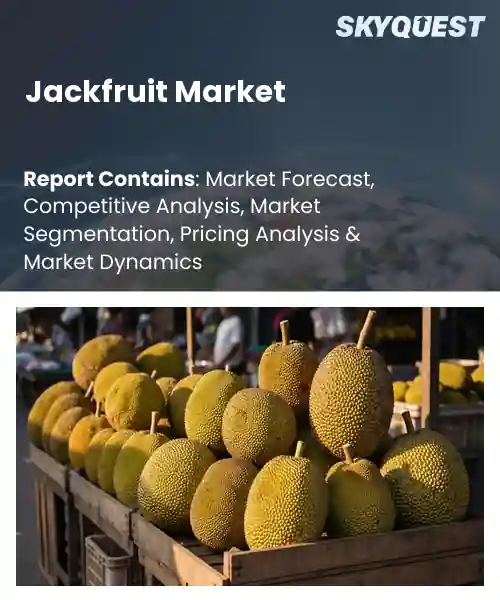
Jackfruit Market
Report ID: SQMIG30I2832
Report ID: SQMIG30I2832
[email protected]
USA +1 351-333-4748
Report ID:
SQMIG30I2832 |
Region:
Global |
Published Date: February, 2026
Pages:
157
|Tables:
94
|Figures:
76


Global Jackfruit Market size was valued at USD 309.62 Billion in 2024 and is poised to grow from USD 317.05 Billion in 2025 to USD 383.29 Billion by 2033, growing at a CAGR of 2.4% during the forecast period (2026-2033).
The global jackfruit market outlook developed from its original status as a regional food in Southeast Asia to become a global product which businesses now sell because of the increasing need for plant-based meat substitutes and eco-friendly food products. Consumers want fibrous substitutes which have a neutral taste and resemble the texture of pulled meat, so processors spent money on developing extraction and freezing and packaging systems which enabled them to ship products across long distances. The supply chain technology changes enabled retailers to increase their product offerings through North American and European markets which included specialty brands and regular grocery stores selling canned and frozen jackfruit products. The market exists because jackfruit cultivation enables smallholders to earn more income through its establishment as a low-input crop which enables farmers to sell their products.
Moreover, the global jackfruit market growth is driven through processing commercial operations which produce value added products that transform perishable fruit into shelf-stable formats for wider distribution and consumer usage. Retailers can maintain their inventory of high-quality canned and frozen jackfruit products through processor investments in pulping and brining and freezing which restaurants and CPG companies use for their plant-based sandwich and ready meal and vegan product lines. The relationship between integrated processing and farm income expansion leads farmers to plant more orchards while agricultural investors support cold-chain system development and jackfruit-based product research through their investments, which creates multiple revenue sources.
How can IoT Improve Supply Chain Traceability in the Global Jackfruit Market?
The use of IoT technology enables better traceability for the global jackfruit industry because it connects physical fruit products to digital identities which exist permanently and it tracks their condition and ownership changes throughout all processing stages. The system consists of essential elements which include low-cost sensors that operate on crates and GPS tracking for delivery vehicles and electronic tags which connect each shipment to its corresponding farming records and cloud systems which gather sensor data streams. The current state of jackfruit supply chains shows fragmentation because they rely on smallholder farms and have inconsistent postharvest processes, so exporters and retailers require visible provenance data along with condition monitoring to establish trust. Through their pilot projects and cooperative programs, Southeast Asian communities have proven that QR tagging and automated sensor logs help businesses prove product origin and reach waste reduction goals while they build consumer trust.
Market snapshot - (2026-2033)
Global Market Size
USD 378.4 Million
Largest Segment
Cheena
Fastest Growth
Black Gold
Growth Rate
5.1% CAGR
To get more insights on this market click here to Request a Free Sample Report
The global jackfruit market is segmented based on variety, application, distribution channel, and region. By variety, the market is categorized into Cheena, Golden Pillow, Tabouey, Black Gold, Cochin, and others. Based on application, it is segmented into fresh consumption, beverages, and confectioneries. In terms of distribution channel, the market includes online retail, retail stores, supermarkets/hypermarkets, and food and drink specialty stores. Regionally, the market is segmented into North America, Europe, Asia Pacific, Latin America, and the Middle East & Africa.
As per the global jackfruit market analysis, the Cheena segment dominates the market because its fruit properties and processing methods match consumer flavors and manufacturer requirements. The product has a consistent texture and balanced sweetness which allows for standard product recipes; this streamlines production processes and decreases material wastage. The strong recognition of specific cultivars enables premium product brands to achieve better display space, while supply chains and existing cultivar dependability lead buyers to choose it as their preferred option for both fresh and cooked products, this strengthens its dominant position in all product lines.
Whereas the Golden Pillow category is anticipated to have the maximum jackfruit market share occurs because its enhanced flavor and modern processing features have driven breeding efforts to develop this variety. The product range which appeals to trend-driven customers enables companies to create new products through its adaptable design for different product formats.
According to the global jackfruit market forecast, the beverages segment leads the market because liquid jackfruit products provide both consumers and industrial customers with easy-to-use products that offer multiple functions. The extraction and stabilization techniques, which achieve efficient results, enable juice and smoothie and functional drink production at scalable levels because they generate high demand from retailers. Jackfruit serves as a constant ingredient across drink products which eliminates product development challenges, while it creates possibilities for brand partnerships and increases drinking occasions, thus establishing beverages as the main revenue source across the entire market.
However, the strongest growth momentum in confectioneries currently exists because innovators use jackfruit to create sweets and fillings and baked goods which combine indulgent and plant-based elements. The new textures and flavor combinations enable premium product positioning because they lead to product launches and artisan brand creation, which drives demand and increases jackfruit consumption beyond its usual limits.
To get detailed segments analysis, Request a Free Sample Report
According to the jackfruit market regional forecast, the market advantage of Asia Pacific exists because its combination of optimal growing conditions, deep culinary ties, established supply networks, and consumer product knowledge creates a strong market defense system. The region's tropical and subtropical climates enable farmers to cultivate their crops throughout the year, while traditional cuisines and street food cultures provide steady demand. The processing and distribution networks of the region enable farmers to transport their products to cities and export terminals, while the diverse network of smallholder and commercial producers maintains a balance between innovation and established practices. The policy frameworks of multiple economies enable agricultural modernization and value-added processing development, while the rising demand for plant-based products through foodservice channels creates deeper market opportunities. The combination of these elements creates an extensive system that maintains supremacy in all aspects of production and consumption, and product development.
The Jackfruit sector in Japan displays its special character because Japanese people show increasing interest in jackfruit through their culinary experiments and their desire for premium food and the existence of high-end retail stores. Retailers and specialty foodservice operators focus on high quality imports and innovative product formats that align with local taste palettes. The distribution system ensures food safety through its tracking system, while importers establish cooperation agreements with supermarket chains for distribution purposes. The dining establishments and lifestyle media create consumer knowledge about plant-based products through their content about new plant-based culinary possibilities.
The South Korean jackfruit market derives its character from current food developments and easily accessible convenience stores and active innovation in foodservice restaurants. Retailers and frozen prepared food manufacturers experiment with textured formats and ready to cook options that suit busy consumers. The distribution network requires distribution partners to maintain cold chain conditions while working together with modern retail outlets. The promotional activities focus on health advantages and culinary application flexibility, while the collaboration between importers and restaurant groups helps restaurants obtain the necessary products for their menu testing activities and marketing campaigns.
The North American jackfruit market is expanding because of consumers who choose plant-based protein, alternative meat and ingredient companies who develop new products, and retailers who quickly adopt new product categories. The foodservice operators and product developers utilize jackfruit because it provides a texture that suits their needs in savory products, while retailers and distributors establish their market presence in both mainstream and specialty markets. The supply chain enhancements together with expanded import options support consistent product distribution, while marketing activities showcaseproducts as versatile culinary items that meet health-conscious consumer preferences. The partnership system between food ingredient providers and foodservice companies speeds up product development for the area which experiences rapid market growth because customers want to test new products and both food distribution channels and restaurants want to work together. E commerce platforms and culinary influencers play a role in raising awareness, while private label initiatives and retail promotions broaden consumer trial and shelf visibility.
The United States jackfruit market shows fast product development because retail outlets and foodservice operations develop new products that use jackfruit as their primary ingredient. Supermarkets offer plant-based savory products which national quick service brands can test through their marketing campaigns and product sampling programs. E commerce and specialty distributors enable niche product discovery, while collaborations between ingredient suppliers and restaurant developers accelerate menu adoption and broaden mainstream consumer exposure.
The Canadian jackfruit market penetration develops through multicultural culinary requirements and a strong specialty retail sector and foodservice innovation activities which take place in Canadian cities. The importers and distributors have two main objectives because they must keep product quality while they need to fulfil cold chain requirements of retailers and product developers need to establish local market products which include ready-to-eat options and special regional delicacies. The ethnic grocery channels and culinary events help promote consumer interest, which leads to broader retail availability of products and gradual acceptance by mainstream consumers.
European countries enhance their continental role through three elements which include better regulatory systems, multiple distribution methods, and increased culinary innovation throughout their markets. Major retailers in important markets dedicate specific store space to plant-based product development and their own products while foodservice establishments use jackfruit in their ethnic and modern dining options. Supply chain operators develop value added processing capabilities to meet rigorous quality and tracing requirements, while international trade systems allow them to access diverse product ranges. People become interested in products through media coverage, chef-led marketing activities, and specific testing programs which lead to repeated buying patterns.
The German jackfruit market benefits from strong vegan and vegetarian values, new ways of customer engagement through retail, and rigorous product quality standards which exist in the market. Certified supply chains plus clear product labeling requirements act as essential standards for importers and processors who need to meet the demands of their customers. Restaurants that follow urban dining concepts and serve plant-based casual meals test new food combinations which supermarkets use as their private products. Companies use sustainable product stories which describe culinary applications to drive conversion from trial use to regular consumer sales in multiple market segments.
Fast casual restaurant chains create demand in the market for jackfruit products in the United Kingdom, while culinary media and grocery stores that sell plant-based products drive growth for this market. Companies offer multiple product formats which fulfill customer needs for convenient solutions, while restaurant chains implement menu items that demonstrate their food items' texture and cooking simplicity. Distribution networks use both regular supermarkets and local independent stores to deliver products, while promotional activities with chef partnerships help people learn about products which leads to their adoption by new audiences.
The French jackfruit market exists at the intersection between traditional culinary values and contemporary plant-based dining preferences which leads to customized product development to meet local taste requirements. Chefs together with artisanal producers create advanced cooking methods which combine jackfruit with bistro and modern dining trends, while specialty stores present selected items to customers. The premium product status of culinary products depends on three core factors which are product origin authenticity, product flavor originality and traditional cooking methods, while culinary education initiatives help professionals understand products which in turn leads to market development.
To know more about the market opportunities by region and country, click here to
Buy The Complete Report
Rising Consumer Demand for Plant Based
The current trend among consumers to choose plant-based products with transparent labels has made jackfruit a preferred ingredient due to its ability to create meat-like flavors and enable product innovation across multiple food categories. Food manufacturers use jackfruit in their products for meat alternatives as well as snacks and ready-made meals to increase their presence in retail and market channels. The market expansion between demand-driven and producer relationships leads to higher production levels and processing investment and develops new product combinations which support sustainable market development.
Expansion of Food Processing Applications
Jackfruit usage in processed foods enables brands to create multiple products which match diverse customer choices, leading to stronger business sustainability. Jackfruit serves three essential functions in food production which benefit private label producers and recipe creators. As culinary applications grow, businesses need uniform raw materials combined with standardized processing systems, which drives them to invest in supply chain solutions plus quality assurance methods. Jackfruit has become a permanent element of industrial food production, which creates constant manufacturer demand plus retailer support to boost market development.
Seasonal Supply Variability and Logistics
The unpredictable supply of fresh jackfruit creates challenges for manufacturers and retailers who require regular product delivery because of seasonal changes in harvesting and the product's nature as a perishable item. The existence of multiple fruit types of results in processing interruptions, which disrupt product availability throughout the year and create difficulties in maintaining year-round supply, which stops businesses from making extended contract agreements and slows down their factory expansion plans. The need to manage harvesting timing and transport delivery and product handling for logisticsoperations leads to quality deterioration and increased waste, which makes companies less willing to invest in business growth and reduces their ability to develop new market channels.
Regulatory and Labeling Challenges
Existing regulations and labeling rules about jackfruit products create hurdles that manufacturers must overcome to sell their products worldwide because manufacturers must comply with different regulations regarding novel foods and ingredient claims and their labeling standards. The complex requirements lead to higher compliance expenses for businesses who need more time to finish their products, which results in companies choosing to distribute their items only to known regions. Investors show less interest in large-scale processing and export infrastructure because of market fragmentation, which decreases producer's capability to meet new market requirements and creates barriers to industry development.
Request Free Customization of this report to help us to meet your business objectives.
The global jackfruit market experiences competition because specialized plant-based startups and established food companies use their retail and foodservice partnerships together with targeted venture funding and supply chain agreements and product innovation to compete against each other. The three companies like Jack & Bry, Karana, and Jack & Annie moved forward with their business operations through different funding methods and expansion agreements.
Jack & Bry: Established in 2019. Their main objective is to develop jackfruit-based meat alternatives for retail and foodservice channels that replicate meat textures and suit mainstream menus. The company completed its seed round while it built commercial relationships to supply major quick service and retail partners in the UK and Netherlands, which brought new SKUs to online supermarkets and fast-foodmenus to create distribution links with large partners.
SkyQuest’s ABIRAW (Advanced Business Intelligence, Research & Analysis Wing) is our Business Information Services team that Collects, Collates, Correlates, and Analyses the Data collected by means of Primary Exploratory Research backed by robust Secondary Desk research. As per SkyQuest analysis, the global jackfruit market is driven primarily by rising consumer demand for plant-based alternatives, while a second key driver is the commercialization of processing and value-added products that enable shelf-stable formats and wider distribution. Growth is constrained by seasonal supply variability and logistics challenges that complicate year-round sourcing and increase waste. Asia Pacific remains the dominating region due to favorable growing conditions, culinary integration and established supply chains, and the beverages segment is the dominating application thanks to scalable extraction and product versatility. Overall, investment in processing, cold-chain infrastructure and traceability will shape near-term adoption and retail penetration.
| Report Metric | Details |
|---|---|
| Market size value in 2024 | USD 378.4 Million |
| Market size value in 2033 | USD 592.07 Million |
| Growth Rate | 5.1% |
| Base year | 2024 |
| Forecast period | (2026-2033) |
| Forecast Unit (Value) | USD Million |
| Segments covered |
|
| Regions covered | North America (US, Canada), Europe (Germany, France, United Kingdom, Italy, Spain, Rest of Europe), Asia Pacific (China, India, Japan, Rest of Asia-Pacific), Latin America (Brazil, Rest of Latin America), Middle East & Africa (South Africa, GCC Countries, Rest of MEA) |
| Companies covered |
|
| Customization scope | Free report customization with purchase. Customization includes:-
|
To get a free trial access to our platform which is a one stop solution for all your data requirements for quicker decision making. This platform allows you to compare markets, competitors who are prominent in the market, and mega trends that are influencing the dynamics in the market. Also, get access to detailed SkyQuest exclusive matrix.
Table Of Content
Executive Summary
Market overview
Parent Market Analysis
Market overview
Market size
KEY MARKET INSIGHTS
COVID IMPACT
MARKET DYNAMICS & OUTLOOK
Market Size by Region
KEY COMPANY PROFILES
Methodology
For the Jackfruit Market, our research methodology involved a mixture of primary and secondary data sources. Key steps involved in the research process are listed below:
1. Information Procurement: This stage involved the procurement of Market data or related information via primary and secondary sources. The various secondary sources used included various company websites, annual reports, trade databases, and paid databases such as Hoover's, Bloomberg Business, Factiva, and Avention. Our team did 45 primary interactions Globally which included several stakeholders such as manufacturers, customers, key opinion leaders, etc. Overall, information procurement was one of the most extensive stages in our research process.
2. Information Analysis: This step involved triangulation of data through bottom-up and top-down approaches to estimate and validate the total size and future estimate of the Jackfruit Market.
3. Report Formulation: The final step entailed the placement of data points in appropriate Market spaces in an attempt to deduce viable conclusions.
4. Validation & Publishing: Validation is the most important step in the process. Validation & re-validation via an intricately designed process helped us finalize data points to be used for final calculations. The final Market estimates and forecasts were then aligned and sent to our panel of industry experts for validation of data. Once the validation was done the report was sent to our Quality Assurance team to ensure adherence to style guides, consistency & design.
Analyst Support
Customization Options
With the given market data, our dedicated team of analysts can offer you the following customization options are available for the Jackfruit Market:
Product Analysis: Product matrix, which offers a detailed comparison of the product portfolio of companies.
Regional Analysis: Further analysis of the Jackfruit Market for additional countries.
Competitive Analysis: Detailed analysis and profiling of additional Market players & comparative analysis of competitive products.
Go to Market Strategy: Find the high-growth channels to invest your marketing efforts and increase your customer base.
Innovation Mapping: Identify racial solutions and innovation, connected to deep ecosystems of innovators, start-ups, academics, and strategic partners.
Category Intelligence: Customized intelligence that is relevant to their supply Markets will enable them to make smarter sourcing decisions and improve their category management.
Public Company Transcript Analysis: To improve the investment performance by generating new alpha and making better-informed decisions.
Social Media Listening: To analyze the conversations and trends happening not just around your brand, but around your industry as a whole, and use those insights to make better Marketing decisions.
REQUEST FOR SAMPLE
 REQUEST FREE CUSTOMIZATION
Global Jackfruit Market size was valued at USD 378.4 Million in 2024 and is poised to grow from USD 397.7 Million in 2025 to USD 592.07 Million by 2033, growing at a CAGR of 5.1% during the forecast period (2026-2033).
Competition in the global jackfruit market is driven by specialist plant based startups and established food companies deploying retail and foodservice partnerships, targeted venture funding, supply chain agreements with growers, and product innovation. Examples include Jack & Bry’s retail and foodservice agreements and seed raise, Karana’s seed financing and restaurant rollouts, and Jack & Annie’s retail expansion after a sizeable funding round. 'The Jackfruit Company', 'Artocarpus Foods Pvt.', 'Anna Food Products', 'Island Valley Delights', 'Nutty Yogi', 'Jackfruit365', 'Mother Dairy Fruit And Vegetable Pvt.', 'Madam Sun', 'Frubites', 'NatureLoC', 'Fresh Consumption', 'Amazing Foods', 'Thrive Foods', 'Greenheart Organic Farms', 'Pure Foods Company', 'FunFoods India', 'Organic Jackfruit', 'Veggie Wonder', 'Naturally Vegan', 'Eco-Friendly Eats'
The increasing consumer preference for plant based alternatives and cleaner label products has elevated jackfruit as a favorable ingredient, offering a meat like texture and versatility that supports product development across categories. Food manufacturers are responding by incorporating jackfruit into meat analogues, snacks, and ready meals, which broadens market access and retail presence. This demand driven adoption encourages growers to expand production, incentivizes investment in processing capabilities, and stimulates innovation in formulations and marketing strategies that collectively underpin sustained market growth.
Plant Based Innovation: Jackfruit is being adopted as a versatile base for meat analogs and convenience foods, encouraging manufacturers to invest in texture, flavor and preservation techniques to enhance sensory quality and shelf stability. Retailers and foodservice operators are developing mainstream and premium offerings, while ingredient suppliers pursue formulation and processing innovations. This dynamic supports expansion of ready meals and culinary applications, enabling the category to move beyond novelty toward sustained consumer acceptance driven by taste, convenience and perceived naturalness and supply partnerships.
Why does Asia Pacific Dominate the Global Jackfruit Market? |@12


Want to customize this report? This report can be personalized according to your needs. Our analysts and industry experts will work directly with you to understand your requirements and provide you with customized data in a short amount of time. We offer $1000 worth of FREE customization at the time of purchase.
Feedback From Our Clients


 USA (+1) 351-333-4748

