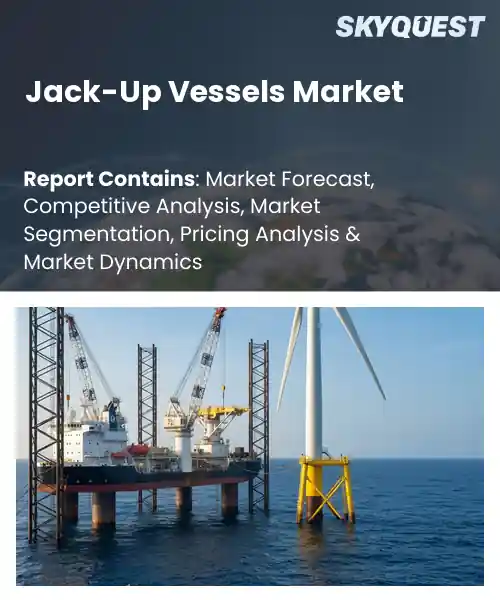
Jack-Up Vessels Market
Report ID: SQMIG20T2056
Report ID: SQMIG20T2056
[email protected]
USA +1 351-333-4748
Report ID:
SQMIG20T2056 |
Region:
Global |
Published Date: July, 2026
Pages:
157
|Tables:
149
|Figures:
78


Global Jack-Up Vessels Market size was valued at USD 4.63 Billion in 2024 and is poised to grow from USD 4.87 Billion in 2025 to USD 7.31 Billion by 2033, growing at a CAGR of 5.2% during the forecast period (2026-2033).
Global jack-up vessels market is made up of specialized offshore platforms that are jacked up by legs to the seabed to provide a stable work deck for drilling, construction and maintenance in shallow waters. Its importance is the rising demand for economic access to offshore oil fields and renewable projects with contracts that facilitate mobilization. In recent years, offshore wind farms in Europe and shipyards updating units with safety systems have revived the sector. Investment has been driven by the increased focus on safety, with operators now wanting vessels that conform to strict classification rules but still offer economical day rates.
This requires shipyards to install hull extensions and ballast systems, which cut contractor operating costs and reduce turnaround times. For example, a Danish wind-farm developer recently hired a converted jack-up to install turbines off Taiwan, citing a 15% reduction in project schedule. This means that markets with emerging offshore wind pipelines like Southeast Asia and the U.S. represent enormous lucrative opportunities for global manufacturers and new service providers looking to capture future market share.
How is AI-driven Automation Influencing Efficiency And Safety In The Jack-up Vessels Market?
AI‑driven automation is reshaping jack‑up vessels by embedding real‑time sensor networks, predictive‑maintenance algorithms and autonomous positioning systems. These tools allow operators to anticipate equipment wear, reduce manual interventions and optimise lift cycles, which translates into faster project timelines and lower risk of human error. This is being seen in the recent boom in vessel deliveries as the market wants owners who can use digital twins and remote monitoring to meet tighter offshore wind schedules. The industry is combining advanced analytics with traditional marine engineering to boost utilization rates, while improving crew safety by minimizing exposure to hazardous tasks.
The new jack-up vessel for Cadeler, delivered in July 2025, will feature AI-driven automation and is expected to provide more streamlined installation processes and increased safety, keeping up with the momentum in the market for smarter, more efficient operations.
Market snapshot - (2026-2033)
Global Market Size
USD 4.63 Billion
Largest Segment
Independent Leg Jack-Up Vessels
Fastest Growth
Mat-Supported Jack-Up Vessels
Growth Rate
5.2% CAGR
To get more insights on this market click here to Request a Free Sample Report
Global jack-up vessels market is segmented by vessel type, application, water depth, end user, ownership and region. Based on vessel type, the market is segmented into Independent Leg Jack-Up Vessels, Mat-Supported Jack-Up Vessels, Self-Elevating Jack-Up Vessels and Others. Based on application, the market is segmented into Offshore Oil & Gas, Offshore Wind, Decommissioning, Marine Construction and Others. Based on water depth, the market is segmented into Shallow Water, Medium Water Depth, Deep Jack-Up Operations and Others. Based on end user, the market is segmented into Oil & Gas Companies, Offshore Wind Developers, EPC Contractors and Others. Based on ownership, the market is segmented into Fleet Owners, Charter Operators and Others. Based on region, the market is segmented into North America, Europe, Asia Pacific, Latin America and Middle East & Africa.
Independent Leg Jack Up Vessels segment dominates because they provide unparalleled stability and quick mobilization, allowing operators to service multiple offshore sites with minimal downtime. Their modular leg design enables adaptation to varying seabed conditions, reducing operational risk and fostering broader acceptance across oil and gas projects. The track record in harsh environments builds confidence among investors and charterers, reinforcing their globally long term strategic market position.
Meanwhile, Mat Supported Jack Up Vessels segment is witnessing the strongest growth momentum because emerging offshore wind farms require foundations on softer seabeds where traditional legs are less effective. The mat system provides enhanced load distribution and quicker installation, attracting developers seeking cost efficient solutions. This innovation is unlocking new project opportunities and propelling market expansion.
Offshore Wind application segment leads because the rapid proliferation of wind farms demands dedicated installation and maintenance platforms that can quickly adapt to turbine foundations. Jack Up vessels offer the needed stability in variable sea states while enabling precise positioning for cable laying and turbine assembly. Their reconfigurable decks accommodate increasing turbine sizes, aligning with industry standards and encouraging operators to prioritize wind focused assets. Policy frameworks and power purchase agreements solidify investment confidence, further reinforcing the sector’s prominence.
Conversely, Decommissioning application segment is emerging as the key high growth area because aging offshore platforms are being retired, creating demand for safe and efficient vessel based removal solutions. Jack Up vessels can provide stable platforms for heavy lifting and cutting operations, meeting strict environmental regulations and reducing project timelines. This rising need is accelerating market diversification and opening new revenue streams.
To get detailed segments analysis, Request a Free Sample Report
Asia Pacific benefits from a confluence of deep‑water resource development, world‑class shipbuilding heritage, and a supply chain that emphasizes engineering excellence and cost efficiency. Proximity to expansive offshore basins fuels robust demand for drilling support, while government policies promote investment in maritime infrastructure. Skilled labor pools, advanced fabrication facilities, and a tradition of high‑precision construction give suppliers a competitive edge that resonates across global operators. Moreover, strategic port locations enable rapid deployment and turnaround, reinforcing the region’s role as the principal hub for jack‑up vessel procurement and service.
Jack‑Up Vessels Market in Japan is anchored by a legacy of precision engineering and a strong emphasis on research and development. Domestic shipyards combine cutting‑edge design with stringent quality standards, attracting international charterers seeking reliability. Collaborative initiatives between energy firms and maritime manufacturers foster continuous innovation, while regulatory frameworks support safe offshore operations. This synergy sustains Japan’s reputation as a pivotal source of high‑performance jack‑up platforms.
Jack‑Up Vessels Market in South Korea thrives on a robust industrial base that integrates large‑scale production capacity with advanced automation. The nation’s shipyards excel in rapid construction cycles, offering flexible solutions that meet diverse client specifications. Strategic government incentives encourage investment in offshore technology, while a skilled workforce ensures adherence to global safety and performance benchmarks. These strengths position South Korea as a leading supplier within the broader Asia Pacific dominance.
Europe’s expansion is propelled by a transition toward sustainable offshore energy, heightened security of supply, and renewed focus on offshore wind integration. Regulatory environments encourage diversification of energy portfolios, stimulating demand for versatile jack‑up platforms that can support both hydrocarbon and renewable projects. Established shipyards leverage centuries of maritime expertise to deliver customized designs, while collaborative research clusters drive efficiency improvements. The region’s access to mature offshore fields, coupled with strategic investments in port infrastructure, reinforces its ability to meet evolving market requirements and solidify a leadership position.
Jack‑Up Vessels Market in Germany is distinguished by a strong engineering culture and a network of specialized suppliers that emphasize innovation. German shipyards focus on high‑efficiency designs, integrating digital monitoring systems that enhance operational safety. Partnerships between energy companies and research institutes accelerate the adoption of eco‑friendly technologies, positioning Germany as a fast‑growing hub for next‑generation jack‑up solutions. The emphasis on precision manufacturing ensures consistent quality that appeals to global operators.
Jack‑Up Vessels Market in the United Kingdom remains dominant due to its historic offshore drilling legacy and extensive experience in deep‑water operations. Leading maritime clusters provide a full spectrum of services from design to after‑sales support, fostering strong client relationships. Government initiatives promote offshore energy security, encouraging investment in modern jack‑up fleets. The UK’s strategic geographic location offers convenient access to North Sea assets and beyond, reinforcing its central role in the European market.
Jack‑Up Vessels Market in France is emerging as an innovative niche, driven by collaborations between aerospace engineers and maritime manufacturers. French firms prioritize lightweight materials and modular construction, enhancing transportability and deployment speed. Investment in offshore wind infrastructure creates new application avenues, while regional ports expand capacity to accommodate larger platforms. This focus on technological advancement positions France as a promising contributor to Europe’s expanding jack‑up landscape.
North America leverages a blend of abundant offshore resources, sophisticated supply chains, and a forward‑looking regulatory climate that encourages investment in both traditional and renewable offshore sectors. Energy companies prioritize flexible jack‑up assets capable of supporting diverse project footprints, prompting domestic builders to adopt advanced fabrication techniques and digital integration. Strategic partnerships with technology providers accelerate the rollout of safety and efficiency enhancements. Robust port infrastructure and logistics expertise ensure swift mobilization, while a culture of continuous improvement sustains competitive advantage across the continent.
Jack‑Up Vessels Market in the United States benefits from a deep reservoir of engineering talent and a mature offshore drilling sector. Shipyards emphasize modular construction and rapid turnaround, aligning with the demand for versatile platforms. Collaborative programs between industry and academia foster innovation in hull design and automation, enhancing operational reliability. Supportive policy frameworks and investment in coastal infrastructure further reinforce the United States’ leadership in the jack‑up arena.
Jack‑Up Vessels Market in Canada is shaped by a focus on cold‑water performance and environmental stewardship. Canadian manufacturers tailor designs to withstand harsh northern conditions, incorporating robust materials and redundancy systems. Government initiatives encourage the development of offshore wind and oil projects, creating a niche for adaptable jack‑up solutions. Close ties with local energy operators and a strong emphasis on safety standards position Canada as a reliable contributor to the regional market.
To know more about the market opportunities by region and country, click here to
Buy The Complete Report
Rising Offshore Energy Projects
Regulatory Emphasis On Safety Standards
High Capital Expenditure Requirements
Limited Skilled Workforce Availability
Request Free Customization of this report to help us to meet your business objectives.
The jack‑up vessel market is defined by intense rivalry among established players such as GustoMSC, DEME, Seajacks, Fred. Olsen Windcarrier and Van Oord, each vying for offshore contracts in key regions. Competition drives fleet modernization, illustrated by the 2026 launch of the Hai Yang Shi You 166 jack‑up production unit, a newer, more efficient platform. Operators also pursue strategic partnerships with regional shipyards to accelerate new‑build deliveries and integrate advanced automation technologies to differentiate their service offerings.
SkyQuest’s ABIRAW (Advanced Business Intelligence, Research & Analysis Wing) is our Business Information Services team that Collects, Collates, Correlates, and Analyses the Data collected by means of Primary Exploratory Research backed by robust Secondary Desk research.
As per SkyQuest analysis, the global jack‑up vessels market is being propelled primarily by the surge in offshore energy projects, especially offshore wind, which fuels demand for stable, mobile platforms; a second important driver is the tightening of safety regulations that push operators toward newer, compliant vessels. The market’s growth is tempered by the high capital expenditure required to acquire and outfit these specialised rigs, limiting participation of smaller players. Asia‑Pacific remains the dominant region due to its strong shipbuilding base and proximity to expanding offshore basins, while Independent Leg Jack‑Up Vessels hold the largest share across vessel‑type categories, underpinning the market’s overall expansion.
| Report Metric | Details |
|---|---|
| Market size value in 2024 | USD 4.63 Billion |
| Market size value in 2033 | USD 7.31 Billion |
| Growth Rate | 5.2% |
| Base year | 2024 |
| Forecast period | (2026-2033) |
| Forecast Unit (Value) | USD Billion |
| Segments covered |
|
| Regions covered | North America (US, Canada), Europe (Germany, France, United Kingdom, Italy, Spain, Rest of Europe), Asia Pacific (China, India, Japan, Rest of Asia-Pacific), Latin America (Brazil, Rest of Latin America), Middle East & Africa (South Africa, GCC Countries, Rest of MEA) |
| Companies covered |
|
| Customization scope | Free report customization with purchase. Customization includes:-
|
To get a free trial access to our platform which is a one stop solution for all your data requirements for quicker decision making. This platform allows you to compare markets, competitors who are prominent in the market, and mega trends that are influencing the dynamics in the market. Also, get access to detailed SkyQuest exclusive matrix.
Table Of Content
Executive Summary
Market overview
Parent Market Analysis
Market overview
Market size
KEY MARKET INSIGHTS
COVID IMPACT
MARKET DYNAMICS & OUTLOOK
Market Size by Region
KEY COMPANY PROFILES
Methodology
For the Jack-Up Vessels Market, our research methodology involved a mixture of primary and secondary data sources. Key steps involved in the research process are listed below:
1. Information Procurement: This stage involved the procurement of Market data or related information via primary and secondary sources. The various secondary sources used included various company websites, annual reports, trade databases, and paid databases such as Hoover's, Bloomberg Business, Factiva, and Avention. Our team did 45 primary interactions Globally which included several stakeholders such as manufacturers, customers, key opinion leaders, etc. Overall, information procurement was one of the most extensive stages in our research process.
2. Information Analysis: This step involved triangulation of data through bottom-up and top-down approaches to estimate and validate the total size and future estimate of the Jack-Up Vessels Market.
3. Report Formulation: The final step entailed the placement of data points in appropriate Market spaces in an attempt to deduce viable conclusions.
4. Validation & Publishing: Validation is the most important step in the process. Validation & re-validation via an intricately designed process helped us finalize data points to be used for final calculations. The final Market estimates and forecasts were then aligned and sent to our panel of industry experts for validation of data. Once the validation was done the report was sent to our Quality Assurance team to ensure adherence to style guides, consistency & design.
Analyst Support
Customization Options
With the given market data, our dedicated team of analysts can offer you the following customization options are available for the Jack-Up Vessels Market:
Product Analysis: Product matrix, which offers a detailed comparison of the product portfolio of companies.
Regional Analysis: Further analysis of the Jack-Up Vessels Market for additional countries.
Competitive Analysis: Detailed analysis and profiling of additional Market players & comparative analysis of competitive products.
Go to Market Strategy: Find the high-growth channels to invest your marketing efforts and increase your customer base.
Innovation Mapping: Identify racial solutions and innovation, connected to deep ecosystems of innovators, start-ups, academics, and strategic partners.
Category Intelligence: Customized intelligence that is relevant to their supply Markets will enable them to make smarter sourcing decisions and improve their category management.
Public Company Transcript Analysis: To improve the investment performance by generating new alpha and making better-informed decisions.
Social Media Listening: To analyze the conversations and trends happening not just around your brand, but around your industry as a whole, and use those insights to make better Marketing decisions.
REQUEST FOR SAMPLE
 REQUEST FREE CUSTOMIZATION
Global Jack-Up Vessels Market size was valued at USD 4.63 Billion in 2024 and is poised to grow from USD 4.87 Billion in 2025 to USD 7.31 Billion by 2033, growing at a CAGR of 5.2% during the forecast period (2026-2033).
The jack‑up vessel market is defined by intense rivalry among established players such as GustoMSC, DEME, Seajacks, Fred. Olsen Windcarrier and Van Oord, each vying for offshore contracts in key regions. Competition drives fleet modernization, illustrated by the 2026 launch of the Hai Yang Shi You 166 jack‑up production unit, a newer, more efficient platform. Operators also pursue strategic partnerships with regional shipyards to accelerate new‑build deliveries and integrate advanced automation technologies to differentiate their service offerings. 'Seatrium Limited', 'Lamprell plc', 'China Merchants Heavy Industry Co., Ltd.', 'COSCO Shipping Heavy Industry Co., Ltd.', 'Shanghai Zhenhua Heavy Industries Co., Ltd.', 'Damen Shipyards Group', 'Borr Drilling Limited', 'Shelf Drilling Ltd.', 'Valaris Limited', 'Noble Corporation plc', 'Saipem S.p.A.', 'Cadeler A/S', 'Havfram AS', 'Fred. Olsen Windcarrier AS', 'Van Oord N.V.', 'Jan De Nul Group', 'DEME Group', 'Eneti Inc.', 'GustoMSC B.V.', 'Keppel Offshore & Marine Ltd.'
Renewable Energy Integration: Operators are increasingly aligning jack‑up vessel deployments with offshore wind farm construction and solar‑based floating platforms, creating a new service niche that leverages existing drilling expertise for renewable infrastructure installation. This shift encourages cross‑sector partnerships, drives the development of specialized jacking legs compatible with turbine foundations, and enhances vessel utilization during traditionally off‑peak periods. As governments expand clean‑energy targets, demand for adaptable offshore platforms rises, positioning jack‑up fleets as critical enablers of the transition to sustainable power generation globally economies.
Why does Asia Pacific Dominate the Global Jack‑Up Vessels Market? |@12


Want to customize this report? This report can be personalized according to your needs. Our analysts and industry experts will work directly with you to understand your requirements and provide you with customized data in a short amount of time. We offer $1000 worth of FREE customization at the time of purchase.
Feedback From Our Clients


 USA (+1) 351-333-4748

