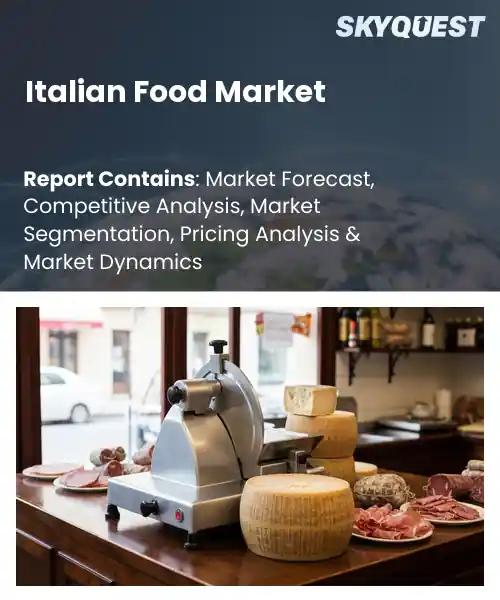
Italian Food Market
Report ID: SQMIG30I2969
Report ID: SQMIG30I2969
[email protected]
USA +1 351-333-4748
Report ID:
SQMIG30I2969 |
Region:
Global |
Published Date: June, 2026
Pages:
157
|Tables:
153
|Figures:
78


Global Italian Food Market size was valued at USD 311.1 Billion in 2024 and is poised to grow from USD 333.19 Billion in 2025 to USD 576.78 Billion by 2033, growing at a CAGR of 7.1% during the forecast period (2026-2033).
The Italian foods industry consists of producers, distributors, and restaurateurs supplying everything from pasta dishes to high-quality cheese domestically and internationally. This industry is important because of the prestige associated with the Mediterranean taste, resulting in high prices and encouraging expenditure on tourism. What caused the recent growth of this industry? It is related to the growing desire of consumers around the world to have authentic, health-related foods. During the past 20 years, this desire has caused an increase in export volume by 45%. This fact could be proven by increased exports of Parmigiano Reggiano cheese to North America and fast growth of online sales of artisan dry pasta.
On the basis of the positive export trend, it can be said that digitalization is the pivotal element which will transform the Italian food industry, opening opportunities for artisanal and multinational businesses. The development of e-commerce systems will allow producers to target their products at consumers who value authenticity of local cuisine, and data-driven logistics will minimize losses and cut expenses, thus making it possible for them to enter new markets like Southeast Asia. As a result, companies which are willing to develop tracking and virtual sampling technologies managed to obtain profits, exemplified by a company which used QR coding for marketing farm-to-table stories and obtained 12 % sales growth in the Chinese online channel.
How is AI Influencing Product Personalization Trends in the Italian Food Market?
AI is changing the way products are personalized in the food industry of Italy through the conversion of information into personal experiences. Machine-learning systems study the tastes of consumers, their purchasing behavior, and regional preferences, helping brands to offer personalized dishes, personalize the blend of ingredients, and change the packaging according to the occasion. The restaurant industry makes use of artificial intelligence to make menu changes according to the season and the prevailing flavors of the region, and manufacturers incorporate intelligent algorithms in their e-commerce portals to give personalized meal kits. The change will help the industry move from standardized products to personalized solutions to foster brand loyalty and capture specialized demands.Barilla, April 2024, has launched a recipe generator through the power of artificial intelligence based on dietary behaviors of individuals.
Market snapshot - (2026-2033)
Global Market Size
USD 311.1 Billion
Largest Segment
Pasta & Noodles
Fastest Growth
Bakery & Confectionery Products
Growth Rate
7.1% CAGR
To get more insights on this market click here to Request a Free Sample Report
Global italian food market is segmented by product type, distribution channel, category, end user, price range and region. Based on product type, the market is segmented into Pasta & Noodles, Pizza & Pizza Ingredients, Sauces, Dressings & Condiments, Bakery & Confectionery Products, Dairy & Cheese Products and Others. Based on distribution channel, the market is segmented into Supermarkets & Hypermarkets, Convenience Stores, Specialty Food Stores, Online Retail, Foodservice Channels and Others. Based on category, the market is segmented into Packaged Italian Food, Fresh Italian Food and Frozen Italian Food. Based on end user, the market is segmented into Household Consumers, Restaurants & Pizzerias, Hotels & Catering Services, Institutional Buyers and Others. Based on price range, the market is segmented into Economy, Mid-Range and Premium. Based on region, the market is segmented into North America, Europe, Asia Pacific, Latin America and Middle East & Africa.
Pasta & Noodles sub-segment leads due to the extent to which it has become part and parcel of daily meals due to the high versatility associated with it, thus catering to the needs of different consumers. The association that the sub-segment has with the Italian food culture keeps up the demand in households and food services as well. It is consumed for its simplicity, long shelf life, and pairing abilities with different types of sauces.
Pizza & Pizza Ingredients sub-segment becomes the most dynamically growing segment as a result of the growing numbers of artisanal and specialty pizza places focusing on making good quality crusts with novel toppings and dough recipes. The demand for regional tastes and healthy ingredients among consumers leads to innovations and consequent growth of the market and development of brand differentiation.
The Supermarkets & Hypermarkets segment holds an advantageous position due to its extensive product mix, which ensures availability of both traditional and contemporary Italian foods. These outlets have developed a network of distribution channels and effective brand collaborations, which help in maintaining shelf space and promotion activities. The consumers are offered affordable prices and convenience, which makes these outlets the center of food purchases.
In contrast, the Online Retail segment is growing at a rapid pace on account of the digital savviness of consumers and the convenience of delivery of fresh and exotic Italian foods. The online shopping websites provide recommendations and subscription services that cater to young consumers.
To get detailed segments analysis, Request a Free Sample Report
The influence of Europe is based on the cultural affinity towards the Mediterranean food, efficient retail systems, and the culinary traditions which coincide with those of Italy. The established trade ties and consumer knowledge about authentic food products result in higher demand in Europe. High premium status of the Italian brands along with well-developed distribution and presence of special food service companies add to the market depth. Besides, the culinary tourism and restaurants increase the exposure to the Italian cuisine.
Market for Italian Food Products in Germany has the advantage of having consumers with an experienced taste bud that is sensitive to artisanal processing and quality ingredients. The consumption of genuine pastas, cheeses, and cured meats is quite common among the population, and as such, there is increased importation of food products as well as adoption by local companies of the Italian method of production.
The market of Italian food in the United Kingdom is flourishing due to the long-lasting passion for Italian cuisine that is evidenced by a variety of restaurants and good provision of groceries. The British customers value high quality and origin, so the sellers strive to offer only high-quality Italian foods and even work with Italian producers directly. Also, the knowledge gained from culinary classes and the media contributes to this trend.
Italian Foods Market in France is supported by common cooking principles that emphasize regional tastes and craftsmanship. The French have no problem incorporating Italian pasta, olive oil, and cheeses into their daily cuisine as well as into haute cuisine. Chain stores provide special spaces in the shelves to place Italian foods, and chefs at high-end restaurants combine their skills to cook Italian dishes in the French style.
North American growth is fueled by greater consumer interest in foreign cuisine, increased preference for high-quality and health-oriented products, and an influential community that appreciates authentic Italian tastes. Retail outlets are creating special departments highlighting their foreign and artisanal products, while food service establishments are incorporating elements of Italian cuisine into different menu styles. Heritage, sustainability, and artisanal marketing stories appeal to consumers who are looking for experiences. The complementary power of e-commerce, media, and cultural events serves to further fuel the growth in the markets of both the US and Canada.
The Italian Food Market in the USA is widely exposed through its active restaurants and supermarkets. Americans prefer high-quality pasta, olive oil, and cheese products, hence the need by the retailers to buy from the Italian producers directly. The role of the celebrity chefs and cooking television shows is also important in increasing the demand for the food products, together with the food service companies presenting authentic Italian cuisine.
Italian Food Market in Canada is an example of a diverse palate where the taste buds accept Mediterranean flavors as well as their own flavors. The people of Canada like high-quality products with a good history, so the retailers provide them with selected Italian products. In the foodservice business, there are menus inspired by Italian food and even regional cuisines are highlighted in festivals.
The rise of Asia Pacific is propelled by increasing interest in global cuisine, the emergence of an affluent middle-class population and increased awareness of the quality of premium imported food products. The teaching of cuisine and media coverage expose people to cooking methods and ingredients of Italy; consequently, this leads individuals to cook using the recipes of the country in their homes as well as the use of recipes by professional cooks. Supermarkets are increasingly reserving spaces within them to stock up Italian foods. Innovative food service concepts have been created to incorporate Italian dishes into regional cuisines, which increases the consumption of such products in the region.
The Italian Food Market in Japan is distinguished by the fact that its consumers are sophisticated and value craftsmanship and authentic tastes. Consumers of the country often look for high-quality pasta, cheese, and ham products, which forces retailers to create special zones for products made in Italy. Cooking schools and TV channels often demonstrate Italian recipes, and even luxury restaurants use Italian cuisine on their menus.
The market for Italian foods in South Korea is advantaged by the presence of an energetic food culture that has an open-minded attitude towards international foods, especially those of the Mediterranean region. The South Korean population has displayed a keen interest in high-quality Italian foods like olive oil, pasta, and cheese, thereby encouraging the importers to increase their product range. In the food service industry, restaurants have been trying out Italian dishes with local flavors added to them.
To know more about the market opportunities by region and country, click here to
Buy The Complete Report
Rising Global Demand for Authentic Cuisine
The increasing interest in genuine flavors of Italy all over the world leads to increasing assortments of products and innovation of traditional recipes on the part of producers. The emerging interest is reflected in the increased popularity of gourmet pasta, olive oil, and cured meat. Such products require the use of authentic ingredients and special branding strategies. With the growth of cultural interests, the experience of eating becomes one of the important differentiating factors in hospitality as well as in home cuisine.
Expansion of Health‑Focused Product Lines
Increasing interest in health and wellbeing leads manufacturers to adapt classic Italian products with lower salt content, natural additives, and more nutritious whole grains. Such an approach makes products appealing to those consumers interested in health issues but still wanting to enjoy genuine flavors, resulting in fortified pastas, protein cheeses, and fat-free sauces appearing on the store shelf. Thus, a combination of culinary traditions and modern dietary needs helps companies attract new customers, gain their loyalty, and increase sales.
Stringent Import Regulations and Tariffs
The complex process involved in customs clearance and the high import duties discourage small and medium sized firms from using premium-quality materials sourced from other countries, leading to use of substitutes which may not help build brands. It becomes difficult for retail companies to provide genuine products, and the consumer is faced with high prices, which can have a dampening effect on demand growth. The uncertainty regarding regulations makes investment decisions more difficult.
Limited Supply Chain Transparency
A lack of visibility in relation to the source and production of foods makes it difficult for brands to prove that their products are authentic and sustainable, thus reducing consumer confidence. Where there is a lack of traceability, fears will emerge about the quality of ingredients, the likelihood of adulteration and compliance with ethical practices, causing consumers to prefer other cuisines that they feel more confident about. This will make it difficult for brands to distinguish themselves, resulting in a lack of premium pricing and slow market adoption.
Request Free Customization of this report to help us to meet your business objectives.
The competitive environment is determined by the high level of M&A deals like the acquisitions of the regional brands by the multinational food companies, collaborations between Italian producers and the global logistics networks, and fast adoption of the AI-enabled systems for restaurant operations, which help to improve ordering and stock management processes.
Premium Authenticity Demand: Consumers are becoming increasingly more concerned with authentic regional flavors and artisan craftsmanship, leading companies to emphasize the origin of their products and traditional recipes. Companies react by using ingredients from designated geographic areas, working with small-scale farmers, and telling stories about the heritage and terroir of their products. This approach raises the level of positioning and allows premium pricing, while also building brand loyalty among sophisticated consumers who appreciate authentic cuisine over convenience.
Health‑Forward Ingredient Innovation: Increasing consciousness about nutrition and health is pushing the food companies to rethink their traditional recipes using reduced sodium content, plant-based, and functional ingredients without compromising taste. They are conducting R&D to include super foods like pulses, heirloom grains, and fortified olive oil that will offer additional health benefits. This trend promotes diversity in menus, clean label claims, and is associated with the consumers' quest for balanced diets making Italian cuisine a gateway to not only pleasure but also health in today's lifestyle.
SkyQuest’s ABIRAW (Advanced Business Intelligence, Research & Analysis Wing) is our Business Information Services team that Collects, Collates, Correlates, and Analyses the Data collected by means of Primary Exploratory Research backed by robust Secondary Desk research.
As per SkyQuest analysis, the global italian food industry is driven mainly by an increasing demand for real cuisine on the international front, driving further product range growth and higher prices, while a second major driver of the industry is provided by the increased range of health-oriented products combining traditional values and nutrition. Europe is the leading geographical region of the industry, utilizing a strong cultural connection and effective retail networks, whereas the pasta & noodles sub-segment represents the backbone of the industry, driven by the routine usage and variety. However, industry growth is limited by heavy import regulations.
| Report Metric | Details |
|---|---|
| Market size value in 2024 | USD 311.1 Billion |
| Market size value in 2033 | USD 576.78 Billion |
| Growth Rate | 7.1% |
| Base year | 2024 |
| Forecast period | (2026-2033) |
| Forecast Unit (Value) | USD Billion |
| Segments covered |
|
| Regions covered | North America (US, Canada), Europe (Germany, France, United Kingdom, Italy, Spain, Rest of Europe), Asia Pacific (China, India, Japan, Rest of Asia-Pacific), Latin America (Brazil, Rest of Latin America), Middle East & Africa (South Africa, GCC Countries, Rest of MEA) |
| Companies covered |
|
| Customization scope | Free report customization with purchase. Customization includes:-
|
To get a free trial access to our platform which is a one stop solution for all your data requirements for quicker decision making. This platform allows you to compare markets, competitors who are prominent in the market, and mega trends that are influencing the dynamics in the market. Also, get access to detailed SkyQuest exclusive matrix.
Table Of Content
Executive Summary
Market overview
Parent Market Analysis
Market overview
Market size
KEY MARKET INSIGHTS
COVID IMPACT
MARKET DYNAMICS & OUTLOOK
Market Size by Region
KEY COMPANY PROFILES
Methodology
For the Italian Food Market, our research methodology involved a mixture of primary and secondary data sources. Key steps involved in the research process are listed below:
1. Information Procurement: This stage involved the procurement of Market data or related information via primary and secondary sources. The various secondary sources used included various company websites, annual reports, trade databases, and paid databases such as Hoover's, Bloomberg Business, Factiva, and Avention. Our team did 45 primary interactions Globally which included several stakeholders such as manufacturers, customers, key opinion leaders, etc. Overall, information procurement was one of the most extensive stages in our research process.
2. Information Analysis: This step involved triangulation of data through bottom-up and top-down approaches to estimate and validate the total size and future estimate of the Italian Food Market.
3. Report Formulation: The final step entailed the placement of data points in appropriate Market spaces in an attempt to deduce viable conclusions.
4. Validation & Publishing: Validation is the most important step in the process. Validation & re-validation via an intricately designed process helped us finalize data points to be used for final calculations. The final Market estimates and forecasts were then aligned and sent to our panel of industry experts for validation of data. Once the validation was done the report was sent to our Quality Assurance team to ensure adherence to style guides, consistency & design.
Analyst Support
Customization Options
With the given market data, our dedicated team of analysts can offer you the following customization options are available for the Italian Food Market:
Product Analysis: Product matrix, which offers a detailed comparison of the product portfolio of companies.
Regional Analysis: Further analysis of the Italian Food Market for additional countries.
Competitive Analysis: Detailed analysis and profiling of additional Market players & comparative analysis of competitive products.
Go to Market Strategy: Find the high-growth channels to invest your marketing efforts and increase your customer base.
Innovation Mapping: Identify racial solutions and innovation, connected to deep ecosystems of innovators, start-ups, academics, and strategic partners.
Category Intelligence: Customized intelligence that is relevant to their supply Markets will enable them to make smarter sourcing decisions and improve their category management.
Public Company Transcript Analysis: To improve the investment performance by generating new alpha and making better-informed decisions.
Social Media Listening: To analyze the conversations and trends happening not just around your brand, but around your industry as a whole, and use those insights to make better Marketing decisions.
REQUEST FOR SAMPLE
 REQUEST FREE CUSTOMIZATION
Global Italian Food Market size was valued at USD 311.1 Billion in 2024 and is poised to grow from USD 333.19 Billion in 2025 to USD 576.78 Billion by 2033, growing at a CAGR of 7.1% during the forecast period (2026-2033).
The competitive landscape is shaped by aggressive M&A activity such as the acquisition of regional specialty brands by multinational food groups, strategic partnerships linking Italian producers with global distribution networks, and rapid adoption of AI‑driven restaurant operating systems that streamline ordering and inventory management, exemplified by recent European roll‑outs targeting Italian chains. These moves intensify competition while accelerating product innovation and market reach. 'Barilla Group', 'Ferrero Group', 'Parmalat S.p.A.', 'Lavazza Group', 'Mutti S.p.A.', 'De Cecco', 'Eataly S.r.l.', 'Galbani (Lactalis Group)', 'Rana Group', 'Divella S.p.A.', 'Buitoni (Nestlé)', 'Dr. Oetker', 'Kraft Heinz Company', 'Conagra Brands, Inc.', 'General Mills, Inc.', 'Campbell Soup Company', 'Unilever PLC', 'Nestlé S.A.', 'Lactalis Group', 'Bauli Group'
Consumers worldwide increasingly seek authentic Italian flavors, driving retailers to expand product assortments and encouraging manufacturers to innovate traditional recipes. This shifting palate elevates demand for premium pasta, olive oil, and cured meats, prompting investments in sourcing authentic ingredients and enhancing branding that emphasizes heritage. As cultural curiosity grows, culinary experiences become a key differentiator in hospitality and home cooking, reinforcing a cycle where heightened visibility sustains robust market expansion and fosters continual product development across global distribution channels and platforms.
Premium Authenticity Demand: Consumers are increasingly seeking genuine regional flavors and artisanal craftsmanship, driving manufacturers to highlight provenance, traditional recipes, and heritage certifications. Brands are responding by sourcing ingredients from protected geographic areas, collaborating with small‑scale producers, and storytelling that emphasizes lineage and terroir. This shift elevates product positioning, encourages premium pricing, and reinforces brand loyalty among discerning diners who value cultural authenticity over convenience, reshaping marketing strategies across the Italian food landscape and fostering long‑term partnerships with local farms for sustainable growth.
Why does Europe Dominate the Global Italian Food Market? |@12


Want to customize this report? This report can be personalized according to your needs. Our analysts and industry experts will work directly with you to understand your requirements and provide you with customized data in a short amount of time. We offer $1000 worth of FREE customization at the time of purchase.
Feedback From Our Clients


 USA (+1) 351-333-4748

