Isotope-Labeled Excipient Market
Report ID: SQMIG35J2244
Report ID: SQMIG35J2244
[email protected]
USA +1 351-333-4748
Report ID:
SQMIG35J2244 |
Region:
Global |
Published Date: March, 2026
Pages:
157
|Tables:
119
|Figures:
77


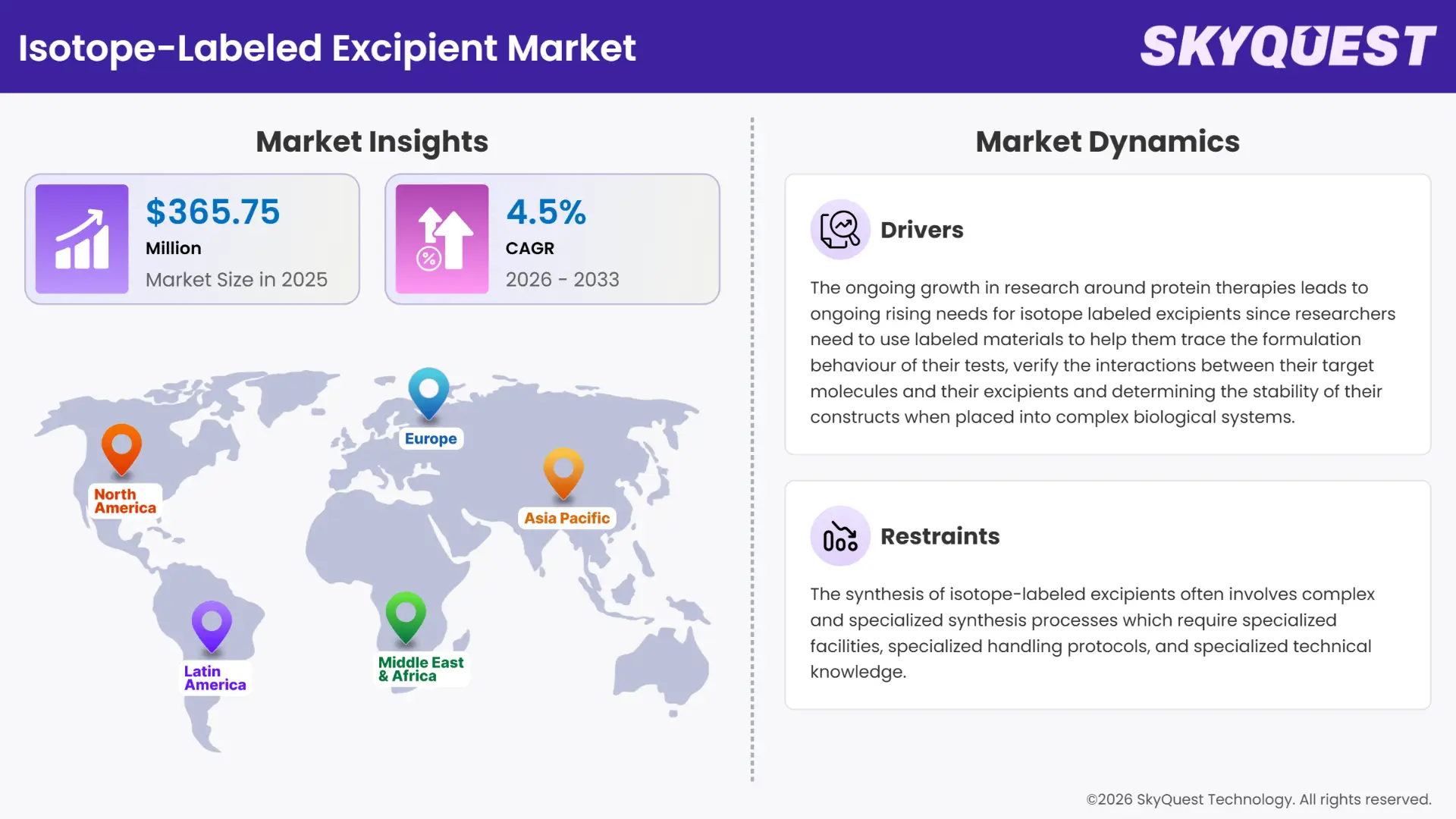
Global Isotope-Labeled Excipient Market size was valued at USD 350.0 Million in 2024 and is poised to grow from USD 365.75 Million in 2025 to USD 520.13 Million by 2033, growing at a CAGR of 4.5% during the forecast period (2026-2033).
Key Takeaways: Market Trends & Insights
Increased requests from the development and regulatory entities to characterize excipients for the purposes of reducing risks of formulation development and establishing similarities between biosimilars have led to the more widespread acceptance of excipient profiling.
The availability of high-resolution mass spectrometers as a common analytical tool has significantly increased as tracers to track the bioavailability of drugs (example: deuterated sorbitol and 13C mannitol used to trace the rate and degree of intestinal absorption). Also, as manufacturers and contract developers of drugs continue to require a more thorough characterization of the excipients used in conjunction with the production of drugs. They are investing heavily in the manufacture of labelled excipients and their associated complex manufacturing processes to develop a larger base of suppliers.
As the volume of production increases, the price per unit of the labelled excipient decreases and the availability of such compounds increases helping to drive increased utilization of these compounds in research studies aimed at obtaining data to support microdosing, stability testing, and use as a tracer.
The success of some cases, such as a contract development manufacturing organization (CDMO) that successfully used deuterated excipients to determine drug clearance values as they relate to immunogenicity assessment. The isotope-labeled excipient market trends reflect a strong upward growth trajectory, driven by increasing reliance on advanced pharmaceutical research and precision medicine approaches.
How is AI Improving Traceability in the Isotope-labeled Excipient Market?
Traceability refers to the creation of records that establish where the excipients were derived from, consider the batch history of the excipients, analytically identify the excipients, and document the chain of custody for specialized excipients used in drug development and quality control. Additionally, artificial intelligence provides value by analyzing more complicated spectral outputs (mass spectral and NMR spectral) to confirm isotopic signatures, by relating the laboratory analytics associated with the excipients to the manufacturing and logistics records related to the excipients and detecting real-time anomalies.
In a rapidly changing market propelled by developments in personalized medicine and increasing regulations, artificial intelligence decreases the time required to resolve deviations, enhances the detection of counterfeits, and optimizes compliance. An example of the value of artificial intelligence in traceability includes those models that can identify atypical spectral patterns and platforms that combine laboratory data and supply chain data for faster root-cause analysis.
For instance, ASP Isotopes announced a supply agreement in June 2025 that improved the availability of a critical isotope supply and highlighted the importance of traceable supply chains. The combination of the securing of this supply with artificial intelligence-driven traceability tools allows manufacturers to automate the verification of the origin of the excipients, streamline the reporting of regulatory compliance, and promote wider adoption of isotope labeled excipients for both research and clinical production.
To get more insights on this market click here to Request a Free Sample Report
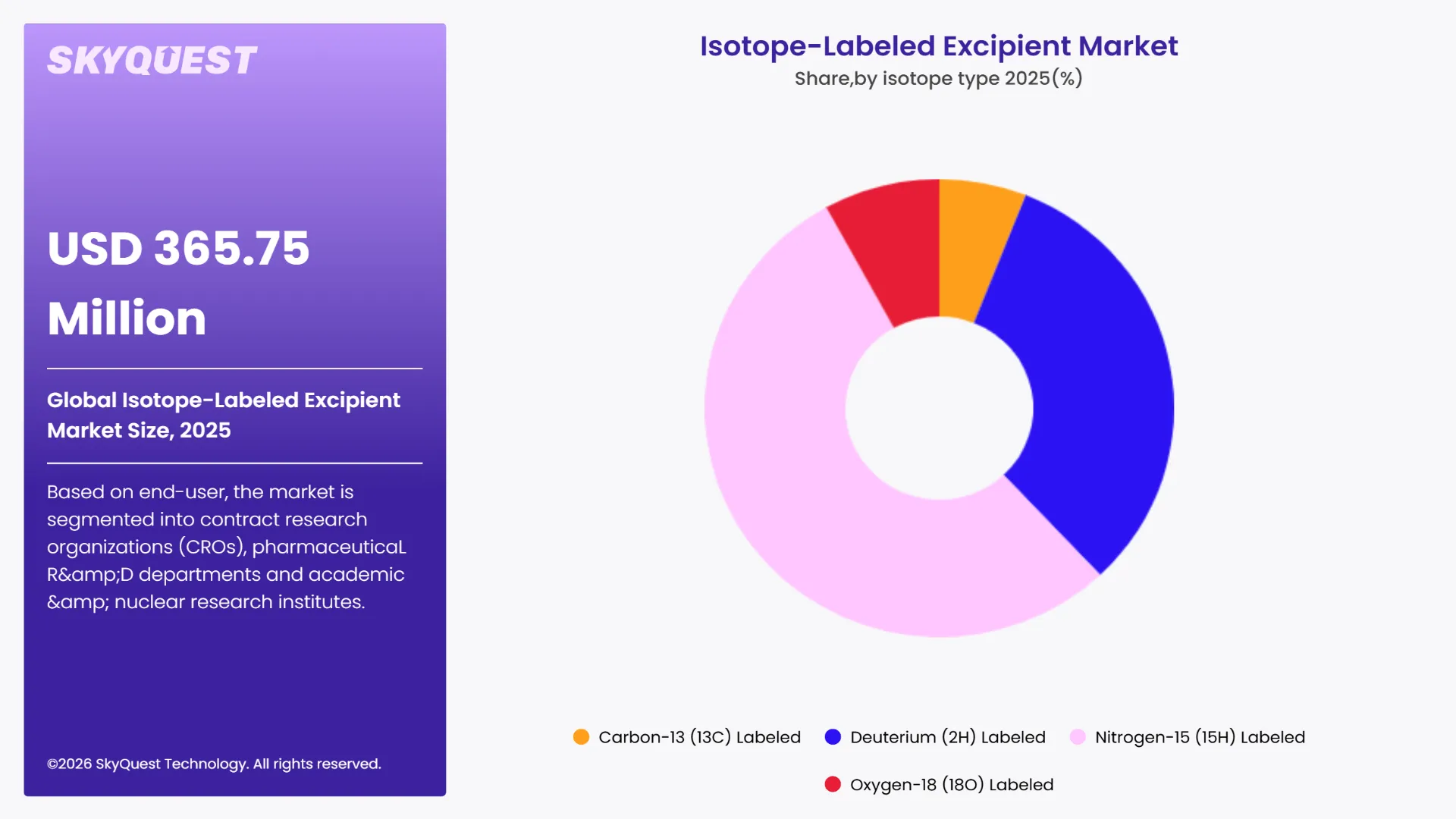
Global isotope-labeled excipient market is segmented into isotope type, excipient category, application/research use, end-user and region. Based on isotope type, the market is segmented into carbon-13 (13C) labeled, deuterium (2H) labeled, nitrogen-15 (15H) labeled and oxygen-18 (18O) labeled. Based on excipient category, the market is segmented into labeled sugars/carbohydrates, labeled lipids & fatty acids and labeled amino acids & polymers. Based on application/research use, the market is segmented into ADME studies, bioavailability & bioequivalence testing, tracer studies in clinical trials and diagnostic imaging & metabolic profiling.
Based on end-user, the market is segmented into contract research organizations (CROs), pharmaceuticaL R&D departments and academic & nuclear research institutes. Based on region, the market is segmented into North America, Europe, Asia Pacific, Latin America and Middle East & Africa.
The labeled sugars/carbohydrates segment with large isotope-labeled excipients market share continues to dominate due to their biochemical compatibility with core metabolic processes, which gives them a strong preference as tracers versus other isotopically labeled excipients. Additionally, their structurally similar composition to native substrates provides an insight into their expected metabolic fates (i.e., the ability to accurately interpret tracer kinetics and pathways).
A variety of current synthesis techniques are being used to synthesize labeled sugars and carbohydrates, and a variety of analytical methods are being used to characterize their metabolic fates, which minimize the risk of failure during development and friction associated with integrating into existing workflows. Therefore, researchers and service providers engaged in metabolic profiling and ADME characterizations are using more labeled sugars and carbohydrates as a tracer tool.
As per global isotope-labeled excipient market forecast, the labeled lipids & fatty acids segment is growing rapidly due to increased interest in lipidomic and metabolic disease research that is focused on developing targeted tracers. The advancements made in both labeling chemistry and analytical sensitivity have also led to increasing numbers of applications within the areas of imaging and metabolic flux studies, creating increased demand for research groups investigating membrane dynamics.
As per global isotope-labeled excipient market analysis, the carbon-13(13C) labeled segment's stability, as a stable isotope, along with its strong visibility within the field of mass spectrometry and NMR, makes it the preferred choice for the ADME (absorption, distribution, metabolism, excretion) segment of the isotope-labelled excipient market. Minimal isotopic perturbation allows Carbon-13 to maintain the native pharmacokinetic properties of a drug while allowing for precise tracking of metabolic transformations (creating a better understanding of drug outcomes). Using well established analytical protocols and scalable synthesis methods increases the level of technical access to ADME studies and as such creates a greater opportunity for pharmaceutical developers and analytical service providers who are seeking dependable tracer resources.
As per global isotope-labeled excipient market outlook, deuterium (2H) labelled excipients are the fastest growing segment of isotope labelled excipients because there are fewer synthetic steps required for their production and due to their growing use in both lipid tracing and metabolic flux studies. Confidence in the use of deuterated labelled excipients is on the rise, therefore contributing to the broad adoption of deuterated labelled excipients across the landscape of research and clinical studies and creating new opportunities for both formulation and analytical services.
To get detailed segments analysis, Request a Free Sample Report
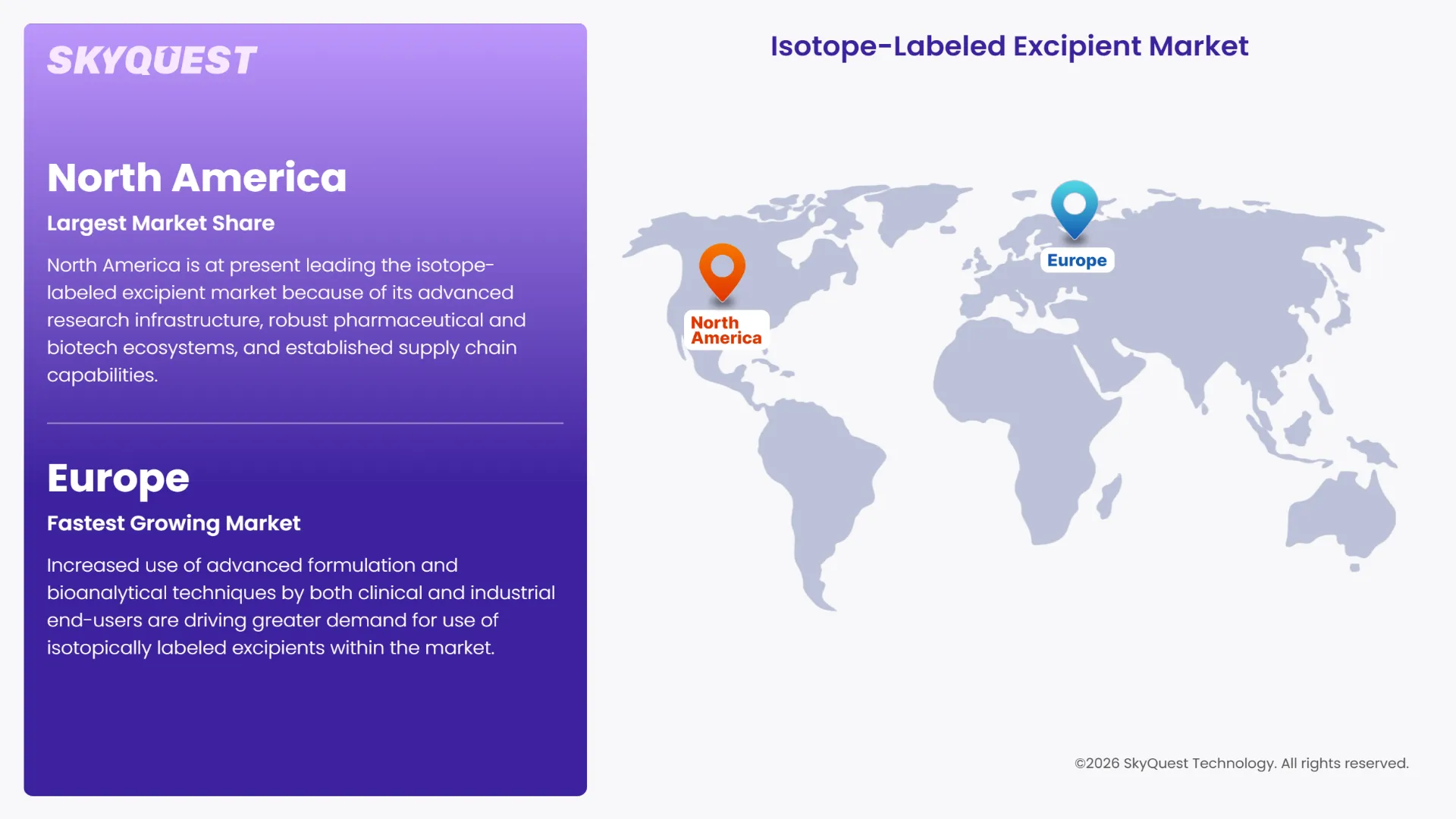
North America is at present leading the isotope-labeled excipient market because of its advanced research infrastructure, robust pharmaceutical and biotech ecosystems, and established supply chain capabilities. Innovation in the development of novel and more effective methods and processes for approval of products by regulatory agencies through the use of isotopes has been supported by a high level of collaboration between academic institutions.
The U.S. isotope-labeled excipient market benefits from having a large number of pharmaceutical developers, advanced analytical laboratories, and contract service providers that all favor the use of isotopes for formulation and bioanalytical purposes. Additionally, well-coordinated academic and industry collaboration will aid in the development of method validation, while a regulatory framework and procurement infrastructure have been developed to ensure that quality standards are met when sourcing materials or developing custom compounds.
The Canada isotope-labeled excipient market is experiencing significant growth as a result of developing clusters of specialty chemical suppliers, academic and research institutions, and contract research organizations that are focused on developing applications of isotope-labeled methodologies. Partnerships between Canadian producers and multinational firms will enhance the ability to develop custom labels and provide analytical services, while a good reputation for quality control, compliance with regulatory agencies, and have available skilled labor will enable Canadian firms to supply manufactures of pharmaceuticals.
Rapid growth in Europe can be attributed to a combination of technology leadership, a solid regulatory framework providing opportunities for rigorous analytics, and a strong manufacturing base within the pharmaceutical industry. The core of this regional capability lies in Germany where mature specialty chemical manufacturing is coupled with applied research to support complex work methods related to labeling workflows. In addition, there are regional 'hubs' throughout Europe to facilitate the commercialization and distribution of the manufactured product.
Increased use of advanced formulation and bioanalytical techniques by both clinical and industrial end-users are driving greater demand for use of isotopically labeled excipients within the market. Collaborative networks among academic institutions, contract research organizations, and custom synthesis suppliers are quickly accelerating the transfer of methods and scale-up capacity from developed countries to developing countries.
The isotope-labeled excipient market is driven by the availability of industrial chemistry skill sets, the number of specialty manufacturers, and applied research institutes that are focused on the development of labeled compounds, all of which support the commercial viability of their production. The synergy between these three distinct areas creates favourable conditions for companies to partner with each other to establish a successful formulation and validate analytical procedures. In addition, because there are many contract research organizations and logistics companies located within proximity of one another facilitates the timely delivery of product. The focus on precision, regulatory compliance, and technical know-how has allowed for Germany to become a major regional hub for high-quality isotopically labeled excipients and services.
In the UK, the isotope-labeled excipient market benefits from a variety of translational research centres, contract research organizations with cutting-edge capabilities, and an ever-increasing demand for sophisticated analytical techniques. The combination of the flexibility afforded by innovative approaches to labelling and strong collaborations between academia and industry facilitates the development and commercialization of new and more effective methods. Additionally, the ability to provide highly developed custom synthesis and analytical services through the extensive supply chain network serves to enhance the ability to support complex formulation programs and attract global partnerships.
As per global isotope-labeled excipient industry analysis, in France, the market is developing through significant investments into analytical sciences, expanding contract research capabilities and specialized chemistry knowledge that provides the basis for isotopic labelling. The partnerships between academic institutions and niche manufacturers provide sufficient opportunity to provide customized synthesis and to develop new methods of formulation and bioanalytical support. Additionally, the emphasis placed on quality assurance, regulatory compliance with EU standards, and localized support provide the basis for success when leveraging the capabilities of academic and commercial organizations to support domestic customers and to engage in international collaborative projects with international partners.
As per the global isotope-labeled excipient market regional outlook, the position of Asia Pacific is becoming increasingly strong due to new technologies in industrial modernization, growth in analytical capabilities, and strategic investments in specialty chemical production. The growing maturity of the contract research organization (CRO) and contract manufacturing (CMO) sectors are also helping to support the domestic market demand for isotopically labeled excipients and creating additional regional sources for the supply of isotopically labeled excipients. Additionally, the establishment of partnerships between academic institutions and industry enables methods to be transferred, and local market adaptation of synthetic scale production to take place.
As per global isotope-labeled excipient market forecast, Japan combines advanced analytical sciences with precision chemical manufacturing and collaboration between academic research and industry. The capabilities in isotopic methods support the sophisticated labeling of products, as well as stringent methods of quality control that comply with the regulatory requirements. Specialized contract manufacturing companies and analytical service providers enhance the ability for customized synthesis and validated manufacturing methods to take place. The high level of technical excellence and supply chain integrity in Japan have positioned the country as a leading source of complex, isotopically labeled excipients for global drug development.
The isotope-labeled excipient market in South Korea continues to expand through the development of biotech research, contract manufacturing ability, and analytical infrastructure. Collaborations between industry and academic institutions are contributing to the transfer of technology and development of methods for isotopic labeling and bioanalysis. The presence of local specialty chemical companies providing custom synthesis support is increasing, while the logistics and quality systems are being improved to enhance supply chain reliability.
To know more about the market opportunities by region and country, click here to
Buy The Complete Report
Expansion of Protein Therapeutics Research
Improvements In Analytical Technologies
Complexity of Isotope Production
Regulatory and Quality Challenges
Request Free Customization of this report to help us to meet your business objectives.
Increased competition in the globally market results from a growing awareness of supply chain security and demand for verified product labels. The result has been an uptick in merger and acquisition activity of isotopes including Thermo Fisher’s purchase of a radiation focused isotope labelled company and agreements for large partnerships such as Eckert and Ziegler with various peptide manufacturers. Similarly, companies with a focus on specialty isotopes are investing in breakthrough production methods (i.e. microwave-assisted synthesis) to decrease cost and expand the variety of products available.
SkyQuest’s ABIRAW (Advanced Business Intelligence, Research & Analysis Wing) is our Business Information Services team that Collects, Collates, Correlates, and Analyses the Data collected by means of Primary Exploratory Research backed by robust Secondary Desk research.
As per SkyQuest analysis, the global isotope-labeled excipient industry is driven primarily by rising demand for tracer compounds to support ADME and formulation studies, with a secondary driver being rapid advances in analytical technologies that improve detection and traceability. Global isotope-labeled excipient market growth is tempered by the complexity of isotope production, which constrains scale-up and supply reliability. North America remains the dominant regional market due to its advanced research infrastructure and strong pharma ecosystem while labeled sugars and carbohydrates lead penetration as the preferred tracers for metabolic and ADME work. Continued partnerships between isotope suppliers, CDMOs and analytical labs will be pivotal to broaden adoption and reduce cost barriers.
| Report Metric | Details |
|---|---|
| Market size value in 2024 | USD 350.0 Million |
| Market size value in 2033 | USD 520.13 Million |
| Growth Rate | 4.5% |
| Base year | 2024 |
| Forecast period | 2026-2033 |
| Forecast Unit (Value) | USD Million |
| Segments covered |
|
| Regions covered | North America (US, Canada), Europe (Germany, France, United Kingdom, Italy, Spain, Rest of Europe), Asia Pacific (China, India, Japan, Rest of Asia-Pacific), Latin America (Brazil, Rest of Latin America), Middle East & Africa (South Africa, GCC Countries, Rest of MEA) |
| Companies covered |
|
| Customization scope | Free report customization with purchase. Customization includes:-
|
To get a free trial access to our platform which is a one stop solution for all your data requirements for quicker decision making. This platform allows you to compare markets, competitors who are prominent in the market, and mega trends that are influencing the dynamics in the market. Also, get access to detailed SkyQuest exclusive matrix.
Table Of Content
Executive Summary
Market overview
Parent Market Analysis
Market overview
Market size
KEY MARKET INSIGHTS
COVID IMPACT
MARKET DYNAMICS & OUTLOOK
Market Size by Region
KEY COMPANY PROFILES
Methodology
For the Isotope-Labeled Excipient Market, our research methodology involved a mixture of primary and secondary data sources. Key steps involved in the research process are listed below:
1. Information Procurement: This stage involved the procurement of Market data or related information via primary and secondary sources. The various secondary sources used included various company websites, annual reports, trade databases, and paid databases such as Hoover's, Bloomberg Business, Factiva, and Avention. Our team did 45 primary interactions Globally which included several stakeholders such as manufacturers, customers, key opinion leaders, etc. Overall, information procurement was one of the most extensive stages in our research process.
2. Information Analysis: This step involved triangulation of data through bottom-up and top-down approaches to estimate and validate the total size and future estimate of the Isotope-Labeled Excipient Market.
3. Report Formulation: The final step entailed the placement of data points in appropriate Market spaces in an attempt to deduce viable conclusions.
4. Validation & Publishing: Validation is the most important step in the process. Validation & re-validation via an intricately designed process helped us finalize data points to be used for final calculations. The final Market estimates and forecasts were then aligned and sent to our panel of industry experts for validation of data. Once the validation was done the report was sent to our Quality Assurance team to ensure adherence to style guides, consistency & design.
Analyst Support
Customization Options
With the given market data, our dedicated team of analysts can offer you the following customization options are available for the Isotope-Labeled Excipient Market:
Product Analysis: Product matrix, which offers a detailed comparison of the product portfolio of companies.
Regional Analysis: Further analysis of the Isotope-Labeled Excipient Market for additional countries.
Competitive Analysis: Detailed analysis and profiling of additional Market players & comparative analysis of competitive products.
Go to Market Strategy: Find the high-growth channels to invest your marketing efforts and increase your customer base.
Innovation Mapping: Identify racial solutions and innovation, connected to deep ecosystems of innovators, start-ups, academics, and strategic partners.
Category Intelligence: Customized intelligence that is relevant to their supply Markets will enable them to make smarter sourcing decisions and improve their category management.
Public Company Transcript Analysis: To improve the investment performance by generating new alpha and making better-informed decisions.
Social Media Listening: To analyze the conversations and trends happening not just around your brand, but around your industry as a whole, and use those insights to make better Marketing decisions.
REQUEST FOR SAMPLE
 REQUEST FREE CUSTOMIZATION
Global Isotope-Labeled Excipient Market size was valued at USD 350.0 Million in 2024 and is poised to grow from USD 365.75 Million in 2025 to USD 520.13 Million by 2033, growing at a CAGR of 4.5% during the forecast period (2026-2033).
Competitive pressure in the global isotope labeled excipient market is driven by demand for supply security and authenticated tracers, prompting acquisitions, targeted partnerships and process innovations. Large suppliers pursued strategic M&A, for example Thermo Fisher's acquisition of a specialist isotope labeling business, while Eckert and Ziegler formed partnerships with peptide developers; specialty firms invest in production breakthroughs such as microwave assisted synthesis to reduce costs and broaden product scope. 'Cambridge Isotope Laboratories, Inc.', 'Sigma-Aldrich', 'Taoglas', 'IsoSciences', 'Astatech', 'Eurisotopes', 'Eli Lilly and Company', 'Otsuka Pharmaceutical Co., Ltd.', 'PerkinElmer, Inc.', 'Chengdu Fuxing Industry Co., Ltd.', 'Ingenza Ltd.', 'Isotopically Enriched Chemicals', 'Icon Genetics GmbH', 'Njord Technologies AS', 'JSC Isotope', 'Ajinomoto Co., Inc.', 'Bracco Imaging S.p.A.', 'Life Science Analytics', 'Ampac Fine Chemicals', 'Carbosynth Limited'
The sustained expansion of protein therapeutics research increases demand for isotope labeled excipients because researchers rely on labeled compounds to trace formulation behavior, verify molecular interactions, and assess stability in complex biologic matrices. As more programs progress through discovery and preclinical development, formulation scientists increasingly incorporate labeled excipients to elucidate excipient and active interactions and to support analytical method development and validation. This practical reliance translates into stronger procurement needs from biopharma and contract development organizations seeking reliable labeled materials to support robust formulation science.
𝗣𝗿𝗲𝗰𝗶𝘀𝗶𝗼𝗻 𝗠𝗲𝗱𝗶𝗰𝗶𝗻𝗲 𝗜𝗻𝘁𝗲𝗴𝗿𝗮𝘁𝗶𝗼𝗻: Adoption of isotope-labeled excipients is increasingly aligned with precision medicine strategies, enabling targeted tracer studies and formulation optimization tailored to specific patient subgroups. Pharmaceutical developers are emphasizing labeled excipients to deconvolute complex pharmacokinetic and biodistribution questions during early and translational research. This trend fosters closer collaboration between excipient suppliers and clinical teams, accelerates candidate selection, and supports differentiated product positioning by demonstrating mechanistic clarity and safer, more effective formulations in niche therapeutic areas, while informing adaptive dosing strategies across programs.
North America dominates the global isotope-labeled excipient market due to strong pharmaceutical R&D, advanced healthcare infrastructure, presence of key players, high drug demand, and increasing adoption in clinical research and drug development.


Want to customize this report? This report can be personalized according to your needs. Our analysts and industry experts will work directly with you to understand your requirements and provide you with customized data in a short amount of time. We offer $1000 worth of FREE customization at the time of purchase.
Feedback From Our Clients


 USA (+1) 351-333-4748

