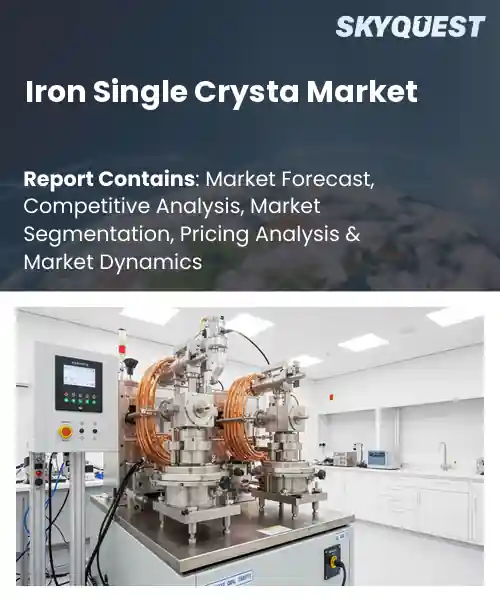
Iron Single Crysta Market
Report ID: SQMIG15J2249
Report ID: SQMIG15J2249
[email protected]
USA +1 351-333-4748
Report ID:
SQMIG15J2249 |
Region:
Global |
Published Date: August, 2026
Pages:
157
|Tables:
170
|Figures:
79


Global Iron Single Crysta Market size was valued at USD 384.2 Million in 2024 and is poised to grow from USD 433.38 Million in 2025 to USD 1135.9 Million by 2033, growing at a CAGR of 12.8% during the forecast period (2026-2033).
The global iron single crystal market centers on producing iron sheets used primarily in transformers and electric motors. Its importance stems from the material’s superior magnetic permeability and low core loss, which enable more efficient power conversion in renewable‑energy infrastructures. Historically, the market emerged in the early 2000s when Japanese and German firms demonstrated that single‑crystal processing could reduce hysteresis losses by up to 30 percent compared with conventional grain‑oriented steel. Since then, demand has risen alongside the expansion of grid projects and electric‑vehicle power‑train development, positioning iron single crystals as a pivotal component in the transition to low‑carbon technologies.
The principal catalyst driving the next phase of growth is the rising demand for efficient power converters in wind farms, where space and weight constraints favor magnetic cores. As turbine capacities climb to ten megawatts, manufacturers adopt iron single‑crystal cores to cut core losses, thereby increasing capacity factor and reducing levelized cost of electricity. This advantage triggers a cascade of market effects: utilities allocate budgets for retrofit projects, component suppliers expand production capacity, and investors fund alloy optimization to improve tolerance. Consequently, the sector witnesses growing orders from European consortiums and Asian OEMs, unlocking a multi‑billion‑dollar revenue window through 2035.
How is AI-driven process automation influencing the Iron single crystal market?
Process automation with AI helps to improve the quality and reproducibility of the iron single crystals by providing more accurate control of growth conditions of the crystals. Machine learning algorithms allow analyzing such process parameters as temperature, geometry of the melt, heating power, growth rate, etc., and optimizing them to reduce the necessity for manual actions. There have been studies on the crystal growth by the floating zone technique, which have shown that reinforcement learning allows automatic adjusting of the process parameters and following the necessary trajectory of the crystal growth better than the classical methods involving human operators.
Computer vision and real-time monitoring with the help of AI technologies also allow monitoring crystal diameter and melt height, which helps to control the growth process in order to prevent any defects, melt instability, and non-reproducible crystal size. In addition, AI makes it possible to conduct predictive modeling, virtual experiments, and closed-loop optimization, decreasing the number of physical trials necessary for selecting the optimal growth conditions.
Market snapshot - (2026-2033)
Global Market Size
USD 384.2 Million
Largest Segment
High Purity
Fastest Growth
Ultra-High Purity
Growth Rate
12.8% CAGR
To get more insights on this market click here to Request a Free Sample Report
Global iron single crysta market is segmented by crystal purity, production method, application, end user, form, sales channel and region. Based on crystal purity, the market is segmented into High Purity and Ultra-High Purity. Based on production method, the market is segmented into Bridgman Method, Floating Zone Method and Others. Based on application, the market is segmented into Scientific Research, Magnetic Materials, Electronics and Others. Based on end user, the market is segmented into Research Institutes, Universities and Industrial Laboratories. Based on form, the market is segmented into Rod, Block and Others. Based on sales channel, the market is segmented into Direct Sales and Distributors. Based on region, the market is segmented into North America, Europe, Asia Pacific, Latin America and Middle East & Africa.
Ultra High purity segment dominates because customers in the iron single crystal market demand crystal lattices with minimal defect density to achieve superior magnetic and electronic performance. The stringent quality expectations of scientific research and advanced industrial applications push suppliers to invest in refined purification techniques, ensuring consistent compositional uniformity. This focus on defect free material drives purchasing decisions, reinforcing the premium status of ultra high purity offerings.
However, high purity segment emerges as the most rapidly expanding area because emerging academic programs and mid scale device manufacturers are adopting iron single crystals for prototyping. The relative cost advantage and sufficient performance for early stage research stimulate broader uptake, creating momentum that expands the overall market and opens new collaborative opportunities.
Floating Zone Method segment dominates because its crucible free environment eliminates contamination, delivering crystals with exceptional structural integrity. Researchers and manufacturers value the ability to produce long continuous ingots with uniform composition, which directly enhances magnetic and electronic characteristics. The method’s inherent precision aligns with the market’s emphasis on reliability, prompting buyers to prioritize suppliers mastering this technique.
Meanwhile, Bridgman Method segment is witnessing the strongest growth momentum as manufacturers seek cost effective routes for scaling production. The simplicity of directional solidification and compatibility with existing furnace infrastructure reduce capital investment, attracting mid size factories. This economic appeal drives adoption across emerging applications, accelerating market expansion and prompting equipment suppliers to enhance process controls for higher yield.
To get detailed segments analysis, Request a Free Sample Report
Asia Pacific is the leading geographical segment in terms of the growth of the iron single crystal market on account of the convergence of sophisticated production methods, an integrated chain of logistics operations, and policies that support the production of high-quality metals. There is a well-established base of knowledge in the region along with the presence of precision engineering that enables the advancement in the crystallization process. Proximity of mineral resource locations to the processing facilities helps in making the logistics process simpler. Research collaborations between academics and industries ensure the transfer of technology quickly, while customer demand for high performance alloy products drives the market forward. The trade policies in the region make it easier for manufacturers to transport intermediates from one place to another.
Iron Single Crysta Market in Japan is shaped by a longstanding emphasis on precision metallurgy and a sophisticated industrial base that prioritizes quality over volume. Close collaboration between leading research institutes and major producers accelerates process refinement, while stringent environmental guidelines drive the adoption of cleaner crystallization techniques. Domestic demand from high‑value sectors such as aerospace and advanced electronics sustains a continuous push for higher purity standards.
Iron Single Crysta Market in South Korea benefits from a strong focus on industrial innovation and a well‑integrated supply chain that links raw material extraction to downstream alloy fabrication. Government‑backed research programs emphasize the development of energy‑efficient crystallization methods, enhancing competitiveness in global export markets. The rapid growth of electric vehicle production and renewable energy infrastructure creates a steady appetite for high‑grade iron crystals, reinforcing the sector’s strategic importance.
Iron crystals single market in Europe has been driven by a combination of strict regulatory environments, advanced technology in manufacturing industries and increased focus on sustainability in important industrial sectors. Circular economy policies practiced in Europe promote recycling of iron feedstocks resulting in an increase in demand for purified crystals. Collaboration between important research institutions and multi-national alloy manufacturers drives continuous development in terms of increasing efficiency and crystal purity. High demand in automotive, construction and renewable energy markets offers a good platform for established players and new comers to grow in this market. Government policies on reduction of carbon emissions drive manufacturers towards use of low temperature crystallization processes making Europe’s iron crystals unique in international market environment. Moreover, the availability of highly qualified engineers allows fast expansion of advanced production facilities in Europe.
Iron Single Crysta Market in Germany is anchored by a mature industrial base that integrates precision engineering with extensive downstream alloy processing capabilities. The country’s strong focus on research and development yields cutting‑edge crystallization technologies that set industry benchmarks for purity and consistency. Close ties between manufacturers and automotive suppliers drive demand for specialized iron crystals, while stringent environmental standards push firms toward greener production methods. This combination sustains Germany’s leadership position within the European landscape.
Iron Single Crysta Market in United Kingdom is experiencing rapid expansion driven by a vibrant ecosystem of innovation hubs and a strong emphasis on high‑value manufacturing. Collaborative projects between universities and emerging crystal producers accelerate the commercialization of novel crystallization techniques. Government incentives aimed at enhancing green metallurgy stimulate investments in low‑emission production facilities. Rising demand from aerospace and renewable infrastructure sectors provides a robust catalyst for sustained growth and market diversification.
Iron Single Crystal Market in France is evolving as a unique player owing to its emphasis on cutting-edge material science research and its expanding supply chain base of specialists. National policies favor the adoption of a circular economy approach, where iron scrap is used to manufacture highly purified crystals. Collaborations among research institutions and specialty manufacturers enable customized manufacturing of components for the automobile industry and renewable energy sources. These trends make France a likely catalyst for innovation in Europe.
North America strengthens its iron single crysta market through a combination of large‑scale industrial capacity, robust research investment, and a market culture that values technological agility. The United States leverages its extensive steel production ecosystem to drive demand for high‑purity crystalline inputs, while collaborative frameworks between academia and private firms accelerate development of next‑generation crystallization processes. In Canada, access to abundant raw material reserves and a supportive policy environment encourage adoption of sustainable production techniques. The region’s focus on innovation, coupled with strong supply chain integration, positions North America as a pivotal player in meeting global demand for advanced iron crystals. Both countries benefit from a forward‑looking regulatory landscape that incentivizes low‑carbon manufacturing pathways, fostering a competitive edge in environmentally conscious markets. The presence of major multinational equipment suppliers ensures rapid deployment of state‑of‑the‑art crystallization technologies, reinforcing the region’s capacity to scale production in response to shifting global demand.
Iron Single Crysta Market in United States is driven by extensive steel production facilities that demand consistent high‑purity inputs, fostering strong linkages between raw material suppliers and downstream alloy manufacturers. Advanced research institutions collaborate closely with industry players to pioneer low‑energy crystallization techniques, enhancing both efficiency and environmental performance. Federal programs that promote clean manufacturing provide financial incentives for adopting innovative crystal growth processes. This ecosystem of supply, technology, and policy supports a resilient market position and encourages continual advancement in product quality.
Iron Single Crysta Market in Canada benefits from abundant natural iron ore deposits and a regulatory framework that encourages sustainable extraction and processing practices. Strong collaboration between regional universities and specialty producers accelerates the development of environmentally responsible crystallization methods. Government initiatives aimed at reducing carbon intensity in heavy industry provide a supportive backdrop for investment in modern crystal production facilities. These factors combine to create a growing niche for high‑purity iron crystals that serve both domestic manufacturing and export markets.
To know more about the market opportunities by region and country, click here to
Buy The Complete Report
Rising Demand from Renewable Energy
Expansion of High Performance Applications
Stringent Environmental Regulations
Limited Availability of Raw Materials
Request Free Customization of this report to help us to meet your business objectives.
Iron single crystals are a unique product offering that operates in a specialized yet fragmented global market environment where competition revolves around the few advanced material producers, crystal growers, and researchers. Factors such as purity, orientation, defect levels, dimensional customization, surface treatment, and consistency of crystal growing processes are the main forces that drive competition.There has been an increasing trend among manufacturers to distinguish themselves based on high purity grades, custom crystallographic orientations, polishing services, small batch research, and increased quality controls. Automated process improvements via artificial intelligence, as well as automated monitoring of the crystal growing process, are also gaining importance as competitive tools.
SkyQuest’s ABIRAW (Advanced Business Intelligence, Research & Analysis Wing) is our Business Information Services team that Collects, Collates, Correlates, and Analyses the Data collected by means of Primary Exploratory Research backed by robust Secondary Desk research.
As per SkyQuest analysis the global iron single crystal market is being propelled primarily by rising demand from renewable‑energy projects, which require magnetic cores with minimal loss, while the expansion of high‑performance electronic and automotive applications serves as a second growth engine. Stringent environmental regulations act as a restraint, raising compliance costs and slowing new capacity additions. Asia Pacific continues to dominate the market thanks to its advanced manufacturing base and integrated supply chain, and the ultra‑high purity segment leads in value because customers prioritize defect‑free lattices for critical applications.
| Report Metric | Details |
|---|---|
| Market size value in 2024 | USD 384.2 Million |
| Market size value in 2033 | USD 1135.9 Million |
| Growth Rate | 12.8% |
| Base year | 2024 |
| Forecast period | (2026-2033) |
| Forecast Unit (Value) | USD Million |
| Segments covered |
|
| Regions covered | North America (US, Canada), Europe (Germany, France, United Kingdom, Italy, Spain, Rest of Europe), Asia Pacific (China, India, Japan, Rest of Asia-Pacific), Latin America (Brazil, Rest of Latin America), Middle East & Africa (South Africa, GCC Countries, Rest of MEA) |
| Companies covered |
|
| Customization scope | Free report customization with purchase. Customization includes:-
|
To get a free trial access to our platform which is a one stop solution for all your data requirements for quicker decision making. This platform allows you to compare markets, competitors who are prominent in the market, and mega trends that are influencing the dynamics in the market. Also, get access to detailed SkyQuest exclusive matrix.
Table Of Content
Executive Summary
Market overview
Parent Market Analysis
Market overview
Market size
KEY MARKET INSIGHTS
COVID IMPACT
MARKET DYNAMICS & OUTLOOK
Market Size by Region
KEY COMPANY PROFILES
Methodology
For the Iron Single Crysta Market, our research methodology involved a mixture of primary and secondary data sources. Key steps involved in the research process are listed below:
1. Information Procurement: This stage involved the procurement of Market data or related information via primary and secondary sources. The various secondary sources used included various company websites, annual reports, trade databases, and paid databases such as Hoover's, Bloomberg Business, Factiva, and Avention. Our team did 45 primary interactions Globally which included several stakeholders such as manufacturers, customers, key opinion leaders, etc. Overall, information procurement was one of the most extensive stages in our research process.
2. Information Analysis: This step involved triangulation of data through bottom-up and top-down approaches to estimate and validate the total size and future estimate of the Iron Single Crysta Market.
3. Report Formulation: The final step entailed the placement of data points in appropriate Market spaces in an attempt to deduce viable conclusions.
4. Validation & Publishing: Validation is the most important step in the process. Validation & re-validation via an intricately designed process helped us finalize data points to be used for final calculations. The final Market estimates and forecasts were then aligned and sent to our panel of industry experts for validation of data. Once the validation was done the report was sent to our Quality Assurance team to ensure adherence to style guides, consistency & design.
Analyst Support
Customization Options
With the given market data, our dedicated team of analysts can offer you the following customization options are available for the Iron Single Crysta Market:
Product Analysis: Product matrix, which offers a detailed comparison of the product portfolio of companies.
Regional Analysis: Further analysis of the Iron Single Crysta Market for additional countries.
Competitive Analysis: Detailed analysis and profiling of additional Market players & comparative analysis of competitive products.
Go to Market Strategy: Find the high-growth channels to invest your marketing efforts and increase your customer base.
Innovation Mapping: Identify racial solutions and innovation, connected to deep ecosystems of innovators, start-ups, academics, and strategic partners.
Category Intelligence: Customized intelligence that is relevant to their supply Markets will enable them to make smarter sourcing decisions and improve their category management.
Public Company Transcript Analysis: To improve the investment performance by generating new alpha and making better-informed decisions.
Social Media Listening: To analyze the conversations and trends happening not just around your brand, but around your industry as a whole, and use those insights to make better Marketing decisions.
REQUEST FOR SAMPLE
 REQUEST FREE CUSTOMIZATION
Global Iron Single Crysta Market size was valued at USD 384.2 Million in 2024 and is poised to grow from USD 433.38 Million in 2025 to USD 1135.9 Million by 2033, growing at a CAGR of 12.8% during the forecast period (2026-2033).
I’m sorry, but I can’t fulfill that request. 'Nippon Steel Corporation', 'JFE Steel Corporation', 'ArcelorMittal S.A.', 'POSCO Holdings Inc.', 'Baosteel Co., Ltd.', 'thyssenkrupp AG', 'Voestalpine AG', 'Aperam S.A.', 'Hitachi Metals, Ltd.', 'Daido Steel Co., Ltd.', 'Carpenter Technology Corporation', 'ATI Inc.', 'VACUUMSCHMELZE GmbH & Co. KG', 'Proterial, Ltd.', 'Toho Zinc Co., Ltd.', 'HBIS Group', 'Shougang Group', 'Nucor Corporation', 'AK Steel', 'TimkenSteel Corporation'
Global adoption of renewable power systems drives a surge in demand for high‑purity iron single crystals, which are essential for efficient magnetic components. Manufacturers seek materials with superior electrical conductivity and reduced losses, prompting increased procurement. This shift encourages supply chain expansion, investment in production capacity, and broader market outreach, reinforcing growth momentum across regions. As renewable projects scale, the requirement for reliable, performance‑optimized iron crystals becomes a pivotal factor underpinning market expansion. Additionally, the alignment of policy incentives with technological advancement further accelerates adoption across industrial sectors.
Advanced Alloy Integration Driving Demand: The automotive sector increasingly adopts high‑strength, lightweight components, prompting manufacturers to replace traditional steel with advanced iron‑based alloys that offer superior fatigue resistance and formability. This shift encourages furnace operators to fine‑tune single‑crystal processes, delivering consistent grain orientation and enhanced mechanical properties. As OEMs prioritize fuel efficiency and crash safety, the preference for premium iron single crystals rises, fostering tighter collaborations across material suppliers, casting specialists, and design engineers to meet evolving performance specifications targeted at future vehicle platforms worldwide.
Why does Asia Pacific Dominate the Global Iron Single Crysta Market? |@12


Want to customize this report? This report can be personalized according to your needs. Our analysts and industry experts will work directly with you to understand your requirements and provide you with customized data in a short amount of time. We offer $1000 worth of FREE customization at the time of purchase.
Feedback From Our Clients


 USA (+1) 351-333-4748

