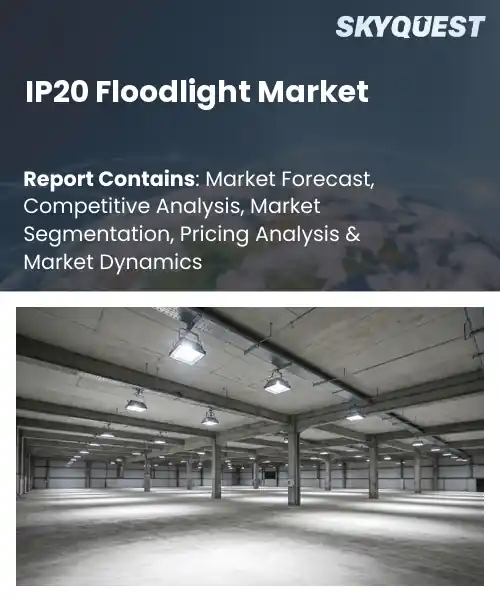
IP20 Floodlight Market
Report ID: SQMIG20D2785
Report ID: SQMIG20D2785
[email protected]
USA +1 351-333-4748
Report ID:
SQMIG20D2785 |
Region:
Global |
Published Date: July, 2026
Pages:
157
|Tables:
149
|Figures:
78


Global IP20 Floodlight Market size was valued at USD 1.42 Billion in 2024 and is poised to grow from USD 1.5 Billion in 2025 to USD 2.32 Billion by 2033, growing at a CAGR of 5.6% during the forecast period (2026-2033).
The IP20 floodlight market share, which provides lighting devices for indoor or shielded environments, has become an infrastructure cornerstone as energy efficiency and low maintenance are critical for commercial and industrial users. This is important as the industry has moved from incandescent lamps to LED modules which can be placed in IP20 rated bodies. Since the 2010s, advances in semiconductor technology have allowed manufacturers to reduce power consumption by up to 70 percent, helping factories, warehouses and retail floors reduce operating costs. One centre, for example, retrofitted 12,000 m of lighting with IP20 LEDs and reported a 45% reduction in bills.
Another important factor that is driving the global IP20 floodlight market growth is the confluence of regulations and IoT controls, which is forcing managers to adopt lighting that can be dimmed remotely to adhere to energy codes. Governments’ stricter carbon mandates are pushing retrofits, particularly in logistics hubs where lights are always on, because networked LED fixtures are cheaper. This pressure has forced manufacturers to bake in wireless drivers and sensors, unlocking subscription-based lighting-as-a-service revenue. One example of the impact is the partnership between a stadium and a firm. IP20 floodlights, with occupancy sensors, reduced electricity demand by 30 percent and provided data for maintenance.
How is IoT Integration Influencing the IP20 Floodlight Market?
The IP20 floodlight market trends is being revolutionized by IoT integration, adding connectivity, remote monitoring, and adaptive control to what were once simply weatherproof lighting units. Sensors allow the lights to adjust their brightness to the surroundings, while cloud platforms collect usage data that can help installers optimize placement and maintenance schedules. Manufacturers are integrating low-power LEDs with wireless modules, allowing users to program schedules, receive fault alerts and integrate the fixtures into larger building-automation systems. This convergence reduces energy waste, extends lamp life and creates new service revenue streams, making IP20 floodlights attractive for smart-city and industrial projects.
AiliteLED launched an IoT-enabled IP20 floodlight in May 2026 that reports power use and fault status to a cloud dashboard so that facility managers can schedule dimming and get predictive maintenance alerts. The smart feature reduces the cost of operations and shows how connectivity drives market adoption.
Market snapshot - (2026-2033)
Global Market Size
USD 1.42 Billion
Largest Segment
LED
Fastest Growth
LED
Growth Rate
5.6% CAGR
To get more insights on this market click here to Request a Free Sample Report
Global IP20 floodlight market is segmented by light source, wattage, mounting type, application, distribution channel and region. Based on light source, the market is segmented into LED, halogen, HID and others. Based on wattage, the market is segmented into Up to 50 W, 51–100 W, 101–200 W and above 200 W. Based on mounting type, the market is segmented into wall mounted, ceiling mounted, pole mounted and others. Based on application, the market is segmented into commercial buildings, warehouses, retail spaces and others. Based on distribution channel, the market is segmented into electrical distributors, online retail, direct sales and others. Based on region, the market is segmented into North America, Europe, Asia Pacific, Latin America and Middle East & Africa.
LED segment dominates because it delivers superior energy efficiency and longer service life, aligning with the IP20 market’s focus on low power consumption and durability. The solid state technology also provides instant illumination without warm up time, meeting safety standards for wet or damp environments. Architects and facility managers favor LED for its minimal maintenance needs, reducing operational costs and supporting sustainability initiatives. Smart integration also enhances dimming flexibility for varied tasks.
Meanwhile, HID segment emerges as the most rapidly expanding area because advances in vapor technology improve luminous output while preserving IP20’s ingress protection. Designers adopt HID for high bay installations where intense illumination is required, and regulatory incentives for high efficiency lighting drive broader uptake across industrial facilities.
Up to 50 W segment dominates because it aligns with the IP20 market’s demand for low power consumption while still delivering adequate illumination for most applications. The modest wattage enables simple thermal management, reducing the need for complex heat sinks and extending product lifespan. Users value the ease of integration with existing fixtures, which minimizes retrofitting costs and supports energy saving initiatives, thereby enhancing overall operational efficiency and reinforcing compliance with environmental standards.
Conversely, Above 200 W segment is witnessing the strongest growth momentum as facilities seek higher luminous output for wide area illumination. Advances in thermal design allow these higher wattage units to maintain IP20 protection without compromising reliability. Growing adoption in outdoor complexes drives demand, positioning this segment as a catalyst for market expansion.
To get detailed segments analysis, Request a Free Sample Report
North America continues to dominate the market due to a combination of a mature lighting infrastructure, large industrial activity and a cultural focus on workplace safety. Regional manufacturers utilize sophisticated production techniques and a vast talent pool to manufacture floodlights that comply with rigorous performance and durability requirements. Strong distribution networks enable fast market penetration, and regulatory frameworks enable adoption of energy-efficient technologies without any reliability trade-off. Demand for commercial, municipal and transportation applications is underpinned by high purchasing power and a track record of investing in public sector projects.
IP20 floodlight market outlook in the United States benefits from a highly diversified industrial landscape that demands reliable outdoor illumination for construction sites, transportation hubs and public venues. Local manufacturers leverage sophisticated production capabilities to deliver products that meet stringent safety certifications, while a well‑developed supply chain ensures rapid availability. End‑users prioritize durability and cost‑effectiveness, reinforcing steady adoption across both commercial and municipal projects. In addition, ongoing emphasis on sustainability drives preference for energy‑saving designs.
IP20 floodlight market forecast in Canada is shaped by demanding climatic conditions that require robust lighting solutions capable of withstanding extreme temperatures and moisture. Domestic producers focus on corrosion‑resistant finishes and high‑performance optics to meet the expectations of utility providers and municipal authorities. Procurement processes emphasize compliance with national safety standards, while the emphasis on energy conservation encourages the adoption of efficient LED‑based floodlights across remote infrastructure projects for public safety.
The European market is experiencing a widespread upgrade of legacy lighting with a harmonized regulatory environment that calls for higher safety and energy-efficiency standards. Strong engineering capabilities in key economies underpin the development of sophisticated optical systems and durable enclosures, and a collaborative approach between manufacturers, utilities and public agencies speeds up product rollout. Innovative design is driven by consumer demand for sustainable and attractive public spaces, while active trade associations promote knowledge sharing that improves market responsiveness across the continent.
IP20 floodlight market regional outlook in Germany benefits from a strong engineering tradition and a concentrated network of original equipment manufacturers that prioritize precision and reliability. German suppliers integrate advanced optics and rigorous testing protocols to satisfy industrial facilities and transportation corridors. Public sector projects emphasize compliance with European safety directives while encouraging energy‑efficient solutions, prompting widespread replacement of legacy fixtures with modern, low‑maintenance floodlights for enhanced visibility in urban areas settings.
IP20 floodlight market regional forecast in the United Kingdom is propelled by a vigorous renovation agenda for public spaces, sports venues and transport hubs. British firms emphasize modular designs that simplify installation and maintenance, aligning with the country’s focus on reducing downtime for critical infrastructure. Policy levers encourage adoption of energy‑saving technologies, while the growing demand for high‑performance illumination in both commercial and residential outskirts fuels rapid market expansion across the nation.
IP20 floodlight market penetration in France is emerging as developers and municipalities prioritize modernization of outdoor lighting to meet sustainability goals. French manufacturers combine aesthetic considerations with robust engineering, delivering fixtures that integrate seamlessly into historic urban settings while offering improved luminous efficiency. Incentive programs focused on energy reduction stimulate replacement cycles, and the growing emphasis on safety in public parks and coastal promenades further accelerates adoption of advanced floodlighting solutions.
Asia Pacific is progressing with the incorporation of smart technologies, increased emphasis on infrastructure resilience and strategic government support for energy-efficient lighting. Regional manufacturers leverage cost-effective manufacturing while adding sophisticated controls that allow adaptive illumination and remote monitoring. As investment in transportation networks, ports and disaster-mitigation projects grows, so does the broad platform for floodlight deployment. Collaborative ecosystems that bring together technology providers, construction companies and policy makers to ensure product development is aligned to changing regulatory expectations and sustainability ambitions.
IP20 floodlight market analysis in Japan is characterized by a blend of high‑technology manufacturing and stringent quality expectations from both industrial and public sectors. Japanese producers apply precision optics and durable enclosures designed to endure humid coastal environments, supporting ports, highways and disaster‑resilient infrastructure. Government initiatives that stress energy efficiency encourage integration of smart control features, while the reputation for reliability drives export interest in neighboring markets across regional trade networks.
IP20 floodlight industry in South Korea reflects a dynamic push toward smart city development and advanced manufacturing capabilities. Korean firms prioritize integration of IoT connectivity and adaptive lighting controls, aligning with national strategies to improve urban livability and reduce power consumption. The market benefits from close collaboration between technology providers and infrastructure planners, ensuring that floodlights meet rigorous performance criteria while supporting deployment across transit stations, industrial parks and coastal defense installations.
To know more about the market opportunities by region and country, click here to
Buy The Complete Report
Urban Development is Expanding Markets
Energy Efficiency is Accelerating Adoption
High Initial Cost is Deterring Buyers
Limited IP20 Awareness is Slowing Growth
Request Free Customization of this report to help us to meet your business objectives.
The global IP20 floodlight market is highly competitive, with established lighting manufacturers focusing on energy-efficient LED technology, smart lighting integration, and connected control systems to strengthen their market positions. Companies continue to invest in advanced optics, intelligent lighting controls, and sustainable product designs while expanding compatibility with building management systems and smart infrastructure platforms. Growing demand for commercial, industrial, retail, and indoor architectural lighting solutions is encouraging manufacturers to improve product performance, reduce energy consumption, and enhance digital lighting management capabilities.
Top Player’s Company Profile
Recent Developments in the IP20 Floodlight Market
SkyQuest’s ABIRAW (Advanced Business Intelligence, Research & Analysis Wing) is our Business Information Services team that Collects, Collates, Correlates, and Analyses the Data collected by means of Primary Exploratory Research backed by robust Secondary Desk research. As per SkyQuest analysis, the global IP20 floodlight market is being propelled primarily by rapid urban development that fuels demand for durable dust‑protected lighting, while the surge in smart‑integration and IoT connectivity serves as a second catalyst by enabling remote control and predictive maintenance. The LED segment, especially units up to 50 W, dominates because of its superior energy efficiency and low operating cost. North America leads the market thanks to mature infrastructure, strong distribution networks and supportive regulations. However, the high upfront cost of advanced IP20 fixtures remains a notable restraint, slowing adoption in price‑sensitive projects and prompting firms to seek financing solutions.
| Report Metric | Details |
|---|---|
| Market size value in 2024 | USD 1.42 Billion |
| Market size value in 2033 | USD 2.32 Billion |
| Growth Rate | 5.6% |
| Base year | 2024 |
| Forecast period | (2026-2033) |
| Forecast Unit (Value) | USD Billion |
| Segments covered |
|
| Regions covered | North America (US, Canada), Europe (Germany, France, United Kingdom, Italy, Spain, Rest of Europe), Asia Pacific (China, India, Japan, Rest of Asia-Pacific), Latin America (Brazil, Rest of Latin America), Middle East & Africa (South Africa, GCC Countries, Rest of MEA) |
| Companies covered |
|
| Customization scope | Free report customization with purchase. Customization includes:-
|
To get a free trial access to our platform which is a one stop solution for all your data requirements for quicker decision making. This platform allows you to compare markets, competitors who are prominent in the market, and mega trends that are influencing the dynamics in the market. Also, get access to detailed SkyQuest exclusive matrix.
Table Of Content
Executive Summary
Market overview
Parent Market Analysis
Market overview
Market size
KEY MARKET INSIGHTS
COVID IMPACT
MARKET DYNAMICS & OUTLOOK
Market Size by Region
KEY COMPANY PROFILES
Methodology
For the IP20 Floodlight Market, our research methodology involved a mixture of primary and secondary data sources. Key steps involved in the research process are listed below:
1. Information Procurement: This stage involved the procurement of Market data or related information via primary and secondary sources. The various secondary sources used included various company websites, annual reports, trade databases, and paid databases such as Hoover's, Bloomberg Business, Factiva, and Avention. Our team did 45 primary interactions Globally which included several stakeholders such as manufacturers, customers, key opinion leaders, etc. Overall, information procurement was one of the most extensive stages in our research process.
2. Information Analysis: This step involved triangulation of data through bottom-up and top-down approaches to estimate and validate the total size and future estimate of the IP20 Floodlight Market.
3. Report Formulation: The final step entailed the placement of data points in appropriate Market spaces in an attempt to deduce viable conclusions.
4. Validation & Publishing: Validation is the most important step in the process. Validation & re-validation via an intricately designed process helped us finalize data points to be used for final calculations. The final Market estimates and forecasts were then aligned and sent to our panel of industry experts for validation of data. Once the validation was done the report was sent to our Quality Assurance team to ensure adherence to style guides, consistency & design.
Analyst Support
Customization Options
With the given market data, our dedicated team of analysts can offer you the following customization options are available for the IP20 Floodlight Market:
Product Analysis: Product matrix, which offers a detailed comparison of the product portfolio of companies.
Regional Analysis: Further analysis of the IP20 Floodlight Market for additional countries.
Competitive Analysis: Detailed analysis and profiling of additional Market players & comparative analysis of competitive products.
Go to Market Strategy: Find the high-growth channels to invest your marketing efforts and increase your customer base.
Innovation Mapping: Identify racial solutions and innovation, connected to deep ecosystems of innovators, start-ups, academics, and strategic partners.
Category Intelligence: Customized intelligence that is relevant to their supply Markets will enable them to make smarter sourcing decisions and improve their category management.
Public Company Transcript Analysis: To improve the investment performance by generating new alpha and making better-informed decisions.
Social Media Listening: To analyze the conversations and trends happening not just around your brand, but around your industry as a whole, and use those insights to make better Marketing decisions.
REQUEST FOR SAMPLE
 REQUEST FREE CUSTOMIZATION
Global Ip20 Floodlight Market size was valued at USD 1.42 Billion in 2024 and is poised to grow from USD 1.5 Billion in 2025 to USD 2.32 Billion by 2033, growing at a CAGR of 5.6% during the forecast period (2026-2033).
The IP20 floodlight market is increasingly shaped by emerging AI‑enabled and IoT‑driven entrants that are challenging incumbent manufacturers through rapid product innovation, strategic partnerships with smart‑city platforms, and targeted acquisitions of niche sensor firms. Recent activity includes collaborations between lighting producers and building‑automation providers to embed adaptive control algorithms, while larger players pursue M&A to integrate advanced optics and energy‑management technologies, intensifying competitive pressure across commercial and municipal segments. No qualifying startups established after 2019 were identified in the provided sources. 'Signify N.V.', 'LEDVANCE GmbH', 'Zumtobel Group AG', 'Acuity Brands, Inc.', 'Current Lighting Solutions, LLC', 'OSRAM GmbH', 'Thorn Lighting Ltd.', 'Havells India Limited', 'Wipro Lighting', 'Opple Lighting Co., Ltd.', 'NVC Lighting Holding Limited', 'Foshan Electrical and Lighting Co., Ltd.', 'LIGMAN Lighting Co., Ltd.', 'Aurora Lighting Group', 'Lutec Group', 'BEGA Gantenbrink-Leuchten KG', 'Ansell Lighting Ltd.', 'Dialight plc', 'RAB Lighting Inc.', 'Eaton Corporation plc'
Urban expansion drives demand for reliable outdoor illumination, and architects increasingly prefer fixtures that can withstand dust and moisture while delivering performance. IP20 floodlights meet these criteria, offering protection against solid objects larger than 12 mm and ensuring longevity in construction zones. This suitability reduces maintenance interruptions, supports safety standards, and aligns with project timelines, encouraging developers to select IP20 solutions for new residential complexes, commercial parks, and infrastructure projects. In addition, the adaptability of IP20 designs to various mounting configurations enables integration with design themes, reinforcing their appeal among designers.
Smart Integration Drives Demand: The convergence of IoT platforms with IP20 floodlights enables remote monitoring, adaptive brightness control, and predictive maintenance, creating compelling value for commercial and municipal customers. Facility managers appreciate the ability to schedule illumination based on real‑time occupancy data, reducing energy waste while enhancing safety. As manufacturers embed connectivity standards and cloud‑based analytics, the technology is becoming a core component of smart city infrastructure, prompting broader adoption beyond traditional lighting projects and delivering measurable ROI for stakeholders across sectors in industry.
Why does North America Dominate the Global IP20 Floodlight Market? |@12


Want to customize this report? This report can be personalized according to your needs. Our analysts and industry experts will work directly with you to understand your requirements and provide you with customized data in a short amount of time. We offer $1000 worth of FREE customization at the time of purchase.
Feedback From Our Clients


 USA (+1) 351-333-4748

