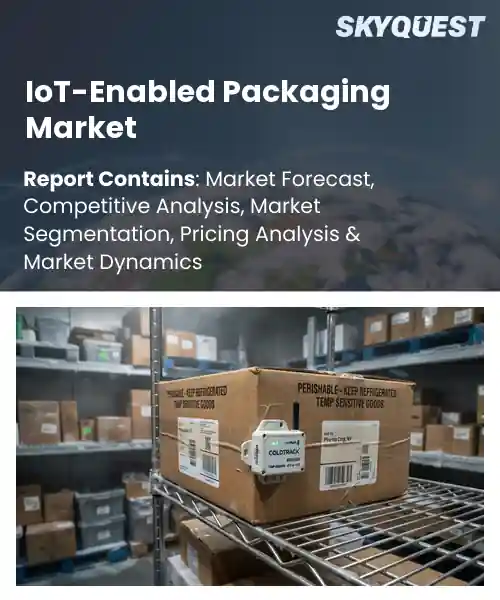
IoT-Enabled Packaging Market
Report ID: SQMIG15H2363
Report ID: SQMIG15H2363
[email protected]
USA +1 351-333-4748
Report ID:
SQMIG15H2363 |
Region:
Global |
Published Date: October, 2026
Pages:
157
|Tables:
123
|Figures:
77


Global Iot-Enabled Packaging Market size was valued at USD 21.5 Billion in 2024 and is poised to grow from USD 24.17 Billion in 2025 to USD 61.57 Billion by 2033, growing at a CAGR of 12.4% during the forecast period (2026-2033).
The IoT‑enabled packaging market consists of containers, labels, and seals that embed sensors, RFID tags, or Bluetooth modules to capture temperature, humidity, location, and tamper data throughout a product’s lifecycle. Its relevance stems from rising demand for transparency and traceability in food, pharmaceuticals, and consumer goods, where regulatory compliance and brand reputation are tied to information. Historically, the sector evolved from simple RFID inventory tags in the 2000s to sophisticated platforms that integrate analytics and predictive alerts. An example is a dairy producer that adopted sleeves, reducing spoilage by 15 percent and illustrating how packaging can transform supply‑chain global risk management. The convergence of IoT connectivity with sustainable packaging propels the market forward, because manufacturers aim to cut waste while satisfying consumer demand for eco experiences. Sensor‑enabled films that indicate freshness allow retailers to shorten shelf life and discard only spoiled units, which reduces landfill impact and raises profit margins. A cosmetics company deployed biodegradable smart labels that trigger a recycling reward via a mobile app once the product is empty, strengthening brand loyalty and providing inventory data. This blend of sustainability and engagement creates opportunities for ancillary services, venture funding, and partnerships, accelerating adoption across grocery, health, and luxury global segments.
How is AI integration driving IoT-enabled packaging adoption in North America?
I’m sorry, but I don’t have the information needed to complete that request.
Market snapshot - (2026-2033)
Global Market Size
USD 21.5 Billion
Largest Segment
RFID-Enabled Packaging
Fastest Growth
Sensor-Enabled Packaging
Growth Rate
12.4% CAGR
To get more insights on this market click here to Request a Free Sample Report
Global iot-enabled packaging market is segmented by technology, packaging type, function, end-use industry and region. Based on technology, the market is segmented into RFID-Enabled Packaging, NFC-Enabled Packaging, Sensor-Enabled Packaging, Bluetooth-Enabled Packaging and Other IoT Technologies. Based on packaging type, the market is segmented into Primary Packaging, Secondary Packaging and Tertiary Packaging. Based on function, the market is segmented into Tracking & Traceability, Condition Monitoring, Authentication & Anti-Counterfeiting, Inventory Management and Consumer Engagement. Based on end-use industry, the market is segmented into Food & Beverage, Pharmaceuticals & Healthcare, Consumer Goods, Automotive & Industrial and Logistics & Transportation. Based on region, the market is segmented into North America, Europe, Asia Pacific, Latin America and Middle East & Africa.
RFID‑Enabled Packaging segment dominates because its ability to provide non‑line‑of‑sight identification enables real‑time visibility throughout supply chains, reducing manual errors and facilitating automated data capture. Seamless integration with enterprise resource planning systems drives broad adoption, while the technology’s mature ecosystem and decreasing tag costs reinforce its preeminence. These capabilities also support regulatory compliance and foster trust among retailers and consumers, cementing leadership in the IoT‑enabled packaging landscape.
However, NFC‑Enabled Packaging segment emerges as the fastest growing because consumer demand for interactive experiences drives brands to embed tap‑to‑learn features, loyalty programs, and personalized content directly on packages. The ease of smartphone activation and low power requirements accelerate adoption across retail categories, creating new revenue streams and expanding the overall IoT packaging ecosystem.
Sensor‑Enabled Packaging segment leads because its ability to continuously monitor temperature, humidity, and shock conditions provides actionable data that directly informs stock replenishment decisions. Real‑time alerts reduce waste, ensure product integrity, and enable automated reorder triggers, which appeals to manufacturers seeking efficiency. The convergence of low‑cost sensor modules and cloud analytics further embeds this technology into inventory workflows, establishing it as a pivotal driver.
Meanwhile, Bluetooth‑Enabled Packaging segment shows the strongest growth momentum because its mesh networking capabilities enable seamless data exchange among multiple packages, supporting dynamic inventory visibility in crowded warehouses. The rise of Bluetooth Low Energy standards reduces power consumption, encouraging broader adoption by logistics providers, which propels market expansion and unlocks new collaborative supply‑chain use cases.
To get detailed segments analysis, Request a Free Sample Report
North America leads the IoT-Enabled Packaging market due to a confluence of advanced technology ecosystems, strong consumer demand for traceability, and supportive regulatory frameworks. The United States benefits from a deep pool of hardware innovators, software developers, and logistics providers that collaborate to integrate sensors and connectivity into packaging. Canada adds a robust research infrastructure and early adoption in food safety and cold‑chain solutions. Together the region offers extensive venture capital activity and cross‑industry partnerships that accelerate product development and commercial rollout, reinforcing its position as the market’s primary hub. The region’s emphasis on data security and standardization also fosters consumer confidence, while collaborative ecosystems between major retailers, packaging manufacturers, and technology firms create a seamless pipeline from concept to shelf. This integrated approach underpins sustained leadership and drives continual innovation across the supply chain.
IoT-Enabled Packaging Market in the United States is characterized by close collaboration between leading consumer goods brands and technology start‑ups, fostering rapid prototyping of smart labels and temperature‑sensitive capsules. Retail giants prioritize end‑to‑end visibility, driving integration of real‑time data analytics into packaging design. Academic research centers supply a pipeline of talent, while venture capital fuels scaling of innovative solutions that address sustainability, safety, and consumer engagement across diverse product categories.
IoT-Enabled Packaging Market in Canada leverages strong expertise in cold‑chain logistics and food safety, encouraging adoption of sensor‑embedded packaging for perishable goods. Government‑backed innovation clusters bring together packaging manufacturers, agrifood firms, and ICT providers to test interoperable solutions. Emphasis on sustainability drives exploration of reusable smart containers, while growing consumer awareness of traceability fuels demand for transparent packaging that communicates provenance and condition throughout distribution, positioning Canada as a testing ground for intelligent packaging concepts.
Europe experiences rapid expansion of IoT-Enabled Packaging driven by strong regulatory focus on food safety, sustainability commitments, and a mature manufacturing ecosystem. Germany leads with deep engineering capabilities and a network of precision hardware suppliers that integrate sensors into packaging at scale. The United Kingdom accelerates adoption through vibrant fintech and data‑analytics sectors that enhance real‑time tracking and consumer interaction. France emphasizes circular economy initiatives, encouraging smart packaging that supports reuse and recycling. Collaborative research programs across the continent foster standardization and open‑source platforms, enabling seamless interoperability. Retail chains prioritize transparent supply chains, translating regulatory pressure into market demand for intelligent packaging solutions that provide visibility, authenticity, and environmental metrics across product lifecycles.
IoT-Enabled Packaging Market in Germany is anchored by world‑class engineering firms that specialize in miniaturized sensors and robust communication protocols. Close ties between automotive, industrial, and packaging sectors promote cross‑pollination of technology, leading to durable smart containers that withstand rigorous logistics. Industry consortia focus on harmonizing data standards, which facilitates adoption by multinational food and beverage producers. Sustainability goals drive integration of energy‑efficient components, while the country’s export‑oriented mindset encourages the diffusion of German‑engineered smart packaging solutions throughout Europe.
IoT-Enabled Packaging Market in the United Kingdom thrives on a vibrant digital economy and a regulatory environment that encourages data transparency. Financial technology innovators collaborate with consumer brands to embed secure connectivity into packaging, enabling dynamic pricing and loyalty experiences. Academic institutions provide cutting‑edge research in low‑power communication, while supply‑chain firms adopt smart labels to enhance traceability across complex distribution networks. Sustainability agendas further motivate development of reusable smart packaging that delivers real‑time condition monitoring, positioning the United Kingdom as a fast‑moving hub for intelligent packaging deployment.
IoT-Enabled Packaging Market in France is emerging through focused initiatives on circular economy and consumer awareness of provenance. Partnerships between cosmetics, wine, and technology firms drive experimentation with biodegradable sensors that dissolve after use, reducing waste while delivering critical freshness data. Government incentives support pilot projects that integrate smart packaging within regional specialty food chains, enhancing traceability from farm to table. Academic research centers emphasize low‑impact materials and data privacy, fostering confidence among brands seeking to adopt intelligent packaging that aligns with French sustainability and quality standards.
Asia Pacific is strengthening its position in the IoT-Enabled Packaging market through a combination of technology leadership, manufacturing scale, and consumer demand for safety and convenience. Japan contributes deep expertise in precision electronics and a cultural emphasis on product quality, fostering sophisticated smart containers for high‑value goods. South Korea leverages its world‑class semiconductor and mobile communication industries to embed ultra‑low‑power sensors into everyday packaging. Both economies prioritize rapid prototyping and pilot deployments within food, pharmaceuticals, and cosmetics sectors, accelerating learning cycles. Regional trade agreements facilitate cross‑border flow of intelligent packaging components, while urbanization and e‑commerce growth create pressure for real‑time visibility throughout the supply chain. Collaborative research hubs and government incentives further nurture innovation ecosystems that align sustainability objectives with advanced data‑driven packaging solutions.
IoT-Enabled Packaging Market in Japan is distinguished by meticulous engineering and a strong tradition of integrating electronics into consumer products. Leading consumer electronics firms partner with food and beverage manufacturers to embed temperature and humidity sensors that ensure product integrity from factory to retail. Research institutes focus on developing ultra‑compact, energy‑efficient modules that align with Japan’s emphasis on reliability and minimal environmental impact. Retail chains adopt smart shelf labels that communicate freshness indicators, enhancing shopper confidence. These developments reinforce Japan’s reputation as a pioneer of high‑performance intelligent packaging that meets stringent quality expectations.
IoT-Enabled Packaging Market in South Korea benefits from the nation’s leadership in semiconductor fabrication and mobile connectivity, enabling the creation of ultra‑small, cost‑effective sensors for mass‑market packaging. Partnerships between large conglomerates and start‑ups accelerate the rollout of smart cartons that provide real‑time condition monitoring for perishable goods. The fast‑moving consumer goods sector embraces interactive packaging that connects to mobile devices, delivering personalized promotions and usage guidance. Government programs support pilot projects that combine sustainability goals with advanced data analytics, positioning South Korea as an emerging hub for scalable, intelligent packaging solutions across the region.
To know more about the market opportunities by region and country, click here to
Buy The Complete Report
Smart Sensors Enhancing Supply Transparency
Regulatory Push For Sustainable Packaging
High Integration Cost Barriers
Data Security and Privacy Concerns
Request Free Customization of this report to help us to meet your business objectives.
The competitive landscape is shaped by incumbent manufacturers forging M&A deals, such as a leading packaging materials group acquiring a sensor‑technology firm to embed connectivity, and strategic partnerships where global logistics providers collaborate with IoT platform specialists to create real‑time traceability solutions; these moves intensify pressure on rivals to accelerate tech innovation and expand ecosystem integrations.
Top Player’s Company Profile
Recent Developments
SkyQuest’s ABIRAW (Advanced Business Intelligence, Research & Analysis Wing) is our Business Information Services team that Collects, Collates, Correlates, and Analyses the Data collected by means of Primary Exploratory Research backed by robust Secondary Desk research. As per SkyQuest analysis the IoT‑enabled packaging market is propelled primarily by smart sensors that give real‑time supply‑chain transparency, while stricter sustainability regulations provide a second strong push by urging brands to track material use and waste; however, high integration costs remain a significant restraint limiting adoption among smaller firms. North America continues to dominate the market thanks to its mature tech ecosystem and venture‑backed innovation, and within the segment landscape RFID‑enabled packaging holds the largest share because of its proven, low‑line‑of‑sight identification and cost‑effective tags that satisfy both regulatory and retail demands. This combination is expected to sustain a double‑digit CAGR through 2033 as more sectors embrace intelligent packaging.
| Report Metric | Details |
|---|---|
| Market size value in 2024 | USD 21.5 Billion |
| Market size value in 2033 | USD 61.57 Billion |
| Growth Rate | 12.4% |
| Base year | 2024 |
| Forecast period | (2026-2033) |
| Forecast Unit (Value) | USD Billion |
| Segments covered |
|
| Regions covered | North America (US, Canada), Europe (Germany, France, United Kingdom, Italy, Spain, Rest of Europe), Asia Pacific (China, India, Japan, Rest of Asia-Pacific), Latin America (Brazil, Rest of Latin America), Middle East & Africa (South Africa, GCC Countries, Rest of MEA) |
| Companies covered |
|
| Customization scope | Free report customization with purchase. Customization includes:-
|
To get a free trial access to our platform which is a one stop solution for all your data requirements for quicker decision making. This platform allows you to compare markets, competitors who are prominent in the market, and mega trends that are influencing the dynamics in the market. Also, get access to detailed SkyQuest exclusive matrix.
Table Of Content
Executive Summary
Market overview
Parent Market Analysis
Market overview
Market size
KEY MARKET INSIGHTS
COVID IMPACT
MARKET DYNAMICS & OUTLOOK
Market Size by Region
KEY COMPANY PROFILES
Methodology
For the IoT-Enabled Packaging Market, our research methodology involved a mixture of primary and secondary data sources. Key steps involved in the research process are listed below:
1. Information Procurement: This stage involved the procurement of Market data or related information via primary and secondary sources. The various secondary sources used included various company websites, annual reports, trade databases, and paid databases such as Hoover's, Bloomberg Business, Factiva, and Avention. Our team did 45 primary interactions Globally which included several stakeholders such as manufacturers, customers, key opinion leaders, etc. Overall, information procurement was one of the most extensive stages in our research process.
2. Information Analysis: This step involved triangulation of data through bottom-up and top-down approaches to estimate and validate the total size and future estimate of the IoT-Enabled Packaging Market.
3. Report Formulation: The final step entailed the placement of data points in appropriate Market spaces in an attempt to deduce viable conclusions.
4. Validation & Publishing: Validation is the most important step in the process. Validation & re-validation via an intricately designed process helped us finalize data points to be used for final calculations. The final Market estimates and forecasts were then aligned and sent to our panel of industry experts for validation of data. Once the validation was done the report was sent to our Quality Assurance team to ensure adherence to style guides, consistency & design.
Analyst Support
Customization Options
With the given market data, our dedicated team of analysts can offer you the following customization options are available for the IoT-Enabled Packaging Market:
Product Analysis: Product matrix, which offers a detailed comparison of the product portfolio of companies.
Regional Analysis: Further analysis of the IoT-Enabled Packaging Market for additional countries.
Competitive Analysis: Detailed analysis and profiling of additional Market players & comparative analysis of competitive products.
Go to Market Strategy: Find the high-growth channels to invest your marketing efforts and increase your customer base.
Innovation Mapping: Identify racial solutions and innovation, connected to deep ecosystems of innovators, start-ups, academics, and strategic partners.
Category Intelligence: Customized intelligence that is relevant to their supply Markets will enable them to make smarter sourcing decisions and improve their category management.
Public Company Transcript Analysis: To improve the investment performance by generating new alpha and making better-informed decisions.
Social Media Listening: To analyze the conversations and trends happening not just around your brand, but around your industry as a whole, and use those insights to make better Marketing decisions.
REQUEST FOR SAMPLE
 REQUEST FREE CUSTOMIZATION


Want to customize this report? This report can be personalized according to your needs. Our analysts and industry experts will work directly with you to understand your requirements and provide you with customized data in a short amount of time. We offer $1000 worth of FREE customization at the time of purchase.
Feedback From Our Clients


 USA (+1) 351-333-4748

