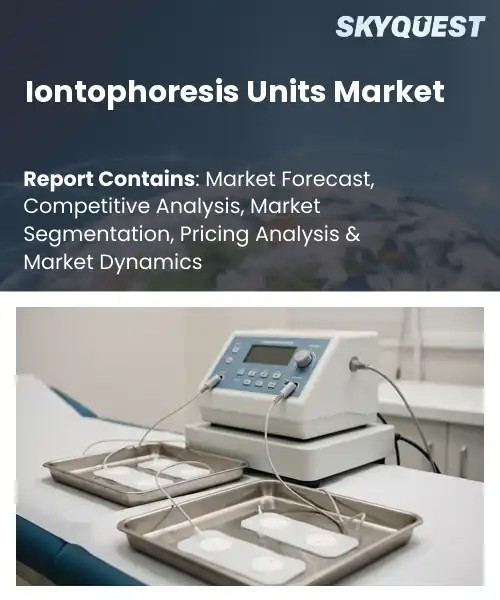
Iontophoresis Units Market
Report ID: SQMIG35B2298
Report ID: SQMIG35B2298
[email protected]
USA +1 351-333-4748
Report ID:
SQMIG35B2298 |
Region:
Global |
Published Date: March, 2026
Pages:
157
|Tables:
115
|Figures:
77


Global Iontophoresis Units Market size was valued at USD 220.0 Million in 2024 and is poised to grow from USD 248.16 Million in 2025 to USD 650.44 Million by 2033, growing at a CAGR of 12.8% during the forecast period (2026-2033).
Iontophoresis systems provide a method to deliver therapeutic charged particles through skin barriers using controlled electrical currents which creates a non-invasive method for receiving treatment. The iontophoresis units industry exists to provide dermatologists and physiotherapists with localized treatment solutions that have fewer systemic effects after decades of development from huge clinical machines to simple home devices. The early clinical tests for hyperhidrosis showed that the treatment worked, which led manufacturers to improve product design through better battery performance and safety enhancements. Telehealth services and regulatory approvals have enabled devices to enter both outpatient settings and home user markets.
Moreover, the major factor driving the global iontophoresis units market growth is the market trend which requires manufacturers to make devices smaller while they implement digital technology to enable home therapy and remote healthcare monitoring. The product development team developed a home-based iontophoresis solution for palmar and plantar hyperhidrosis which reduced clinic visits while Bluetooth technology and app-based guidance helped patients use the device.
The lower user burden led physiotherapy and sports medicine providers to show interest in using anti-inflammatory and analgesic compounds for localized treatment because it results in faster patient recovery with fewer adverse effects. The practical benefits of the technology have attracted investment while pharmaceutical companies work with them to reformulate charged drugs for transdermal delivery, which creates clear paths for market entry.
How is AI Improving Device Performance in the Iontophoresis Units Market?
The field of artificial intelligence improves iontophoresis systems by using machine learning to develop better sensing systems and automatic current control systems. Real-time skin impedance sensing and data-driven current profile customization and closed-loop systems that decrease treatment differences represent the core elements of the system. The market currently prefers portable and wearable products which offer digital health connections for remote health monitoring and treatment compliance tracking. The AI-driven treatment features provide users with more predictable results while also making clinical operations more efficient by showing when maintenance should occur and when treatment sessions should start. Electroresponsive delivery systems represent one type of product that handles patient response while collecting data to create treatment adjustments.
Market snapshot - 2026-2033
Global Market Size
USD 220.0 Million
Largest Segment
Hyperhidrosis Control Units
Fastest Growth
Aesthetic/Beauty Iontophoresis Devices
Growth Rate
12.8% CAGR
To get more insights on this market click here to Request a Free Sample Report
The global iontophoresis units market is segmented based on product type, power source, current type, end user, and region. By product type, the market is categorized into hyperhidrosis control units, transdermal drug delivery systems, and aesthetic or beauty iontophoresis devices. Based on power source, it is divided into mains-powered and battery-operated units. In terms of current type, the market includes pulsed current (PC) and direct current (DC). By end user, it is segmented into dermatology clinics, rehabilitation and physical therapy centers, and home care settings. Regionally, the market is classified into North America, Europe, Asia Pacific, Latin America, and the Middle East & Africa.
According to the global iontophoresis units market analysis, the hyperhidrosis control unit market leads dominating because its devices provide researchers with specialized medical solutions which medical professionals use to treat patients who have permanent sweating problems. The established treatment protocols and focused efficacy of the treatment method led clinicians to favor the treatment, while insurance companies approve it, which pushes manufacturers to develop products and create service networks. The combination of better usability with clinician training results in positive outcomes, which drives product adoption, while clinicians with user training deliver better health outcomes through their enhanced user knowledge.
However, the transdermal drug delivery systems category is anticipated to have the highest iontophoresis units market share because it enables precise medicine distribution through its product combination of devices and pharmaceutical substances. The increasing number of combination products that achieve regulatory approval leads to more clinical testing and partnership creation, which delivers new product lines for both clinical applications and consumer markets.
As per the global iontophoresis units market forecast, the battery-operated segment leads the market because its portable design combined with its simple power management enables both at-home users and patients at clinics to experience seamless power supply while they operate battery-powered devices which manufacturers make to suit both personal users and professional users. The device's portability combined with its minimal space requirements leads medical professionals to test the device in their clinics while using it at home and renting it out. Hospitals and medical centers need to invest in user interface upgrades and remote patient tracking systems because these systems will help improve their design process while boosting user adoption across different healthcare facilities.
Whereas the mains-powered growing area proves its superiority because its constant power supply enables users to operate complex treatment systems with clinic integration capabilities. Medical facilities need special systems that can run continuously, which forces developers to create systems that combine multiple diagnostic functions while developing special features that medical institutions need for service delivery excellence.
To get detailed segments analysis, Request a Free Sample Report
As per the iontophoresis units market regional forecast, North America leads the market through its established healthcare system, dedicated medical experts, and existing payment systems that support market growth. The presence of device manufacturers together with clinical research organizations enables faster product development through their testing processes. All clinicians and patients are aware of noninvasive treatment options which create continuous demand for these treatments. The combination of distribution networks and service experts guarantees that equipment will be installed and serviced at the scheduled times. The industry partners with major medical institutions to create agreements which allow for quick implementation of clinical applications.
The market maintains its leadership position because regulatory bodies provide clear guidance and professional organizations operate actively while healthcare organizations maintain their dedication to training clinicians and delivering post market assistance which builds long term trust with both providers and patients. The ecosystem for innovation establishes permanent funding through private and institutional investments which allows continuous development in device functionalities and usability and safety. Clinical evidence becomes standard practice through clinical guidelines and payer relationships which facilitate the transition from research to clinical applications.
The United States Iontophoresis Units industry benefits from its strong clinical research base and its numerous device manufacturers and its wide recognition of noninvasive therapies by clinicians who work in the field. The processes for hospital procurement together with the reimbursement information available to multiple healthcare environments enable providers to implement new treatments. Academic institutions work together with industry partners to create better research pathways which lead to faster clinical evaluations and market adoption. The distribution and service networks which already exist in the market enable businesses to maintain their technology through immediate installation and repairs for their equipment.
The Canadian Iontophoresis Units Market combines healthcare delivery through integrated systems and provincial procurement frameworks to create coordinated healthcare access for patients which leads to cost-effective treatment. Clinical networks help establish training programs together with clinics which disseminate educational materials and practices. Public health systems work together with manufacturers to make the device evaluation process more efficient. Service and distribution providers establish methods to serve different areas while educator initiatives enable clinicians across various urban and regional community settings to develop confidence in noninvasive treatments.
The European market experiences fast growth because three factors operate simultaneously in the market which include more doctors using noninvasive treatments and the establishment of regulatory systems that favor device development and the development of reimbursement systems through effective payer partnerships in different healthcare environments. The clinical centers which operate numerous research partnerships with industry partners create an environment which produces evidence that leads to new clinical guidelines.
The regional pilots which operate within integrated healthcare systems support the broad implementation of effective healthcare delivery systems. The manufacturing and service networks in important markets guarantee that products maintain availability, and customers receive complete support during the product lifecycle. Europe transforms into a fast-growing iontophoresis market because medical knowledge sharing between countries and professional society advocacy raise clinician knowledge which leads to increased product usage, while each country adopts unique strategic approaches.
The German Iontophoresis Units sector operates within a network of domestic manufacturers and clinical research facilities together with established hospital procurement systems which support the use of validated medical devices. The clinical evaluation process benefits industry partnerships with academic institutions and specialist societies because they work together to develop clinical guidelines. The service and maintenance systems of the organization ensure that devices function effectively throughout their entire lifespan. The country maintains an innovative atmosphere which enables medical centers to develop new clinical pathways while maintaining their existing operational methods.
The United Kingdom Iontophoresis Units Market demonstrates quick market entry through its clinical pilot programs and direct partnerships between academic institutions and medical facilities which enable hospitals to adopt new procurement methods. Specialist clinics benefit from the advanced medtech ecosystem and doctor-led advocacy which fast-tracks awareness and adoption of latest techniques. The combination of digital health initiatives and post-market support systems advances clinical performance. The healthcare field achieves rapid clinical practice adoption through direct partnerships between industry and academic institutions and health providers.
Three forces are driving the French market into development, which includes innovation efforts, rising interest from both public and private healthcare facilities, and joint research studies that prove clinical advantages. The health authority engagement process together with current reimbursement negotiations enables successful implementation of healthcare systems. National care delivery models serve as the framework through which medtech firms and partners customize their solutions. Clinician education programs at specialist centers increase awareness which enables healthcare professionals to gradually include new technologies in their therapeutic and aesthetic treatment workflows.
Asia Pacific is developing its power through focused investments in device technology and expanded clinical research facilities and regional medtech companies establishing partnerships with international manufacturing partners. Healthcare systems and specialized clinics assess noninvasive treatment options while local manufacturers customize their devices to meet the specific clinical requirements and regulatory frameworks of the area. The organization of distribution and service networks enables healthcare facilities to overcome geographical obstacles while the clinician training programs deliver specialist education to medical practitioners.
The region achieves its clinical evidence development through three pathways which include cross-border cooperation and pilot programs and digital health platform partnerships, which allow for the deployment of evidence-based practices through direct clinical integration from select medical specialties to complete treatment procedures.
The Japan Iontophoresis Units Market benefits from its advanced manufacturing capabilities together with its strong medical research institutions and its technology ecosystem which enables the development of high-quality medical equipment. The manufacturing team works together with the clinical centers to conduct thorough testing of the product, which results in a refined medical device. The distribution network together with its after-sales service system delivers dependable support for customers. The combination of clinician training together with digital health tool connections leads to better practical usage, which results in greater acceptance of the system in both specialist and outpatient medical environments.
The South Korean Iontophoresis Units Market achieves its success through the close relationships between precision electronics manufacturing and medical device development which results in user friendly medical systems that clinicians can easily operate. Medtech startups and established companies' partner with medical institutions and research organizations to assess how their products perform in clinical environments. The distribution system, which operates through direct sales and regulatory processes, enables medical solutions to reach all regions of the country. The combination of dedicated training together with local service networks and digital health platform connections establishes a foundation for clinicians to accept new therapies.
To know more about the market opportunities by region and country, click here to
Buy The Complete Report
Increasing Preference for Needleless Delivery
Needless delivery methods have improved patient adherence to topical and transdermal drugs which has made iontophoresis an appealing option for clinicians and providers who treat patients. Iontophoretic solutions enable hospitals to treat more patients because they offer better comfort and lower needlestick injury risks and easier administration procedures. Patients and practitioners demand noninvasive delivery devices which control delivery because of their positive experiences with these devices, which results in market growth and ongoing product innovation.
Advances in Device Technology
The safety and usability of iontophoresis units have improved through technological advancements in electronics and materials and control algorithms, which make these units suitable for both clinical environments and home use. The system enables doctors to deliver precise drug dosages, which need less monitoring from highly trained medical professionals because the system uses better miniaturization and user-friendly interfaces and advanced current-control technology. The upgrades to devices boost doctors' trust in iontophoretic delivery, which leads to the exploration of new therapeutic areas, and drives manufacturers to allocate resources for market introduction and user education, which results in increased acceptance of the technology in different medical settings.
Limited Reimbursement Coverage
The absence of reliable reimbursement systems for iontophoretic medical procedures and equipment prevents medical facilities from using these technologies while patients face treatment restrictions because hospitals must assess their medical device costs against unpredictable insurance payments. The absence of clear funding pathways leads hospitals and clinics to postpone equipment procurement while doctors stop recommending devices that require patients to pay their own costs. The funding uncertainty creates a barrier which prevents manufacturers from expanding their distribution networks and leads to lower product implementation rates, while hospitals postpone product adoption despite actual clinical benefits, which restricts patient access to treatment alternatives.
High Initial Device Costs
The purchase of iontophoresis units with their required consumables needs a large initial capital investment which creates a financial barrier that prevents hospitals and specialty clinics from purchasing these products during times when budget limitations lead to competing purchasing preferences. After the initial purchase, stakeholders must evaluate three cost elements which include staff training expenses and maintenance requirements and the costs of products that work together with their existing equipment. The financial barrier created by this system slows the advancement of trial adoption while extending the time required to select products and it restricts distribution in places with limited resources, which prevents manufacturers from expanding their production and distribution networks while creating challenges for the sustainable maintenance of the market.
Request Free Customization of this report to help us to meet your business objectives.
The global iontophoresis units market develops its competitive environment through companies establishing strategic partnerships and making specific investments while they quickly implement technological advancements which determine their market position. The market moves forward through strategic corporate investments in skin biosensor startups and commercial partnerships which boost development of soft patch and iontophoresis-enabled monitoring and delivery platforms. The acquisitions of the company have enabled it to expand its platform operations while also simplifying its path to obtain regulatory approvals.
Expanded Home Healthcare Adoption
Device Integration with Digital Health
SkyQuest’s ABIRAW (Advanced Business Intelligence, Research & Analysis Wing) is our Business Information Services team that Collects, Collates, Correlates, and Analyses the Data collected by means ofPrimary Exploratory Research backed by robust Secondary Desk research.
As per SkyQuest analysis, needleless delivery systems have become the preferred method for delivering iontophoresis units because they enhance patient acceptance and enable their use in outpatient and homecare settings. The advancement of device technology through miniaturization and AI-powered digital integration has developed two major forces which allow for the creation of home-based systems that provide users with personalized connected setups. The restricted reimbursement coverage prevents institutions from purchasing products and limits patient access to clinically proven treatments that demonstrate clear medical benefits. North America leads the market because it has developed healthcare infrastructure and multiple device manufacturers and established reimbursement systems which enable healthcare providers to purchase hyperhidrosis control units.
| Report Metric | Details |
|---|---|
| Market size value in 2024 | USD 220.0 Million |
| Market size value in 2033 | USD 650.44 Million |
| Growth Rate | 12.8% |
| Base year | 2024 |
| Forecast period | 2026-2033 |
| Forecast Unit (Value) | USD Million |
| Segments covered |
|
| Regions covered | North America (US, Canada), Europe (Germany, France, United Kingdom, Italy, Spain, Rest of Europe), Asia Pacific (China, India, Japan, Rest of Asia-Pacific), Latin America (Brazil, Rest of Latin America), Middle East & Africa (South Africa, GCC Countries, Rest of MEA) |
| Companies covered |
|
| Customization scope | Free report customization with purchase. Customization includes:-
|
To get a free trial access to our platform which is a one stop solution for all your data requirements for quicker decision making. This platform allows you to compare markets, competitors who are prominent in the market, and mega trends that are influencing the dynamics in the market. Also, get access to detailed SkyQuest exclusive matrix.
Table Of Content
Executive Summary
Market overview
Parent Market Analysis
Market overview
Market size
KEY MARKET INSIGHTS
COVID IMPACT
MARKET DYNAMICS & OUTLOOK
Market Size by Region
KEY COMPANY PROFILES
Methodology
For the Iontophoresis Units Market, our research methodology involved a mixture of primary and secondary data sources. Key steps involved in the research process are listed below:
1. Information Procurement: This stage involved the procurement of Market data or related information via primary and secondary sources. The various secondary sources used included various company websites, annual reports, trade databases, and paid databases such as Hoover's, Bloomberg Business, Factiva, and Avention. Our team did 45 primary interactions Globally which included several stakeholders such as manufacturers, customers, key opinion leaders, etc. Overall, information procurement was one of the most extensive stages in our research process.
2. Information Analysis: This step involved triangulation of data through bottom-up and top-down approaches to estimate and validate the total size and future estimate of the Iontophoresis Units Market.
3. Report Formulation: The final step entailed the placement of data points in appropriate Market spaces in an attempt to deduce viable conclusions.
4. Validation & Publishing: Validation is the most important step in the process. Validation & re-validation via an intricately designed process helped us finalize data points to be used for final calculations. The final Market estimates and forecasts were then aligned and sent to our panel of industry experts for validation of data. Once the validation was done the report was sent to our Quality Assurance team to ensure adherence to style guides, consistency & design.
Analyst Support
Customization Options
With the given market data, our dedicated team of analysts can offer you the following customization options are available for the Iontophoresis Units Market:
Product Analysis: Product matrix, which offers a detailed comparison of the product portfolio of companies.
Regional Analysis: Further analysis of the Iontophoresis Units Market for additional countries.
Competitive Analysis: Detailed analysis and profiling of additional Market players & comparative analysis of competitive products.
Go to Market Strategy: Find the high-growth channels to invest your marketing efforts and increase your customer base.
Innovation Mapping: Identify racial solutions and innovation, connected to deep ecosystems of innovators, start-ups, academics, and strategic partners.
Category Intelligence: Customized intelligence that is relevant to their supply Markets will enable them to make smarter sourcing decisions and improve their category management.
Public Company Transcript Analysis: To improve the investment performance by generating new alpha and making better-informed decisions.
Social Media Listening: To analyze the conversations and trends happening not just around your brand, but around your industry as a whole, and use those insights to make better Marketing decisions.
REQUEST FOR SAMPLE
 REQUEST FREE CUSTOMIZATION
Global Iontophoresis Units Market size was valued at USD 220.0 Million in 2024 and is poised to grow from USD 248.16 Million in 2025 to USD 650.44 Million by 2033, growing at a CAGR of 12.8% during the forecast period (2026-2033).
Key vendors in the Iontophoresis Units Market include leading medical device companies such as R.A. Fischer Co., IOMED Inc., Hidrex GmbH, Drionic, Dermadry Laboratories Inc., Idromed, AAM Healthcare, Saalmann Medical GmbH, Kimetec GmbH, Medisana AG, and Zimmer MedizinSysteme GmbH.
The key driver of the Iontophoresis Units Market is the increasing prevalence of hyperhidrosis, driving demand for effective treatment solutions. Additionally, the growing preference for non-invasive, drug-free therapies and rising awareness of such treatments are significantly contributing to market growth.
A key market trend in the Iontophoresis Units Market is the increasing demand for home-use and portable devices for treating hyperhidrosis. Additionally, there is a growing focus on user-friendly designs and technologically advanced features to improve convenience, safety, and treatment effectiveness.
North America accounted for the largest share in the Iontophoresis Units Market, driven by a higher prevalence of hyperhidrosis, strong awareness, advanced healthcare infrastructure, and increased adoption of non-invasive treatment devices across the region.


Want to customize this report? This report can be personalized according to your needs. Our analysts and industry experts will work directly with you to understand your requirements and provide you with customized data in a short amount of time. We offer $1000 worth of FREE customization at the time of purchase.
Feedback From Our Clients


 USA (+1) 351-333-4748

