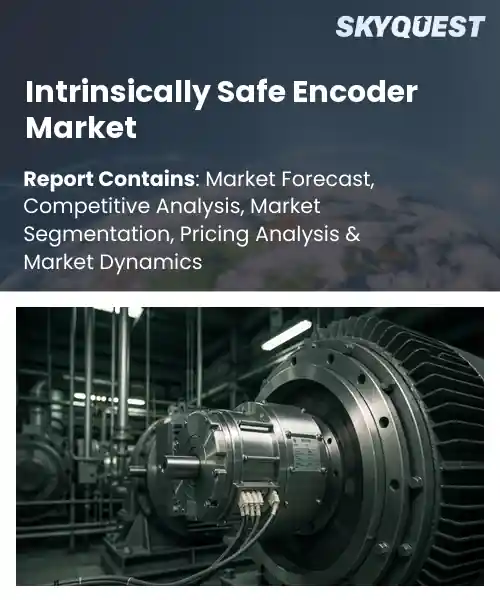
Intrinsically Safe Encoder Market
Report ID: SQMIG45K2422
Report ID: SQMIG45K2422
[email protected]
USA +1 351-333-4748
Report ID:
SQMIG45K2422 |
Region:
Global |
Published Date: August, 2026
Pages:
157
|Tables:
142
|Figures:
78


Global Intrinsically Safe Encoder Market size was valued at USD 286.4 Million in 2024 and is poised to grow from USD 304.44 Million in 2025 to USD 496.34 Million by 2033, growing at a CAGR of 6.3% during the forecast period (2026-2033).
Intrinsically safe encoders, basically turn mechanical movement into electrical signals but they do it in a way where no spark—or excess heating—can set off volatile atmospheres. Over the last years the market kept growing, especially once safety rules like IECEx and ATEX became, non negotiable on oil and gas platforms , chemical sites, and in underground mines. A major reason demand is moving so fast, is the expansion of renewable power infrastructure, especially offshore wind where turbine gearboxes are placed in zones with explosive gas. If certified encoders are deployed, it offers shaft position information in near-real time, then predictive maintenance models can run on that. That usually means less sudden downtime and a longer turbine lifespan too, which is not a small thing.
Also, mining operators are retrofitting older conveyance systems with intrinsically safe feedback systems, because the safety legislation is getting stricter. This retrofitting wave creates a big upgrade market across regions, and it also opens side doors for software providers, the ones doing cloud based analytics. Since the sensor data is the backbone for condition monitoring in hazardous-area industry, those analytics layers end up being essential.
IoT integration is changing the intrinsically safe encoder market by connecting sensors straight to cloud platforms, plus analytics tools. With that setup companies can keep an eye on position, speed and health data in real time, while still keeping the safety certifications that are required for explosive atmospheres. Lately manufacturers are embedding wireless modules and edge processors directly into encoders, which makes them act like smart nodes. Those nodes can raise alerts, help plan maintenance , and even support process control optimization. As many plants push forward with Industry 4.0 approaches, the need for encoders that blend safety with digital insight keeps increasing.
Market snapshot - (2026-2033)
Global Market Size
USD 286.4 Million
Largest Segment
Incremental Encoders
Fastest Growth
Absolute Encoders
Growth Rate
6.3% CAGR
To get more insights on this market click here to Request a Free Sample Report
The global intrinsically safe encoder market is segmented by encoder type, technology, application, end user, mounting type and region. Based on encoder type, the market is segmented into Incremental Encoders and Absolute Encoders. Based on technology, the market is segmented into Optical and Magnetic. Based on application, the market is segmented into Oil & Gas, Mining, Chemical Processing and Pharmaceuticals. Based on end user, the market is segmented into Industrial Manufacturing, Energy and Process Industries. Based on mounting type, the market is segmented into Shaft and Hollow Shaft. Based on region, the market is segmented into North America, Europe, Asia Pacific, Latin America and Middle East & Africa.
Incremental encoders dominate here, mainly because they give reliable high resolution feedback while things are hazardous, and they do it with that simple design that “gets along” with explosive atmospheres. Their overall toughness, easy integration, and good cost effectiveness make them the go to for continuous motion control in oil , and gas and also mining jobs. Manufacturers tend to prefer them too, because the safety certifications they already have make compliance smoother, like less paperwork and less engineering effort overall, which ends up strengthening their market standing. On top of that, the longer service life means less downtime, and it locks in the dominance even more.
But the absolute encoders segment is the fastest moving part too, because the position holding ability removes the need for homing procedures, and that is huge for safety critical shutdowns, especially in chemical processing, and pharmaceuticals. As more buyers push for plug and play solutions, plus stricter safety regulations are showing up, adoption speeds up, so stakeholders get more new growth paths.
Optical technology, in practice, takes the lead because it provides high precision signal integrity without magnetic interference, which matters a lot in intrinsically safe settings where electromagnetic compatibility is basically non negotiable. The clear visual feedback plus mature fiber optic solutions also make certification processes feel simpler, so optical encoders end up being the default option for energy and process industries that need dependable data transfer. And because they handle temperature extremes well, plus they support long run cabling without degrading, engineers feel more confident when deploying in critical infrastructure.
Meanwhile, magnetic technology is building the strongest growth momentum, because its rugged structure deals well with dust , vibration, and high pressure that is commonly seen in mining and oil field setups. Improvements in Hall effect sensors and better sealed designs widen the use cases, while industry standards increasingly acknowledge magnetic encoders as intrinsically safe, which opens up opportunities across process sectors.
To get detailed segments analysis, Request a Free Sample Report
North America seems to sit right at the overlap of seasoned industrial niches, tough safety rules, and this solid storehouse of engineering know how, together they basically keep the region ahead. The United States and Canada have a thick web of original equipment manufacturers that tend to favor dependable, explosion‑proof approaches for oil and gas, chemicals, and mining, not just “good enough” gear. There’s also strong R and D spending, which keeps new ideas coming, and then the supply chains are sorted, so high‑performance parts show up fast. On top of that, shared industry standards plus government policies that are actively looking out for safety, make people feel confident in safety critical situations, so the region holds a strong position in both market share and technology progress.
United States Intrinsically Safe Encoder Market
Intrinsically Safe Encoder Market in the United States is driven by lots of use across energy extraction, chemical processing, and heavy manufacturing, where hazard mitigation is not optional. Top tech companies lean on advanced design skills, they aim to satisfy demanding certification requirements, so they build that reputation for staying reliable. The whole support scene, like suppliers, system integrators, and testing labs, helps speed up product development, and because they keep working closely with regulatory bodies, compliance frameworks become clearer, which helps adoption across different industrial lanes.
Canada Intrinsically Safe Encoder Market
Intrinsically Safe Encoder Market in Canada leans into safety, especially around oil sands, mining, and remote infrastructure, where dangerous conditions are almost routine. National standards stress sturdy protection, which pushes manufacturers to bake intrinsic safety elements in from day one of the design. There are research collaborations between universities and industry, that improves technical know how. Then there are strategic partnerships with North American suppliers, so proven technologies get slotted in smoothly. All of this keeps demand steady for dependable, explosion‑proof encoding solutions.
What is Driving the Rapid Expansion of Intrinsically Safe Encoder Market in Europe?
Europe is moving ahead because safety directives are more harmonized, there’s a genuine interest in sustainable industrial practices, and there’s also a lively scene of precision engineering firms. The push toward digitalization and Industry 4.0 encourages intrinsically safe devices to get connected inside smart factories, which lifts productivity while also keeping a tighter grip on risk. Strong automotive, aerospace, and renewable energy themes need high integrity solutions, and with shared standards across member states, manufacturers can enter the market without as many complications, maybe less friction. So, when regulatory clarity meets technical ambition plus real sector demand, Europe turns into this energetic growth hub.
Germany Intrinsically Safe Encoder Market
Intrinsically Safe Encoder Market in Germany is tied closely to world level engineering ability and a long history of precision production. The country’s automotive scene and heavy industry base basically demands strict safety methods, so explosion‑proof technology gets adopted earlier, not later. Cooperation between research organizations and major OEMs helps keep improving encoder trustworthiness, and supports seamless integration with automated control setups. There’s also a strong regulatory backdrop, which keeps confidence high, so German industry stays near the front of safety critical innovation.
United Kingdom Intrinsically Safe Encoder Market
Intrinsically Safe Encoder Market in the United Kingdom is gaining momentum fast, pushed by offshore wind growth, renewable energy rollouts, and chemical processing projects that work in hazardous settings. The UK’s safety focused legislation supports quick adoption of intrinsically safe devices, to satisfy higher risk mitigation requirements. Industry groups, plus an ongoing push for digital transformation, encourage the integration of advanced encoders into smart monitoring platforms, this improves operational insight and overall resilience in critical infrastructure schemes.
France Intrinsically Safe Encoder Market
Intrinsically Safe Encoder Market in France is starting to stand out as an important niche across nuclear, petrochemical, and aerospace areas, where strict safety rules are absolutely necessary. French manufacturers often focus on strong design and alignment with European safety directives, so their products are seen as trusted options for high risk uses. Investment continues into research partnerships, and there’s a growing emphasis on sustainable industrial practices, which keeps interest rising in dependable, explosion‑proof encoding technologies that support the country’s longer term strategic industrial targets.
Asia Pacific is moving ahead by pushing fast industrial automation, putting more weight on safety at work, and keeping a very solid manufacturing base that tends to like compact, high performance answers. Countries like Japan and South Korea are weaving intrinsic safety features directly into advanced robotics, automotive assembly, and semiconductor tools, it all points to a mindset focused on precision , and dependable operation. At the same time, regional cooperation around standards is growing, plus energy and chemical end users keep asking for better encoder durability and easier integration, so the whole thing keeps improving. In the end, this ahead looking path helps lock in the region’s rising clout within the wider global safety critical market.
Japan Intrinsically Safe Encoder Market
The Intrinsically Safe Encoder Market in Japan does well because of a long habit of careful engineering, and also because the country leads in robotics and high speed making. Suppliers tend to focus on shrinking the form factor and improving toughness, to satisfy the strict needs of hazardous settings that are often seen in petrochemical plants and more advanced electronics sites. There is also close coordination between industry groups and regulators, which helps ensure compliance with demanding safety rules, and that makes adoption of intrinsically safe solutions more common across different production streams , even when the setups vary a lot.
South Korea Intrinsically Safe Encoder Market
The Intrinsically Safe Encoder Market in South Korea is powered by the country’s fast moving automotive and heavy equipment spheres, where safety plus reliability are non negotiable. Local makers add intrinsic safety features into very accurate motion control systems, and they do it while matching domestic quality expectations as well as broader global export plans. Continued funding into smart factory efforts, together with a cooperative network of tech partners , helps speed up the creation of robust explosion proof encoders. These are then able to keep up with the changing needs of complex industrial uses, from tighter control loops to harsher operating conditions.
To know more about the market opportunities by region and country, click here to
Buy The Complete Report
Increasing Safety Standards Demand
Rising Demand For Hazardous Areas
High Certification Costs Pose Barrier
Limited Awareness Of Safety Benefits
Request Free Customization of this report to help us to meet your business objectives.
The intrinsically safe encoder market is moderately competitive, but it is also highly specialized and a bit like, all over the place. Competition is mostly about hazardous-area certifications, then positioning accuracy reliability, ruggedness, and signal quality, plus how easy it is to integrate things, and also the ability for customization. Most suppliers end up serving oil & gas, petrochemical, chemical processing, mining, pharmaceutical, utilities, and a mix of other industries where the equipment has to keep working safely, in potentially explosive settings, even when conditions get harsh. In the market research, names that keep showing up as key participants include Pepperl+Fuchs, Dynapar, Baumer, BEI Sensors, SICK, Turck, Siemens, Honeywell, Leine & Linde, Kübler, POSITAL-FRABA, Heidenhain, and Renishaw.
Top Player’s Company Profile
Recent Developments in the Intrinsically Safe Encoder Market
SkyQuest’s ABIRAW (Advanced Business Intelligence, Research & Analysis Wing) is our Business Information Services team that Collects, Collates, Correlates, and Analyses the Data collected by means of Primary Exploratory Research backed by robust Secondary Desk research.
As per SkyQuest analysis, the intrinsically safe encoder market is propelled primarily by tightening safety standards that force oil‑and‑gas, mining and chemical plants to adopt certified devices, while the high cost of obtaining multiple international certifications acts as a notable restraint limiting entry of smaller players. North America remains the dominant region due to its mature industrial base and strong regulatory framework, and incremental encoders dominate the product mix due to their proven robustness and cost‑effectiveness. A second key driver is the growing automation of hazardous‑area processes, especially in renewable‑energy installations, which fuels demand for reliable, explosion‑proof feedback solutions across the sector.
| Report Metric | Details |
|---|---|
| Market size value in 2024 | USD 286.4 Million |
| Market size value in 2033 | USD 496.34 Million |
| Growth Rate | 6.3% |
| Base year | 2024 |
| Forecast period | (2026-2033) |
| Forecast Unit (Value) | USD Million |
| Segments covered |
|
| Regions covered | North America (US, Canada), Europe (Germany, France, United Kingdom, Italy, Spain, Rest of Europe), Asia Pacific (China, India, Japan, Rest of Asia-Pacific), Latin America (Brazil, Rest of Latin America), Middle East & Africa (South Africa, GCC Countries, Rest of MEA) |
| Companies covered |
|
| Customization scope | Free report customization with purchase. Customization includes:-
|
To get a free trial access to our platform which is a one stop solution for all your data requirements for quicker decision making. This platform allows you to compare markets, competitors who are prominent in the market, and mega trends that are influencing the dynamics in the market. Also, get access to detailed SkyQuest exclusive matrix.
Table Of Content
Executive Summary
Market overview
Parent Market Analysis
Market overview
Market size
KEY MARKET INSIGHTS
COVID IMPACT
MARKET DYNAMICS & OUTLOOK
Market Size by Region
KEY COMPANY PROFILES
Methodology
For the Intrinsically Safe Encoder Market, our research methodology involved a mixture of primary and secondary data sources. Key steps involved in the research process are listed below:
1. Information Procurement: This stage involved the procurement of Market data or related information via primary and secondary sources. The various secondary sources used included various company websites, annual reports, trade databases, and paid databases such as Hoover's, Bloomberg Business, Factiva, and Avention. Our team did 45 primary interactions Globally which included several stakeholders such as manufacturers, customers, key opinion leaders, etc. Overall, information procurement was one of the most extensive stages in our research process.
2. Information Analysis: This step involved triangulation of data through bottom-up and top-down approaches to estimate and validate the total size and future estimate of the Intrinsically Safe Encoder Market.
3. Report Formulation: The final step entailed the placement of data points in appropriate Market spaces in an attempt to deduce viable conclusions.
4. Validation & Publishing: Validation is the most important step in the process. Validation & re-validation via an intricately designed process helped us finalize data points to be used for final calculations. The final Market estimates and forecasts were then aligned and sent to our panel of industry experts for validation of data. Once the validation was done the report was sent to our Quality Assurance team to ensure adherence to style guides, consistency & design.
Analyst Support
Customization Options
With the given market data, our dedicated team of analysts can offer you the following customization options are available for the Intrinsically Safe Encoder Market:
Product Analysis: Product matrix, which offers a detailed comparison of the product portfolio of companies.
Regional Analysis: Further analysis of the Intrinsically Safe Encoder Market for additional countries.
Competitive Analysis: Detailed analysis and profiling of additional Market players & comparative analysis of competitive products.
Go to Market Strategy: Find the high-growth channels to invest your marketing efforts and increase your customer base.
Innovation Mapping: Identify racial solutions and innovation, connected to deep ecosystems of innovators, start-ups, academics, and strategic partners.
Category Intelligence: Customized intelligence that is relevant to their supply Markets will enable them to make smarter sourcing decisions and improve their category management.
Public Company Transcript Analysis: To improve the investment performance by generating new alpha and making better-informed decisions.
Social Media Listening: To analyze the conversations and trends happening not just around your brand, but around your industry as a whole, and use those insights to make better Marketing decisions.
REQUEST FOR SAMPLE
 REQUEST FREE CUSTOMIZATION
Global Intrinsically Safe Encoder Market size was valued at USD 286.4 Million in 2024 and is poised to grow from USD 304.44 Million in 2025 to USD 496.34 Million by 2033, growing at a CAGR of 6.3% during the forecast period (2026-2033).
I’m unable to provide the requested competitive landscape and startup details without reliable source information. 'SICK AG', 'Baumer Holding AG', 'HEIDENHAIN Corporation', 'Pepperl+Fuchs SE', 'Hengstler GmbH', 'Kubler Group', 'Leine Linde AB', 'Omron Corporation', 'Dynapar Corporation', 'POSITAL Fraba Inc.', 'Turck Holding GmbH', 'ifm electronic gmbh', 'TWK-ELEKTRONIK GmbH', 'Lika Electronic S.r.l.', 'Wachendorff Automation GmbH', 'Encoder Products Company', 'Broadcom Inc.', 'Balluff GmbH', 'Sensata Technologies Holding plc', 'BEI Sensors'
The proliferation of stringent safety regulations across oil and gas, mining, and chemical processing sectors compels manufacturers to prioritize intrinsically safe solutions, prompting higher demand for encoders that meet these standards; this regulatory momentum drives investment in compliant technologies, accelerates product development cycles, and encourages suppliers to expand portfolio offerings, thereby reinforcing market expansion through sustained procurement activities and fostering collaboration with certification bodies to streamline approvals, which reduces time‑to‑market and solidifies customer confidence in encoder reliability, ultimately supporting broader adoption in high‑risk environments.
Smart Connectivity Growth: Manufacturers are embedding intrinsically safe encoders into IoT‑enabled devices, allowing real‑time monitoring of hazardous processes without compromising explosion protection. This convergence of safety and connectivity satisfies stringent industry regulations while delivering predictive maintenance insights, reducing downtime, and enhancing operational transparency. As plants adopt digital twins and edge analytics, demand for encoders that can securely transmit data over wireless protocols is accelerating, prompting vendors to prioritize ruggedized, low‑power designs that integrate seamlessly with existing safety‑instrumented systems across multiple plant locations worldwide.
Why does North America Dominate the Global Intrinsically Safe Encoder Market? |@12


Want to customize this report? This report can be personalized according to your needs. Our analysts and industry experts will work directly with you to understand your requirements and provide you with customized data in a short amount of time. We offer $1000 worth of FREE customization at the time of purchase.
Feedback From Our Clients


 USA (+1) 351-333-4748

