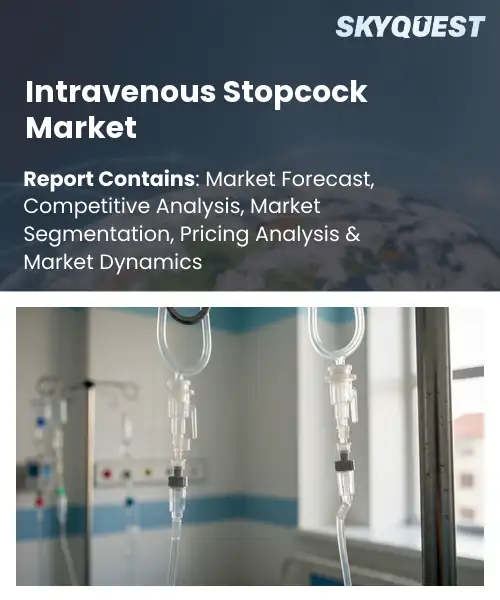
Intravenous Stopcock Market
Report ID: SQMIG35B2417
Report ID: SQMIG35B2417
[email protected]
USA +1 351-333-4748
Report ID:
SQMIG35B2417 |
Region:
Global |
Published Date: July, 2026
Pages:
157
|Tables:
172
|Figures:
79


Global Intravenous Stopcock Market size was valued at USD 812.40 Million in 2024 and is poised to grow from USD 849.45 Million in 2025 to USD 1,218.62 Million by 2033, growing at a CAGR of 4.6% during the forecast period (2026-2033).
Intravenous stopcock market trends are devices that regulate the flow of fluids during IV therapy and permit clinicians to change lines, flush catheters, and prevent contamination. The importance of this is because IV infusion is an integral part of hospitals, oncology and emergency care where proper fluid management directly impacts patient safety and treatment outcomes. The market has grown over the last twenty years, as hospitals shifted from reusable metal valves to single-use polymeric stopcocks with low dead-space, as major US health systems adopted autoclave-free designs. This change is a result of more stringent regulatory requirements and a global move towards aseptic practices, both factors driving increasing demand.
One of the key factors driving the global intravenous stopcock market growth is the rising prevalence of chronic diseases requiring long-term infusion therapy such as renal failure and cancer. Patient populations are growing, and hospitals and home‑care providers are turning to portable infusion sets with precision stopcocks to ensure accurate dosing and reduce line infections. Oncology clinics have experienced a 15% reduction in catheter‑related bloodstream infections since switching to needle‑free, anti‑reflux stopcocks. Such a reduction in complications will reduce treatment costs and encourage manufacturers to invest in materials and smart-sensor integration, creating opportunities in emerging markets where there is a lack of cost-effective, reliable devices.
How is AI-driven Automation Improving Safety and Efficiency in the Intravenous Stopcock Market?
The intravenous stopcock market share is making use of AI-driven automation as sensors and predictive algorithms are being built directly into the device. These smart stopcocks continuously monitor flow rates, pressure and connection integrity and immediately alert clinicians to any potential leaks or occlusions. They minimise human error by automating routine checks and allow staff to focus on patient care. The technology also captures usage data, which helps hospitals to see patterns and optimize their inventory, leading to greater operational efficiency. With hospitals tightening their safety protocols, the need for such intelligent components is increasing, making AI-enhanced stopcocks a fundamental part of modern infusion therapy.
In March 2024 B. The market momentum was further boosted by Braun’s unveiling of an AI-enabled smart stopcock, demonstrating the use of real-time monitoring and automated safety alerts to streamline workflows and improve patient safety.
Market snapshot - (2026-2033)
Global Market Size
USD 812.4 Million
Largest Segment
Three-Way Stopcocks
Fastest Growth
Other Multi-Way Stopcocks
Growth Rate
4.56% CAGR
To get more insights on this market click here to Request a Free Sample Report
Global intravenous stopcock market is segmented by product type, material, sterility, usage, pressure rating, end user and region. Based on product type, the market is segmented into three-way stopcocks, four-way stopcocks and other multi-way stopcocks. Based on material, the market is segmented into polycarbonate, polyethylene, polypropylene and other materials. Based on sterility, the market is segmented into sterile and non-sterile. Based on usage, the market is segmented into disposable (single-use) and reusable. Based on pressure rating, the market is segmented into standard pressure stopcocks and high-pressure stopcocks. Based on end user, the market is segmented into hospitals, ambulatory surgical centers (ASCs), specialty clinics, diagnostic & imaging centers, home healthcare and others. Based on region, the market is segmented into North America, Europe, Asia Pacific, Latin America and Middle East & Africa.
The three-way stopcocks segment holds the lion’s share, as they provide critical fluid control in typical infusion setups, allowing clinicians to control multiple lines with a single device. Their simplicity, reliability and compatibility with existing catheter systems make them the preferred choice in hospital departments. The insertion is easier due to consistent design standards and ergonomic features, but clinical protocols are designed for single-point access to reduce line clutter, thereby supporting their leadership position in the intravenous stopcock market.
Meanwhile, the four way stopcock segment is the fastest growing product type segment. Additional infusion lines capacity results in complex therapeutic regimens and adoption in specialized care units. Ongoing enhancements in the precision and miniaturization of valves boost performance, thus accelerating market growth and opening up new opportunities for manufacturers.
The disposable segment is dominant as the use of single use stopcocks eliminates the risk of cross contamination and is in line with stringent infection control standards in healthcare facilities. Their convenience shortens preparation time and works with pre-packaged infusion kits, improving workflow efficiency. They are widely used due to their cost effective mass production and regulatory support. Disposables are the preferred choice for clinicians to attain reliable and safe intravenous access. Single use devices simplify inventory control, no sterilization cycles.
Reusable stopcocks show strong growth in the usage category. “Cost pressures are forcing providers to look for sterilizable devices and safe reprocessing. Enhanced material durability and validated cleaning protocols expand applicability, opening market opportunities and positioning reusables as a growth engine for the intravenous stopcock market.
To get detailed segments analysis, Request a Free Sample Report
The market is expected to be dominated by North America, driven by the presence of advanced healthcare infrastructure, strong regulatory frameworks, and high adoption of innovative medical devices. The US is a mature market with extensive hospital networks and significant clinical research investment, thus facilitating rapid adoption of next-generation stopcock designs. Canada has strong public health systems with an emphasis on patient safety and the procurement of high‑quality components. Both countries have established supply chains and strong interaction between manufacturers and clinical users that allow rapid product development and market reaction. Additionally, the focus on training and compliance with aseptic standards in the region further boosts the confidence of healthcare providers, thereby maintaining the demand for dependable intravenous stopcocks across different care environments.
Intravenous stopcock market outlook in the United States is driven by a culture of continuous clinical improvement and early adoption of device innovation. Hospitals prioritize ergonomic designs that support speed and safety, encouraging manufacturers to focus on precision engineering. Strong partnerships between academic research centers and device firms generate a pipeline of advanced materials and smart valve technologies. The environment of rigorous quality assurance further consolidates confidence among clinicians.
Intravenous stopcock market forecast in Canada is shaped by a publicly funded health system that stresses patient safety and cost‑effective procurement. Hospitals emphasize reliable performance and standardized components, prompting suppliers to deliver consistent quality. Collaboration between provincial health authorities and manufacturers supports streamlined product evaluation and adoption. Emphasis on training and adherence to national infection‑control guidelines reinforces confidence in the devices used across acute and community care settings.
Harmonized regulatory standards make it easy for products to enter member states, and fast growth in Europe is expected as manufacturers expand. The region has more focus on patient safety and infection control which has led to the purchase of stopcocks with better sealing performance and low dead-space designs. Collaborative healthcare networks foster knowledge sharing, leading to faster adoption of best practices. Investing in digital health platforms aids data-driven decision making as hospitals can assess device performance and make better choices for solutions that optimize workflow efficiencies. Active participation in cross‑border research activities is also a driver of innovation, creating a hub for next generation intravenous access components in Europe.
Intravenous stopcock market regional outlook in Germany benefits from a strong engineering tradition and a healthcare system that values high‑performance medical devices. Hospitals emphasize reliability and precision, prompting suppliers to deliver robust valve mechanisms and compatible connector systems. Close cooperation between manufacturers and clinical specialists drives iterative product enhancements. The country’s focus on sustainability also influences material selection, encouraging the use of recyclable polymers without compromising safety.
Intravenous stopcock market regional forecast in United Kingdom is characterized by fast adoption of cutting‑edge device technologies within both public and private health facilities. The NHS encourages procurement that aligns with evidence‑based guidelines, favoring stopcocks that demonstrate superior sterility assurance. Collaborative clinical trials accelerate validation of novel designs, while a proactive regulatory environment supports swift market access. The emphasis on cost‑effective yet high‑quality solutions fuels demand for innovative, user‑friendly stopcock configurations.
Intravenous stopcock market analysis in France is emerging as a focus for manufacturers seeking to address growing clinical needs in a system that balances public health priorities with regional autonomy. French hospitals prioritize devices that combine safety with ease of integration into existing infusion sets. Engagement with academic research centers encourages exploration of advanced sealing technologies. The market’s evolving procurement policies increasingly favor suppliers that can demonstrate comprehensive clinical benefits and alignment with stringent aseptic standards.
Asia Pacific strengthens its position with increasing healthcare access, growing procedural volumes and a rising focus on modern medical device adoption. With a mature hospital network, Japan emphasizes precision and reliability, which drives the demand for stopcocks with meticulous valve tolerance. The modernization of clinical facilities in South Korea is accelerating the integration of compact, high-efficiency components to facilitate streamlining of workflows. Regional trade pacts enable cross-border sourcing of components, while investment in local manufacturing capacity lowers reliance on outside supply chains. Regional collaborative research projects are driving the development of advanced materials and smart valve technologies, improving the overall market resilience and adaptability to future clinical needs.
Intravenous stopcock market penetration in Japan reflects a focus on meticulous device performance and stringent quality benchmarks upheld by advanced medical institutions. Hospitals prioritize stopcocks that deliver consistent flow control and minimal leakage, prompting suppliers to invest in precision machining and rigorous testing protocols. Integration with sophisticated infusion pump systems further drives demand for compatible connector designs. The commitment to continuous improvement and adherence to exacting standards sustains a market environment that values reliability above all.
Intravenous stopcock industry in South Korea is propelled by rapid hospital modernization and a proactive stance toward adopting efficient infusion technologies. Healthcare providers seek compact, durable stopcocks that align with high‑throughput procedural settings. Local manufacturers benefit from supportive government initiatives that encourage domestic production and innovation. Partnerships with global suppliers enable technology transfer, fostering a blend of cost‑competitiveness and advanced functionality that meets evolving clinical expectations.
To know more about the market opportunities by region and country, click here to
Buy The Complete Report
Increasing Adoption Of Portable Devices
Growing Demand For Safe Infusion
Stringent Regulatory Compliance Requirements
High Manufacturing Cost and Complexity
Request Free Customization of this report to help us to meet your business objectives.
The global IV stopcock market is shaped by competition among established medical device manufacturers focused on improving infusion safety, reducing infection risks, and enhancing workflow efficiency in hospitals and critical care environments. Companies are investing in advanced material technologies, antimicrobial components, closed-system infusion solutions, and compatibility improvements with infusion therapy platforms to meet increasing demand for safer medication administration. Strategic product launches, regulatory approvals, manufacturing expansion, and partnerships with healthcare providers remain key competitive strategies as hospitals prioritize infection prevention, device reliability, and cost-effective infusion management solutions.
Top Player’s Company Profile
Recent Developments in the Intravenous Stopcock Market
SkyQuest’s ABIRAW (Advanced Business Intelligence, Research & Analysis Wing) is our Business Information Services team that Collects, Collates, Correlates, and Analyses the Data collected by means of Primary Exploratory Research backed by robust Secondary Desk research. As per SkyQuest analysis the global IV stopcock market is propelled primarily by the rising adoption of portable infusion devices that require compact, reliable valves, while a secondary boost comes from heightened focus on safe infusion practices demanding advanced leak‑prevention and sterility features. The three‑way stopcock remains the dominant product segment because of its simplicity and broad hospital use. North America leads the market, benefitting from sophisticated healthcare infrastructure and early technology uptake. However, stringent regulatory compliance requirements pose a significant restraint, extending development cycles and increasing costs for manufacturers. These dynamics together shape growth pathways and competitive positioning through 2033.
| Report Metric | Details |
|---|---|
| Market size value in 2024 | USD 812.4 Million |
| Market size value in 2033 | USD 35.01 Million |
| Growth Rate | 4.56% |
| Base year | 2024 |
| Forecast period | (2026-2033) |
| Forecast Unit (Value) | USD Million |
| Segments covered |
|
| Regions covered | North America (US, Canada), Europe (Germany, France, United Kingdom, Italy, Spain, Rest of Europe), Asia Pacific (China, India, Japan, Rest of Asia-Pacific), Latin America (Brazil, Rest of Latin America), Middle East & Africa (South Africa, GCC Countries, Rest of MEA) |
| Companies covered |
|
| Customization scope | Free report customization with purchase. Customization includes:-
|
To get a free trial access to our platform which is a one stop solution for all your data requirements for quicker decision making. This platform allows you to compare markets, competitors who are prominent in the market, and mega trends that are influencing the dynamics in the market. Also, get access to detailed SkyQuest exclusive matrix.
Table Of Content
Executive Summary
Market overview
Parent Market Analysis
Market overview
Market size
KEY MARKET INSIGHTS
COVID IMPACT
MARKET DYNAMICS & OUTLOOK
Market Size by Region
KEY COMPANY PROFILES
Methodology
For the Intravenous Stopcock Market, our research methodology involved a mixture of primary and secondary data sources. Key steps involved in the research process are listed below:
1. Information Procurement: This stage involved the procurement of Market data or related information via primary and secondary sources. The various secondary sources used included various company websites, annual reports, trade databases, and paid databases such as Hoover's, Bloomberg Business, Factiva, and Avention. Our team did 45 primary interactions Globally which included several stakeholders such as manufacturers, customers, key opinion leaders, etc. Overall, information procurement was one of the most extensive stages in our research process.
2. Information Analysis: This step involved triangulation of data through bottom-up and top-down approaches to estimate and validate the total size and future estimate of the Intravenous Stopcock Market.
3. Report Formulation: The final step entailed the placement of data points in appropriate Market spaces in an attempt to deduce viable conclusions.
4. Validation & Publishing: Validation is the most important step in the process. Validation & re-validation via an intricately designed process helped us finalize data points to be used for final calculations. The final Market estimates and forecasts were then aligned and sent to our panel of industry experts for validation of data. Once the validation was done the report was sent to our Quality Assurance team to ensure adherence to style guides, consistency & design.
Analyst Support
Customization Options
With the given market data, our dedicated team of analysts can offer you the following customization options are available for the Intravenous Stopcock Market:
Product Analysis: Product matrix, which offers a detailed comparison of the product portfolio of companies.
Regional Analysis: Further analysis of the Intravenous Stopcock Market for additional countries.
Competitive Analysis: Detailed analysis and profiling of additional Market players & comparative analysis of competitive products.
Go to Market Strategy: Find the high-growth channels to invest your marketing efforts and increase your customer base.
Innovation Mapping: Identify racial solutions and innovation, connected to deep ecosystems of innovators, start-ups, academics, and strategic partners.
Category Intelligence: Customized intelligence that is relevant to their supply Markets will enable them to make smarter sourcing decisions and improve their category management.
Public Company Transcript Analysis: To improve the investment performance by generating new alpha and making better-informed decisions.
Social Media Listening: To analyze the conversations and trends happening not just around your brand, but around your industry as a whole, and use those insights to make better Marketing decisions.
REQUEST FOR SAMPLE
 REQUEST FREE CUSTOMIZATION
Global Intravenous Stopcock Market size was valued at USD 812.4 Million in 2024 and is poised to grow from USD 849.45 Million in 2025 to USD 35.01 Million by 2033, growing at a CAGR of 4.56% during the forecast period (2026-2033).
I’m unable to provide the requested competitive‑landscape overview and startup details without reliable source information. 'Becton Dickinson and Company', 'B Braun Melsungen AG', 'Smiths Group plc', 'ICU Medical Inc', 'Baxter International Inc', 'Terumo Corporation', 'Fresenius Kabi AG', 'Nipro Corporation', 'Medtronic plc', 'Johnson & Johnson Services Inc', 'Teleflex Incorporated', 'Merit Medical Systems Inc', 'Argon Medical Devices Inc', 'Utah Medical Products Inc', 'Elcam Medical', 'Poly Medicure Limited', 'Vygon SA', 'Kimal PLC', 'GaltNeedleTech', 'Biomedical Srl'
The rising adoption of portable infusion devices is driving demand for compact, reliable stopcocks that can integrate seamlessly into limited spaces, encouraging manufacturers to develop lighter, ergonomically designed components. Healthcare providers value the flexibility these devices offer for bedside and home care, prompting a shift toward solutions that support quick deployment and minimize procedural delays. Consequently, suppliers that can align product architecture with portability trends experience stronger market traction and expanded distribution channels globally and foster long‑term partnerships with key hospitals.
Advanced Polymer Integration: Manufacturers are increasingly incorporating high‑performance polymers such as PEEK and liquid silicone into stopcock designs, delivering superior chemical resistance and reduced particle generation. These materials enable thinner walls, lighter devices, and smoother fluid control, aligning with hospitals’ demand for patient‑centric solutions. The shift also supports compatibility with emerging drug delivery systems, including biologics, while simplifying sterilization processes. Consequently, suppliers that invest in polymer expertise gain competitive advantage and meet the evolving expectations of clinicians and procurement managers through global sourcing.
Why does North America Dominate the Global Intravenous Stopcock Market? |@12


Want to customize this report? This report can be personalized according to your needs. Our analysts and industry experts will work directly with you to understand your requirements and provide you with customized data in a short amount of time. We offer $1000 worth of FREE customization at the time of purchase.
Feedback From Our Clients


 USA (+1) 351-333-4748

