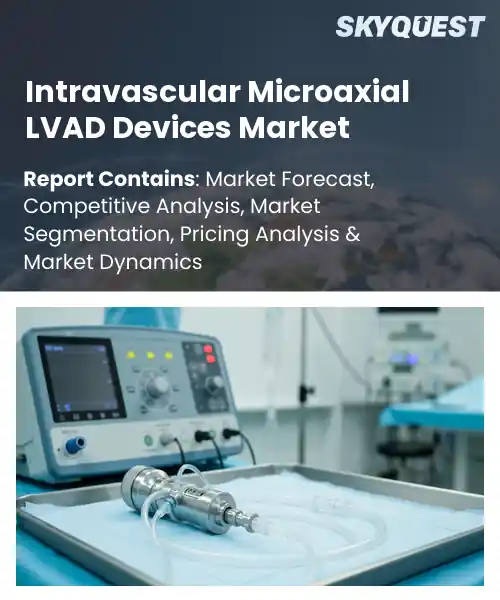
Intravascular Microaxial LVAD Devices Market
Report ID: SQMIG35A3276
Report ID: SQMIG35A3276
[email protected]
USA +1 351-333-4748
Report ID:
SQMIG35A3276 |
Region:
Global |
Published Date: February, 2026
Pages:
157
|Tables:
119
|Figures:
77


Global Intravascular Microaxial LVAD Devices Market size was valued at USD 594.0 Billion in 2024 and is poised to grow from USD 694.39 Billion in 2025 to USD 2421.68 Billion by 2033, growing at a CAGR of 16.9% during the forecast period (2026-2033).
Growing prevalence of advanced heart failure, rising incidence of cardiogenic shock, increasing adoption of minimally invasive cardiac support technologies, advancements in catheter-based circulatory support devices, and growing demand for rapid hemodynamic stabilization in critical care are driving sales of intravascular microaxial LVAD devices.
Continuous technological advancements are also reducing device size while improving hemodynamic performance, allowing clinicians to deploy these pumps more quickly and with fewer complications. As catheter profiles become smaller and motor efficiency improves, physicians can use these devices earlier during high-risk interventions and cardiogenic shock management. These clinical benefits help reduce reliance on vasopressors, improve organ perfusion, and shorten ICU stays, which lowers overall treatment costs and strengthens the value proposition for healthcare providers and payers. Growing incidence of acute cardiogenic shock and advanced heart failure coupled with increasing demand for rapid and minimally invasive circulatory support are expected to primarily drive intravascular microaxialLVAD devices market growth.
On the contrary, high device costs, risk of device-related complications such as bleeding or vascular injury, limited availability of trained specialists in some regions, and stringent regulatory approval requirements are predicted to impede intravascular microaxial LVAD devices market penetration across the study period.
AI is improving the performance and adoption of intravascular microaxial LVAD devices by enhancing monitoring, imaging, and clinical decision support. It analyzes real-time pump sensor data, uses AI-assisted echocardiography to confirm pump position and heart function, and provides predictive alerts when a patient’s condition may worsen. As microaxial pumps become more widely used as a less invasive circulatory support option, AI tools are improving safety, workflow efficiency, and treatment outcomes, encouraging broader adoption in hospitals.
Market snapshot - (2026-2033)
Global Market Size
USD 594.0 Billion
Largest Segment
Mid‑flow devices (3–4 L/min)
Fastest Growth
High‑flow devices (≥ 4 L/min)
Growth Rate
16.9% CAGR
To get more insights on this market click here to Request a Free Sample Report
Global intravascular microaxial LVAD devices market is segmented by product type, duration of support, clinical indication, end user, and region. Based on product type, the market is segmented into low‑flow devices (< 3 L/min), Mid‑flow devices (3–4 L/min), and high‑flow devices (≥ 4 L/min). Based on duration of support, the market is segmented into ultra‑short term (< 24 hours), short‑term (1–3 days),and prolonged support (> 3 days up to 14 days). Based on clinical indication, the market is segmented into Acute Myocardial Infarction (AMI) with cardiogenic shock, high‑risk Percutaneous Coronary Intervention (PCI), Post‑cardiotomy Shock (PCS), acute decompensated heart failure, and other indications. Based on end user, the market is segmented into tertiary care hospitals, specialized heart & vascular centers, and academic & research hospitals. Based on region, the market is segmented into North America, Europe, Asia Pacific, Latin America, and Middle East & Africa.
The high‑flow devices (≥ 4 L/min) segment is projected to lead the global intravascular microaxial LVAD devices market revenue generation across the study period. The ability of these systems to provide the strongest support in the setting of severe circulatory collapse and complex support is contributing to their dominance over other devices. This is because of the confidence they provide the clinicians in the management of severe cardiogenic shock. Continued engineering refinement, stronger clinical evidence, and integration with procedural workflows further entrench their role in acute care pathways.
However, mid‑flow devices (3–4 L/min) are emerging as the most rapidly expanding segment as per this intravascular microaxial LVAD devices industry analysis. These devices balance substantive circulatory support with lower invasiveness and simplified deployment, which creates new business scope. Growing adoption in high-risk PCI and short-term cardiogenic decline, targeted product innovation, and clearer regulatory pathways accelerate clinician uptake, enabling broader use across procedures and unlocking new treatment protocols that expand market opportunity.
The prolonged support (> 3 days up to 14 days) segment is predicted to account for the highest global intravascular microaxial LVAD devices market share going forward. Increased reliance on extended duration microaxial support as a bridging strategy to support the transition of critically ill patients to a path of recovery, transplantation, or definitive therapy contributes to this segment’s sustained dominance. This ability of this segment to sustain support has a direct influence on procurement decisions. Evidence demonstrating organ recovery and institutional willingness to manage extended courses further consolidate their prominence in care settings.
Meanwhile, short‑term (1–3 days) support is emerging as the fastest-growing segment, driven by demand for procedural haemodynamic protection during high-risk interventions and transient cardiogenic episodes. Rapid deployment designs, streamlined training requirements, and product features optimized for brief use lower logistical barriers and broaden adoption across cath labs and acute care units, creating new avenues for market expansion and device differentiation.
To get detailed segments analysis, Request a Free Sample Report
A robust collection of clinical, commercial, and infrastructural advantages that facilitate early adoption and sustained utilization of advanced cardiac care are helping North America lead intravascular microaxial LVAD devices sales. Barriers to the implementation of VADs will be reduced through strong training ecosystems, well established referral pathways, and high degrees of clinician familiarity. Comprehensive service and maintenance networks ensure reliable operations as well as long term clinician confidence in VADs. Furthermore, integrated data capture/quality programs will support evidence based refinement of clinical pathways and device utilization. Active collaboration and availability of robust venture capital backing are also expected to boost R&D and commercialization of novel intravascular microaxial LVAD devices across the study period and beyond.
Availability of extensive clinical expertise and strong collaboration between device manufacturers and leading cardiac programs support consistent demand for intravascular microaxial LVAD devices in the United States. High volume practices drive clinical skill and technology acceptance. Advanced healthcare infrastructure and sophisticated reimbursement systems enable access to advanced technology in circulatory support. Close ties between clinical researchers and device companies drive iterative device development, further boosting clinician confidence and acceptance.
Robust network of tertiary cardiac centers and growing clinician familiarity with percutaneous circulatory support are slated to influence intravascular microaxial LVAD devices demand in Canada. Public health delivery structures support access to specialized services. Academic hospitals and device innovators work together to create training programs which generate local evidence that enhances institutional capabilities for interventional cardiology and cardiac surgery teams.
Advancements in clinical practice, expanding institutional capacity, and intensified engagement from device developers drive steady demand for intravascular microaxial LVAD devices across Europe. Clinical registries, provider guidelines and agreements between different hospitals are improving patient selection and procedural pathways. Manufacturers are building stronger local commercial capabilities and providing more hands-on education and post-market support for operators. Reimbursement policies and centralized procurement in certain countries are helping hospitals use percutaneous mechanical circulatory support technologies more frequently due to increased familiarity among clinicians and the collaborative approach of physician-led multidisciplinary heart teams. Enhanced reporting of outcomes following surgery is generating greater confidence in the use of these technologies and further driving the adoption of intravascular microaxial LVAD devices by providers across all European countries.
Presence of a massive network of cardiac centers, robust hospital infrastructure, and deep clinician engagement with circulatory support technologies are driving intravascular microaxial LVAD devicesadoption in Germany. Favorable reimbursement frameworks and hospital investment priorities are also expected to uplift the sales of intravascular microaxial LVAD devices going forward. Launch of new training programs for operators and clinicians is also predicted to create new business scope.
High investments in tertiary cardiac services and clinician engagement with percutaneous support strategies support consistent intravascular microaxial LVAD devices demand in the United Kingdom. Academic hospitals and regional cardiac networks work together to create efficient systems which distribute procedural knowledge and practical training resources. Specialist centers receive operational control through system commissioning and dedicated patient referral routes.
Development of specialized cardiac centers and clinician training initiatives are slated to boost sales of intravascular microaxial LVAD devices in the country. Working together with academic organizations and pilot programs is building evidence at the local level. Companies providing local support and training programs help build readiness at the operator level. This is supporting the adoption and integration within the multidisciplinary heart teams across the heart care centers in France.
Expansion of clinical capacityy, rising healthcare spending, and growing incidence of cardiac disorders are positioning Asia Pacific as a rewarding region for intravascular microaxial LVAD devices providers. Emerging regional centers of excellence are developing focused operator training programs to improve procedural confidence. Multinational manufacturers are establishing a local presence, while regional innovators are advancing new supportive technologies and service models. Regulatory agencies are creating streamlined pathways to support evidence generation through clinical collaboration. Strategic collaboration between hospitals and industry for training, service support, and quality measurement in the post-procedure phase will greatly enhance clinician utilization rates and institutional commitment.
Presence of a developed hospital infrastructure, high clinician expertise in complex cardiac interventions, and growing geriatric population are supporting intravascular microaxial LVAD devices adoption in Japan. Increasing partnerships between medical institutions and medical device companies for clinical trials and training medical experts is also creating new business scope. Reimbursement considerations and coordinated regional referral pathways are also predicted to boost the sales of intravascular microaxial LVAD devices in the long run.
Rise in clinician adoption, high number of advanced hospitals, and proactive collaboration between device companies and medical centers are driving sales of intravascular microaxial LVAD devices in South Korea. The national medical innovation initiative provides support for clinical training together with development of advanced service capabilities. Experience concentration at referral centers enables development of medical protocols which use their specialized knowledge.
To know more about the market opportunities by region and country, click here to
Buy The Complete Report
Rising Prevalence of Heart Failure
The increase in the number of patients suffering from end-stage heart failure and cardiogenic shock creates the need for temporary and short-term circulatory support, and this has led hospitals and clinicians to seek effective mechanical devices such as microaxial LVADs. This has encouraged the increase in the number of patients, hence the need for investment in the acquisition of the devices and the development of clinical programs. It has also encouraged the manufacturers to focus on innovations across the intravascular microaxial LVAD devices market outlook as well as the broader cardiac care industry.
Technological Advancements In Devices
The continuous improvement in miniaturization, hemocompatibility, and monitoring aspects associated with these devices makes them more clinically relevant and increases the confidence level in utilizing these devices for patient care. Therefore, microaxial LVADs can be more widely used in a variety of clinical conditions because these devices can be more easily inserted in the body with a more favorable profile for these devices. Hence, more emphasis is being placed on design improvement for these devices, making them more clinically relevant for a variety of conditions for interventional cardiologists and intensivists.
High Procedural Costs and Reimbursement
The procedural costs involved in the implantation of medical devices, patient monitoring, etc., act as a deterrent for the adoption of microaxial LVADs by hospitals due to financial constraints. In addition, lack of adequate reimbursement policies for LVADs adds to the financial burden on healthcare providers or institutions, making them more reluctant to adopt this technology for their patients. As a result, hospitals are more likely to adopt established treatments or restrict LVADs to certain cases only, thereby impeding the widespread adoption of microaxial LVADs in different healthcare facilities.
Limited Clinical Expertise Availability
The clinical skills and coordination required to safely implant and manage microaxial devices limit the adoption of these devices due to the lack of expertise and experience among many surgeons and medical teams. This has led to the perceived difficulty and risk in performing these devices, making it difficult for many institutions to take up these technologies and widen the market reach of these devices, which is still largely confined to tertiary referral centers with high volumes and expertise in the management of these devices.
Request Free Customization of this report to help us to meet your business objectives.
Competition in the intravascular microaxial LVAD market is driven by a race to miniaturize pumps and improve deliverability, prompting incumbents and challengers to use acquisitions, licensing partnerships, and accelerated clinical programs to protect share and speed adoption. Here are a few startups that have the potential to revolutionize the future of intravascular microaxial LVAD devices as per this intravascular microaxial LVAD devices market analysis.
Catheter Miniaturization and Portability: Improvements in device design focus on miniaturization and delivery system design, which emerges as a key intravascular microaxial LVAD devices market trend in the future. Rising demand for minimally invasive implantation and adoption in procedural settings beyond tertiary care facilities are help boost the demand for novel intravascular microaxial LVADdevices. Hence, improving miniaturization and portability of microaxial pumps is gaining traction among all intravascular microaxial LVAD devices providers through 2033.
Integration with Remote Care: The increasing focus on connectivity has positioned intravascular microaxial LVADs as part of the ecosystem of remote care solutions. Integration of embedded sensors and interoperable platforms allows for physiological monitoring, which highlights the importance of this intravascular microaxial LVAD devices industry trend in the long run. Collaborations between device data streams and telehealth solutions has streamlined care coordination for different disciplines, thus reducing burden for patients and care teams.
SkyQuest’s ABIRAW (Advanced Business Intelligence, Research & Analysis Wing) is our Business Information Services team that Collects, Collates, Correlates, and Analyses the Data collected by means ofPrimary Exploratory Research backed by robust Secondary Desk research.
As per SkyQuest analysis, rising incidence of cardiogenic shock and increasing prevalence of advanced heart failure are anticipated to drive the demand for intravascular microaxial LVAD devices going forward. However, high device costs and risks of procedure-related complications such as bleeding and vascular injury are slated to slow down the adoption of intravascular microaxial LVAD devices in the future. North America is slated to spearhead the demand for intravascular microaxial LVAD devices owing to strong presence of advanced cardiac care infrastructure, high adoption of minimally invasive cardiovascular technologies, and favorable reimbursement policies. Development of AI-enabled monitoring and imaging tools and expansion of device indications for high-risk cardiac interventions are anticipated to be key trends driving the intravascular microaxial LVAD devices sector over the coming years.
| Report Metric | Details |
|---|---|
| Market size value in 2024 | USD 594.0 Billion |
| Market size value in 2033 | USD 2421.68 Billion |
| Growth Rate | 16.9% |
| Base year | 2024 |
| Forecast period | (2026-2033) |
| Forecast Unit (Value) | USD Billion |
| Segments covered |
|
| Regions covered | North America (US, Canada), Europe (Germany, France, United Kingdom, Italy, Spain, Rest of Europe), Asia Pacific (China, India, Japan, Rest of Asia-Pacific), Latin America (Brazil, Rest of Latin America), Middle East & Africa (South Africa, GCC Countries, Rest of MEA) |
| Companies covered |
|
| Customization scope | Free report customization with purchase. Customization includes:-
|
To get a free trial access to our platform which is a one stop solution for all your data requirements for quicker decision making. This platform allows you to compare markets, competitors who are prominent in the market, and mega trends that are influencing the dynamics in the market. Also, get access to detailed SkyQuest exclusive matrix.
Table Of Content
Executive Summary
Market overview
Parent Market Analysis
Market overview
Market size
KEY MARKET INSIGHTS
COVID IMPACT
MARKET DYNAMICS & OUTLOOK
Market Size by Region
KEY COMPANY PROFILES
Methodology
For the Intravascular Microaxial LVAD Devices Market, our research methodology involved a mixture of primary and secondary data sources. Key steps involved in the research process are listed below:
1. Information Procurement: This stage involved the procurement of Market data or related information via primary and secondary sources. The various secondary sources used included various company websites, annual reports, trade databases, and paid databases such as Hoover's, Bloomberg Business, Factiva, and Avention. Our team did 45 primary interactions Globally which included several stakeholders such as manufacturers, customers, key opinion leaders, etc. Overall, information procurement was one of the most extensive stages in our research process.
2. Information Analysis: This step involved triangulation of data through bottom-up and top-down approaches to estimate and validate the total size and future estimate of the Intravascular Microaxial LVAD Devices Market.
3. Report Formulation: The final step entailed the placement of data points in appropriate Market spaces in an attempt to deduce viable conclusions.
4. Validation & Publishing: Validation is the most important step in the process. Validation & re-validation via an intricately designed process helped us finalize data points to be used for final calculations. The final Market estimates and forecasts were then aligned and sent to our panel of industry experts for validation of data. Once the validation was done the report was sent to our Quality Assurance team to ensure adherence to style guides, consistency & design.
Analyst Support
Customization Options
With the given market data, our dedicated team of analysts can offer you the following customization options are available for the Intravascular Microaxial LVAD Devices Market:
Product Analysis: Product matrix, which offers a detailed comparison of the product portfolio of companies.
Regional Analysis: Further analysis of the Intravascular Microaxial LVAD Devices Market for additional countries.
Competitive Analysis: Detailed analysis and profiling of additional Market players & comparative analysis of competitive products.
Go to Market Strategy: Find the high-growth channels to invest your marketing efforts and increase your customer base.
Innovation Mapping: Identify racial solutions and innovation, connected to deep ecosystems of innovators, start-ups, academics, and strategic partners.
Category Intelligence: Customized intelligence that is relevant to their supply Markets will enable them to make smarter sourcing decisions and improve their category management.
Public Company Transcript Analysis: To improve the investment performance by generating new alpha and making better-informed decisions.
Social Media Listening: To analyze the conversations and trends happening not just around your brand, but around your industry as a whole, and use those insights to make better Marketing decisions.
REQUEST FOR SAMPLE
 REQUEST FREE CUSTOMIZATION
Global Intravascular Microaxial Lvad Devices Market size was valued at USD 594.0 Billion in 2024 and is poised to grow from USD 694.39 Billion in 2025 to USD 2421.68 Billion by 2033, growing at a CAGR of 16.9% during the forecast period (2026-2033).
Competition in the intravascular microaxial LVAD market is driven by a race to miniaturize pumps and improve deliverability, prompting incumbents and challengers to use acquisitions, licensing partnerships, and accelerated clinical programs to protect share and speed adoption. Examples include Johnson & Johnson’s acquisition of Abiomed, regional commercialization deals such as PulseCath’s China partnership, and recent clinical and financing milestones from emerging pVAD developers advancing low profile pump designs. 'Abbott Laboratories', 'Medtronic', 'Terumo Corporation', 'Boston Scientific', 'St. Jude Medical', 'Cardiac Assist', 'SynCardia Systems', 'arterial therapeutics', 'NovaCor Medical', 'HeartWare International', 'ReliantHeart', 'Getinge Group', 'CARMAT', 'BiVACOR', 'Xeltis', 'EROS Medical', 'CircuLite', 'Leviticus Cardio', 'Asahi Kasei Medical', 'Abiomed'
The growing number of patients with advanced heart failure and cardiogenic shock increases clinical demand for temporary and short-term circulatory support, prompting hospitals and clinicians to seek effective mechanical options such as microaxial LVADs. This broader patient pool encourages investment in device procurement and training, supports expanded clinical programs, and motivates manufacturers to prioritize innovations that improve ease of use and patient outcomes. Consequently, sustained clinical need directly stimulates adoption across acute care and cardiac centers seeking improved survival and recovery.
Catheter Miniaturization And Portability: Advancements in device design emphasize reduced profile and simplified delivery systems, enabling less invasive implantation and expanding procedural settings beyond tertiary centers. Smaller, portable microaxial pumps support rapid deployment in emergency and cath lab environments, improve patient comfort, and facilitate single operator use. Manufacturers focus on ergonomic consoles and disposables that streamline preparation. These innovations increase clinical flexibility, encourage adoption among broader range of clinicians, and create opportunity for new care models for timely circulatory support.
A robust collection of clinical, commercial, and infrastructural advantages that facilitate early adoption and sustained utilization of advanced cardiac care are helping North America lead intravascular microaxial LVAD devices sales.


Want to customize this report? This report can be personalized according to your needs. Our analysts and industry experts will work directly with you to understand your requirements and provide you with customized data in a short amount of time. We offer $1000 worth of FREE customization at the time of purchase.
Feedback From Our Clients


 USA (+1) 351-333-4748

