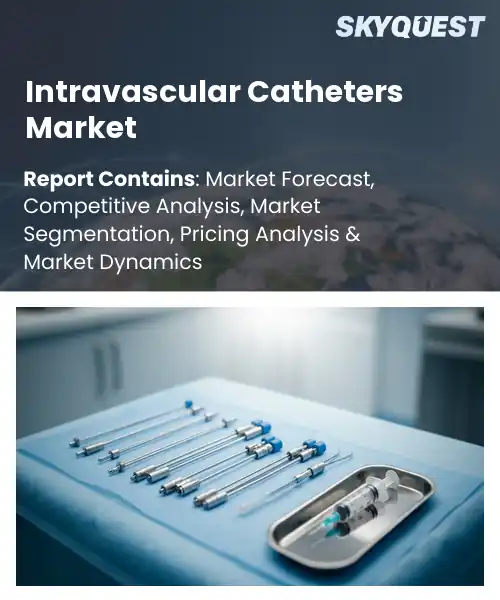
Intravascular Catheters Market
Report ID: SQMIG35A3434
Report ID: SQMIG35A3434
[email protected]
USA +1 351-333-4748
Report ID:
SQMIG35A3434 |
Region:
Global |
Published Date: May, 2026
Pages:
157
|Tables:
120
|Figures:
72


Global Intravascular Catheters Market size was valued at USD 12.52 Billion in 2024 and is poised to grow from USD 13.39 Billion in 2025 to USD 22.85 Billion by 2033, growing at a CAGR of 6.92% during the forecast period (2026-2033).
The demand for intravascular catheters market share is being driven by a number of factors but probably by the need to ensure reliable vascular access to an increasingly aging population and their medical needs. Intravascular catheters include both peripheral and central lines that are used to provide patients with life-saving medications through the use of chemotherapy, dialysis, parenteral nutrition, and intensive monitoring; in addition to allowing pharmacological intervention through critical therapies, they affect infection rates and costs associated with hospitalization. For example, historically, the intravascular catheter industry has evolved over the past several decades from the use of rubber tubing to the introduction of polyurethane and silicone devices that incorporate antimicrobial or heparin coatings, and include ultrasound-compatible construction, as well as implantable ports. The development of peripherally inserted central catheters (PICCs) as an alternative method for outpatient infusion therapy, as well as tunneled dialysis catheters for renal replacement therapy, has also demonstrated that advances in both clinical protocols and the science of materials have expanded the indications for use and the use of intravascular catheters.
Innovations in technology are now the primary driver of future growth in the global intravascular catheters market growth for invasive IV catheters. Because of product design innovations, the complication rates and cost of treating patients with IV catheters will decrease and as a result, providers will increasingly prefer using advanced products. Antimicrobials and antithrombotics on catheter surfaces can reduce CAUTIs, maximize the length of stay in the hospital, and provide stronger reimbursement opportunities for the health system. Additionally, alternative-site use of IV catheters (e.g., bedside placement of ultrasound compatible injection sites) is now possible with power injectable cathters, expanding the use of IVCs to home infusion and outpatient chemotherapy. Providers have started using coated PICCs, which have resulted in lower infection rates and faster transitions to ambulatory chemotherapy, while dialysis centers using tunneled catheters with higher levels of biocompatibility have also reported a decrease in thrombosis rates, creating significant commercial opportunity and scalability.
How is AI Improving Clinical Outcomes in the Intravascular Catheters Market?
Intravascular catheters market trends have been transformed by AI through the automation of image interpretation as well as the guidance of catheter positioning or placement and support of clinicians' decisions during procedures. Some key areas include intelligent intravascular imaging that recognizes lumen and vessel borders; automated lesion assessment and real-time guidance based on images captured by the intravascular ultrasound (IVUS) device to standardize stent sizes and deployment. The greater use of AI in IVUS and physiology platforms to reduce variability among practitioners (by removing the differences in talent levels) as well as to streamline workflow processes in catheterization labs is resulting in value to hospitals looking for safer procedure intervention and faster procedure throughput. AI products have also been developed to identify plaque morphology, suggest device sizes, and facilitate navigation to minimize complications and enhance consistency of results for these procedures.
A peer-reviewed study demonstrated the proof of concept describing the AVVIGO+ AI feature for automated lesion assessment of IVUS from Boston Scientific in July 2025. This advancement illustrates the positive influence of AI in assisting the advancement of the invascular ultrasound device category by supporting more streamlined procedural efficiencies, standardization of clinical decisions and establishing better access to intravascular imaging by healthcare providers for greater acceptance of this technology and improved clinical outcomes.
Market snapshot - (2026-2033)
Global Market Size
USD 12.52 Billion
Largest Segment
Peripheral IV Catheters
Fastest Growth
PICC Lines
Growth Rate
6.92% CAGR
To get more insights on this market click here to Request a Free Sample Report
Global intravascular catheters market is segmented by product type, material, application, end-user and region. Based on product type, the market is segmented into central venous catheters, peripheral IV catheters, dialysis catheters, PICC lines and pulmonary artery catheters. Based on material, the market is segmented into polyurethane, silicone and others. Based on application, the market is segmented into drug infusion, blood transfusion, hemodialysis and monitoring. Based on end-user, the market is segmented into hospitals, dialysis centers and ambulatory care. Based on region, the market is segmented into North America, Europe, Asia Pacific, Latin America and Middle East & Africa.
Central venous catheters (CVC) dominate the vascular access market. They provide long-term access via a centrally placed catheter to patients with complex therapies spanning critical care and oncology; they also support multiple lumen configurations with diverse clinical applications. Hospitals favor CVC contingent on their compatibility with power injection, integrated safety features, and clinician experience, thus promoting manufacturer's investment into refinement and supply chain scale to meet procurement needs by creating continued investment incentives for hospitals and specialty providers.
The most rapidly growing segment of the vascular access market is the peripherally inserted central catheters (PICC). This market is being driven by outpatient infusion growth, declines in insertion complexity requiring additional pre/post insertion hospital stay = decreased hospital costs. Improvements in antimicrobial coatings and the development of vascular access teams will continue to widen access to home health care providers and increase the number of ambulatory care facilities; therefore, this will introduce new procurement channels within the vascular access marketplace and create a larger market opportunity moving forward.
The hemodialysis market is currently leading the industry, with specialized and durable access devices needed to treat patients while withstanding aggressive blood flow conditions for long-term use. The need for ongoing renal replacement therapy has also encouraged dialysis providers and hospitals to constantly purchase access devices. As a result, manufacturers are developing products based on strict requirements regarding the strength of materials used in their production, lumen size and shape, and features to resist infection, thus creating significant clinical preference and investment in dedicated device portfolios, service support systems, and training programs that focus on outcomes.
In addition, device innovators are also expected to benefit from rapid growth in the monitoring segment as a result of increasing demand for continuous hemodynamic assessment and the integration of sensors into intravascular devices. The advancements being made through minimally invasive monitoring practices and technologies, connectivity and analytics are changing the clinical approach to treating patients and driving new care pathways and commercial models for device innovators to consider.
To get detailed segments analysis, Request a Free Sample Report
Due to a variety of factors that lead to its status as a market leader and continued innovation, North America is the largest market worldwide for vascular access devices. North America has a well-established medical infrastructure and concentration of major medical device manufacturers, which creates an optimal development and commercialization environment. The USA also has established processes for regulation and reimbursement for both inpatient and outpatient settings, facilitating to the adoption of devices. The close working relationships amongst hospitals, research institutions, and corporations create favourable conditions to refine products and develop Real World Evidence. In addition, high levels of demand from very complex healthcare needs for vascular access devices, along with mature distribution and service networks, have created more than enough depth and resiliency in the North American vascular access device marketplace than in any other region. In addition, the North American vascular access device marketplace continues to grow and be invested in because of high levels of R&D investment, extensive clinician training opportunities, and focus on infection control. Lastly, new product introductions and growth in manufacturing capacity in the North American vascular access device market are further supported through active strategic partnerships and investment capital flowing into the med-tech industry.
Intravascular catheters market analysis in the United States is driven by a dense network of care facilities; high volumes of procedures; and a significant concentration of innovative medical technologies. The high activity level of clinical trials and proximity to manufacturers allows for rapid adoption of newly designed catheter products. The care model also includes substantial reimbursement structure and sophisticated hospital purchasing systems that support product adoption. Additionally, hospitals focus on infection prevention strategies, clinician training, and post-market surveillance, which help establish trust in and standardization of advanced vascular access solutions.
Intravascular catheters market regional outlook in Canada has a public-funded structure with an emphasis on evidence based clinical practice and has well-developed academic hospital systems. There is an investment made by all of the regions into the procurement process and education for clinicians so that they will adopt the use of safer/effective/more minimally invasive vascular devices. The collaboration between regional health authorities and vendors provides for standardized protocols that help support these requests from clinicians. The population’s need to prevent infection and manage its population health will drive the need for reliable catheters and their associated innovative products that are aligned with the system’s goals of efficiency.
The growth of the European market can be attributed to modernization of clinical pathways for treating patients, combined with collaborative initiatives to improve patient safety, and a healthy mix of established global suppliers of medical equipment and nimble local innovators. The harmonization of regulatory pathways across different regions supports the approval of new products and the conduct of clinical trials on a transnational basis, while the increased emphasis on minimally invasive techniques drives up demand for advanced catheter technologies. Numerous national health systems as well as private hospital networks are moving toward standardizing clinical protocols and purchasing methodologies and will reward evidence-based clinical quality and safety. Transnational collaborations, public-private partnerships, and the growing focus on infection control and outcome measurement are also accelerating adoption. Regulatory harmonization and the existence of concentrated centers of vascular expertise in multiple countries creates opportunities for faster adoption of innovative intravascular access products.
Intravascular catheters market forecast in Germany has strong prospects due to the availability of cutting-edge hospital systems, comprehensive clinical research networks, and a robust base of manufacturers who support innovation and scalability. The existence of high-quality clinical evidence and the broad use of minimally invasive procedures encourage the use of advanced catheters. Collaboration between healthcare providers and manufacturers allows for thorough evaluations and improvement of products. The emphasis on the efficiency of procedures and patient safety ensures that there will continue to be a demand for dependable vascular access options throughout hospitals.
Intravascular catheters market outlook in the United Kingdom is advancing rapidly due to new policy initiatives, strong clinical leadership, and an emphasis on modernising care. Catheters that are minimally invasive are becoming increasingly common as a result of a greater emphasis on outpatient vascular care and the integration of digital health into the practice used to treat patients. As a result of the interactions between clinical trial sites, specialist clinicians and the developers of intravascular devices, pilot programmes have been accelerated and the generation of evidence has been greatly increased. The rate at which vascular access technologies can be scaled across the UK will be further increased by changing procurement models and training clinicians to use these technologies.
Intravascular catheters market penetration in France has achieved significant penetration due to improvements in various hospital practices, along with a greater level of collaboration between international medical device manufacturers and French clinical centers of excellence for vascular expertise. As a result, advanced catheter systems are being tested at these centers while procurement agencies increasingly focus on values such as clinical outcomes and cost effectiveness. Academic hospitals also work with manufacturers to adapt their products to specific hospitals and practices within France. Over time patient safety, infection prevention, and training have slowly but surely created a growing market for intravascular catheters in France.
The Asia Pacific area is growing its importance with their continued improvement of clinical facilities through additional clinical facilities, the growing capacity of local manufacturers and improved relationship to international medtech companies. Clinical excellence is evaluated and integrated in urban tertiary hospitals that have advanced catheter technology. Regional manufacturers are adapting the designs of products from international manufacturers so they fit the local clinical and pricing needs. Government regulations and funding for training and quality assurance are also improving the quality of practice and making regulations clearer. Partnerships, technology transfer, and localized supply chain enhancements are allowing for faster and easier access to new medical devices. Adoption of clinical guidelines, increased emphasis on cost efficient product development and increasing availability of outpatient vascular services will also expand the acceptance of new technologies within many health care systems.
Intravascular catheters industry in Japan is fueled by a well-established healthcare system, powerful medical research facilities, and precise engineering to create high-quality devices. Leading hospitals are centers for the clinical evaluation and implementation of new catheter technology and the partnership between manufacturers and clinical stakeholders ensures rigorous testing for safety and efficacy. Besides putting emphasis on procedural excellence, clinician training and surveillance ensures the ongoing confidence in, and utilisation of, innovative vascular access options across Japan.
Intravascular catheters market analysis in South Korea has advantages due to a robust medical device industry, strong electronics capabilities, and an active public policy supporting the advancement of new technologies in health care. Tertiary hospitals and specialized clinics are responsible for testing and adopting new catheter technologies. Close collaboration between manufacturers, research institutes, and hospitals allows for fast iterations and entertainment of characteristics so that the products are better suited to the South Korean market based upon the advice of clinicians. The use of quality assurance processes, training of clinicians, and production for export support both the growth of domestic markets and competitiveness in international markets.
To know more about the market opportunities by region and country, click here to
Buy The Complete Report
Rising Chronic Disease Burden
Technological Innovations In Devices
High Product Development Costs
Catheter Related Infection Concerns
Request Free Customization of this report to help us to meet your business objectives.
Incumbents are consolidating and differentiating through technology with a variety of tactics, executing focused M&A, forming regional distribution partnerships, and providing platform innovations to create clinical pathways. Both the recent acquisition by Johnson & Johnson of Shockwave Medical and Abiomed's acquisition of preCARDIA are examples of this competitive strategy while numerous distribution joint ventures and investment in both AI-enabled imaging and catheter-directed methods of oxygenation also raises competitive rivalry and makes it more difficult for new companies to enter this space.
Flow Medical: Established in 2020, was created to develop a steerable, integrated thrombolysis and monitoring catheter to improve precision and outcomes when treating pulmonary embolism with catheter-directed therapies. Recently, they have closed initial seed funding for their early stages of research and development (having raised friends and family funding in late 2023), appointed an experienced CEO to facilitate the translation from bench to bedside, and have partnered under an SBIR matching grant to enhance the design of their device and prepare for regulatory submissions.
Top Player’s Company Profile
Recent Developments in the Intravascular Catheters Market
SkyQuest’s ABIRAW (Advanced Business Intelligence, Research & Analysis Wing) is our Business Information Services team that Collects, Collates, Correlates, and Analyses the Data collected by means of Primary Exploratory Research backed by robust Secondary Desk research.
As per SkyQuest analysis, the market for intravascular catheters worldwide is being driven by two main factors: the increasing need for dependable access to veins due to a growing elderly population and an increase in non-communicable diseases; and rapid advances in technology which enhance the properties of the catheter (antimicrobial surface coatings, antithrombotic surface coatings, ultrasound compatible) and improve therapeutic outcomes through the use of artificial intelligence to produce images that enable better treatment decisions or to reduce complications and help patients receive care at home rather than going into the hospital. An important constraint on the market is the concern over catheter-associated infections, which limit the use of catheters and create significant costs related to the validation of catheters and the training of physicians to use them properly. The leading region is North America because of its well developed healthcare systems and strong medical device industry, while the leading segment of the global catheter market is central venous catheters, due to their important role in providing long-term vascular access for oncology patients, patients requiring critical care, and patients receiving complex therapies.
| Report Metric | Details |
|---|---|
| Market size value in 2024 | USD 12.52 Billion |
| Market size value in 2033 | USD 22.85 Billion |
| Growth Rate | 6.92% |
| Base year | 2024 |
| Forecast period | (2026-2033) |
| Forecast Unit (Value) | USD Billion |
| Segments covered |
|
| Regions covered | North America (US, Canada), Europe (Germany, France, United Kingdom, Italy, Spain, Rest of Europe), Asia Pacific (China, India, Japan, Rest of Asia-Pacific), Latin America (Brazil, Rest of Latin America), Middle East & Africa (South Africa, GCC Countries, Rest of MEA) |
| Companies covered |
|
| Customization scope | Free report customization with purchase. Customization includes:-
|
To get a free trial access to our platform which is a one stop solution for all your data requirements for quicker decision making. This platform allows you to compare markets, competitors who are prominent in the market, and mega trends that are influencing the dynamics in the market. Also, get access to detailed SkyQuest exclusive matrix.
Table Of Content
Executive Summary
Market overview
Parent Market Analysis
Market overview
Market size
KEY MARKET INSIGHTS
COVID IMPACT
MARKET DYNAMICS & OUTLOOK
Market Size by Region
KEY COMPANY PROFILES
Methodology
For the Intravascular Catheters Market, our research methodology involved a mixture of primary and secondary data sources. Key steps involved in the research process are listed below:
1. Information Procurement: This stage involved the procurement of Market data or related information via primary and secondary sources. The various secondary sources used included various company websites, annual reports, trade databases, and paid databases such as Hoover's, Bloomberg Business, Factiva, and Avention. Our team did 45 primary interactions Globally which included several stakeholders such as manufacturers, customers, key opinion leaders, etc. Overall, information procurement was one of the most extensive stages in our research process.
2. Information Analysis: This step involved triangulation of data through bottom-up and top-down approaches to estimate and validate the total size and future estimate of the Intravascular Catheters Market.
3. Report Formulation: The final step entailed the placement of data points in appropriate Market spaces in an attempt to deduce viable conclusions.
4. Validation & Publishing: Validation is the most important step in the process. Validation & re-validation via an intricately designed process helped us finalize data points to be used for final calculations. The final Market estimates and forecasts were then aligned and sent to our panel of industry experts for validation of data. Once the validation was done the report was sent to our Quality Assurance team to ensure adherence to style guides, consistency & design.
Analyst Support
Customization Options
With the given market data, our dedicated team of analysts can offer you the following customization options are available for the Intravascular Catheters Market:
Product Analysis: Product matrix, which offers a detailed comparison of the product portfolio of companies.
Regional Analysis: Further analysis of the Intravascular Catheters Market for additional countries.
Competitive Analysis: Detailed analysis and profiling of additional Market players & comparative analysis of competitive products.
Go to Market Strategy: Find the high-growth channels to invest your marketing efforts and increase your customer base.
Innovation Mapping: Identify racial solutions and innovation, connected to deep ecosystems of innovators, start-ups, academics, and strategic partners.
Category Intelligence: Customized intelligence that is relevant to their supply Markets will enable them to make smarter sourcing decisions and improve their category management.
Public Company Transcript Analysis: To improve the investment performance by generating new alpha and making better-informed decisions.
Social Media Listening: To analyze the conversations and trends happening not just around your brand, but around your industry as a whole, and use those insights to make better Marketing decisions.
REQUEST FOR SAMPLE
 REQUEST FREE CUSTOMIZATION
Global Intravascular Catheters Market size was valued at USD 12.52 Billion in 2024 and is poised to grow from USD 13.39 Billion in 2025 to USD 22.85 Billion by 2033, growing at a CAGR of 6.92% during the forecast period (2026-2033).
The competitive landscape is driven by consolidation and technology differentiation with incumbents executing targeted M&A, regional distribution partnerships, and platform innovation to secure clinical pathways. Examples include Johnson & Johnson’s acquisition of Shockwave Medical and Abiomed’s purchase of preCARDIA, while distribution joint ventures and investments in AI-enabled imaging and catheter-directed oxygenation intensify competition and raise barriers to entry. 'Becton Dickinson', 'Medtronic plc', 'Teleflex Inc.', 'Edwards Lifesciences', 'Cook Medical', 'Arrow International (Teleflex)', 'AngioDynamics', 'ICU Medical', 'Merit Medical Systems', 'B. Braun SE', 'Nipro Corporation', 'Biosig Technologies', 'NovaBay Pharmaceuticals', 'Vygon SA', 'Smiths Medical (ICU Medical)'
The increasing prevalence of chronic cardiovascular, renal, and oncological conditions drives sustained demand for intravascular catheters as essential tools for long-term vascular access, dialysis, chemotherapy, and hemodynamic monitoring. Clinicians and healthcare providers prioritize reliable catheter solutions to support ongoing patient management, which encourages procurement and formulary inclusion. Hospitals invest in catheter inventories and training to maintain care continuity, while manufacturers focus on device reliability and compatibility. This sustained clinical reliance on intravascular access reinforces market expansion through consistent consumption and institutional purchasing practices.
Connected Catheter Systems: Adoption of smart, sensor-enabled catheters and interoperable platforms is reshaping procedural workflow and postprocedure monitoring. Manufacturers are integrating telemetry, pressure and flow sensing, and secure data transmission to support real-time decision making and remote collaboration among clinicians. This trend emphasizes ecosystem partnerships with device makers, software vendors, and health systems to deliver integrated solutions that improve procedural efficiency, reduce variability, and enable longitudinal patient follow up through continuous data capture and analytics-driven insights for personalized care pathways and outcomes optimization.
Why does North America Dominate the Global Intravascular Catheters Market? |@12


Want to customize this report? This report can be personalized according to your needs. Our analysts and industry experts will work directly with you to understand your requirements and provide you with customized data in a short amount of time. We offer $1000 worth of FREE customization at the time of purchase.
Feedback From Our Clients


 USA (+1) 351-333-4748

