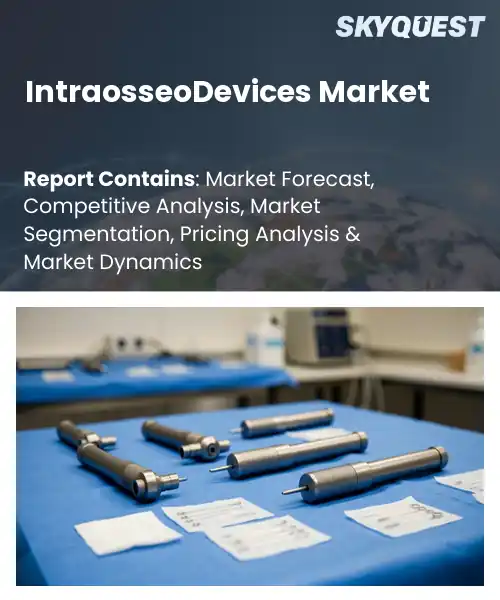
Intraosseous Devices Market
Report ID: SQMIG35A4463
Report ID: SQMIG35A4463
[email protected]
USA +1 351-333-4748
Report ID:
SQMIG35A4463 |
Region:
Global |
Published Date: August, 2026
Pages:
157
|Tables:
173
|Figures:
79


Global Intraosseous Devices Market size was valued at USD 0.78 Billion in 2024 and is poised to grow from USD 0.84 Billion in 2025 to USD 1.54 Billion by 2033, growing at a CAGR of 7.8% during the forecast period (2026-2033).
The intraosseous device market trends encompasses implants and delivery systems that penetrate bone to provide stable fixation or to deliver drugs into the medullary cavity. Its importance stems from the ability to achieve hemostasis in trauma, enhance prosthetic anchorage, and enable infusion for chronic conditions such as osteoporosis. The primary driver of market expansion is the rising incidence of traumatic injuries and orthopedic surgeries fueled by aging populations. Over the past decade, adoption has accelerated; for example, intraosseous catheters became standard in emergency departments worldwide, while porous titanium implants have gained regulatory approval, illustrating a trajectory from niche to mainstream practice.
Building on that foundation, the emergence of smart‑sensor integration stands as the pivotal factor reshaping the global intraosseous devices market growth. By embedding telemetry that monitors pressure, temperature, and biochemical markers, manufacturers enable clinicians to adjust therapy in real time, thereby reducing complications such as infection or bone necrosis. This capability fuels demand in intensive‑care units where continuous monitoring improves patient outcomes and shortens hospital stay, which in turn drives cost‑effectiveness for health systems. Consequently, venture capital flows toward startups developing Bluetooth‑enabled catheters and bio‑resorbable scaffolds, creating expansion opportunities across emerging economies that are modernizing trauma care infrastructure globally and sustainably.
How is AI Improving Safety and Efficacy in the Intraosseous Devices Market?
Artificial intelligence is reshaping intraosseous devices by adding layers of safety and precision. AI algorithms analyze sensor data and imaging in real time, guiding clinicians to the optimal insertion point and depth. Predictive models flag potential complications before they occur, while machine learning based training simulators build operator confidence. The market, driven by the need for rapid vascular access in emergency and pre hospital settings, benefits from reduced insertion errors and faster drug delivery. Recent device designs embed micro sensors that transmit continuous feedback to a handheld interface, allowing immediate adjustments. These advances make the technology more reliable and expand its use beyond hospitals into field care.
In March 2024 a leading intraosseous devices manufacturer introduced an AI guided insertion system that improves placement accuracy and lowers complication risk, supporting market growth and efficiency.
Market snapshot - (2026-2033)
Global Market Size
USD 0.78 Billion
Largest Segment
Intraosseous Access Systems
Fastest Growth
Intraosseous Drill Systems
Growth Rate
7.8% CAGR
To get more insights on this market click here to Request a Free Sample Report
Global intraosseous devices market is segmented by product type, age group, application, end user, usage, distribution channel and region. Based on product type, the market is segmented into intraosseous needles, intraosseous access systems, intraosseous drill systems and others. Based on age group, the market is segmented into adult, pediatric and neonatal. Based on application, the market is segmented into emergency medicine, trauma care, critical care and others. Based on end user, the market is segmented into hospitals, emergency medical services, military and others. Based on usage, the market is segmented into disposable and reusable. Based on distribution channel, the market is segmented into direct sales, medical distributors and online. Based on region, the market is segmented into North America, Europe, Asia Pacific, Latin America and Middle East & Africa.
Intraosseous needles segment dominates because they represent the most fundamental and widely adopted tool for rapid vascular access across diverse clinical settings. Their simplicity, low cost, and compatibility with existing emergency kits drive universal acceptance among clinicians. The ease of insertion and minimal training requirements reinforce their preference, ensuring they remain the primary choice for immediate care. Consequently, they anchor the market’s volume and shape product development priorities.
However, intraosseous access systems segment emerges as the most rapidly expanding area, propelled by integrated safety features and automated insertion mechanisms that reduce procedural errors. Ongoing innovations enhance user confidence, while expanding indications in prehospital and critical care environments stimulate adoption, positioning this segment as a catalyst for future market growth.
Hospitals segment dominates because they generate the largest procurement volumes, driven by continuous demand for reliable intraosseous access in emergency departments, intensive care units, and surgical suites. Institutional purchasing power enables bulk contracts, encouraging manufacturers to prioritize hospital focused designs and compliance with stringent regulatory standards. The need for standardized training programs and integration with hospital information systems further consolidates their central role, anchoring market stability and guiding innovation pathways.
On the other hand, military segment is witnessing the strongest growth momentum, fueled by heightened investment in battlefield medical readiness and portable intraosseous solutions. Emerging compact, ruggedized devices tailored for austere environments attract defense procurement, while training initiatives expand user familiarity. This surge propels market diversification and opens avenues for technology transfer.
To get detailed segments analysis, Request a Free Sample Report
North America leads the intraosseous devices market because of a confluence of advanced healthcare infrastructure, deep investment in research and development, and a regulatory environment that encourages rapid product introduction. The region benefits from a mature network of academic medical centers that collaborate closely with device manufacturers, fostering continuous innovation in surgical techniques. Reimbursement frameworks are well‑aligned with the value of minimally invasive orthopedic solutions, enabling hospitals and clinics to adopt new technologies without fiscal hesitation. Additionally, a highly skilled surgical workforce drives demand for sophisticated intraosseous devices, while robust supply chains ensure timely availability across the United States and Canada. This combination of clinical expertise, supportive policy, and commercial readiness sustains North America’s dominant position. The collaborative ecosystem also accelerates clinical trials, allowing evidence‑based adoption to spread quickly among practitioners.
Intraosseous devices market outlook in the United States is shaped by a vast network of leading research hospitals that drive early adoption of cutting‑edge orthopedic solutions. Strong intellectual property protections encourage manufacturers to introduce innovative designs, while payer systems increasingly recognize the clinical benefits of intraosseous technologies. Collaborative partnerships between academia, industry, and professional societies streamline training programs, ensuring surgeons are proficient in the latest device applications across diverse clinical settings today.
Intraosseous devices market forecast in Canada benefits from a publicly funded health system that emphasizes evidence‑based adoption and cost‑effectiveness. Provincial health authorities work closely with clinical experts to evaluate new intraosseous technologies, facilitating uniform rollout across major hospitals. Strong academic collaborations and a focus on patient outcomes drive continuous refinement of surgical protocols, while domestic manufacturers leverage this environment to develop devices tailored to the specific needs of Canadian orthopedic practice today.
Europe’s intraosseous device sector is expanding rapidly due to harmonized regulatory standards that simplify cross‑border product approvals and encourage multinational collaborations. Health systems across the continent place growing emphasis on minimally invasive orthopedic procedures, recognizing their potential to reduce hospital stays and improve patient recovery. Robust funding for clinical research, combined with a dense network of specialized orthopedic centers, accelerates the generation of real‑world evidence supporting device efficacy. Additionally, a strong tradition of engineering excellence and precision manufacturing in key markets fuels continuous product refinement. Collaborative initiatives between academic institutions, industry consortia, and policy makers further align reimbursement incentives with innovative treatment pathways, creating a fertile environment for sustained market growth throughout Europe. The focus on patient‑centered outcomes also drives clinicians to adopt newer intraosseous solutions that demonstrate clear clinical advantage.
Intraosseous devices market regional outlook in Germany is anchored by a reputation for precision engineering and a strong industrial base that produces high‑quality orthopedic components. Close collaboration between device manufacturers and leading university hospitals accelerates clinical validation, while national health insurance schemes support reimbursement for proven technologies. The country’s emphasis on rigorous clinical training ensures surgeons are adept at integrating intraosseous devices into complex procedures, reinforcing Germany’s position as a dominant European market.
Intraosseous devices market regional forecast in the United Kingdom benefits from a research ecosystem that translates academic discoveries into commercial products. The National Health Service pilots innovative intraosseous solutions within specialized orthopedic units, creating adoption pathways. Strong ties between industry and professional societies foster education for surgeons, while reimbursement policies increasingly reflect the value of minimally invasive techniques. This framework positions the United Kingdom as the fastest‑growing market in Europe for intraosseous devices.
Intraosseous devices market penetration in France is emerging as a hub for innovative orthopedic solutions, driven by health policy that encourages early adoption of validated technologies. Collaborative research programs linking national hospitals with device manufacturers accelerate the generation of evidence supporting intraosseous applications. Reimbursement mechanisms are evolving to reward outcomes that reduce recovery time, while professional societies provide training that equips surgeons with the skills needed to integrate these devices into practice.
Asia Pacific is strengthening its position in the intraosseous device arena through a blend of demographic pressure, technological ambition, and supportive policy environments. An aging population coupled with rising incidence of musculoskeletal disorders fuels demand for advanced orthopedic interventions that minimize hospital stays. Governments across the region are investing in modern healthcare infrastructure and encouraging domestic innovation, leading to the emergence of high‑tech manufacturing clusters in Japan and South Korea. Close collaboration between academic research institutes and device firms accelerates the development of precision‑engineered solutions tailored to local clinical needs. Additionally, expanding private healthcare networks and increasing patient awareness of minimally invasive options are accelerating market adoption, positioning Asia Pacific as a rapidly advancing hub for intraosseous technology. The region’s focus on digital integration further enhances surgical precision and post‑operative monitoring.
Intraosseous devices market analysis in Japan is characterized by a commitment to quality standards and a culture of precision engineering. The country’s network of university hospitals collaborates closely with domestic manufacturers to validate new intraosseous technologies through clinical studies. Government initiatives that promote medical device research, combined with an aging demographic, drive sustained demand for minimally invasive orthopedic solutions. This ecosystem supports innovation and positions Japan as a market in the region.
Intraosseous devices industry in South Korea is driven by adoption of health tools and a focus on research‑based product development. Partnerships between biotech startups and established device firms accelerate creation of intraosseous solutions that incorporate sensor data for surgical precision. Health programs support minimally invasive orthopedic care with reimbursement pathways, encouraging clinicians to use devices. This environment promotes market growth and positions South Korea as a key innovator in the region.
To know more about the market opportunities by region and country, click here to
Buy The Complete Report
Adopting Advanced Imaging Guidance
Growing Preference for Minimally Invasive Procedures
Regulatory Hurdles Delay Market Entry
Limited Reimbursement Frameworks Constrain Adoption
Request Free Customization of this report to help us to meet your business objectives.
The global intraosseous device market is highly competitive, with established medical-device manufacturers and specialized emergency-care companies competing through device reliability, insertion speed, needle safety, patient-size coverage, portability, and ease of use. Major participants include Teleflex, Becton, Dickinson and Company, PerSys Medical, SAM Medical, Cook Medical, Vygon, Cardinal Health, Merit Medical Systems, Medtronic, Stryker, ICU Medical, Ambu, Fresenius Kabi, Argon Medical Devices, and Medline Industries. Teleflex maintains a strong position through its Arrow EZ-IO intraosseous vascular access system, which offers powered insertion, multiple needle lengths, stabilization and extension accessories, and applications across hospital, pre-hospital, military, and transport settings. BD competes with its Intraosseous Vascular Access System, offering both manual and powered access, multiple needle lengths, integrated needle-tip safety, rechargeable powered drivers, and securement features. PerSys Medical and SAM Medical further strengthen competition through compact, rapid-deployment IO systems designed for emergency and pre-hospital use. Competitive differentiation increasingly centers on first-pass success, insertion control, sharps safety, portability, procedure standardization, training support, and the ability to serve adult and pediatric patients in emergency, trauma, military, and EMS environments.
Top Player’s Company Profile
Recent Developments
SkyQuest’s ABIRAW (Advanced Business Intelligence, Research & Analysis Wing) is our Business Information Services team that Collects, Collates, Correlates, and Analyses the Data collected by means of Primary Exploratory Research backed by robust Secondary Desk research. As per SkyQuest analysis the intraosseous devices market is driven foremost by advanced imaging guidance that enhances placement precision, while the parallel surge in minimally invasive procedure preference further fuels demand. The most used product category remains intraosseous needles, anchoring overall volume, and North America continues to lead thanks to its strong healthcare infrastructure and R&D ecosystem. However, stringent regulatory approval processes pose a significant restraint, slowing new product introductions and adding cost for developers. Together these forces shape a market where innovation thrives yet must navigate compliance hurdles to sustain growth in the coming decade.
| Report Metric | Details |
|---|---|
| Market size value in 2024 | USD 0.78 Billion |
| Market size value in 2033 | USD 1.54 Billion |
| Growth Rate | 7.8% |
| Base year | 2024 |
| Forecast period | (2026-2033) |
| Forecast Unit (Value) | USD Billion |
| Segments covered |
|
| Regions covered | North America (US, Canada), Europe (Germany, France, United Kingdom, Italy, Spain, Rest of Europe), Asia Pacific (China, India, Japan, Rest of Asia-Pacific), Latin America (Brazil, Rest of Latin America), Middle East & Africa (South Africa, GCC Countries, Rest of MEA) |
| Companies covered |
|
| Customization scope | Free report customization with purchase. Customization includes:-
|
To get a free trial access to our platform which is a one stop solution for all your data requirements for quicker decision making. This platform allows you to compare markets, competitors who are prominent in the market, and mega trends that are influencing the dynamics in the market. Also, get access to detailed SkyQuest exclusive matrix.
Table Of Content
Executive Summary
Market overview
Parent Market Analysis
Market overview
Market size
KEY MARKET INSIGHTS
COVID IMPACT
MARKET DYNAMICS & OUTLOOK
Market Size by Region
KEY COMPANY PROFILES
Methodology
For the Intraosseous Devices Market, our research methodology involved a mixture of primary and secondary data sources. Key steps involved in the research process are listed below:
1. Information Procurement: This stage involved the procurement of Market data or related information via primary and secondary sources. The various secondary sources used included various company websites, annual reports, trade databases, and paid databases such as Hoover's, Bloomberg Business, Factiva, and Avention. Our team did 45 primary interactions Globally which included several stakeholders such as manufacturers, customers, key opinion leaders, etc. Overall, information procurement was one of the most extensive stages in our research process.
2. Information Analysis: This step involved triangulation of data through bottom-up and top-down approaches to estimate and validate the total size and future estimate of the Intraosseous Devices Market.
3. Report Formulation: The final step entailed the placement of data points in appropriate Market spaces in an attempt to deduce viable conclusions.
4. Validation & Publishing: Validation is the most important step in the process. Validation & re-validation via an intricately designed process helped us finalize data points to be used for final calculations. The final Market estimates and forecasts were then aligned and sent to our panel of industry experts for validation of data. Once the validation was done the report was sent to our Quality Assurance team to ensure adherence to style guides, consistency & design.
Analyst Support
Customization Options
With the given market data, our dedicated team of analysts can offer you the following customization options are available for the Intraosseous Devices Market:
Product Analysis: Product matrix, which offers a detailed comparison of the product portfolio of companies.
Regional Analysis: Further analysis of the Intraosseous Devices Market for additional countries.
Competitive Analysis: Detailed analysis and profiling of additional Market players & comparative analysis of competitive products.
Go to Market Strategy: Find the high-growth channels to invest your marketing efforts and increase your customer base.
Innovation Mapping: Identify racial solutions and innovation, connected to deep ecosystems of innovators, start-ups, academics, and strategic partners.
Category Intelligence: Customized intelligence that is relevant to their supply Markets will enable them to make smarter sourcing decisions and improve their category management.
Public Company Transcript Analysis: To improve the investment performance by generating new alpha and making better-informed decisions.
Social Media Listening: To analyze the conversations and trends happening not just around your brand, but around your industry as a whole, and use those insights to make better Marketing decisions.
REQUEST FOR SAMPLE
 REQUEST FREE CUSTOMIZATION
Global Intraosseodevices Market size was valued at USD 0.78 Billion in 2024 and is poised to grow from USD 0.84 Billion in 2025 to USD 1.54 Billion by 2033, growing at a CAGR of 7.8% during the forecast period (2026-2033).
The intraosseous device market is shaped by intense competition among established medical technology firms such as Becton Dickinson, Medtronic, Cook Medical and Teleflex, each leveraging strategic M&A, distribution alliances and rapid tech innovation to secure hospital contracts. Recent examples include Medtronic’s partnership with a major health system to integrate smart infusion monitoring, and Teleflex’s acquisition of a niche catheter manufacturer to broaden its product portfolio. 'Teleflex Incorporated', 'Becton, Dickinson and Company', 'SAM Medical', 'PerSys Medical', 'Cook Medical', 'Pyng Medical Corp.', 'Vygon SA', 'Cardinal Health, Inc.', 'Sarstedt AG & Co. KG', 'Merit Medical Systems, Inc.', 'Smiths Medical', 'Medtronic plc', 'Stryker Corporation', 'ICU Medical, Inc.', 'NIO (PerSys Medical)', 'Ambu A/S', 'Fresenius Kabi AG', 'Argon Medical Devices, Inc.', 'Medline Industries, LP', 'Teleflex Arrow'
The integration of high‑resolution imaging modalities enables surgeons to visualize bone structures with greater clarity, reducing procedural uncertainty and enhancing precision in device placement. Clinicians benefit from real‑time feedback, which shortens operative time and minimizes tissue disruption. This confidence drives broader acceptance of intraosseous devices across various clinical settings, encouraging hospitals to incorporate the technology into standard practice. Consequently, the market experiences increased demand as institutions prioritize improved patient outcomes and operational efficiency. The improved visualization also supports training programs, helping new surgeons acquire competence more rapidly.
Minimally Invasive Adoption Surge: The shift toward minimally invasive procedures is accelerating the demand for intraosseous devices that can be placed quickly through small incisions. Surgeons value solutions that reduce operative time, lower infection risk, and shorten patient recovery. Device manufacturers are responding by designing compact, ergonomically engineered needles and delivery systems that integrate seamlessly with image‑guided platforms. This trend is reshaping procurement priorities, as hospitals prioritize technologies that support faster turnover, improve patient throughput, and enhance overall surgical efficiency and clinical outcomes significantly.
Why does North America Dominate the Global IntraosseoDevices Market? |@12


Want to customize this report? This report can be personalized according to your needs. Our analysts and industry experts will work directly with you to understand your requirements and provide you with customized data in a short amount of time. We offer $1000 worth of FREE customization at the time of purchase.
Feedback From Our Clients


 USA (+1) 351-333-4748

