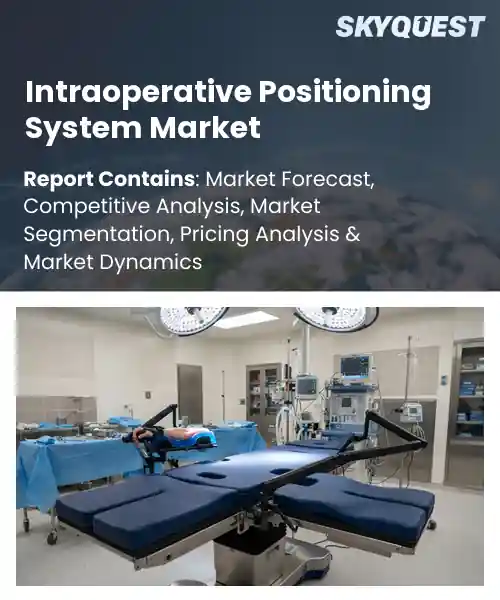
Intraoperative Positioning System Market
Report ID: SQMIG35A4393
Report ID: SQMIG35A4393
[email protected]
USA +1 351-333-4748
Report ID:
SQMIG35A4393 |
Region:
Global |
Published Date: August, 2026
Pages:
157
|Tables:
91
|Figures:
76


Global Intraoperative Positioning System Market size was valued at USD 1.84 Billion in 2024 and is poised to grow from USD 2.02 Billion in 2025 to USD 4.2 Billion by 2033, growing at a CAGR of 9.6% during the forecast period (2026-2033).
The intraoperative positioning system (IPS) market comprises technologies that ensure precise patient alignment during surgery, encompassing motorized tables, optical tracking platforms, and robot‑assisted fixtures. Its importance stems from the direct link between accurate positioning and reduced operative time, lower complication rates, and enhanced surgeon ergonomics. Historically, the market emerged in the early 2000s when spine and orthopedic procedures demanded stricter alignment tolerances; early adopters such as Medtronic’s Solera table demonstrated measurable reductions in intra‑operative radiation exposure. Over the past decade, advances in imaging integration and data analytics have amplified adoption, prompting hospitals to view IPS as a component of care.One pivotal growth factor is the rising demand for minimally invasive spine and neurosurgery procedures, which rely on sub‑millimeter positioning accuracy to avoid injury. As surgeons adopt navigation‑guided techniques, they increasingly require IPS platforms that can integrate with intra‑operative imaging and provide feedback; the integration of O‑arm imaging with a motorized table in a tertiary center reduced revision rates by 12 % and shortened procedure length from 180 to 140 minutes. This evidence drives hospital procurement teams to prioritize IPS investments, creating a loop that spurs manufacturers to embed AI‑based error‑prediction modules, thereby expanding market opportunities in regions pursuing bundled‑payment models.
How is AI-driven automation reshaping the intraoperative positioning system market?
AI‑driven automation is turning intraoperative positioning from a manual, time‑intensive task into a data‑rich, predictive process. Smart sensors map patient anatomy in real time while machine‑learning algorithms suggest optimal tilt and support, reducing the need for constant adjustments. Integrated platforms communicate directly with surgical tables and imaging devices, creating a seamless workflow that frees staff to focus on clinical decisions. The technology also logs positioning data for postoperative analysis, helping teams refine techniques and improve safety. As hospitals adopt these intelligent systems, the overall efficiency of operating rooms rises and the risk of positioning‑related complications declines.Recent advances have embedded AI into positioning hardware, enabling automatic alignment and continuous monitoring that streamline procedures and support faster turnover. This evolution reinforces market momentum by delivering measurable gains in precision and workflow simplicity.
Market snapshot - (2026-2033)
Global Market Size
USD 1.84 Billion
Largest Segment
Positioning Tables
Fastest Growth
Positioning Accessories
Growth Rate
9.6% CAGR
To get more insights on this market click here to Request a Free Sample Report
Global intraoperative positioning system market is segmented by product type, surgery type, end user and region. Based on product type, the market is segmented into Positioning Tables and Positioning Accessories. Based on surgery type, the market is segmented into General Surgery, Orthopedic Surgery, Neurosurgery, Cardiovascular Surgery and Other Surgeries. Based on end user, the market is segmented into Hospitals, Ambulatory Surgical Centers and Specialty Clinics. Based on region, the market is segmented into North America, Europe, Asia Pacific, Latin America and Middle East & Africa.
Positioning tables segment dominates because they provide the core structural platform that ensures patient stability, precise alignment, and surgeon ergonomics during complex procedures. Their integration with imaging and robotic systems creates a seamless workflow, reducing operative time and complications. Consequently, manufacturers prioritize innovation in table design, driving widespread adoption across surgical specialties. The reliability of these tables under varying load conditions also supports high‑risk interventions, reinforcing their status as indispensable assets in modern operating rooms.
However, positioning accessories segment is witnessing the strongest growth momentum as surgeons seek modular solutions that enhance table functionality without extensive capital outlay. Innovations such as adaptable headrests, limb supports, and integrated sensor kits enable customized patient positioning, expanding the market reach into minimally invasive and outpatient settings.
Neurosurgery segment dominates because precise patient alignment is critical for delicate intracranial procedures, where millimeter accuracy can affect outcomes. The need for stable, adjustable platforms that accommodate advanced imaging and navigation tools drives hospitals to invest heavily in specialized positioning solutions. This focus on safety and procedural fidelity reinforces neurosurgery’s central role in shaping product development priorities and sustaining market demand. The complexity of cranial access also necessitates integrated positioning systems that synchronize with intra‑operative monitoring, further cementing its dominance.
Meanwhile, cardiovascular surgery segment is emerging as the key high‑growth area as minimally invasive cardiac interventions require adaptable positioning platforms that accommodate fluoroscopic and robotic guidance. The surge in transcatheter procedures and hybrid operating rooms fuels demand for tables with dynamic tilt and rotation capabilities, propelling market expansion and prompting manufacturers to innovate for cardiac-specific ergonomics.
To get detailed segments analysis, Request a Free Sample Report
North America leads through a combination of sophisticated surgical ecosystems, extensive investment in cutting‑edge medical technologies and a regulatory environment that encourages rapid product introduction. The region benefits from deep networks of academic medical centers that drive clinical validation and early adoption. Strong reimbursement structures support acquisition of advanced positioning solutions, while a concentration of global device manufacturers ensures a steady pipeline of innovative offerings. Collaborative initiatives between hospitals, research institutions and technology firms further accelerate knowledge transfer, cementing a leadership position that is reinforced by a highly skilled surgical workforce and an emphasis on patient safety outcomes.
United States Intraoperative Positioning System Market
Intraoperative Positioning System Market in the United States is shaped by a concentration of leading research hospitals that actively integrate advanced positioning technologies into complex procedures. The market enjoys robust support from payers that recognize the value of precision in reducing intraoperative complications. A mature supply chain, coupled with a culture of continuous improvement, drives clinicians to adopt next‑generation systems that enhance ergonomics and patient outcomes. Collaborative partnerships between device innovators and surgical societies promote rapid dissemination of best practices across the nation’s extensive network of specialty centers.
Canada Intraoperative Positioning System Market
Intraoperative Positioning System Market in Canada is propelled by a publicly funded health system that prioritizes evidence‑based adoption of technologies that improve surgical efficiency and safety. Provincial health authorities facilitate coordinated procurement processes, allowing hospitals to access state‑of‑the‑art positioning solutions. Academic institutions play a pivotal role in evaluating clinical benefits, while interdisciplinary training programs ensure surgical teams are proficient in the latest equipment. This supportive environment fosters steady market growth and encourages manufacturers to tailor offerings to meet the specific regulatory and operational needs of Canadian healthcare providers.
Europe’s expansion is driven by strong governmental commitment to patient safety and the integration of precision medicine within surgical practice. The region’s well‑established network of specialist hospitals and academic centers fosters early adoption of sophisticated positioning platforms. Harmonized regulatory pathways across member states streamline market entry, while collaborative research initiatives generate robust clinical evidence supporting technology uptake. Reimbursement frameworks increasingly reward outcomes that reduce operative time and postoperative complications, encouraging healthcare providers to invest in advanced solutions. Additionally, a growing emphasis on minimally invasive techniques creates demand for positioning systems that enhance surgeon control and patient ergonomics, positioning Europe as a dynamic growth arena.
Germany Intraoperative Positioning System Market
Intraoperative Positioning System Market in Germany is anchored by a dense landscape of high‑volume tertiary hospitals that prioritize technological excellence. Strong engineering expertise and close cooperation with device manufacturers drive customization of positioning solutions to meet stringent clinical standards. The nation’s healthcare financing models reward efficiency and safety, prompting rapid integration of innovative systems. Continuous professional development programs ensure surgeons remain adept with emerging technologies, reinforcing Germany’s role as a dominant market within the European context.
United Kingdom Intraoperative Positioning System Market
Intraoperative Positioning System Market in the United Kingdom is experiencing accelerated uptake due to national health initiatives that emphasize surgical precision and outcome improvement. NHS trusts are actively piloting advanced positioning platforms across a range of specialties, supported by clinical research networks that generate real‑world evidence. Funding mechanisms that link reimbursement to quality metrics encourage hospitals to adopt technologies that demonstrably reduce complications. Educational collaborations between academia and industry further expedite skill acquisition among surgical teams, fueling the country’s rapid market expansion.
France Intraoperative Positioning System Market
Intraoperative Positioning System Market in France is emerging as a focal point for innovative surgical solutions within a health system that balances universal coverage with a drive for clinical excellence. French university hospitals serve as early adopters, testing novel positioning devices within multidisciplinary programs. Policy incentives aimed at enhancing patient safety and reducing postoperative morbidity create a favorable climate for technology diffusion. Partnerships between domestic research institutes and international manufacturers facilitate knowledge exchange, positioning France as an emerging hub for market development across the continent.
Asia Pacific is strengthening its role through a convergence of rising surgical volumes, heightened focus on patient-centric care and strategic government investments in medical technology infrastructure. The region’s leading economies are expanding tertiary care facilities that demand precision equipment to support complex procedures. Growing awareness of the benefits of accurate intraoperative positioning for reducing complications drives hospital decision‑makers to seek advanced solutions. Collaborative ventures between global manufacturers and local distributors accelerate technology transfer, while regional clinical consortia generate evidence that underpins adoption. Cultural emphasis on continuous improvement and the emergence of specialized training centers further embed positioning systems into standard surgical practice, advancing the region’s market stature.
Japan Intraoperative Positioning System Market
Intraoperative Positioning System Market in Japan is propelled by a mature healthcare system that values precision and reliability in surgical environments. Leading academic hospitals integrate cutting‑edge positioning platforms to support high‑tech procedures, backed by government policies that encourage technology adoption. Strong collaborations between manufacturers and institutional research units foster iterative product enhancements tailored to local clinical workflows. Continuous surgeon education programs ensure proficiency with new systems, reinforcing Japan’s leadership in the regional market.
South Korea Intraoperative Positioning System Market
Intraoperative Positioning System Market in South Korea benefits from rapid modernization of surgical facilities and a proactive regulatory framework that facilitates timely market entry. Major medical centers prioritize integration of advanced positioning technologies to improve operative efficiency and patient safety. Close ties between Korean manufacturers and global technology providers enable swift adaptation of innovative features to meet domestic clinical needs. Dedicated training academies cultivate expertise among operating room personnel, accelerating diffusion of sophisticated positioning solutions across the nation.
To know more about the market opportunities by region and country, click here to
Buy The Complete Report
Advancements In Imaging Guidance
Growing Emphasis On Minimally Invasive Surgery
High Initial Capital Investment
Regulatory And Compliance Complexities
Request Free Customization of this report to help us to meet your business objectives.
The intraoperative positioning market is shaped by intense competition as firms pursue strategic M&A, cross‑industry partnerships, and rapid tech innovation to secure market share; recent equity inflows have accelerated product rollouts and integration of AI‑driven navigation, while collaborations with imaging leaders are sharpening differentiation.
Top Player’s Company Profile
Recent Developments
SkyQuest’s ABIRAW (Advanced Business Intelligence, Research & Analysis Wing) is our Business Information Services team that Collects, Collates, Correlates, and Analyses the Data collected by means of Primary Exploratory Research backed by robust Secondary Desk research. As per SkyQuest analysis the intraoperative positioning system market is expanding rapidly, propelled chiefly by the growing emphasis on minimally invasive surgery which demands precise patient alignment and fuels hospital investment in advanced tables, while high initial capital costs act as a notable restraint limiting adoption in budget‑constrained facilities. North America remains the dominant region thanks to its sophisticated surgical ecosystem and strong reimbursement support, and positioning tables continue to lead the segment share because they provide the core platform for accuracy and ergonomics. A second driver is the integration of AI‑driven navigation that enhances real‑time alignment, shortens operative time and further boosts market momentum across specialties.
| Report Metric | Details |
|---|---|
| Market size value in 2024 | USD 1.84 Billion |
| Market size value in 2033 | USD 4.2 Billion |
| Growth Rate | 9.6% |
| Base year | 2024 |
| Forecast period | (2026-2033) |
| Forecast Unit (Value) | USD Billion |
| Segments covered |
|
| Regions covered | North America (US, Canada), Europe (Germany, France, United Kingdom, Italy, Spain, Rest of Europe), Asia Pacific (China, India, Japan, Rest of Asia-Pacific), Latin America (Brazil, Rest of Latin America), Middle East & Africa (South Africa, GCC Countries, Rest of MEA) |
| Companies covered |
|
| Customization scope | Free report customization with purchase. Customization includes:-
|
To get a free trial access to our platform which is a one stop solution for all your data requirements for quicker decision making. This platform allows you to compare markets, competitors who are prominent in the market, and mega trends that are influencing the dynamics in the market. Also, get access to detailed SkyQuest exclusive matrix.
Table Of Content
Executive Summary
Market overview
Parent Market Analysis
Market overview
Market size
KEY MARKET INSIGHTS
COVID IMPACT
MARKET DYNAMICS & OUTLOOK
Market Size by Region
KEY COMPANY PROFILES
Methodology
For the Intraoperative Positioning System Market, our research methodology involved a mixture of primary and secondary data sources. Key steps involved in the research process are listed below:
1. Information Procurement: This stage involved the procurement of Market data or related information via primary and secondary sources. The various secondary sources used included various company websites, annual reports, trade databases, and paid databases such as Hoover's, Bloomberg Business, Factiva, and Avention. Our team did 45 primary interactions Globally which included several stakeholders such as manufacturers, customers, key opinion leaders, etc. Overall, information procurement was one of the most extensive stages in our research process.
2. Information Analysis: This step involved triangulation of data through bottom-up and top-down approaches to estimate and validate the total size and future estimate of the Intraoperative Positioning System Market.
3. Report Formulation: The final step entailed the placement of data points in appropriate Market spaces in an attempt to deduce viable conclusions.
4. Validation & Publishing: Validation is the most important step in the process. Validation & re-validation via an intricately designed process helped us finalize data points to be used for final calculations. The final Market estimates and forecasts were then aligned and sent to our panel of industry experts for validation of data. Once the validation was done the report was sent to our Quality Assurance team to ensure adherence to style guides, consistency & design.
Analyst Support
Customization Options
With the given market data, our dedicated team of analysts can offer you the following customization options are available for the Intraoperative Positioning System Market:
Product Analysis: Product matrix, which offers a detailed comparison of the product portfolio of companies.
Regional Analysis: Further analysis of the Intraoperative Positioning System Market for additional countries.
Competitive Analysis: Detailed analysis and profiling of additional Market players & comparative analysis of competitive products.
Go to Market Strategy: Find the high-growth channels to invest your marketing efforts and increase your customer base.
Innovation Mapping: Identify racial solutions and innovation, connected to deep ecosystems of innovators, start-ups, academics, and strategic partners.
Category Intelligence: Customized intelligence that is relevant to their supply Markets will enable them to make smarter sourcing decisions and improve their category management.
Public Company Transcript Analysis: To improve the investment performance by generating new alpha and making better-informed decisions.
Social Media Listening: To analyze the conversations and trends happening not just around your brand, but around your industry as a whole, and use those insights to make better Marketing decisions.
REQUEST FOR SAMPLE
 REQUEST FREE CUSTOMIZATION


Want to customize this report? This report can be personalized according to your needs. Our analysts and industry experts will work directly with you to understand your requirements and provide you with customized data in a short amount of time. We offer $1000 worth of FREE customization at the time of purchase.
Feedback From Our Clients


 USA (+1) 351-333-4748

