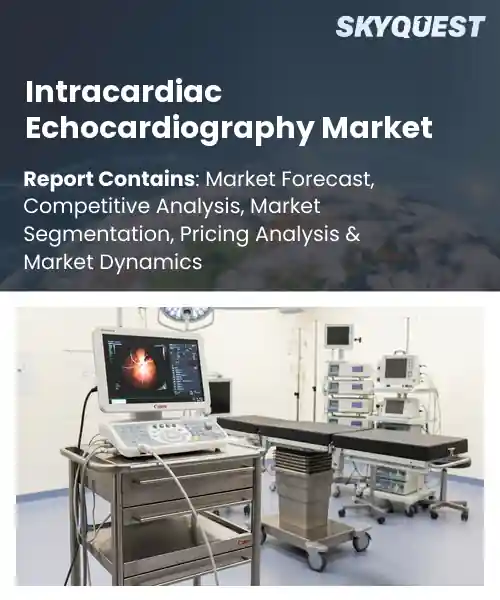
Intracardiac Echocardiography Market
Report ID: SQMIG35A4231
Report ID: SQMIG35A4231
[email protected]
USA +1 351-333-4748
Report ID:
SQMIG35A4231 |
Region:
Global |
Published Date: July, 2026
Pages:
157
|Tables:
172
|Figures:
79


Global Intracardiac Echocardiography Market size was valued at USD 5.6 Billion in 2024 and is poised to grow from USD 5.91 Billion in 2025 to USD 9.14 Billion by 2033, growing at a CAGR of 5.6% during the forecast period (2026-2033).
The intracardiac echocardiography (ICE) market comprises devices that generate high‑resolution ultrasound images from within the heart, enabling real‑time guidance for electrophysiology, structural‑heart, and coronary interventions. Its importance lies in reducing fluoroscopy exposure, improving procedural precision, and shortening hospital stays, which collectively enhance patient safety and lower overall costs. Historically, the market emerged in the early 2000s as clinicians sought alternatives to transesophageal echo; adoption accelerated after 2010 when miniaturized probes and single‑use catheters were introduced by firms such as Siemens and Abbott. These technological strides transformed ICE from a niche tool into a mainstream imaging modality across cardiology centers worldwide.
The key trend driving the global intracardiac echocardiography sector is the expanding demand for minimally invasive structural‑heart procedures, particularly left‑atrial appendage closure and transcatheter mitral‑valve repair. As physicians pursue alternatives to open‑heart surgery, ICE provides anatomic feedback that shortens procedure time and reduces reliance on expensive hybrid‑operating rooms. Consequently, hospitals are allocating budgets toward single‑use ICE systems, which mitigate cross‑contamination risk and simplify inventory management. Real‑world evidence from the PROTECT AF trial demonstrates that ICE‑guided closure of the left atrial appendage cuts procedural complications by 30 % compared with conventional fluoroscopy, prompting insurers to reimburse ICE use and further fueling market expansion.
How is AI Enhancing Image Analysis in the Intracardiac Echocardiography Market?
AI is reshaping image analysis in intracardiac echocardiography by providing real time tissue characterization, automated border detection and artifact suppression. Machine learning models trained on large echo datasets can highlight subtle structural changes that are difficult for the human eye. This capability speeds procedural decision making and reduces reliance on expert interpretation. As the intracardiac echocardiography market expands, clinicians seek tools that improve diagnostic confidence while shortening procedure time. AI enhanced platforms are being integrated directly into catheter based probes, delivering clearer visuals at the point of care and supporting broader adoption across cardiac labs.
In June 2026, Medtronic announced strategic investments in two privately held companies developing AI driven intracardiac echocardiography solutions. The partnership brings advanced image processing to its catheter systems, improving clarity and workflow efficiency and reinforcing market momentum. This development accelerates adoption of AI tools across cardiac labs and supports the growing demand for precise imaging.
Market snapshot - (2026-2033)
Global Market Size
USD 5.6 Billion
Largest Segment
ICE Consoles & Imaging Systems
Fastest Growth
Accessories & Consumables
Growth Rate
5.6% CAGR
To get more insights on this market click here to Request a Free Sample Report
Global intracardiac echocardiography market is segmented by product type, technology, application, end user, patient type, procedure type and region. Based on product type, the market is segmented into intracardiac echocardiography (ICE) catheters, ICE consoles & imaging systems and accessories & consumables. Based on technology, the market is segmented into 2D intracardiac echocardiography, 3D intracardiac echocardiography and doppler intracardiac echocardiography. Based on application, the market is segmented into electrophysiology procedures, structural heart disease interventions, transcatheter valve procedures, left atrial appendage closure and others. Based on end user, the market is segmented into hospitals, cardiac catheterization laboratories, ambulatory surgical centers and specialty cardiac centers. Based on patient type, the market is segmented into adult and pediatric. Based on procedure type, the market is segmented into diagnostic procedures and interventional procedures. Based on region, the market is segmented into North America, Europe, Asia Pacific, Latin America and Middle East & Africa.
ICE catheters segment dominates because they provide direct real time imaging essential for safe navigation during electrophysiology procedures, enabling clinicians to visualize intracardiac structures without reliance on external imaging. Their integration with mapping systems and ease of deployment make them the preferred choice, driving widespread adoption across hospitals and catheter labs. Because they reduce procedure time, enhance image clarity, and support complex arrhythmia ablation strategies, clinicians rely on them for consistent outcomes.
However, accessories & consumables segment emerges as the most rapidly expanding area, fueled by growing demand for single use sheaths, specialized guidewires, and imaging gel formulations that enhance sterility and image quality. Continuous innovation in disposable technology encourages hospitals to adopt newer kits, accelerating market penetration and creating fresh revenue streams for manufacturers.
3D intracardiac echocardiography segment dominates because it delivers volumetric visualization that improves device placement accuracy in structural heart disease interventions, allowing clinicians to assess anatomy from multiple angles in real time. This depth perception reduces uncertainty, shortens procedural learning curves, and supports precise deployment of transcatheter valves and closure devices, leading practitioners to favor 3D systems over conventional 2D alternatives, enhancing procedural confidence and enabling broader adoption across both adult and pediatric cardiac programs.
Meanwhile, doppler intracardiac echocardiography segment is witnessing the strongest growth momentum as clinicians seek quantitative flow assessment during complex interventions. Advances in miniaturized Doppler technology improve hemodynamic evaluation, prompting integration with navigation platforms and expanding its use in valve and closure procedures, thereby unlocking new clinical pathways and driving market expansion.
To get detailed segments analysis, Request a Free Sample Report
As per the global intracardiac echocardiography market share, North America dominates the industry due to a convergence of mature healthcare infrastructure, aggressive adoption of minimally invasive cardiac procedures, and strong financial reimbursement mechanisms that encourage technology integration. Leading medical device manufacturers maintain extensive research and development bases in the United States and Canada, fostering rapid product innovation and regulatory approval pathways. A highly skilled workforce of electrophysiologists and imaging specialists supports advanced procedural techniques, while academic centers generate robust clinical evidence that drives best‑practice guidelines. Collaborative ecosystems linking hospitals, industry, and professional societies accelerate knowledge transfer and training, reinforcing high procedural volumes and sustaining the region’s leadership position. The region’s emphasis on patient outcomes and continuous quality improvement further incentivizes adoption, while insurance coverage models reduce cost barriers for institutions. Moreover, strong intellectual property protection encourages investment in novel probe designs, maintaining a pipeline of next‑generation solutions that keep the market ahead of global peers.
Intracardiac echocardiography market in the United States benefits from a health system that emphasizes adoption of advanced imaging. Provincial funding frameworks facilitate integration of the technology into tertiary cardiac centers, while regulatory alignment with neighboring United States enables access to devices. Ongoing professional education programs foster skilled operator pools, and interdisciplinary networks between interventional cardiologists and imaging specialists promote procedural confidence. This supportive environment encourages steady growth and broader clinical acceptance.
Intracardiac echocardiography market in Canada is reinforced by a health system that emphasizes adoption of advanced imaging. Provincial funding frameworks facilitate integration of the technology into tertiary cardiac centers, while regulatory alignment with neighboring United States enables access to devices. Ongoing professional education programs foster skilled operator pools, and interdisciplinary networks between interventional cardiologists and imaging specialists promote procedural confidence. This supportive environment encourages steady growth and broader clinical acceptance.
Based on global intracardiac echocardiography regional forecast, Europe’s rapid expansion of the industry is driven by a combination of supportive regulatory environments, evolving clinical guidelines, and increasing demand for minimally invasive cardiac interventions across its major healthcare systems. Strong public and private reimbursement frameworks promote adoption in tertiary centers, while collaborative research networks among leading universities and hospitals generate compelling outcome data that reinforce guideline recommendations. Germany’s established manufacturing base and technical expertise anchor the region, whereas the United Kingdom’s proactive health policy and focus on innovation accelerate market penetration. France’s emerging ecosystem benefits from targeted investments in cardiac imaging research and growing specialist training programs. Integrated efforts among industry, clinical societies, and policymakers create a fertile landscape for technology diffusion, ensuring sustained growth and heightened clinical acceptance throughout Europe.
Intracardiac echocardiography market in Germany benefits from a tradition of biomedical research and a dense network of tertiary cardiac institutions. Close collaboration between device manufacturers and university hospitals accelerates technology transfer, while national health reimbursement schemes support routine clinical use. Rigorous clinical guidelines encourage integration into electrophysiology programs, and comprehensive training pathways ensure proficient operator expertise. This combination sustains high procedural adoption and reinforces Germany’s leadership within the European landscape.
Intracardiac echocardiography market in the United Kingdom is propelled by a regulatory framework that encourages swift adoption of innovative imaging solutions. National health service initiatives prioritize minimally invasive cardiac procedures, creating demand for intracardiac imaging. Strong academic collaborations generate evidence supporting clinical benefits, while dedicated training academies expand the skilled operator base. These factors combine to accelerate uptake and position the United Kingdom as a fast‑moving hub for technology diffusion.
Intracardiac echocardiography market in France is emerging through investment in cardiac imaging research and a growing network of electrophysiology units. Reimbursement policies increasingly recognize the procedural efficiency offered by intracardiac imaging, encouraging its integration into routine practice. Partnerships between French medical societies and device innovators foster knowledge exchange, while educational workshops expand clinician familiarity. This ecosystem nurtures gradual adoption and positions France as a rising player in the European market.
As per global intracardiac echocardiography regional outlook, Asia Pacific is strengthening its position in the industry through strategic investments in cardiac care infrastructure, an expanding pool of skilled interventional cardiologists, and increasing acceptance of minimally invasive procedures. National health initiatives in key economies prioritize advanced imaging to improve procedural safety and outcomes, fostering favorable reimbursement environments that accelerate technology uptake. Collaborative partnerships between regional device manufacturers and global innovators facilitate rapid localization of cutting‑edge probes, while dedicated training academies and fellowship programs build robust operator expertise. Governments also support domestic research grants aimed at developing indigenous probe technologies, and growing patient awareness drives demand for safer, image‑guided interventions across both urban and emerging markets. These combined efforts enhance procedural volumes, drive continuous innovation, and position the Asia Pacific region as an emerging hub for next‑generation intracardiac imaging solutions.
Intracardiac echocardiography market in Japan is strengthened by a national focus on minimally invasive cardiac therapies and a high concentration of advanced medical centers. Collaborative frameworks between academic institutions and device manufacturers accelerate the introduction of imaging probes. Government‑backed initiatives promote skill development through training programs, while reimbursement structures facilitate broader clinical use. This integrated approach drives procedural uptake and reinforces Japan’s reputation as a leader in cardiac imaging innovation.
Intracardiac echocardiography market in South Korea is propelled by adoption of advanced therapies and a network of tertiary hospitals embracing imaging. Government health policies prioritize cardiac care, creating favorable reimbursement conditions for intracardiac technologies. Partnerships with device firms enable swift localization of probes, while fellowship programs cultivate a skilled operator community. These dynamics foster expanding clinical use and position South Korea as an emerging significant hub for intracardiac imaging advancement.
To know more about the market opportunities by region and country, click here to
Buy The Complete Report
Increasing Adoption of Minimally Invasive Procedures
Advancements In Real‑Time Imaging Technology
High Capital Investment Requirements
Limited Reimbursement Coverage Across Regions
Request Free Customization of this report to help us to meet your business objectives.
The competitive landscape in the global intracardiac echocardiography market outlook is shaped by AI‑focused entrants leveraging strategic financing and hospital alliances to accelerate ICE technology adoption, while incumbent imaging firms pursue partnerships and acquisitions to embed advanced analytics. Recent M&A activity and joint development agreements reflect a race to differentiate on real‑time image processing, regulatory clearance speed, and integrated workflow solutions, driving market consolidation.
Top Player’s Company Profile
Recent Developments
SkyQuest’s ABIRAW (Advanced Business Intelligence, Research & Analysis Wing) is our Business Information Services team that Collects, Collates, Correlates, and Analyses the Data collected by means of Primary Exploratory Research backed by robust Secondary Desk research.
As per SkyQuest analysis, the global intracardiac echocardiography industy is propelled by the rising adoption of minimally invasive cardiac procedures which rely on real‑time intracardiac imaging to improve safety and shorten hospital stays; a second catalyst is the rapid advancement of high‑resolution probe technology and AI‑enhanced image analysis that boost diagnostic confidence and procedural efficiency. The primary restraint remains the high capital outlay required for ICE systems, compounded by uneven reimbursement coverage that slows uptake in cost‑sensitive hospitals. North America dominates the landscape thanks to its mature health‑care infrastructure and strong reimbursement incentives, while ICE catheters lead the segment hierarchy by providing essential real‑time visual guidance during electrophysiology interventions.
| Report Metric | Details |
|---|---|
| Market size value in 2024 | USD 5.6 Billion |
| Market size value in 2033 | USD 9.14 Billion |
| Growth Rate | 5.6% |
| Base year | 2024 |
| Forecast period | (2026-2033) |
| Forecast Unit (Value) | USD Billion |
| Segments covered |
|
| Regions covered | North America (US, Canada), Europe (Germany, France, United Kingdom, Italy, Spain, Rest of Europe), Asia Pacific (China, India, Japan, Rest of Asia-Pacific), Latin America (Brazil, Rest of Latin America), Middle East & Africa (South Africa, GCC Countries, Rest of MEA) |
| Companies covered |
|
| Customization scope | Free report customization with purchase. Customization includes:-
|
To get a free trial access to our platform which is a one stop solution for all your data requirements for quicker decision making. This platform allows you to compare markets, competitors who are prominent in the market, and mega trends that are influencing the dynamics in the market. Also, get access to detailed SkyQuest exclusive matrix.
Table Of Content
Executive Summary
Market overview
Parent Market Analysis
Market overview
Market size
KEY MARKET INSIGHTS
COVID IMPACT
MARKET DYNAMICS & OUTLOOK
Market Size by Region
KEY COMPANY PROFILES
Methodology
For the Intracardiac Echocardiography Market, our research methodology involved a mixture of primary and secondary data sources. Key steps involved in the research process are listed below:
1. Information Procurement: This stage involved the procurement of Market data or related information via primary and secondary sources. The various secondary sources used included various company websites, annual reports, trade databases, and paid databases such as Hoover's, Bloomberg Business, Factiva, and Avention. Our team did 45 primary interactions Globally which included several stakeholders such as manufacturers, customers, key opinion leaders, etc. Overall, information procurement was one of the most extensive stages in our research process.
2. Information Analysis: This step involved triangulation of data through bottom-up and top-down approaches to estimate and validate the total size and future estimate of the Intracardiac Echocardiography Market.
3. Report Formulation: The final step entailed the placement of data points in appropriate Market spaces in an attempt to deduce viable conclusions.
4. Validation & Publishing: Validation is the most important step in the process. Validation & re-validation via an intricately designed process helped us finalize data points to be used for final calculations. The final Market estimates and forecasts were then aligned and sent to our panel of industry experts for validation of data. Once the validation was done the report was sent to our Quality Assurance team to ensure adherence to style guides, consistency & design.
Analyst Support
Customization Options
With the given market data, our dedicated team of analysts can offer you the following customization options are available for the Intracardiac Echocardiography Market:
Product Analysis: Product matrix, which offers a detailed comparison of the product portfolio of companies.
Regional Analysis: Further analysis of the Intracardiac Echocardiography Market for additional countries.
Competitive Analysis: Detailed analysis and profiling of additional Market players & comparative analysis of competitive products.
Go to Market Strategy: Find the high-growth channels to invest your marketing efforts and increase your customer base.
Innovation Mapping: Identify racial solutions and innovation, connected to deep ecosystems of innovators, start-ups, academics, and strategic partners.
Category Intelligence: Customized intelligence that is relevant to their supply Markets will enable them to make smarter sourcing decisions and improve their category management.
Public Company Transcript Analysis: To improve the investment performance by generating new alpha and making better-informed decisions.
Social Media Listening: To analyze the conversations and trends happening not just around your brand, but around your industry as a whole, and use those insights to make better Marketing decisions.
REQUEST FOR SAMPLE
 REQUEST FREE CUSTOMIZATION
Global Intracardiac Echocardiography Market size was valued at USD 5.6 Billion in 2024 and is poised to grow from USD 5.91 Billion in 2025 to USD 9.14 Billion by 2033, growing at a CAGR of 5.6% during the forecast period (2026-2033).
The competitive landscape is shaped by AI‑focused entrants leveraging strategic financing and hospital alliances to accelerate ICE technology adoption, while incumbent imaging firms pursue partnerships and acquisitions to embed advanced analytics. Recent M&A activity and joint development agreements reflect a race to differentiate on real‑time image processing, regulatory clearance speed, and integrated workflow solutions, driving market consolidation. 'Boston Scientific Corporation', 'Johnson & Johnson MedTech', 'Abbott Laboratories', 'Conavi Medical Corp.', 'Siemens Healthineers AG', 'Koninklijke Philips N.V.', 'GE HealthCare Technologies Inc.', 'Canon Medical Systems Corporation', 'Terumo Corporation', 'MicroPort Scientific Corporation', 'Merit Medical Systems, Inc.', 'Fujifilm Holdings Corporation', 'Shenzhen Mindray Bio-Medical Electronics Co., Ltd.', 'Esaote S.p.A.', 'Cook Medical LLC', 'Lepu Medical Technology (Beijing) Co., Ltd.', 'Acutus Medical, Inc.', 'CardioSound Incorporated', 'NuVision Imaging Technologies', 'Sonic Incytes Medical Corp.'
Clinicians prefer intracardiac echocardiography because it enables precise visualization during catheter‑based interventions, reducing reliance on external imaging suites and minimizing procedural complexity. This confidence encourages hospitals to expand minimally invasive cardiac programs, which directly drives demand for intracardiac echocardiography systems as essential tools for safe and efficient treatment delivery across diverse patient populations. The enhanced procedural outcomes also improve overall workflow efficiency, supporting broader institutional adoption and reinforcing the technology's strategic value within cardiac care pathways and overall patient satisfaction rates.
Expanded Imaging Guidance Adoption: The adoption of intracardiac echocardiography as a primary imaging tool during minimally invasive cardiac procedures is accelerating across major healthcare systems. Clinicians value real‑time, high‑resolution visualization that reduces dependence on fluoroscopy, thereby minimizing radiation exposure for patients and staff. Hospitals are integrating ICE platforms into hybrid operating rooms, supporting multidisciplinary teams and enhancing procedural confidence. This shift is driven by growing evidence of improved outcomes, shorter procedure times, and greater procedural flexibility, fostering broader acceptance beyond traditional electrophysiology applications worldwide.
Why does North America Dominate the Global Intracardiac Echocardiography Market? |@12


Want to customize this report? This report can be personalized according to your needs. Our analysts and industry experts will work directly with you to understand your requirements and provide you with customized data in a short amount of time. We offer $1000 worth of FREE customization at the time of purchase.
Feedback From Our Clients


 USA (+1) 351-333-4748

