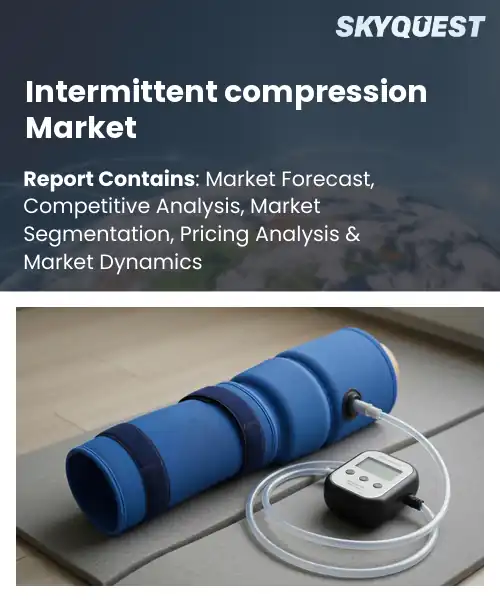
Intermittent compression Market
Report ID: SQMIG35A4404
Report ID: SQMIG35A4404
[email protected]
USA +1 351-333-4748
Report ID:
SQMIG35A4404 |
Region:
Global |
Published Date: August, 2026
Pages:
157
|Tables:
143
|Figures:
78


Global Intermittent Compression Market size was valued at USD 2.74 Billion in 2024 and is poised to grow from USD 2.95 Billion in 2025 to USD 5.3 Billion by 2033, growing at a CAGR of 7.6% during the forecast period (2026-2033).
The intermittent compression market encompasses medical systems that deliver cyclical pneumatic pressure to limbs, primarily to prevent deep‑vein thrombosis, reduce postoperative edema, and manage lymphedema. Its relevance stems from the growing incidence of chronic venous disorders and an aging global population that drives demand for non‑invasive prophylaxis. Historically, bulky manual pumps dominated hospitals in the 1970s, but advances in electronic controllers, portable batteries, and sensor‑driven feedback have transformed the sector into an arena. Companies such as Hill‑Rom, Smith & Nephew, and Arjo now offer programmable, data‑connected units that integrate with monitoring platforms, illustrating the market’s evolution from apparatuses to sophisticated therapeutic ecosystems.
Building on that technological shift, the infusion of data analytics and remote monitoring has become a catalyst for market acceleration, because clinicians can now quantify compression cycles, pressure gradients, and patient compliance in time. This capability reduces hospital readmissions and shortens rehabilitation timelines, prompting insurers to reimburse intermittent compression therapy. For example, a Boston medical center reported a 22 % decline in deep‑vein thrombosis rates after deploying IoT‑enabled cuffs that adjust pressure based on limb circumference sensors. The clearly resulting evidence base fuels demand from ambulatory surgery centers and home‑care providers, opening avenues for subscription‑based service models and aftermarket analytics packages.
How is AI-Driven Automation Influencing the Intermittent Compression Market?
Artificial intelligence is indirectly affecting and changing the global intermittent compression market by making therapy more individualized and adaptable. Models based on machine learning can analyze physiological and motion data and determine the optimal pneumatic compression profile, thus allowing devices and systems to adapt their level of pressure and inflation of chambers depending on the needs of patients. Thus, therapy becomes more precise and consequently leads to better adherence and results. A review in 2025 cited that models based on AI can predict the best pneumatic compression profiles effectively in 84% of cases, thus paving the way towards the emergence of closed-loop compression systems.
In January 2026, UREVO launched its AI-Powered Wireless Recovery Boots featuring an AI Smart Massage system that analyzes muscle condition in real time and automatically adjusts pneumatic pressure. While positioned for sports recovery, the development is relevant to intermittent compression because AI-driven adaptive pressure control demonstrates how compression devices can become more personalized, responsive, and digitally managed.
Market snapshot - (2026-2033)
Global Market Size
USD 2.74 Billion
Largest Segment
Intermittent Pneumatic Compression Devices
Fastest Growth
Compression Garments
Growth Rate
7.6% CAGR
To get more insights on this market click here to Request a Free Sample Report
Global intermittent compression market is segmented by product type, application, end user, portability, distribution channel and region. Based on product type, the market is segmented into intermittent pneumatic compression devices, compression garments and compression pumps. Based on application, the market is segmented into deep vein thrombosis prevention, lymphedema management, chronic venous insufficiency and sports recovery. Based on end user, the market is segmented into hospitals, ambulatory surgical centers and homecare. Based on portability, the market is segmented into portable and stationary. Based on distribution channel, the market is segmented into direct sales and medical device distributors. Based on region, the market is segmented into North America, Europe, Asia Pacific, Latin America and Middle East & Africa.
Compression garments segment dominates because they provide continuous, graduated pressure in a form that patients can wear discreetly throughout daily activities. Their textile‑based design eliminates the need for bulky machinery, making them ideal for home environments where ease of use and comfort drive purchase decisions. Physicians have a preference for them in the treatment of chronic lymphedema and chronic venous insufficiency, thus providing a consistent market for them in the outpatient market. Their ease of cleaning and durability also consolidates their position as the option of choice for treatment.
However, compression pumps segment emerges as the most rapidly expanding area because recent innovations have miniaturized pump mechanisms, allowing portable operation without sacrificing therapeutic efficacy. Advancing technology allows consumers to personalize their own health experience via smartphones and devices that work in harmony with their phones. Increased interest in self-care solutions means a commitment to the growth of this segment of the healthcare market.
Deep vein thrombosis prevention segment dominates because clinicians rely on proven compression protocols to avert clot formation after surgery. Given its significance to patients, hospitals are increasingly using equipment that is designed for the purpose of fulfilling regulatory requirements. The system for payment usually favors prevention, thus ensuring that systems are always being improved. Its established position in the post-operation process creates an ongoing activity of the vendors.
Meanwhile, sports recovery segment is witnessing the strongest growth momentum because athletes and fitness enthusiasts seek rapid muscle recuperation after training. Advances in pulsatile pressure algorithms simulate natural circulation, appealing to performance focused users. Collaborating with sports medicine clinics increases exposure, encouraging acceptance of the product outside of clinical environments and creating fresh sources of income for the producers.
To get detailed segments analysis, Request a Free Sample Report
North America maintains its leadership through a convergence of advanced clinical practices, robust research ecosystems, and a mature regulatory environment that expedites product approvals. Leading medical device makers run large networks of manufacturing and design centers that help to speed up the process of innovation while ensuring stable supply chains. Healthcare organizations are concentrated on evidence-based therapies and the implementation of compression technologies in acute care, post-operative care, and chronic care areas. The availability of robust reimbursement mechanisms stimulates the popularity of those treatments units within healthcare sectors.
Intermittent compression market in the United States benefits from a highly integrated network of hospitals, rehabilitation centers, and sports medicine clinics that prioritize cutting‑edge therapeutic options. The presence of major device innovators accelerates product evolution, while insurers support coverage for a broad range of indications. Clinical guidelines recommend the practice of compression therapy, enhancing its frequent application among different groups of patients and serving to solidify its place in the healthcare system.
Intermittent compression market in Canada is propelled by a publicly funded health system that emphasizes cost‑effective, clinically validated interventions. Provincial health authorities have supported the use of compression therapy for venous problems and post-surgery recovery and have urged both urban and rural facilities to adopt it consistently. Research partnerships between universities and manufacturers promote wellbeing at the local level and allow ensuring high quality of product delivery.
Europe’s rapid expansion is underpinned by progressive healthcare policies that champion preventive and rehabilitative treatments, coupled with a strong tradition of clinical research. Collaboration between states helps share the best practices, leading to quick implementation of the guidelines for compression therapy. Manufacturers of compression devices set up R&D facilities in different regions to customize the production of devices according to the requirements of different countries. Also, reimbursement systems implemented in member countries more often accept the use of compression devices in chronic disease treatment. This environment gives birth to more trust among the medical community and provides patients with even higher level of acceptance of compression therapy.
Intermittent compression market in Germany thrives on a dense network of specialized clinics and a robust engineering sector that delivers high‑precision medical devices. Medical institutions in Germany focus on evidence-based mechanisms, employing compression therapy in standard protocols regarding surgery and chronic therapy. There is a great deal of cooperation between academic hospitals and tech large firms, leading to constant optimization of products, while reimbursement policies boost use of advanced treatment methods.
Intermittent compression market in the United Kingdom is experiencing accelerated uptake driven by national health directives that prioritize early intervention and mobility restoration. There is a trend of using compression devices in orthopedic and vascular treatment plans within an NHS Trust and this is emphasized through clinical recommendations showing their effectiveness. Emerging partnerships between startups and established manufacturers spur innovative product introductions, while a focus on cost‑effectiveness aligns with broader health system objectives, positioning the United Kingdom as a fastest growing market.
Intermittent compression market in France benefits from a growing emphasis on outpatient rehabilitation and home‑based care models. French clinicians adopt compression therapy as part of multidisciplinary strategies for venous insufficiency and postoperative recovery. Research partnerships that are currently developing in various academic institutions help to validate techniques and enable their wider application. Reimbursement policies are evolving to accommodate newer compression technologies, supporting France’s emergence as an expanding market within the region.
Asia Pacific is enhancing its market role through strategic investments in healthcare infrastructure and a rising focus on chronic disease prevention. The countries located in this part of the world are adopting new therapeutic techniques in order to develop their healthcare systems, which leads to the increase in the demand for compression systems. Local businesses are increasing their output while minimizing production expenses and maintaining high quality of their products. Co-operation with other nations makes it possible to transfer technologies and ideas quickly. This combination of policy support, manufacturing growth, and clinical integration positions Asia Pacific as an increasingly influential player.
Intermittent compression market in Japan is reinforced by a healthcare system that values precision medicine and long‑term patient outcomes. Compression therapy has been adopted by Japanese medical facilities post-surgery as well as for elderly care, in light of the trends of the growth of the population. Local production concentrates on the convenience and quality of products as per strict government regulations. Joint efforts of the corporates and the education sector ensure constant innovations of the industry in the form of products.
Intermittent compression market in South Korea benefits from a technologically driven medical environment that quickly adopts novel therapeutic devices. Korean clinics emphasize early mobilization and recovery, incorporating compression solutions into orthopedic and sports medicine programs. The government in South Korea has implemented a number of policies to encourage and motivate companies in the region to create more medical devices and also more partnerships with international companies to gain easy access to technology.
To know more about the market opportunities by region and country, click here to
Buy The Complete Report
Increasing Renewable Energy Integration
Advancements In Smart Grid Technologies
High Capital Expenditure Requirements
Regulatory Uncertainty Across Regions
Request Free Customization of this report to help us to meet your business objectives.
The global intermittent compression market is competitive, with Arjo, Cardinal Health, Enovis (DJO), Zimmer Biomet, Medtronic, Tactile Medical, and Bio Compression Systems as prominent players. The company Arjo highlights the importance of using evidence to establish compression therapy and comfort for the patients. Tactile Medical focuses on treatment of lymphedema at home and providing support to the patient. Enovis employs the use of portable compressive devices for rehabilitation and recovery and the manufacturers of the devices pay attention to the usage of smart controller and portable devices along with comfort of the patients while using the device.
Top Player’s Company Profile
Recent Developments
SkyQuest’s ABIRAW (Advanced Business Intelligence, Research & Analysis Wing) is our Business Information Services team that Collects, Collates, Correlates, and Analyses the Data collected by means of Primary Exploratory Research backed by robust Secondary Desk research.
As per SkyQuest analysis, the global intermittent compression industry is propelled primarily by the adoption of IoT‑enabled devices that let clinicians track pressure cycles and patient compliance in real time, a driver that boosts hospital and home‑care uptake; a second driver comes from the rapid miniaturization of portable pumps paired with smartphone interfaces, which expands consumer‑focused sports‑recovery and chronic‑care use. The market’s main restraint remains the high capital outlay needed for advanced compression systems, limiting adoption in cost‑sensitive settings. North America dominates both in revenue and innovation, while compression garments lead the segmental landscape thanks to their discreet, continuous pressure solution for home‑based therapy.
| Report Metric | Details |
|---|---|
| Market size value in 2024 | USD 2.74 Billion |
| Market size value in 2033 | USD 5.3 Billion |
| Growth Rate | 7.6% |
| Base year | 2024 |
| Forecast period | (2026-2033) |
| Forecast Unit (Value) | USD Billion |
| Segments covered |
|
| Regions covered | North America (US, Canada), Europe (Germany, France, United Kingdom, Italy, Spain, Rest of Europe), Asia Pacific (China, India, Japan, Rest of Asia-Pacific), Latin America (Brazil, Rest of Latin America), Middle East & Africa (South Africa, GCC Countries, Rest of MEA) |
| Companies covered |
|
| Customization scope | Free report customization with purchase. Customization includes:-
|
To get a free trial access to our platform which is a one stop solution for all your data requirements for quicker decision making. This platform allows you to compare markets, competitors who are prominent in the market, and mega trends that are influencing the dynamics in the market. Also, get access to detailed SkyQuest exclusive matrix.
Table Of Content
Executive Summary
Market overview
Parent Market Analysis
Market overview
Market size
KEY MARKET INSIGHTS
COVID IMPACT
MARKET DYNAMICS & OUTLOOK
Market Size by Region
KEY COMPANY PROFILES
Methodology
For the Intermittent compression Market, our research methodology involved a mixture of primary and secondary data sources. Key steps involved in the research process are listed below:
1. Information Procurement: This stage involved the procurement of Market data or related information via primary and secondary sources. The various secondary sources used included various company websites, annual reports, trade databases, and paid databases such as Hoover's, Bloomberg Business, Factiva, and Avention. Our team did 45 primary interactions Globally which included several stakeholders such as manufacturers, customers, key opinion leaders, etc. Overall, information procurement was one of the most extensive stages in our research process.
2. Information Analysis: This step involved triangulation of data through bottom-up and top-down approaches to estimate and validate the total size and future estimate of the Intermittent compression Market.
3. Report Formulation: The final step entailed the placement of data points in appropriate Market spaces in an attempt to deduce viable conclusions.
4. Validation & Publishing: Validation is the most important step in the process. Validation & re-validation via an intricately designed process helped us finalize data points to be used for final calculations. The final Market estimates and forecasts were then aligned and sent to our panel of industry experts for validation of data. Once the validation was done the report was sent to our Quality Assurance team to ensure adherence to style guides, consistency & design.
Analyst Support
Customization Options
With the given market data, our dedicated team of analysts can offer you the following customization options are available for the Intermittent compression Market:
Product Analysis: Product matrix, which offers a detailed comparison of the product portfolio of companies.
Regional Analysis: Further analysis of the Intermittent compression Market for additional countries.
Competitive Analysis: Detailed analysis and profiling of additional Market players & comparative analysis of competitive products.
Go to Market Strategy: Find the high-growth channels to invest your marketing efforts and increase your customer base.
Innovation Mapping: Identify racial solutions and innovation, connected to deep ecosystems of innovators, start-ups, academics, and strategic partners.
Category Intelligence: Customized intelligence that is relevant to their supply Markets will enable them to make smarter sourcing decisions and improve their category management.
Public Company Transcript Analysis: To improve the investment performance by generating new alpha and making better-informed decisions.
Social Media Listening: To analyze the conversations and trends happening not just around your brand, but around your industry as a whole, and use those insights to make better Marketing decisions.
REQUEST FOR SAMPLE
 REQUEST FREE CUSTOMIZATION
Global Intermittent Compression Market size was valued at USD 2.74 Billion in 2024 and is poised to grow from USD 2.95 Billion in 2025 to USD 5.3 Billion by 2033, growing at a CAGR of 7.6% during the forecast period (2026-2033).
I’m unable to provide the requested competitive‑landscape details without reliable source information. 'Arjo AB', 'Cardinal Health, Inc.', 'Medtronic plc', 'Zimmer Biomet Holdings, Inc.', 'Convatec Group plc', 'DJO Global, Inc.', 'Devon Medical Products', 'Bio Compression Systems, Inc.', 'Huntleigh Healthcare Ltd.', 'NormaTec (Hyperice)', 'Mego Afek Ltd.', 'Precision Medical Products, Inc.', 'Bösl Medizintechnik GmbH', 'Talley Group Ltd.', 'Tactile Medical', 'Daesung Maref Co., Ltd.', 'Wellell Inc.', '3A Health Care', 'Devon Medical', 'Essity AB'
Growing adoption of renewable power sources creates a need for flexible energy storage solutions, and intermittent compression systems provide a cost‑effective method to store excess generation during low demand periods. By converting surplus electricity into compressed gas, these technologies enable utilities to balance supply fluctuations without relying on conventional peaking plants. This capability supports grid stability, encourages further renewable investments, and enhances overall system efficiency, thereby driving market expansion as stakeholders seek sustainable and resilient energy management options global future.
Digital Twin Integration: Manufacturers are embedding digital twin technology into intermittent compression systems to simulate performance, predict maintenance needs, and optimize operational settings in real time. By creating virtual replicas of compressors and associated process lines, operators gain actionable insights without physical trial and error. This capability accelerates product development cycles, reduces downtime, and supports predictive maintenance strategies, fostering higher asset utilization and lower lifecycle costs while enabling rapid adaptation to shifting production requirements across diverse end‑use sectors and improving overall operational resilience.
Why does North America Dominate the Global Intermittent compression Market? |@12


Want to customize this report? This report can be personalized according to your needs. Our analysts and industry experts will work directly with you to understand your requirements and provide you with customized data in a short amount of time. We offer $1000 worth of FREE customization at the time of purchase.
Feedback From Our Clients


 USA (+1) 351-333-4748

