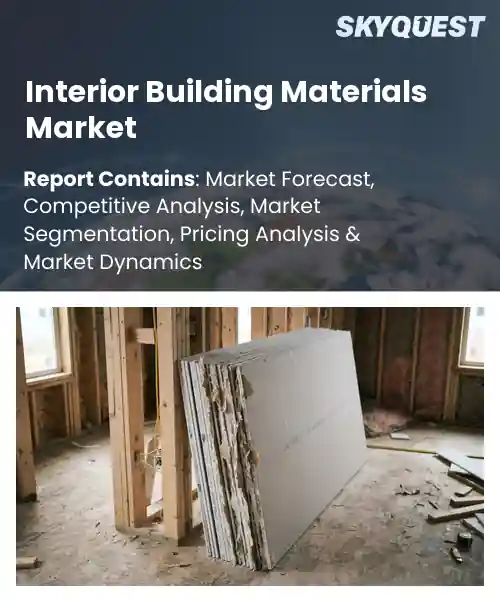
Interior Building Materials Market
Report ID: SQMIG20B2372
Report ID: SQMIG20B2372
[email protected]
USA +1 351-333-4748
Report ID:
SQMIG20B2372 |
Region:
Global |
Published Date: September, 2026
Pages:
157
|Tables:
129
|Figures:
77


Global Interior Building Materials Market size was valued at USD 22.4 Billion in 2024 and is poised to grow from USD 23.72 Billion in 2025 to USD 37.53 Billion by 2033, growing at a CAGR of 5.9% during the forecast period (2026-2033).
The interior building materials market encompasses products such as paints, flooring, wall claddings, ceilings, and decorative trims that shape the functional and aesthetic character of residential spaces. Its importance stems from the impact these materials have on construction cost, health, and energy efficiency, making them a focal point for developers and architects. Over the past two decades, the sector has shifted from conventional timber and solvent‑based finishes toward engineered composites, low‑VOC coatings, and printed panels, driven largely by heightened sustainability regulations. For instance, European manufacturers have introduced emission‑free paints, while Asian builders specify bamboo flooring to meet green‑building certifications today. Building on these regulatory pushes, manufacturing emerges as a key factor reshaping the global interior building materials market, unlocking growth through customization, faster time‑to‑market, and cost reductions. CNC milling and 3‑D printing enable producers to tailor panel textures and color palettes to project briefs, which in turn shortens installation cycles and lowers labor expenses. An example is the adoption of acoustic ceiling tiles in Japanese office towers, where factories deliver units that fit exact room dimensions, eliminating cutting and reducing waste by 30 percent. This efficiency attracts multinational developers seeking solutions, thereby expanding market size and creating significant export opportunities for material innovators.
How is AI-driven customization influencing the interior building materials market?
AI‑driven customization is reshaping the interior building‑materials market by turning static product lines into dynamic design services. Machines analyze design trends, spatial data and user preferences to generate material finishes, textures and dimensions on demand. Suppliers now offer digital libraries that clients can tweak in real time, eliminating long lead times and excess stock. The technology also enables virtual sampling, allowing architects to preview how a wallcovering or flooring will look under specific lighting before ordering. As a result, manufacturers are shifting from batch production to flexible, on‑the‑fly manufacturing, creating tighter alignment with project schedules and stronger customer engagement.In April 2024 Sherwin‑Williams launched an AI‑powered ColorSnap Visualizer Pro that creates bespoke paint palettes instantly, streamlining specification and cutting waste. The tool links to ordering systems so manufacturers produce only the colors needed, lowering inventory and delivering faster to contractors and homeowners in residential and commercial projects across markets.
Market snapshot - (2026-2033)
Global Market Size
USD 22.4 Billion
Largest Segment
Flooring Materials
Fastest Growth
Decorative Materials
Growth Rate
5.9% CAGR
To get more insights on this market click here to Request a Free Sample Report
Global interior building materials market is segmented by material type, material, application, end-use industry and region. Based on material type, the market is segmented into Flooring Materials, Wall Coverings, Ceiling Materials, Interior Doors & Panels, Decorative Materials and Others. Based on material, the market is segmented into Wood, Metal, Glass, Plastic & Composite, Ceramic and Others. Based on application, the market is segmented into Residential Interiors, Commercial Interiors, Hospitality Interiors, Institutional Interiors, Industrial Interiors and Others. Based on end-use industry, the market is segmented into Residential Construction, Commercial Construction, Hospitality, Healthcare, Education and Others. Based on region, the market is segmented into North America, Europe, Asia Pacific, Latin America and Middle East & Africa.
Wood segment dominates because its timeless aesthetic, natural warmth, and versatility align with consumer preferences for sustainable and authentic interiors. Designers favor wood for flooring, wall cladding, and custom millwork, driving consistent demand across residential and commercial projects. Moreover, advancements in engineered and reclaimed wood technologies enhance performance, lower maintenance, and reduce environmental impact, reinforcing wood’s central position in the interior building materials market and long‑term value proposition.
Meanwhile, ceramic segment emerges as the most rapidly expanding area, propelled by rising consumer appetite for high‑gloss finishes, durability, and hygienic properties in wet zones. Innovative large‑format tiles and digital printing enable designer‑driven aesthetics, while sustainability certifications boost acceptance, accelerating market expansion and creating new design opportunities.
Residential interiors segment dominates because homeowners prioritize comfort, personalization, and health‑focused environments, driving demand for softer flooring, acoustic wall solutions, and sustainable finishes. The rise of remote work and multigenerational living amplifies the need for flexible layouts and resilient materials, prompting manufacturers to innovate with moisture‑resistant composites and low‑VOC products. These preferences anchor residential projects as the primary driver of volume and product development in the market across diverse buyer cohorts.
On the other hand, hospitality interiors segment emerges as the fastest growing niche, fueled by increasing travel demand and experiential design trends that prioritize striking aesthetics and durable high‑traffic finishes. Smart surface technologies, antimicrobial coatings, and modular wall systems are gaining traction, expanding opportunities for premium material suppliers and accelerating market dynamism.
To get detailed segments analysis, Request a Free Sample Report
Asia Pacific leads the interior building materials market through a combination of expansive urban development, strong design culture, and advanced manufacturing capabilities. The region benefits from a deep pool of skilled designers and engineers who integrate contemporary aesthetics with functional performance, driving demand for high‑quality finishes and modular solutions. Robust supply chains supported by efficient logistics and proximity to raw material sources reduce lead times and enhance cost efficiency. Growing consumer emphasis on sustainability encourages the adoption of eco‑friendly products, prompting local manufacturers to invest in green technologies and certifications. Additionally, supportive government policies that promote construction activity and innovation create a fertile environment for both domestic producers and multinational entrants, reinforcing the region’s dominant position on the global stage.
Japan Interior Building Materials Market
Interior Building Materials Market in Japan is shaped by a sophisticated design ethos that blends tradition with cutting‑edge technology. Consumers value high craftsmanship and durability, prompting manufacturers to prioritize premium finishes and innovative surface treatments. Strong collaboration between architects, suppliers, and retailers accelerates product development, while stringent quality standards ensure reliability. The focus on space efficiency and minimalistic aesthetics further fuels demand for modular and multifunctional interior solutions in homes.
South Korea Interior Building Materials Market
Interior Building Materials Market in South Korea thrives on rapid urbanization and a strong appetite for contemporary aesthetics. Manufacturers emphasize sleek finishes, smart integration, and sustainable sourcing to meet consumer expectations for both style and environmental responsibility. Close ties between technology firms and interior product developers foster innovative solutions such as responsive lighting and adaptive surfaces. The competitive landscape encourages continuous improvement, driving a flow of design concepts and materials.
Europe’s interior building materials market expands rapidly due to a confluence of heritage design sensibility, stringent sustainability regulations, and a mature consumer base that values quality and innovation. The region’s long‑standing architectural traditions inspire demand for refined finishes that blend classic elegance with modern functionality. Robust environmental directives push manufacturers toward low‑impact production, encouraging the development of recycled and bio‑based materials. Strong collaboration among design schools, research institutes, and industry accelerates the introduction of advanced surface technologies and smart integration. Additionally, well‑established distribution networks and a focus on customization enable suppliers to meet diverse market preferences, reinforcing Europe’s position as a dynamic hub for interior material evolution. The emphasis on heritage craftsmanship combined with cutting‑edge digital design tools further fuels market vibrancy, attracting both established brands and innovative startups seeking to shape the future of interior environments.
Germany Interior Building Materials Market
Interior Building Materials Market in Germany is driven by a strong engineering culture and a rigorous focus on energy efficiency. Manufacturers prioritize high‑performance insulation, acoustic solutions, and recyclable finishes to align with strict building codes. Close cooperation between industry associations and research institutes accelerates the adoption of innovative composites and digital fabrication methods. Consumer preference for durability and precision further reinforces demand for premium, sustainably sourced interior products in markets.
United Kingdom Interior Building Materials Market
Interior Building Materials Market in United Kingdom experiences growth fueled by a strong design sector and retrofit activity. The focus on preserving historic character while integrating modern upgrades drives demand for adaptable finishes that offer performance. Manufacturers respond with modular systems, eco‑friendly coatings, and smart lighting solutions that meet regulatory standards. Collaboration between architects, developers, and suppliers accelerates product innovation, positioning the market as a leading hub for interior solutions.
France Interior Building Materials Market
Interior Building Materials Market in France is emerging as designers seek a blend of craftsmanship and sustainability. The market emphasizes natural textures, recycled composites, and bespoke finishes that reflect French aesthetic sensibility. Growing consumer awareness of environmental impact encourages manufacturers to adopt circular production methods and low‑impact materials. Collaborative networks linking design schools, boutique manufacturers, and eco‑certification bodies accelerate the introduction of unique interior solutions that cater to market segments.
North America reinforces its position in the interior building materials market through a blend of technological innovation, sustainability focus, and a consumer‑driven design culture. Advanced manufacturing techniques, such as 3D printing and automated coating processes, enable rapid product development and customization. Growing environmental awareness pushes manufacturers toward low‑emission adhesives, recycled content, and certified green products, aligning with stringent regional regulations. Strong collaboration between tech firms, design studios, and material suppliers accelerates the integration of smart surfaces and IoT‑enabled fixtures, meeting the rising demand for connected living spaces. A well‑established distribution infrastructure and a competitive retail landscape ensure broad market access, while continuous investment in research and development sustains a pipeline of high‑performance, aesthetically versatile interior solutions. These dynamics collectively position North America as a catalyst for global trends, attracting international partnerships and fostering continuous evolution of interior material standards.
United States Interior Building Materials Market
Interior Building Materials Market in United States is characterized by an emphasis on innovation and consumer personalization. Leading manufacturers invest heavily in research to develop sustainable products such as low‑VOC paints and modular wall systems. The widespread adoption of smart home technology drives demand for integrated lighting and responsive surface materials. Retail channels and a culture of design experimentation enable rapid diffusion of new trends, reinforcing the market’s growth trajectory.
Canada Interior Building Materials Market
Interior Building Materials Market in Canada reflects a commitment to sustainability and design. Manufacturers prioritize renewable resources, such as timber composites and bio‑based finishes, to meet environmental standards. The growing emphasis on energy‑efficient interiors drives demand for performance insulation and glazing. Collaborative initiatives between government agencies, research institutions, and industry players foster innovation in circular product life cycles. This ecosystem supports adoption of eco‑friendly solutions across residential and commercial projects.
To know more about the market opportunities by region and country, click here to
Buy The Complete Report
Sustainable Design Adoption
Energy Efficiency Demands
High Raw Material Costs
Regulatory Compliance Complexity
Request Free Customization of this report to help us to meet your business objectives.
The global interior building materials market is shaped by intense competition as major firms pursue strategic M&A, joint ventures, and technology‑driven product innovations to secure market share; recent examples include a leading tile manufacturer acquiring a smart‑glazing startup and a flooring giant forming a partnership with a digital supply‑chain platform, both moves accelerating material performance and sustainability differentiation while responding to heightened demand for eco‑friendly interiors.
Top Player’s Company Profile
Recent Developments
SkyQuest’s ABIRAW (Advanced Business Intelligence, Research & Analysis Wing) is our Business Information Services team that Collects, Collates, Correlates, and Analyses the Data collected by means of Primary Exploratory Research backed by robust Secondary Desk research. As per SkyQuest analysis the global interior building materials market is being propelled primarily by the growing adoption of sustainable design, which pushes manufacturers toward eco‑friendly, low‑VOC and recycled products, while AI‑driven customization serves as a second catalyst by turning static inventories into on‑demand design services that shorten lead times and boost customer engagement. High raw material costs act as a restraint, limiting investment in new product development and pressuring pricing. Asia Pacific dominates the market thanks to rapid urbanization, strong design culture and efficient supply chains, and the wood segment remains the leading material due to its timeless appeal, versatility and increasing use of engineered and reclaimed varieties.
| Report Metric | Details |
|---|---|
| Market size value in 2024 | USD 22.4 Billion |
| Market size value in 2033 | USD 37.53 Billion |
| Growth Rate | 5.9% |
| Base year | 2024 |
| Forecast period | (2026-2033) |
| Forecast Unit (Value) | USD Billion |
| Segments covered |
|
| Regions covered | North America (US, Canada), Europe (Germany, France, United Kingdom, Italy, Spain, Rest of Europe), Asia Pacific (China, India, Japan, Rest of Asia-Pacific), Latin America (Brazil, Rest of Latin America), Middle East & Africa (South Africa, GCC Countries, Rest of MEA) |
| Companies covered |
|
| Customization scope | Free report customization with purchase. Customization includes:-
|
To get a free trial access to our platform which is a one stop solution for all your data requirements for quicker decision making. This platform allows you to compare markets, competitors who are prominent in the market, and mega trends that are influencing the dynamics in the market. Also, get access to detailed SkyQuest exclusive matrix.
Table Of Content
Executive Summary
Market overview
Parent Market Analysis
Market overview
Market size
KEY MARKET INSIGHTS
COVID IMPACT
MARKET DYNAMICS & OUTLOOK
Market Size by Region
KEY COMPANY PROFILES
Methodology
For the Interior Building Materials Market, our research methodology involved a mixture of primary and secondary data sources. Key steps involved in the research process are listed below:
1. Information Procurement: This stage involved the procurement of Market data or related information via primary and secondary sources. The various secondary sources used included various company websites, annual reports, trade databases, and paid databases such as Hoover's, Bloomberg Business, Factiva, and Avention. Our team did 45 primary interactions Globally which included several stakeholders such as manufacturers, customers, key opinion leaders, etc. Overall, information procurement was one of the most extensive stages in our research process.
2. Information Analysis: This step involved triangulation of data through bottom-up and top-down approaches to estimate and validate the total size and future estimate of the Interior Building Materials Market.
3. Report Formulation: The final step entailed the placement of data points in appropriate Market spaces in an attempt to deduce viable conclusions.
4. Validation & Publishing: Validation is the most important step in the process. Validation & re-validation via an intricately designed process helped us finalize data points to be used for final calculations. The final Market estimates and forecasts were then aligned and sent to our panel of industry experts for validation of data. Once the validation was done the report was sent to our Quality Assurance team to ensure adherence to style guides, consistency & design.
Analyst Support
Customization Options
With the given market data, our dedicated team of analysts can offer you the following customization options are available for the Interior Building Materials Market:
Product Analysis: Product matrix, which offers a detailed comparison of the product portfolio of companies.
Regional Analysis: Further analysis of the Interior Building Materials Market for additional countries.
Competitive Analysis: Detailed analysis and profiling of additional Market players & comparative analysis of competitive products.
Go to Market Strategy: Find the high-growth channels to invest your marketing efforts and increase your customer base.
Innovation Mapping: Identify racial solutions and innovation, connected to deep ecosystems of innovators, start-ups, academics, and strategic partners.
Category Intelligence: Customized intelligence that is relevant to their supply Markets will enable them to make smarter sourcing decisions and improve their category management.
Public Company Transcript Analysis: To improve the investment performance by generating new alpha and making better-informed decisions.
Social Media Listening: To analyze the conversations and trends happening not just around your brand, but around your industry as a whole, and use those insights to make better Marketing decisions.
REQUEST FOR SAMPLE
 REQUEST FREE CUSTOMIZATION


Want to customize this report? This report can be personalized according to your needs. Our analysts and industry experts will work directly with you to understand your requirements and provide you with customized data in a short amount of time. We offer $1000 worth of FREE customization at the time of purchase.
Feedback From Our Clients


 USA (+1) 351-333-4748

