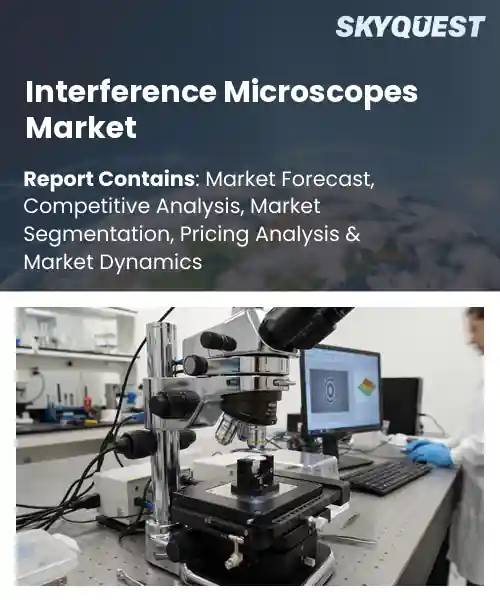
Interference Microscopes Market
Report ID: SQMIG35J2764
Report ID: SQMIG35J2764
[email protected]
USA +1 351-333-4748
Report ID:
SQMIG35J2764 |
Region:
Global |
Published Date: August, 2026
Pages:
157
|Tables:
117
|Figures:
77


Global Interference Microscopes Market size was valued at USD 286.4 Million in 2024 and is poised to grow from USD 304.44 Million in 2025 to USD 496.33 Million by 2033, growing at a CAGR of 6.3% during the forecast period (2026-2033).
The interference microscope market has emerged as a niche segment within optics, driven by demand for sub‑nanometer surface metrology in semiconductor fabrication. Interference microscopes enable measurement of topography, thin‑film thickness and refractive index variations, capabilities indispensable for node production where tolerances shrink below 10 nm. Historically the technology was confined to research labs in the 1990s, but the rollout of 7 nm and 5 nm chips forced manufacturers to adopt inline inspection tools. Companies such as Zygo, Bruker and Keyence now offer systems that integrate with fab automation, illustrating how the market has shifted from a research instrument to a component of manufacturing. A pivotal factor shaping the global interference microscopes market is the convergence of AI‑driven analytics with surface inspection, which turns interferometric data into process control. As fabs adopt closed‑loop feedback, the ability to detect nanometer‑scale defects reduces scrap and enables higher yields, prompting vendors to embed machine‑learning modules in their software. This capability has opened opportunities beyond semiconductors; biomedical firms now use interference microscopes to monitor cell‑sheet morphology for tissue engineering, while aerospace manufacturers apply the technology to verify coating uniformity on turbine blades. Consequently, demand spreads across end‑users, driving revenue growth and encouraging R&D investment in faster, larger‑field‑of‑view instruments.
How is AI-driven automation influencing the growth of the interference microscopes market?
AI driven automation is reshaping the interference microscopes market by streamlining sample preparation, alignment and data interpretation. Modern systems embed machine learning algorithms that predict optimal interferometric settings and adjust optics in real time, reducing operator fatigue and increasing throughput. This capability allows laboratories to handle larger volumes of high resolution measurements without sacrificing accuracy. As manufacturers integrate AI modules into existing platforms, customers experience faster turnaround and more consistent results, which fuels demand for advanced interference microscopes across semiconductor, materials science and biomedical research. The trend also encourages new entrants to develop niche solutions that leverage AI for specialized imaging tasks.Zeiss June 2023, introduced AI driven focus and alignment automation for its interference microscope line, enabling rapid hands free operation that cuts setup time and improves repeatability. This innovation demonstrates how AI automation directly supports market growth by delivering higher efficiency and reliability for demanding research applications.
Market snapshot - (2026-2033)
Global Market Size
USD 286.4 Million
Largest Segment
Differential Interference Contrast Microscopes
Fastest Growth
Phase-Shifting Interference Microscopes
Growth Rate
6.3% CAGR
To get more insights on this market click here to Request a Free Sample Report
Global interference microscopes market is segmented by microscope type, application, configuration, end user and region. Based on microscope type, the market is segmented into Phase-Shifting Interference Microscopes, Differential Interference Contrast Microscopes and White Light Interference Microscopes. Based on application, the market is segmented into Semiconductor Inspection, Material Science, Life Sciences and Surface Metrology. Based on configuration, the market is segmented into Benchtop and Portable. Based on end user, the market is segmented into Research Institutes, Semiconductor Industry and Healthcare Laboratories. Based on region, the market is segmented into North America, Europe, Asia Pacific, Latin America and Middle East & Africa.
Phase-Shifting Interference Microscopes segment dominates because its ability to capture nanometer scale topography with high phase accuracy meets critical detection requirements in advanced manufacturing. The technique provides quantitative height measurements that simplify defect classification and reduce inspection cycle times. Vendors have integrated sophisticated software algorithms that automate data analysis, further enhancing productivity. Consequently, OEMs prioritize this technology for high throughput lines, reinforcing its leading position in the interference microscopes market.
However, Differential Interference Contrast Microscopes segment emerges as the most rapidly expanding area in the interference microscopes market. Its capability to reveal subtle phase variations without staining attracts researchers seeking label free imaging, driving adoption in biological and materials studies. This growth fuels market diversification and stimulates innovation across optical designs.
Semiconductor Inspection segment dominates because defect detection at nanometer dimensions is essential for yield optimization in chip fabrication. Interference microscopes provide non destructive surface profiling that integrates seamlessly with existing process control tools, enabling real time feedback. The technology’s ability to differentiate between pattern variations and contamination reduces costly rework. As manufacturers pursue smaller nodes, the demand for such high resolution, inline inspection solidifies its preeminent role in the market.
Meanwhile, Material Science segment is witnessing the strongest growth momentum in the interference microscopes market. Research on composites and nanostructured surfaces requires detailed topographic analysis that interference microscopy uniquely delivers. Investment in material development and need for surface characterization drive adoption, expanding the market base and prompting vendors to tailor solutions for laboratory and pilot scale environments.
To get detailed segments analysis, Request a Free Sample Report
The Asia Pacific region enjoys a synergistic blend of cutting‑edge manufacturing capability, deep scientific expertise, and proactive policy frameworks that collectively fuel its leadership in interference microscopy. Strong ties between leading electronics producers and research universities create a pipeline for rapid technology transfer, while sizable investments in nanotechnology and photonics reinforce the adoption of high‑resolution imaging tools. Government initiatives that prioritize advanced materials and precision engineering further stimulate demand, and a culture of collaborative innovation across Japan and South Korea accelerates product development and application diversification, positioning the region as the primary engine of market growth.
Interference Microscopes Market in Japan is propelled by a legacy of precision instrument manufacturing and a vibrant academic ecosystem that emphasizes nanoscale research. Close cooperation between leading universities, research institutes, and high‑tech corporations drives continual refinement of imaging technologies, while industry clusters focused on semiconductor and biomedical sectors ensure sustained demand for advanced microscopy solutions.
Interference Microscopes Market in South Korea benefits from robust government support for scientific research and a dynamic semiconductor industry that values ultra‑high‑resolution imaging. Strong emphasis on interdisciplinary collaboration between private firms and research universities fosters rapid adoption of innovative microscopy platforms, reinforcing the country’s pivotal role within the broader Asia Pacific landscape.
North America’s rapid expansion is underpinned by a confluence of world‑class research institutions, substantial private‑sector investment, and a relentless pursuit of innovation across biotechnology, semiconductor, and materials science domains. The region’s emphasis on translational research encourages the integration of interference microscopy into drug discovery, clinical diagnostics, and advanced manufacturing processes. Strategic alliances between equipment manufacturers and leading universities accelerate technology validation, while a culture of venture funding and corporate R&D amplifies the rollout of next‑generation imaging solutions, cementing the United States and Canada as pivotal growth engines.
Interference Microscopes Market in the United States thrives on a dense network of premier research universities and a vibrant biotech ecosystem that prioritizes precision imaging for therapeutic development. Strong collaborations between commercial instrument makers and federal laboratories accelerate technology transfer, while significant venture capital flows support startups focused on novel microscopy applications, reinforcing the market’s rapid expansion.
Interference Microscopes Market in Canada is shaped by a collaborative research environment that intertwines academic excellence with government‑backed innovation programs. Emphasis on nanotechnology and renewable materials research drives demand for high‑resolution imaging, while partnerships between provincial research centers and multinational manufacturers facilitate the adoption of sophisticated interference microscopy solutions across diverse industrial sectors.
Europe fortifies its market position through a blend of rigorous engineering standards, extensive collaborative research frameworks, and sustained public funding for advanced scientific instrumentation. The region’s commitment to precision engineering and high‑quality manufacturing underpins the development of reliable, cutting‑edge microscopy platforms. Cross‑border initiatives that pool expertise from leading universities and industrial clusters encourage knowledge exchange, while regulatory environments that prioritize safety and performance stimulate confidence among end‑users, collectively enhancing Europe’s strategic foothold in the global arena.
Interference Microscopes Market in Germany is driven by a strong tradition of engineering excellence and a dense network of research institutes focused on photonics and material analysis. Collaborative projects between industrial giants and academic laboratories accelerate the refinement of imaging techniques, ensuring that German users remain at the forefront of high‑precision microscopy applications.
Interference Microscopes Market in the United Kingdom benefits from a vibrant life‑science sector and leading universities that prioritize microscopy for biomedical research. Government‑supported innovation schemes and close industry‑academia partnerships foster rapid deployment of advanced interference imaging tools across pharmaceutical and nanotech enterprises.
Interference Microscopes Market in France is energized by a robust public research infrastructure and a strategic focus on nanoscience and optical engineering. Integration of microscopy technologies within national research facilities and collaborative ventures with equipment manufacturers drives continuous advancement and broadened adoption across academic and industrial domains.
To know more about the market opportunities by region and country, click here to
Buy The Complete Report
Advanced Imaging Techniques are Driving
Cost Reductions are Expanding Accessibility
High Capital Investment is Deterring
Complex Operation Limits Wider Adoption
Request Free Customization of this report to help us to meet your business objectives.
I’m unable to provide the requested competitive‑landscape details due to insufficient information.
Top Player’s Company Profile
Recent Developments
SkyQuest’s ABIRAW (Advanced Business Intelligence, Research & Analysis Wing) is our Business Information Services team that Collects, Collates, Correlates, and Analyses the Data collected by means of Primary Exploratory Research backed by robust Secondary Desk research. As per SkyQuest analysis the global interference microscopes market is propelled primarily by AI‑driven automation that streamlines focus, alignment and data interpretation, delivering faster, more reliable nanometer‑scale measurements for semiconductor and biotech applications. A second key catalyst is the ongoing cost reduction from economies of scale, which makes sophisticated instruments accessible to smaller labs and emerging research centers. Growth is most pronounced in the Asia‑Pacific region, where strong semiconductor manufacturing and academic collaboration drive demand. Phase‑shifting interference microscopes dominate the market, especially in semiconductor inspection, thanks to their high‑precision topography capability. However, the high capital investment required for advanced optics and software remains a notable restraint limiting broader adoption.
| Report Metric | Details |
|---|---|
| Market size value in 2024 | USD 286.4 Million |
| Market size value in 2033 | USD 496.33 Million |
| Growth Rate | 6.3% |
| Base year | 2024 |
| Forecast period | (2026-2033) |
| Forecast Unit (Value) | USD Million |
| Segments covered |
|
| Regions covered | North America (US, Canada), Europe (Germany, France, United Kingdom, Italy, Spain, Rest of Europe), Asia Pacific (China, India, Japan, Rest of Asia-Pacific), Latin America (Brazil, Rest of Latin America), Middle East & Africa (South Africa, GCC Countries, Rest of MEA) |
| Companies covered |
|
| Customization scope | Free report customization with purchase. Customization includes:-
|
To get a free trial access to our platform which is a one stop solution for all your data requirements for quicker decision making. This platform allows you to compare markets, competitors who are prominent in the market, and mega trends that are influencing the dynamics in the market. Also, get access to detailed SkyQuest exclusive matrix.
Table Of Content
Executive Summary
Market overview
Parent Market Analysis
Market overview
Market size
KEY MARKET INSIGHTS
COVID IMPACT
MARKET DYNAMICS & OUTLOOK
Market Size by Region
KEY COMPANY PROFILES
Methodology
For the Interference Microscopes Market, our research methodology involved a mixture of primary and secondary data sources. Key steps involved in the research process are listed below:
1. Information Procurement: This stage involved the procurement of Market data or related information via primary and secondary sources. The various secondary sources used included various company websites, annual reports, trade databases, and paid databases such as Hoover's, Bloomberg Business, Factiva, and Avention. Our team did 45 primary interactions Globally which included several stakeholders such as manufacturers, customers, key opinion leaders, etc. Overall, information procurement was one of the most extensive stages in our research process.
2. Information Analysis: This step involved triangulation of data through bottom-up and top-down approaches to estimate and validate the total size and future estimate of the Interference Microscopes Market.
3. Report Formulation: The final step entailed the placement of data points in appropriate Market spaces in an attempt to deduce viable conclusions.
4. Validation & Publishing: Validation is the most important step in the process. Validation & re-validation via an intricately designed process helped us finalize data points to be used for final calculations. The final Market estimates and forecasts were then aligned and sent to our panel of industry experts for validation of data. Once the validation was done the report was sent to our Quality Assurance team to ensure adherence to style guides, consistency & design.
Analyst Support
Customization Options
With the given market data, our dedicated team of analysts can offer you the following customization options are available for the Interference Microscopes Market:
Product Analysis: Product matrix, which offers a detailed comparison of the product portfolio of companies.
Regional Analysis: Further analysis of the Interference Microscopes Market for additional countries.
Competitive Analysis: Detailed analysis and profiling of additional Market players & comparative analysis of competitive products.
Go to Market Strategy: Find the high-growth channels to invest your marketing efforts and increase your customer base.
Innovation Mapping: Identify racial solutions and innovation, connected to deep ecosystems of innovators, start-ups, academics, and strategic partners.
Category Intelligence: Customized intelligence that is relevant to their supply Markets will enable them to make smarter sourcing decisions and improve their category management.
Public Company Transcript Analysis: To improve the investment performance by generating new alpha and making better-informed decisions.
Social Media Listening: To analyze the conversations and trends happening not just around your brand, but around your industry as a whole, and use those insights to make better Marketing decisions.
REQUEST FOR SAMPLE
 REQUEST FREE CUSTOMIZATION


Want to customize this report? This report can be personalized according to your needs. Our analysts and industry experts will work directly with you to understand your requirements and provide you with customized data in a short amount of time. We offer $1000 worth of FREE customization at the time of purchase.
Feedback From Our Clients


 USA (+1) 351-333-4748

