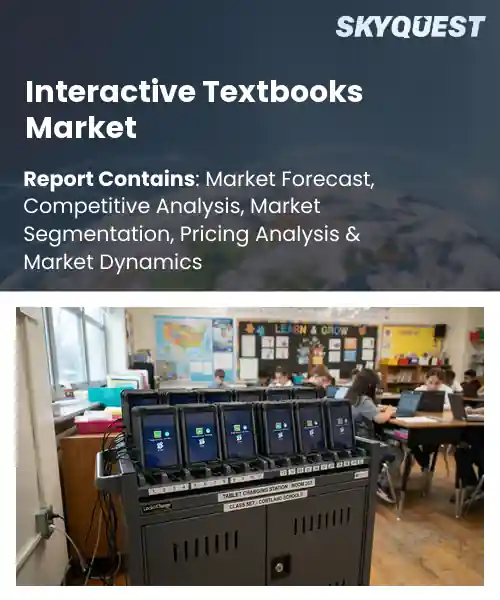
Interactive Textbooks Market
Report ID: SQMIG25R2077
Report ID: SQMIG25R2077
[email protected]
USA +1 351-333-4748
Report ID:
SQMIG25R2077 |
Region:
Global |
Published Date: September, 2026
Pages:
157
|Tables:
153
|Figures:
78


Global Interactive Textbooks Market size was valued at USD 2.9 Billion in 2024 and is poised to grow from USD 3.18 Billion in 2025 to USD 6.73 Billion by 2033, growing at a CAGR of 9.8% during the forecast period (2026-2033).
The surge in transformation within education serves as the primary driver of the interactive textbooks market. Interactive textbooks are digital learning resources that embed video, simulations, instant quizzes, and feedback into traditional content, allowing students to engage actively rather than passively read. This capability matters because it aligns with pedagogical emphasis on personalized learning, which links to higher retention rates. The market evolved from simple e‑books in the early 2000s to platforms such as Pearson’s MyLab, McGraw‑Hill’s Connect, and Knewton’s adaptive engine, each adding layers of interactivity and analytics. These examples illustrate how technology adoption and curriculum reform have jointly propelled market growth. The second factor shaping the interactive textbooks education market is the integration of personalization, which turns engagement metrics into actionable learning pathways. When platforms capture clickstreams, quiz results, and time‑on‑task, algorithms can recommend videos or problems, thereby increasing mastery and encouraging institutions to invest. This loop has spurred significant growth opportunities for publishers who now bundle analytics dashboards with subscription licenses, creating new revenue streams. Examples include a university deployment of an adaptive chemistry textbook that reduced failure rates by 15 % and a Texas district that used interactive modules to meet STEM proficiency targets, illustrating how clear measurable outcomes drive further overall expansion.
How is AI enhancing personalization in the interactive textbooks market?
AI is reshaping interactive textbooks by tailoring content to each learner’s pace, style and knowledge gaps. Adaptive algorithms analyze reading patterns, quiz responses and engagement signals to recommend supplemental videos, practice problems or alternative explanations. Publishers embed these engines directly into digital platforms, allowing teachers to monitor progress through dashboards. The market sees growing adoption in K 12 and higher education as schools seek tools that keep students motivated while reducing manual grading. Examples include real time feedback loops that adjust difficulty, contextual hints that appear when a concept is misunderstood, and multimodal resources that match individual preferences.Pearson launched an AI powered personalization engine in March 2024, enabling textbooks to adapt explanations instantly based on student responses and to suggest targeted practice that supports faster learning and higher engagement across classrooms. The system also provides teachers with analytics that highlight individual strengths and areas needing reinforcement, helping them allocate instructional time more effectively.
Market snapshot - (2026-2033)
Global Market Size
USD 2.9 Billion
Largest Segment
STEM Textbooks
Fastest Growth
Professional and Vocational Textbooks
Growth Rate
9.8% CAGR
To get more insights on this market click here to Request a Free Sample Report
Global interactive textbooks market is segmented by textbook type, content format, platform, education level, end user and region. Based on textbook type, the market is segmented into STEM Textbooks, Humanities Textbooks, Social Sciences Textbooks, Language Textbooks, Professional and Vocational Textbooks and Others. Based on content format, the market is segmented into Text-Based, Multimedia-Enhanced, Interactive Simulations, Augmented Reality-Enabled, Virtual Reality-Enabled and Others. Based on platform, the market is segmented into Web-Based, Mobile Applications and Desktop Applications. Based on education level, the market is segmented into Primary Education, Secondary Education, Higher Education and Professional Education. Based on end user, the market is segmented into Schools, Colleges and Universities, Corporate Training, Individual Learners and Others. Based on region, the market is segmented into North America, Europe, Asia Pacific, Latin America and Middle East & Africa.
Multimedia-Enhanced segment dominates because it merges traditional narrative with rich audio, video, and animation, creating a learning experience that aligns with digital native expectations. This format captures learner attention, supports diverse cognitive styles, and simplifies complex concepts through visual storytelling. Publishers adopt it to differentiate offerings, while educators favor it for higher engagement and retention, leading to its central role in interactive textbook adoption across K12 and higher education environments.
However, Augmented Reality Enabled segment is witnessing the strongest growth momentum as immersive overlays allow students to interact with 3D models directly within textbook pages. This capability addresses demand for experiential learning, spurs teacher adoption, and fuels content creator investment, thereby accelerating market expansion and opening new revenue streams for publishers.
Higher Education segment dominates because universities seek comprehensive, updatable resources that support research intensive curricula and collaborative learning. Interactive textbooks at this level integrate citations, data visualizations, and cross platform synchronization, meeting faculty demands for depth and flexibility. Institutions prioritize digital solutions to reduce physical inventory, while students expect seamless access across devices, reinforcing the centrality of higher education in driving market adoption and shaping product development for future growth.
On the other hand, Professional Education segment emerges as the key high growth area as corporations and certification bodies demand up to date, skill focused content that can be delivered quickly. The need for just in time learning drives adoption of modular interactive textbooks, prompting innovative authoring tools and expanding market opportunities.
To get detailed segments analysis, Request a Free Sample Report
North America dominates the global interactive textbooks market due to its advanced digital infrastructure, higher‑education and K‑12 ecosystems, and a culture that embraces innovative learning solutions. Significant investment from public and private sectors fuels research and development of educational technologies. Established publishing houses collaborate with technology providers to create content that integrates multimedia, assessment, and analytics. Policy frameworks encourage adoption of digital resources, while widespread broadband access ensures that interactive textbooks reach diverse learner populations. Additionally, a robust ecosystem of venture capital and startup activity accelerates the introduction of novel interactive platforms, reinforcing the region’s leadership. Data‑driven instruction drives demand for analytics‑rich textbooks that provide real‑time feedback to educators and learners. Strong intellectual property protections encourage publishers to invest in high‑quality interactive content, while collaborations with partners expand the reach of North American innovations. This confluence of readiness, supportive policy, and market demand sustains the region’s dominant position.
Interactive Textbooks Market in the United States benefits from a mature edtech ecosystem, research universities, and a culture that embraces digital learning tools. Publishers collaborate closely with technology providers to embed multimedia and assessment features. Institutional procurement processes favor scalable solutions, and educators prioritize student engagement through interactive content. The market also benefits from strong public‑private partnerships that accelerate product development and distribution across K‑12 and higher education.
Interactive Textbooks Market in Canada is propelled by a collaborative education framework that encourages early adoption of digital resources. Provincial education ministries actively support integration of interactive content, while a network of innovative publishers and technology firms co‑create solutions tailored to bilingual curricula. Teachers value the ability to personalize learning pathways, and the market benefits from strong research funding that drives continuous improvement of interactive pedagogical tools.
Europe’s interactive textbooks market is energized by a convergence of progressive educational policies, strong public investment in digital learning, and a deep tradition of academic excellence. Collaborative initiatives among governments, research institutions, and edtech innovators foster the development of multilingual, standards‑aligned content that meets diverse classroom needs. The region’s mature publishing sector leverages its expertise in curriculum design to embed interactive elements that enhance student engagement. Additionally, a growing emphasis on competency‑based education drives demand for adaptive learning experiences, positioning Europe as a hub for sophisticated, research‑backed interactive textbook solutions. Cross‑border collaborations enable sharing of best practices and joint development of resources, while extensive professional development programs equip educators with the skills to integrate interactive textbooks effectively. The regulatory environment encourages open standards, facilitating interoperability across platforms and fostering a competitive landscape that drives continuous improvement.
Interactive Textbooks Market in Germany is anchored by a robust research university network and a publishing industry renowned for rigorous content quality. Federal education initiatives prioritize digital transformation, encouraging schools to adopt interactive solutions that align with national curriculum standards. Collaboration between technology firms and textbook publishers yields highly localized, multimedia‑rich resources, while teacher training programs emphasize pedagogical integration, reinforcing Germany’s position as a leading European market.
Interactive Textbooks Market in the United Kingdom experiences rapid expansion driven by a dynamic edtech ecosystem and strong governmental support for digital learning initiatives. Universities and schools actively experiment with immersive content, fostering a culture of innovation. Publisher collaborations focus on creating flexible, modular resources that cater to diverse learner pathways, while professional development schemes equip teachers with the confidence to embed interactive textbooks across curricula, accelerating market momentum.
Interactive Textbooks Market in France is emerging as educators seek to modernize instruction through engaging digital resources. National education reforms encourage the integration of interactive content, prompting publishers to develop French‑language multimedia materials aligned with curriculum goals. Collaborative pilots between schools and technology startups showcase the potential for personalized learning experiences, while teacher training initiatives focus on building digital competencies, gradually expanding market acceptance across primary and secondary education.
Asia Pacific is strengthening its position in the interactive textbooks market through a combination of rapid technology adoption, government‑driven digital education agendas, and a culturally diverse learner base that values innovative instructional tools. Strong investment in broadband infrastructure and mobile connectivity enables widespread access to interactive content across urban and emerging markets. Leading technology firms collaborate with regional publishers to create culturally relevant, multilingual resources that integrate artificial intelligence and adaptive learning features. Additionally, a focus on skill‑based education and lifelong learning drives demand for interactive textbooks that support competency development, positioning the region as a dynamic growth engine for the global market. National education ministries provide incentives for schools to integrate digital resources, while teacher training programs ensure pedagogical use. Collaborative research hubs across the region explore emerging technologies such as augmented reality, further enriching the interactive textbook ecosystem and reinforcing Asia Pacific’s role as an innovation leader.
Interactive Textbooks Market in Japan benefits from a highly disciplined education system and a strong culture of technological innovation. Government initiatives promote digital textbooks as a means to enhance student engagement, while leading publishers partner with tech firms to embed rich multimedia and adaptive learning functions. Teacher professional development emphasizes effective integration of interactive resources, and the market’s focus on high‑quality, culturally resonant content sustains broad acceptance across primary and secondary schools.
Interactive Textbooks Market in South Korea is driven by rapid broadband penetration and a national emphasis on STEM education. The government’s digital learning strategies encourage schools to adopt interactive resources that support inquiry‑based teaching. Collaboration between innovative publishers and leading electronics companies yields immersive, AI‑enhanced textbooks that adapt to individual learner progress. Comprehensive teacher training programs further ensure that interactive textbooks are effectively leveraged to improve student outcomes.
To know more about the market opportunities by region and country, click here to
Buy The Complete Report
Enhanced Student Engagement Through Interactivity
Institutional Adoption driven By Curriculum Integration
High Development Costs Limit Adoption
Technology Infrastructure Challenges Restrict Usage
Request Free Customization of this report to help us to meet your business objectives.
The competitive landscape of the Global Interactive Textbooks Market is shaped by aggressive M&A activity, strategic partnerships, and rapid technology integration, with incumbents acquiring niche content platforms to broaden digital portfolios, while new entrants leverage AI‑driven personalization to capture classroom adoption. Recent examples include a major publisher’s acquisition of a cloud‑based learning platform to enhance analytics capabilities, and a collaboration between a leading textbook provider and a virtual‑reality firm to embed immersive simulations directly into digital chapters, driving differentiation and user engagement.
Top Player’s Company Profile
Recent Developments
SkyQuest’s ABIRAW (Advanced Business Intelligence, Research & Analysis Wing) is our Business Information Services team that Collects, Collates, Correlates, and Analyses the Data collected by means of Primary Exploratory Research backed by robust Secondary Desk research. As per SkyQuest analysis, the market is propelled chiefly by enhanced student engagement through interactivity, which makes learning more active and improves retention, while high development costs serve as a notable restraint limiting rapid adoption in budget‑constrained schools. North America continues to dominate the market thanks to its robust digital infrastructure and strong institutional investment, and within the product mix the multimedia‑enhanced segment commands the largest share by delivering audio, video and animation that match digital‑native expectations. A second driver, AI‑powered personalization, is accelerating growth by adapting content to individual learners and providing real‑time analytics for teachers, thereby deepening the value proposition and encouraging further institutional uptake.
| Report Metric | Details |
|---|---|
| Market size value in 2024 | USD 2.9 Billion |
| Market size value in 2033 | USD 6.73 Billion |
| Growth Rate | 9.8% |
| Base year | 2024 |
| Forecast period | (2026-2033) |
| Forecast Unit (Value) | USD Billion |
| Segments covered |
|
| Regions covered | North America (US, Canada), Europe (Germany, France, United Kingdom, Italy, Spain, Rest of Europe), Asia Pacific (China, India, Japan, Rest of Asia-Pacific), Latin America (Brazil, Rest of Latin America), Middle East & Africa (South Africa, GCC Countries, Rest of MEA) |
| Companies covered |
|
| Customization scope | Free report customization with purchase. Customization includes:-
|
To get a free trial access to our platform which is a one stop solution for all your data requirements for quicker decision making. This platform allows you to compare markets, competitors who are prominent in the market, and mega trends that are influencing the dynamics in the market. Also, get access to detailed SkyQuest exclusive matrix.
Table Of Content
Executive Summary
Market overview
Parent Market Analysis
Market overview
Market size
KEY MARKET INSIGHTS
COVID IMPACT
MARKET DYNAMICS & OUTLOOK
Market Size by Region
KEY COMPANY PROFILES
Methodology
For the Interactive Textbooks Market, our research methodology involved a mixture of primary and secondary data sources. Key steps involved in the research process are listed below:
1. Information Procurement: This stage involved the procurement of Market data or related information via primary and secondary sources. The various secondary sources used included various company websites, annual reports, trade databases, and paid databases such as Hoover's, Bloomberg Business, Factiva, and Avention. Our team did 45 primary interactions Globally which included several stakeholders such as manufacturers, customers, key opinion leaders, etc. Overall, information procurement was one of the most extensive stages in our research process.
2. Information Analysis: This step involved triangulation of data through bottom-up and top-down approaches to estimate and validate the total size and future estimate of the Interactive Textbooks Market.
3. Report Formulation: The final step entailed the placement of data points in appropriate Market spaces in an attempt to deduce viable conclusions.
4. Validation & Publishing: Validation is the most important step in the process. Validation & re-validation via an intricately designed process helped us finalize data points to be used for final calculations. The final Market estimates and forecasts were then aligned and sent to our panel of industry experts for validation of data. Once the validation was done the report was sent to our Quality Assurance team to ensure adherence to style guides, consistency & design.
Analyst Support
Customization Options
With the given market data, our dedicated team of analysts can offer you the following customization options are available for the Interactive Textbooks Market:
Product Analysis: Product matrix, which offers a detailed comparison of the product portfolio of companies.
Regional Analysis: Further analysis of the Interactive Textbooks Market for additional countries.
Competitive Analysis: Detailed analysis and profiling of additional Market players & comparative analysis of competitive products.
Go to Market Strategy: Find the high-growth channels to invest your marketing efforts and increase your customer base.
Innovation Mapping: Identify racial solutions and innovation, connected to deep ecosystems of innovators, start-ups, academics, and strategic partners.
Category Intelligence: Customized intelligence that is relevant to their supply Markets will enable them to make smarter sourcing decisions and improve their category management.
Public Company Transcript Analysis: To improve the investment performance by generating new alpha and making better-informed decisions.
Social Media Listening: To analyze the conversations and trends happening not just around your brand, but around your industry as a whole, and use those insights to make better Marketing decisions.
REQUEST FOR SAMPLE
 REQUEST FREE CUSTOMIZATION


Want to customize this report? This report can be personalized according to your needs. Our analysts and industry experts will work directly with you to understand your requirements and provide you with customized data in a short amount of time. We offer $1000 worth of FREE customization at the time of purchase.
Feedback From Our Clients


 USA (+1) 351-333-4748

