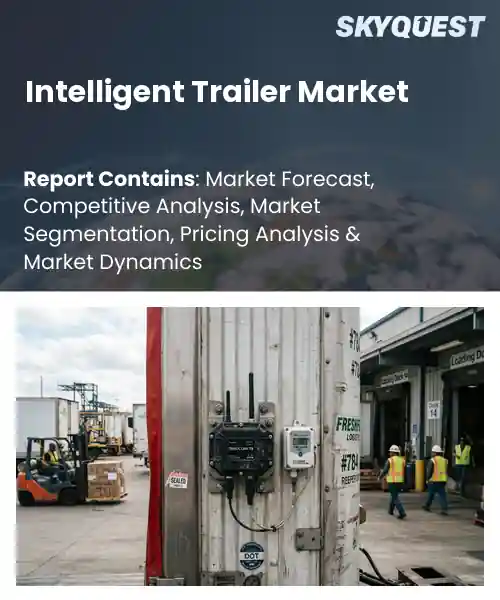
Intelligent Trailer Market
Report ID: SQMIG25A3007
Report ID: SQMIG25A3007
[email protected]
USA +1 351-333-4748
Report ID:
SQMIG25A3007 |
Region:
Global |
Published Date: October, 2026
Pages:
157
|Tables:
121
|Figures:
77


Global Intelligent Trailer Market size was valued at USD 2.85 Billion in 2024 and is poised to grow from USD 3.12 Billion in 2025 to USD 6.4 Billion by 2033, growing at a CAGR of 9.4% during the forecast period (2026-2033).
Integration of autonomous‑driving technology amplifies market expansion because intelligent trailers can relay predictive braking and alignment data to driverless tractors, reducing accidents and fuel waste. A European logistics consortium piloted linked trailer‑tractor pairs that adjust suspension, achieving a 12 percent drop in cargo damage on long hauls. This success spurs demand for sensors and modules, opening opportunities for semiconductor and software firms. At the same time, tightening carbon‑regulation pushes carriers toward such solutions; a South‑American fleet retrofitted its trailers with adaptive aerodynamic skirting and recorded an 8 percent emission reduction, demonstrating how policy pressure translates into technology adoption and advantage. The global intelligent trailer market comprises freight carriers equipped with sensors, telematics, and AI control systems that optimise load stability, route efficiency, and safety. Its importance stems from the escalating pressure on logistics networks to reduce consumption while meeting delivery windows. The primary driver is the rising adoption of IoT connectivity across supply chains, which enables data exchange between trailers, tractors, and platforms. Over the past decade, regulatory mandates on emissions and the proliferation of e‑commerce have accelerated investments; for instance, a trucking firm reduced idle time by 30 percent after deploying trailers that monitor brake temperature and cargo shift.
How are AI and IoT enhancing safety and efficiency in the intelligent trailer market?
AI and IoT are reshaping the intelligent trailer market by linking sensors, cloud analytics through continuous data exchange across the industry to improve safety and operational efficiency. Real time monitoring of brake temperature, load distribution and tire pressure alerts drivers to potential hazards before they become critical. Predictive maintenance algorithms analyze vibration patterns to schedule service only when needed, reducing downtime. Integrated route optimization uses traffic data and vehicle performance to adjust speed and fuel consumption while geofencing ensures trailers stay within authorized zones. These capabilities create a more responsive fleet, lower operating costs and enhance driver confidence.Wabco launched an AI driven trailer health platform in March 2024, combining sensor fusion with cloud based analytics to predict brake wear and optimize load balance, which shortens service intervals and improves safety, reinforcing market growth and fleet efficiency across global logistics networks and supports sustainable transport initiatives through innovation.
Market snapshot - (2026-2033)
Global Market Size
USD 2.85 Billion
Largest Segment
Trailer Telematics Systems
Fastest Growth
Tire Pressure Monitoring Systems
Growth Rate
9.4% CAGR
To get more insights on this market click here to Request a Free Sample Report
Global intelligent trailer market is segmented by technology, trailer type, connectivity, end user and region. Based on technology, the market is segmented into Trailer Telematics Systems, Tire Pressure Monitoring Systems, Electronic Braking & Stability Systems, Load & Cargo Monitoring Systems and Advanced Safety & Tracking Systems. Based on trailer type, the market is segmented into Dry Van Trailers, Refrigerated Trailers, Flatbed Trailers, Tanker Trailers and Other Trailer Types. Based on connectivity, the market is segmented into Wired Systems and Wireless & Connected Systems. Based on end user, the market is segmented into Logistics & Transportation Companies, Fleet Operators, Retail & E-Commerce Companies and Industrial & Manufacturing Companies. Based on region, the market is segmented into North America, Europe, Asia Pacific, Latin America and Middle East & Africa.
Trailer Telematics Systems segment dominates because it provides real time visibility into location, temperature, and asset health, enabling operators to make proactive decisions that reduce downtime and improve asset utilization. The integration of cloud analytics with on board sensors creates a unified data layer that drives predictive maintenance and route optimization. As fleets pursue tighter cost control and regulatory compliance, this capability becomes a core differentiator that underpins broader market adoption.
Meanwhile, Electronic Braking and Stability Systems are witnessing the strongest growth momentum as safety regulations tighten and autonomous trailer concepts emerge. Advanced actuation and sensor fusion enable precise brake modulation and roll stability control, which are increasingly required for high value cargo and mixed fleets. This adoption fuels new revenue streams and accelerates intelligent trailer ecosystem development.
Wireless and Connected Systems segment dominates because it eliminates physical limitations, delivering continuous data streams that empower real time decision making across dispersed fleets. The ability to integrate cellular, satellite and IoT networks ensures coverage in remote corridors, while over the air updates keep firmware current without service interruption. This seamless connectivity supports predictive analytics, remote diagnostics and dynamic routing, making it indispensable for operators seeking agility and cost efficiency.
On the other hand, Wired Systems are experiencing rapid expansion as heavy duty applications demand ultra reliable, low latency communication for advanced automation. Fixed Ethernet and fiber links provide deterministic data transfer essential for synchronized braking, load monitoring and high precision positioning. Growing investment in depot level infrastructure and industry standards is propelling adoption, positioning wired connectivity as a pivotal growth catalyst for next generation intelligent trailers.
To get detailed segments analysis, Request a Free Sample Report
The dominance of North America stems from a convergence of sophisticated logistics networks, aggressive investment in digital freight technologies, and a regulatory environment that encourages safety and efficiency innovations. Major automotive and technology manufacturers collaborate closely with logistics providers, accelerating the integration of sensors, connectivity platforms, and predictive analytics into trailer fleets. The region’s extensive highway system and high-value commodity flows create a compelling business case for intelligent trailer adoption, while strong intellectual property protection supports continuous R&D. Additionally, deep talent pools in engineering and data science enable rapid prototyping and deployment, reinforcing North America’s leadership position.
Intelligent Trailer Market activity in the United States benefits from a vibrant ecosystem of technology start‑ups, established equipment manufacturers, and forward‑looking freight carriers. Robust research institutions and venture capital participation fuel innovation in sensor fusion, autonomous braking, and fleet management software. The market enjoys supportive policy frameworks that prioritize emissions reduction and supply‑chain visibility, encouraging carriers to replace conventional assets with connected solutions. Collaborative pilots between logistics firms and technology providers further accelerate real‑world validation and scale‑up.
Intelligent Trailer Market development in Canada is driven by a strategic focus on cross‑border efficiency and harsh‑climate resilience. Canadian operators prioritize advanced telematics that can withstand extreme temperatures while delivering real‑time load monitoring and route optimization. Government incentives aimed at reducing road wear and emissions create a favorable climate for adopting smart trailer technologies. Partnerships with American firms and local research centres enhance knowledge transfer, ensuring that Canadian fleets remain at the forefront of connectivity and safety advancements.
Europe’s rapid expansion is propelled by stringent emissions directives, a strong emphasis on road safety, and extensive integration of digital logistics platforms across the continent. Collaborative industry clusters in Germany, the United Kingdom, and France foster shared innovation, while automotive suppliers invest heavily in modular, software‑defined trailer architectures. The region’s dense transportation corridors and multimodal hubs demand precise tracking and predictive maintenance, prompting carriers to adopt intelligent solutions. Furthermore, harmonized standards and cross‑border regulatory alignment simplify deployment across national boundaries, creating a unified market that accelerates adoption and scale.
Intelligent Trailer Market momentum in Germany is anchored by world‑class engineering expertise and a legacy of precision manufacturing. Leading OEMs incorporate advanced sensor arrays and cloud‑based analytics into trailer designs, catering to a robust automotive supply chain that values reliability and data‑driven decision making. German logistics providers prioritize interoperability and cybersecurity, ensuring seamless integration with national freight management systems. Collaborative research initiatives between universities and industry strengthen the pipeline of innovative features that keep German fleets at the cutting edge.
Intelligent Trailer Market growth in the United Kingdom is characterized by a fast‑moving adoption curve driven by progressive freight operators and a vibrant tech start‑up scene. The market benefits from strong governmental focus on reducing congestion and emissions, encouraging the rollout of connected trailer solutions that enhance route efficiency and load optimization. Partnerships between universities, research labs, and logistics firms accelerate the development of AI‑enabled diagnostics and autonomous safety functions. The United Kingdom’s position as a gateway to Europe further amplifies demand for interoperable, high‑performance intelligent trailers.
Intelligent Trailer Market activity in France is emerging through targeted initiatives that align with national sustainability goals and digital transformation agendas. French carriers seek intelligent solutions to improve fuel efficiency and cargo security, prompting collaboration with local technology firms specializing in IoT connectivity. Government programs supporting green logistics incentivize the retrofitting of existing fleets with sensor‑rich trailers. Academic research centers contribute to advancements in predictive maintenance algorithms, positioning France as an upcoming hub for intelligent trailer innovation.
Asia Pacific is strengthening its role by leveraging rapid urbanization, expanding e‑commerce networks, and a growing appetite for supply‑chain digitization. Nations in the region invest heavily in smart infrastructure and prioritize the integration of telematics to address congestion and freight reliability challenges. Close collaboration between automotive manufacturers and technology providers yields compact, energy‑efficient trailer designs suited to dense logistics corridors. Regional trade agreements facilitate cross‑border standardization, while a surge in skilled engineering talent supports scalable deployment of AI‑driven monitoring and autonomous functions, collectively elevating the region’s market presence.
Intelligent Trailer Market progress in Japan is driven by a culture of precision engineering and a national focus on automation. Japanese logistics firms adopt advanced connectivity solutions that enable real‑time cargo monitoring and predictive route adjustments, addressing the country’s intricate delivery networks. Partnerships between chassis manufacturers and electronics specialists produce highly integrated trailer systems with robust resilience to seismic activity. Government initiatives encouraging digital transformation in freight further accelerate adoption, positioning Japan as a leader in intelligent trailer reliability and efficiency.
Intelligent Trailer Market evolution in South Korea benefits from a dynamic technology ecosystem and strong support for smart manufacturing. Korean carriers integrate cutting‑edge sensor platforms and cloud‑based analytics to enhance load management and reduce operational downtime. Collaboration between global automotive groups and local software developers yields innovative trailer solutions that emphasize low emissions and autonomous safety features. National policies promoting sustainable logistics encourage widespread rollout of intelligent trailers across both domestic and export‑focused supply chains.
To know more about the market opportunities by region and country, click here to
Buy The Complete Report
Growing Demand for Autonomous Logistics
Leveraging Connectivity For Real Time Optimization
High Initial Capital Investment
Regulatory Uncertainty Across Regions
Request Free Customization of this report to help us to meet your business objectives.
Top Player’s Company Profile
Recent Developments
SkyQuest’s ABIRAW (Advanced Business Intelligence, Research & Analysis Wing) is our Business Information Services team that Collects, Collates, Correlates, and Analyses the Data collected by means of Primary Exploratory Research backed by robust Secondary Desk research. According to SkyQuest analysis the global intelligent trailer market is expanding quickly, driven primarily by the surge in demand for autonomous logistics that require sensor‑rich, AI‑enabled trailers, while a second significant driver is the growing ability of real‑time connectivity continues to optimize routes and reduce fuel use. The market is led by North America where advanced logistics networks and supportive policies accelerate adoption, and the Trailer Telematics Systems segment commands the largest share by providing instant location, load and health data. However, high initial capital investment remains a notable restraint, slowing uptake among smaller carriers until clear return‑on‑investment evidence emerges.
| Report Metric | Details |
|---|---|
| Market size value in 2024 | USD 2.85 Billion |
| Market size value in 2033 | USD 6.4 Billion |
| Growth Rate | 9.4% |
| Base year | 2024 |
| Forecast period | (2026-2033) |
| Forecast Unit (Value) | USD Billion |
| Segments covered |
|
| Regions covered | North America (US, Canada), Europe (Germany, France, United Kingdom, Italy, Spain, Rest of Europe), Asia Pacific (China, India, Japan, Rest of Asia-Pacific), Latin America (Brazil, Rest of Latin America), Middle East & Africa (South Africa, GCC Countries, Rest of MEA) |
| Companies covered |
|
| Customization scope | Free report customization with purchase. Customization includes:-
|
To get a free trial access to our platform which is a one stop solution for all your data requirements for quicker decision making. This platform allows you to compare markets, competitors who are prominent in the market, and mega trends that are influencing the dynamics in the market. Also, get access to detailed SkyQuest exclusive matrix.
Table Of Content
Executive Summary
Market overview
Parent Market Analysis
Market overview
Market size
KEY MARKET INSIGHTS
COVID IMPACT
MARKET DYNAMICS & OUTLOOK
Market Size by Region
KEY COMPANY PROFILES
Methodology
For the Intelligent Trailer Market, our research methodology involved a mixture of primary and secondary data sources. Key steps involved in the research process are listed below:
1. Information Procurement: This stage involved the procurement of Market data or related information via primary and secondary sources. The various secondary sources used included various company websites, annual reports, trade databases, and paid databases such as Hoover's, Bloomberg Business, Factiva, and Avention. Our team did 45 primary interactions Globally which included several stakeholders such as manufacturers, customers, key opinion leaders, etc. Overall, information procurement was one of the most extensive stages in our research process.
2. Information Analysis: This step involved triangulation of data through bottom-up and top-down approaches to estimate and validate the total size and future estimate of the Intelligent Trailer Market.
3. Report Formulation: The final step entailed the placement of data points in appropriate Market spaces in an attempt to deduce viable conclusions.
4. Validation & Publishing: Validation is the most important step in the process. Validation & re-validation via an intricately designed process helped us finalize data points to be used for final calculations. The final Market estimates and forecasts were then aligned and sent to our panel of industry experts for validation of data. Once the validation was done the report was sent to our Quality Assurance team to ensure adherence to style guides, consistency & design.
Analyst Support
Customization Options
With the given market data, our dedicated team of analysts can offer you the following customization options are available for the Intelligent Trailer Market:
Product Analysis: Product matrix, which offers a detailed comparison of the product portfolio of companies.
Regional Analysis: Further analysis of the Intelligent Trailer Market for additional countries.
Competitive Analysis: Detailed analysis and profiling of additional Market players & comparative analysis of competitive products.
Go to Market Strategy: Find the high-growth channels to invest your marketing efforts and increase your customer base.
Innovation Mapping: Identify racial solutions and innovation, connected to deep ecosystems of innovators, start-ups, academics, and strategic partners.
Category Intelligence: Customized intelligence that is relevant to their supply Markets will enable them to make smarter sourcing decisions and improve their category management.
Public Company Transcript Analysis: To improve the investment performance by generating new alpha and making better-informed decisions.
Social Media Listening: To analyze the conversations and trends happening not just around your brand, but around your industry as a whole, and use those insights to make better Marketing decisions.
REQUEST FOR SAMPLE
 REQUEST FREE CUSTOMIZATION


Want to customize this report? This report can be personalized according to your needs. Our analysts and industry experts will work directly with you to understand your requirements and provide you with customized data in a short amount of time. We offer $1000 worth of FREE customization at the time of purchase.
Feedback From Our Clients


 USA (+1) 351-333-4748

